Adhyaya 116
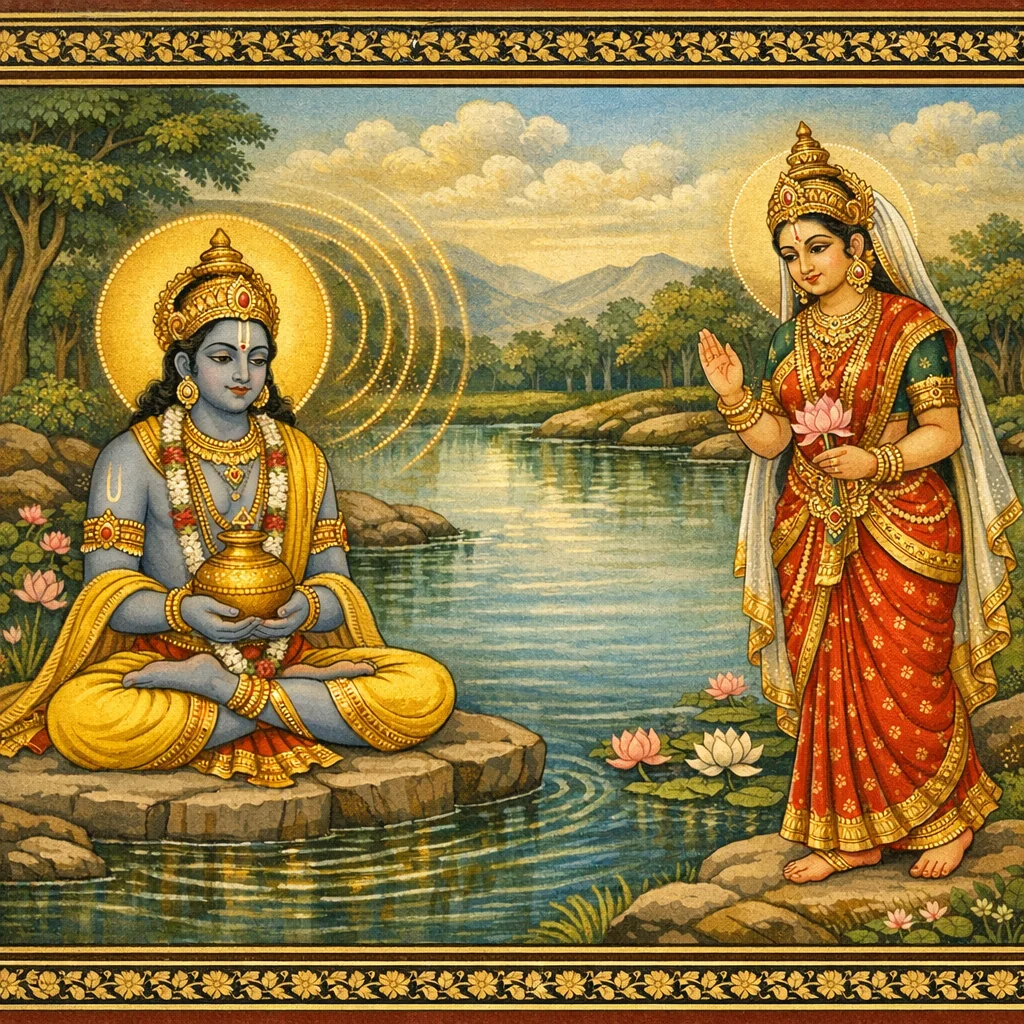
Īśvara speaks to Devī and points to a goddess-site called Kuṇḍeśvarī, praised as a giver of saubhāgya (auspicious good fortune) and as one who removes sin and poverty. The shrine is located with clear directions and distance markers, and a nearby water-body, Śaṅkhodaka Kuṇḍa, is introduced as a destroyer of all pāpaka (sins). An origin-legend is then told: Viṣṇu once slew a being named Śaṅkha; carrying the great conch-like body to Prabhāsa, he washed it and established there a powerful tīrtha. Drawn by the conch’s sound, the Goddess arrives and asks the cause; from this encounter arise the names Kuṇḍeśvarī (the Goddess of the kuṇḍa) and Śaṅkhodaka (the conch-associated water). A calendrical rule follows: worship on the third lunar day (tṛtīyā) of the month of Māgha is said to lead devotees—men or women—to attain gaurīpada, the state/abode of Gaurī. The chapter also teaches pilgrimage ethics through giving: feeding a couple (dampatī), gifting a garment (kañcuka), and feeding women revered as Gaurī (gourīṇī), for those who seek the fruits of pilgrimage.
Shlokas
Verse 1
ईश्वर उवाच । ततो गच्छेन्महादेवि देवीं सौभाग्यकारिणीम् । कुण्डेश्वरीति विख्यातां पुष्कराद्वायुगोचरे
Īśvara said: “Then, O Mahādevī, one should go to the Goddess who bestows good fortune, renowned as Kuṇḍeśvarī, situated in the region reached from Puṣkara in the direction of Vāyu (the wind-quarter).”
Verse 2
धनुषां त्रिंशता देवि भूतनाथाच्च नैरृते । संस्थिता पापदमनी दारिद्र्यौघविनाशिनी
O Devī, she is situated thirty dhanu-lengths away, to the southwest (Nairṛta) of Bhūtanātha; she subdues sin and destroys the flood of poverty.
Verse 3
तस्या नैरृतदिग्भागे धनुःपञ्चदशे स्थितम् । शंखोदकंनाम कुण्डं सर्वपातकनाशनम्
In her southwestern quarter, at a distance of fifteen dhanu-lengths, lies a pond named Śaṅkhodaka, which destroys all sins.
Verse 4
तत्र स्नात्वा तु ये मर्त्या नारी वा शुभवारिणि । पूजयेत्तां महादेवि शंखावर्तेति विश्रुताम्
There, those mortals—men or women—who bathe in those auspicious waters should thereafter worship that Goddess, O Mahādevī, renowned as Śaṅkhāvartā.
Verse 5
कलौ कुण्डेश्वरीनाम सर्वसौख्यप्रदायिनी । शंखो नाम पुरा देवि विष्णुना निहतः प्रिये
In the age of Kali she is known as Kuṇḍeśvarī, bestower of every happiness. Long ago, O Devī, beloved, a being named Śaṅkha was slain by Viṣṇu.
Verse 6
तस्य देहं समादाय महान्तं शंखरूपिणम् । तीर्थोदकेन संपूर्य प्रभासं क्षेत्रमागतः
Taking up his great body in the form of a conch, and filling it with sacred water from a tīrtha, he came to the holy field of Prabhāsa.
Verse 7
तत्र शंखं तु प्रक्षाल्य कृतं तीर्थं महाप्रभम् । तत्र पूरितवाञ्छङ्खं मेघगम्भीरनिस्वनम्
There, having washed the conch, he established a greatly radiant tīrtha. There he filled the conch, resonant with a deep sound like thunderclouds.
Verse 8
तस्य नादेन महता देवी तत्र समागता । पृच्छती कारणं तत्र तत्कुण्डस्य समीपगा । तेन कुण्डेश्वरी ख्याता कुण्डं शंखोदकं स्मृतम्
Drawn by that mighty sound, the Goddess came there. Approaching the kuṇḍa, she asked the reason for it. Therefore she became renowned as Kuṇḍeśvarī, and that pond came to be remembered as Śaṅkhodaka (“Conch-water”).
Verse 9
माघे मासि तृतीयायां यस्तां पूजयते नरः । नारी वा भक्तिसंयुक्ता स गौरीपदमाप्नुयात्
In the month of Māgha, on the third lunar day (tṛtīyā), whoever worships Her—man or woman—endowed with devotion, attains the state and abode of Gaurī.
Verse 10
दंपत्योर्भोजनं तत्र देयं यात्राफलेप्सुभिः । कञ्चुकं फलदानं च गौरिणीनां च भोजनम्
Those who seek the fruit of pilgrimage should, there, offer a meal to a married couple; they should also give a kañcuka (upper garment) and fruits, and provide food to women devoted to Gaurī.
Verse 116
इति श्रीस्कान्दे महापुराण एकाशीतिसाहस्र्यां सहितायां सप्तमे प्रभासखण्डे प्रथमे प्रभासक्षेत्रमाहात्म्ये शंखोदककुण्डेश्वरीगौरीमाहात्म्यवर्णनंनाम षोडशोत्तरशततमोऽध्यायः
Thus ends, in the revered Skanda Mahāpurāṇa—within the collection of eighty-one thousand verses—Chapter 116, entitled “The Description of the Māhātmya of Śaṅkhodaka, Kuṇḍeśvarī, and Gaurī,” in the seventh (Prabhāsa) Khaṇḍa, in the first division: Prabhāsakṣetra Māhātmya.