Adhyaya 323
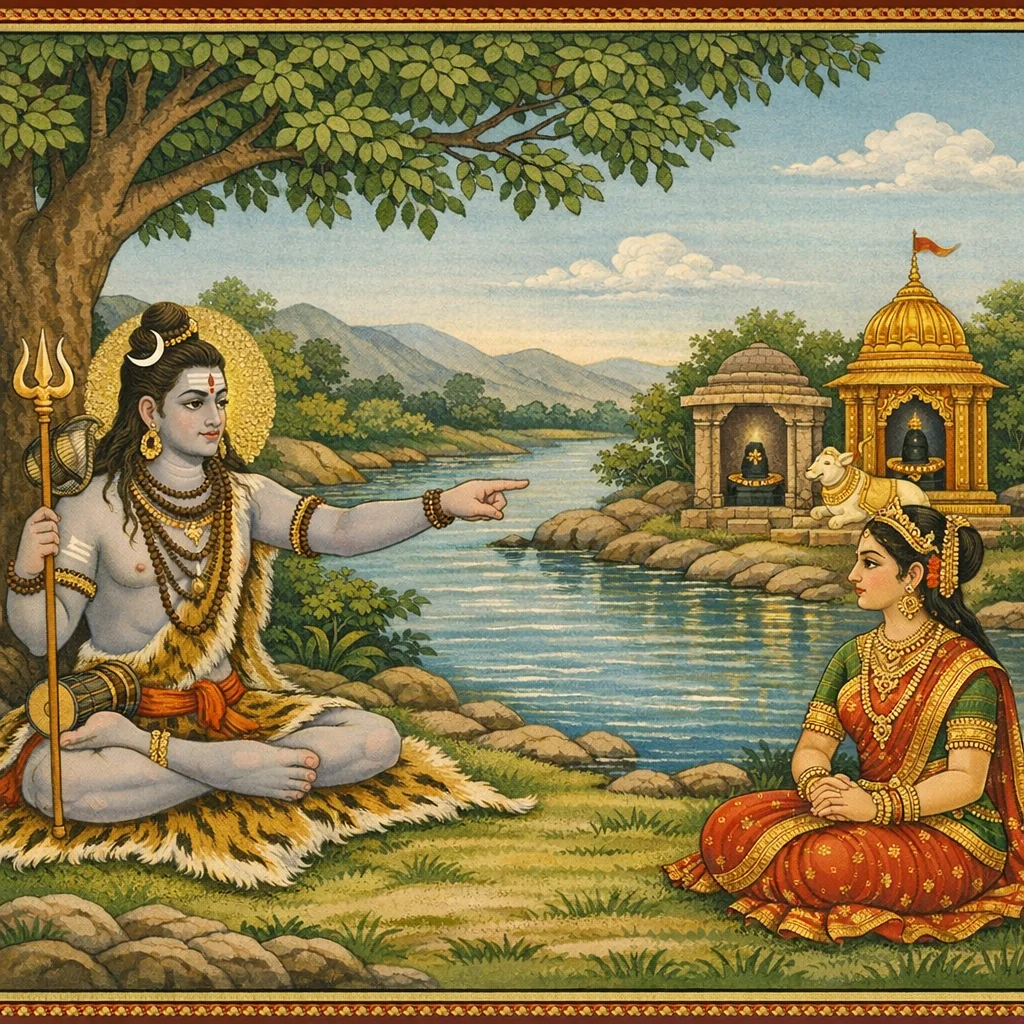
In an instructive dialogue between Śiva and Devī, Īśvara directs Devī’s gaze to a shrine lying “to the south” of the previously mentioned sacred spot, on the bank of the Ṛṣitoya river. The place is identified as Kṣemeśvara, and the account preserves its names across time: formerly it was called Bhūtīśvara, while in the Kali age it is proclaimed as Kṣemeśa/Kṣemeśvara. The chapter’s practical teaching is brief and pilgrimage-centered: mere darśana (sacred sight) followed by pūjā (worship) of this deity is said to release the devotee from all kilbiṣa—moral and ritual impurities. The closing colophon classifies it within the 81,000-verse recension of the Skanda Mahāpurāṇa, in the seventh division (Prabhāsa Khaṇḍa), first subsection (Prabhāsakṣetramāhātmya), under the title “Kṣemeśvaramāhātmya-varṇana”.
Shlokas
Verse 1
ईश्वर उवाच । ततः पश्येन्महादेवि तस्य दक्षिणतः स्थितम् । क्षेमेश्वरेति विख्यातमृषितोयातटे स्थितम्
Īśvara said: “Then, O Great Goddess, one should behold to the south of that place the site renowned as Kṣemeśvara, situated on the bank of the Ṛṣitoya waters.”
Verse 2
भूतीश्वरेति नामास्य पूर्वं च परिकीर्तितम् । क्षेमेशेति कलौ देवि तस्य नाम प्रकीर्तितम्
Formerly, this deity was praised by the name Bhūtīśvara; but in the age of Kali, O Goddess, his name is proclaimed as Kṣemeśa, the Lord of welfare and peace.
Verse 3
तं दृष्ट्वा पूजयित्वा च मुक्तः स्यात्सर्वकिल्बिषैः
Having seen him and having worshipped him, one becomes freed from all sins and impurities.
Verse 323
इति श्रीस्कांदे महापुराण एकाशीतिसाहस्र्यां संहितायां सप्तमे प्रभासखण्डे प्रथमे प्रभासक्षेत्रमाहात्म्ये क्षेमेश्वरमाहात्म्यवर्णनंनाम त्रयोविंशत्युत्तरत्रिशततमोऽध्यायः
Thus ends the three-hundred-and-twenty-third chapter, called “The Description of the Greatness of Kṣemeśvara,” in the Prabhāsa Khaṇḍa—within the Prabhāsa-kṣetra Māhātmya—of the holy Śrī Skanda Mahāpurāṇa, in the Saṃhitā of eighty-one thousand ślokas.