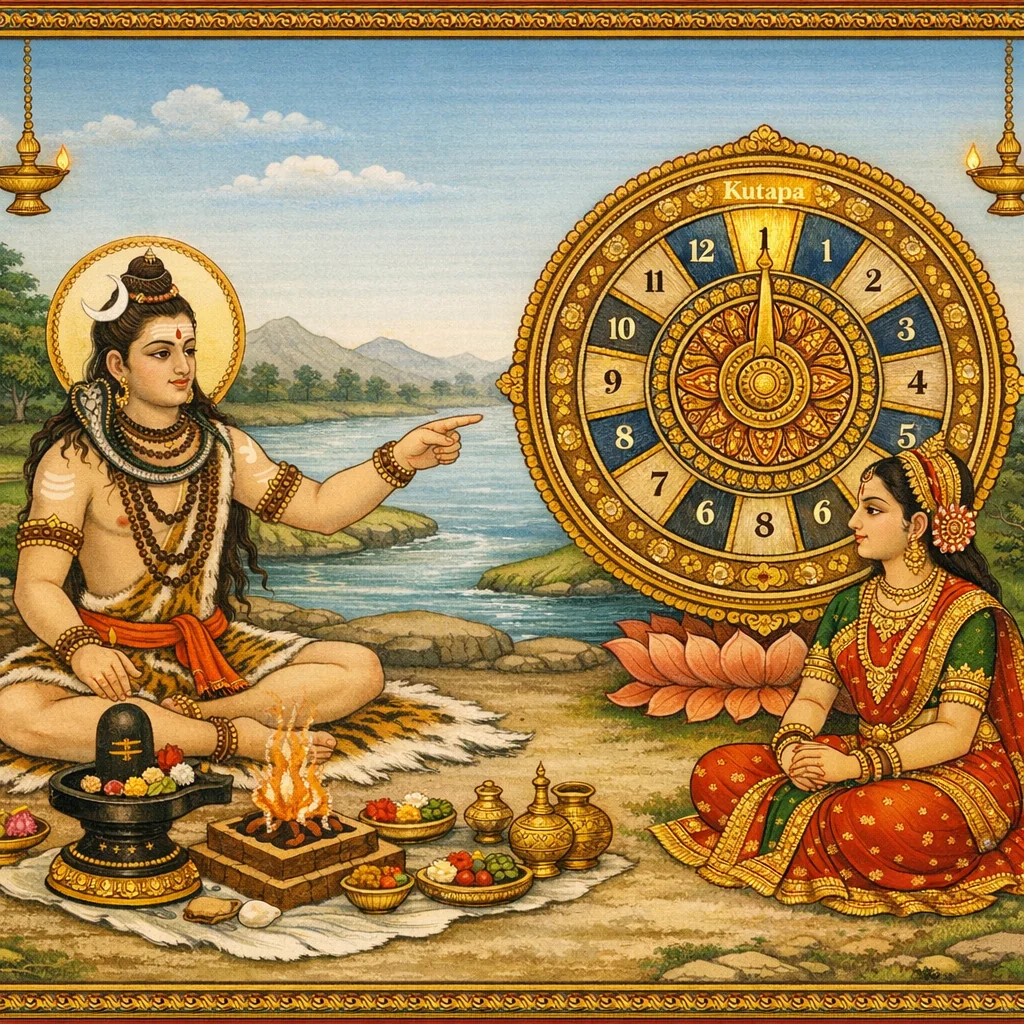
Adhyaya 205
Adhyāya 205 unfolds as a theological and ritual dialogue in which Devī asks Īśvara to teach the meritorious procedure of śrāddha, with special emphasis on the proper time of day and its observance in the sacred setting of Prabhāsa/Sarasvatī. Īśvara delineates the day’s muhūrtas, exalting the kutapa-kāla around midday as especially efficacious, and warns against performing the rite in the evening. The chapter lists protective and purificatory requisites—most notably kuśa/darbha grass and black sesame (tila)—and explains the notion of svadhā-bhavana time. It praises three key “purifiers” for śrāddha (dauhitra, kutapa, tila) and commends virtues such as purity, freedom from anger, and unhurried composure. It then classifies wealth by purity (śukla/śambala/kṛṣṇa), arguing that offerings made from unjustly acquired resources divert satisfaction to inauspicious beings rather than to the ancestors. A substantial portion sets out detailed eligibility standards for recipients: learned, disciplined Brāhmaṇas are recommended, followed by extensive exclusion lists (apāṅkteya) describing disqualifying conduct, occupations, and moral conditions. The chapter closes by reiterating that improper selection undermines the fruit of the rite.
Shlokas
Verse 1
देव्युवाच । भगन्देवदेवेश संसारार्णवतारक । ब्रूहि श्राद्धविधिं पुण्यं विस्तराज्जगतांपते
The Goddess said: “O auspicious Lord, Lord of the gods, who ferries beings across the ocean of saṃsāra—O Lord of the worlds, please explain in detail the holy procedure of śrāddha.”
Verse 2
कस्मिन्वासरभागे तु श्राद्धकृच्छ्राद्धमाचरेत् । अस्मिन्सरस्वती तीर्थे प्रभासक्षेत्र उत्तमे
“In which part of the day should one who performs śrāddha carry out the śrāddha—here, at this Sarasvatī tīrtha, in the supremely excellent Prabhāsa Kṣetra?”
Verse 3
कस्मिंस्तीर्थे कृतं श्राद्धं बहुपुण्यफलं भवेत् । एतत्सर्वं महादेव यथावद्वक्तुमर्हसि
At which tīrtha does śrāddha, when performed, yield abundant merit? O Mahādeva, please explain all this properly and in due order.
Verse 4
ईश्वर उवाच । प्रातःकाले मुहूतांस्त्रीन्संगवस्तावदेव तु । मध्याह्नस्त्रिमुहूर्तः स्यादपराह्णस्ततः परम्
Īśvara said: “Morning consists of three muhūrtas; the forenoon (saṅgava) is of the same measure. Midday is three muhūrtas, and after that comes the afternoon (aparāhṇa).”
Verse 5
सायाह्नस्त्रिमुहूर्तः स्याच्छ्राद्धं तत्र न कारयेत् । राक्षसीनाम सा वेला गर्हिता सर्वकर्मसु
The sāyāhna, lasting three muhūrtas, should not be used for performing śrāddha. That time is said to belong to the rākṣasīs and is therefore censured for all sacred undertakings.
Verse 6
अह्नो मुहूर्ता विख्याता दशपंच च सर्वदा । तत्राष्टमो मुहूर्तो यः स कालः कुतपः स्मृतः
The day is always known to consist of fifteen muhūrtas. Among them, the eighth muhūrta is remembered as the time called Kutapa.
Verse 7
मध्याह्ने सर्वदा यस्मान्मन्दीभवति भास्करः । तस्मादनंतफलदस्तदारम्भो भविष्यति
Because at midday the Sun’s heat becomes gentle, an undertaking begun then becomes a bestower of endless fruit.
Verse 8
मध्याह्नः खड्गपात्रं तु तथान्ये कालकम्बलाः । रूप्यं दर्भांस्तिला गावो दौहित्रश्चाष्टमः स्मृतः
At midday, the ‘khaḍga-pātra’ (a horn-vessel), and likewise the others—kāla-kambala, silver, darbha-grass, sesame, cows, and the dauhitra—are remembered here as the eight auspicious aids.
Verse 9
पापं कुत्सितमित्याहुस्तस्य सन्तापकारिणः । अष्ट चैवं मतास्तस्मात्कुतपा इति विश्रुताः
Sin is called ‘kutsita’—that which is blameworthy and brings burning torment. Therefore these are regarded as eight and are renowned by the name ‘Kutapa’.
Verse 10
ऊर्ध्वं मुहूर्तात्कुतपाद्यन्मुहूर्तचतुष्टयम् । मुहूर्तपञ्चकं चैव स्वधाभवनमिष्यते
The four muhūrtas that follow the Kutapa muhūrta—and indeed the full span of five muhūrtas—are held to be ‘Svadhā-bhavana’, a fitting abode for offerings to the Pitṛs.
Verse 11
विष्णोर्देहसमुद्भूताः कुशाः कृष्णास्तिलास्तथा । श्राद्धस्य रक्षणार्थाय एतत्प्राहुर्दिवौकसः
Kuśa grass and black sesame are said to have arisen from Viṣṇu’s own body. The gods declare them to be for the protection of śrāddha.
Verse 12
तिलोदकाञ्जलिर्देयो जलस्थैस्तीर्थवासिभिः । सदर्भहस्तेनैकेन श्राद्धसेवनमिष्यते
Those residing at the tīrtha, while standing in water, should offer a handful of sesame-water. With one hand holding darbha, the performance of śrāddha is approved.
Verse 13
त्रीणि श्राद्धे पवित्राणि दौहित्रः कुतपस्तिलाः । त्रीणि चात्र प्रशंसंति शुद्धिमक्रोधमत्वराम्
In śrāddha, three are purifying: the dauhitra, Kutapa, and sesame. And here they also praise three virtues—purity, freedom from anger, and unhurriedness.
Verse 14
दौहित्रं खड्गमित्युक्तं ललाटे शृङ्गमस्ति यत् । तस्य शृंगस्य यत्पात्रं तद्दौहित्रमिति स्मृतम्
“Dauhitra” is said to mean “khaḍga”—the animal that bears a horn upon its forehead. The vessel made from that horn is remembered as “dauhitra”.
Verse 15
क्षीरिणी वापि चित्रा गौस्तत्क्षीरायद्घृतं भवेत् । तद्दौहित्रमिति प्रोक्तं दैवे पित्र्ये च कर्मणि
From a milk-giving cow—even if she is spotted—whatever ghee is produced from her milk is called “dauhitṛa.” Such ghee is commended for both offerings to the gods and rites for the ancestors.
Verse 16
दर्भाग्रं दैवमित्युक्तं समूलाग्रं तु पैतृकम् । तत्रावलंबिनो ये तु कुशास्ते कुतपाः स्मृताः
The tips of darbha grass are declared fit for divine rites; but darbha used with both root and tip is prescribed for ancestral rites. And those kuśa blades that hang downward there are known as “kutapa” kuśas.
Verse 17
शरीरद्रव्यदाराभूमनोमंत्रद्वि जन्मनाम् । शुद्धिः सप्तसु विज्ञेया श्राद्धकाले विशेषतः
For the twice-born, purity is to be understood in seven domains—body, possessions, wife, land, mind, mantras, and their own conduct—especially at the time of śrāddha.
Verse 18
सप्तधा द्रव्यशुद्धिस्तु सोत्तमा मध्यमाऽधमा
Material purity is sevenfold, and is classed as superior, middling, and inferior.
Verse 19
श्रुतं शौर्यं तपः कन्या शिष्याद्यं चान्वयागतम् । धनं सप्तविधं शुक्लमुपायोप्यस्य तादृशः
Learning, valor, austerity, a daughter, disciples and the like, and inherited wealth—these seven kinds of “wealth” are called pure (śukla); and the means of obtaining them is likewise of that pure nature.
Verse 20
कुत्सितं कृषिवाणिज्यं शुक्लं शिल्पानुवृत्तिभिः । कृतोपकारादाप्तं च शंबलं समुदाहृतम्
In the śrāddha context, farming and trade are spoken of as blameworthy; livelihood maintained through crafts is considered pure. And what is obtained in return for services rendered is called śaṃbala, subsistence-gain.
Verse 21
उत्कोचतश्च यत्प्राप्तं यत्प्राप्तं चैव साहसात् । व्याजेनोपार्जितं यच्च तत्कृष्णं समुदाहृतम्
Whatever is obtained by bribery, by violence or coercion, and whatever is earned through deceitful pretexts—this is declared “black” (kṛṣṇa), impure wealth.
Verse 22
अन्यायोपार्जितैर्द्रव्यै र्यच्छ्राद्धं क्रियते नरैः । तृप्यंति तेन चण्डालाः पुष्कसाद्यासु योनिषु
When men perform śrāddha with wealth acquired through injustice, it is the Caṇḍālas—those born in Puṣkasa and similar wombs—who are satisfied by that offering, not the intended ancestors.
Verse 23
अन्नप्रकिरणं यत्तु मनुष्यैः क्रियते भुवि । तेन तृप्तिमुपायांति ये पिशाचत्वमागताः
When people scatter food upon the ground, by that very act those who have fallen into the state of piśācas attain satisfaction.
Verse 24
यत्पयः स्नानवस्त्रोत्थं भूमौ पतति पुत्रक । तेन ये तरुतां प्राप्तास्तेषांतृप्तिः प्रजायते
Dear child, whatever water drips to the ground from bathing cloth, by that those who have attained the state of trees come to be satisfied.
Verse 25
यास्तु गंधांबुकणिकाः पतंति धरणीतले । ताभिराप्यायनं तेषां ये देवत्वमुपागताः
Those tiny scented droplets of water that fall upon the earth—by them are nourished and refreshed the departed who have attained the state of the gods.
Verse 26
उद्धृतेष्वपि पिण्डेषु याश्चान्नकणिका भुवि । ताभिराप्यायनं तेषां तिर्यक्त्वं च कुले गताः
Even when the piṇḍas have been lifted away, whatever grains and tiny morsels of food remain upon the ground—by those too are nourished the departed who have fallen into animal birth within a family line.
Verse 27
ये चादग्धाः कुले बालाः स्त्रियो याश्चाप्यसंस्कृताः । विपन्नास्ते तु विकिरसंमार्जनसुलालसाः
And those in a family who were not cremated—children, and women too who lacked the prescribed rites—when misfortune befalls them, they eagerly seek even the scattered remnants and sweepings of offerings for their relief.
Verse 28
भुक्त्वा वा भ्रमते यच्च जलं यच्चाह्नि सेवते । ब्राह्मणानां तथान्नेन तेन तृप्तिं प्रयांति ते
Whether it is the water sipped after eating or the water used in daily observance, and likewise the food offered to Brāhmaṇas—through that, the departed attain satisfaction.
Verse 29
पिशाचत्वमनुप्राप्ताः कृमिकीटत्वमेव ये । अथ कालान्प्रवक्ष्यामि कथ्यमा नान्निबोध मे
Even those who have reached the state of piśācas, and those who have become worms and insects—now I shall declare the proper times for the rites; understand what I am about to teach.
Verse 30
श्राद्धं कार्यममावास्यां मासिमासींदुसंक्षये । तथाष्टकासु विप्राप्तौ सूर्येन्दुग्रहणे तथा
Śrāddha should be performed on the new-moon day, month after month at the waning of the moon; likewise on the Aṣṭakā days, at the arrival of worthy Brāhmaṇas, and also during solar and lunar eclipses.
Verse 31
अयने विषुवे युग्मे सामान्ये चार्कसंक्रमे । अमावास्याष्टकायां च कृष्णपक्षे विशेषतः
During the solstices, the equinoxes, paired special occasions, and also at the sun’s ingress; and especially on Amāvāsyā and Aṣṭakā in the dark fortnight—Śrāddha is particularly commended.
Verse 32
आर्द्रामघारोहिणीषु द्रव्यब्राह्मणसंगमे । गजच्छायाव्यतीपाते विष्टिवैधृति वासरे
On the days of the nakṣatras Ārdrā, Maghā, and Rohiṇī; when one has the means and worthy Brāhmaṇas are present; at Vyatīpāta and Gajacchāyā; and on days marked by Viṣṭi and Vaidhṛti—Śrāddha should be performed.
Verse 33
वैशाखस्य तृतीयायां नवम्यां कार्त्तिकस्य च । पंचदश्यां तु माघस्य नभस्ये च त्रयोदशी
On Vaiśākha’s third tithi; on Kārttika’s ninth; on Māgha’s fifteenth; and on Nabhasya’s thirteenth—these too are appointed occasions for sacred giving (dāna) and rites for the Pitṛs (ancestors).
Verse 34
युगादयः स्मृता एता दत्त स्याक्षयकारिकाः
These are remembered as the “beginnings of yugas”; gifts given on these occasions become causes of akṣaya merit—imperishable and inexhaustible.
Verse 35
यस्य मन्वन्तरस्यादौ रथारूढो दिवाकरः । माघमासस्य सप्तम्यां सा तु स्याद्रथसप्तमी
That seventh tithi in the month of Māgha—on which, at the beginning of a Manvantara, the Sun (Divākara) is said to mount his chariot—is known as Rathasaptamī.
Verse 36
वैशाखस्य तृतीयायां कृष्णायां फाल्गुनस्य च । पंचमी चैत्रमासस्य तस्यैवान्त्या तथापरा
Likewise, the third tithi in Vaiśākha, the tithi in Phālguna’s Kṛṣṇa (dark) fortnight, and the fifth tithi in the month of Caitra—these too are counted among those special days, including the concluding one as well.
Verse 37
शुक्लत्रयोदशी माघे कार्त्तिकस्य च सप्तमी । कार्त्तिकी फाल्गुनी चैत्री ज्यैष्ठी पञ्चदशीति च । मन्वन्तराः स्मृता ह्येता दत्तस्याक्षयकारिकाः
Māgha Śukla Trayodaśī, and also the seventh tithi of Kārttika; and the full-moon days (pūrṇimā) of Kārttika, Phālguna, Caitra, and Jyaiṣṭha—these are remembered as “Manvantara” days, making dāna inexhaustibly fruitful (akṣaya).
Verse 38
श्रावणस्याष्टमी कृष्णा तथाषाढी च पूर्णिमा । कार्त्तिकी फाल्गुनी चैत्री ज्यैष्ठी पञ्चदशी तिथिः
The Kṛṣṇa Aṣṭamī of Śrāvaṇa, and the full-moon day (Pūrṇimā) of Āṣāḍha; likewise the Pañcadaśī (fifteenth, full-moon) tithis of Kārttikī, Phālgunī, Caitrī, and Jyaiṣṭhī are dates worthy of sacred remembrance.
Verse 39
मन्वादयः स्मृताश्चैता दत्तस्याक्षयकारिकाः । नवमी मार्गशीर्षस्य सप्तैताः संस्मरा म्यहम्
These are remembered as Manva-days and the like, making the fruit of gifts inexhaustible. I recall seven such dates, including the Navamī of Mārgaśīrṣa.
Verse 40
कल्पनामादयो देवि दत्तस्याक्षयकारिकाः । तथा मन्वन्तरस्यादौ द्वादशैव वरानने
O Goddess, the Kalpa-days and the like make the fruit of gifts inexhaustible; likewise, at the beginning of a Manvantara there are indeed twelve excellent occasions, O fair-faced one.
Verse 41
नित्यं नैमित्तिकं काम्यं वृद्धि श्राद्धं सपिण्डकम् । पार्वणं चातिविज्ञानं गोष्ठं शुद्ध्यर्थमुत्तमम्
Śrāddha is described as: daily (nitya), occasional (naimittika), desire-motivated (kāmya), the vṛddhi-śrāddha, the sapiṇḍa rite, the pārvaṇa rite, the ‘ativijñāna’ type, and the goṣṭha-śrāddha—excellent for the sake of purification.
Verse 42
कर्मांगं नवमं प्रोक्तं दैवकं दशमं स्मृतम् । एकादशं क्षयाहं तु पुष्ट्यर्थे द्वादशं स्मृतम्
The ninth is said to be ‘karmāṅga’ (auxiliary to rites); the tenth is remembered as ‘daivaka’ (pertaining to the gods). The eleventh is ‘kṣayāha’ (for averting loss and decay), while the twelfth is remembered as that performed for puṣṭi—nourishment and flourishing.
Verse 43
सर्वेषामेव श्राद्धानां श्रेष्ठं सांवत्सरं स्मृतम् । अहन्यहनि यच्छ्राद्धं नित्यं तत्परिकीर्तितम्
Among all śrāddhas, the annual (sāṃvatsara) śrāddha is remembered as the best. And the śrāddha performed day after day is declared to be “nitya” (daily).
Verse 44
वैश्वदेवविहीनं तु अशक्तावुदकेन तु । एकोद्दिष्टं तु यच्छ्राद्धं तन्नैमित्तिकमुच्यते
That śrāddha performed without the Vaiśvadeva offering—and, when one is unable, even with water alone—namely the ekoddiṣṭa śrāddha intended for a single departed one, is called “naimittika” (occasional).
Verse 45
कामेन विहितं काम्यमभिप्रेतार्थसिद्धये । वृद्धौ यत्क्रियते श्राद्धं वृद्धि श्राद्धं तदुच्यते
That śrāddha instituted with a specific desire, for the accomplishment of a wished-for aim, is called a kāmya (desire-motivated) śrāddha. And the śrāddha performed on an occasion of increase and prosperity is known as vṛddhi-śrāddha (the śrāddha for growth).
Verse 46
ये समाना इति द्वाभ्यामेतच्छ्राद्धं सपिण्डनम् । अमावास्यां तु यच्छ्राद्धं तत्पार्वणमुदाहृतम्
The śrāddha connected with the rite of sapiṇḍana, the uniting of the departed into the ancestral offering, is indicated by the two mantras beginning “ye samānā…”. And the śrāddha performed on the new-moon day (amāvāsyā) is declared to be the pārvaṇa-śrāddha.
Verse 47
गोष्ठ्यां यत्क्रि यते श्राद्धं तद्गोष्ठीश्राद्धमुच्यते । क्रियते पापशुद्ध्यर्थं शुद्धिश्राद्धं तदुच्यते
The śrāddha performed in an assembly or communal gathering is called goṣṭhī-śrāddha. And the śrāddha performed for purification from sin is called śuddhi-śrāddha.
Verse 48
निषेककाले सोमे च सीमन्तोन्नयने तथा । तथा पुंसवने चैव श्राद्धं कर्मांगमेव च
At the time of the niṣeka (conception rite), at the Soma rite, at the sīmantonnayana (hair-parting ceremony), and likewise at the puṃsavana rite—śrāddha should be performed as an integral limb of those sacraments.
Verse 49
देवमुद्दिश्य क्रियते यत्तद्दैवकमुच्यते । गच्छेद्देशान्तरं यस्तु श्राद्धं कार्यं तु सर्पिषा
That śrāddha which is performed with a deity in view is called daivaka-śrāddha. And for one who is about to depart to another region, śrāddha should be performed using ghee.
Verse 50
पुष्ट्यर्थमेतद्विज्ञेयं क्षयाहं द्वादशं स्मृतम् । मृतेऽहनि पितुर्यस्तु न कुर्याच्छ्राद्धमादरात्
This ghee-based śrāddha should be understood as being for nourishment and well-being; it is remembered as the ‘twelfth’ rite called kṣayāha. But whoever, on the death-day of his father, does not perform śrāddha with due care—
Verse 51
मातुश्चैव वरारोहे वत्सरान्ते मृतेऽहनि । नाहं तस्य महादेवि पूजां गृह्णामि नो हरिः
O fair-hipped one, likewise on the death-day of one’s mother, when the year is completed—O Great Goddess—neither do I accept that person’s worship, nor does Hari accept it.
Verse 52
मृताहर्यो न जानाति मानवो यदि वा क्वचित् । तेन कार्यममावास्यां श्राद्धं माघेऽथ मार्गके
If a person does not know (or is uncertain about) the exact death-day, then śrāddha should be performed on the new-moon day (amāvāsyā), in the month of Māgha, or else in Mārgaśīrṣa.
Verse 53
अथ विप्रान्प्रवक्ष्यामि श्राद्धे ये केचन क्षमाः । विशिष्टः श्रोत्रियो योगी वेदविद्यासमन्वितः
Now I shall describe the brāhmaṇas fit to be invited for śrāddha: one who is distinguished, a learned śrotriya, a yogin, and one endowed with Vedic knowledge and sacred learning.
Verse 54
त्रिणाचिकेतस्त्रिमधुस्त्रिसुपर्णः षडंगवित् । दौहित्रकस्तु जामाता स्वस्रीयः श्वशुरस्तथा
One who has performed the threefold Agni rite (triṇāciketa), one versed in the ‘three madhus’, one who knows the ‘three suparṇas’, and one who knows the six auxiliaries (ṣaḍaṅgas) of the Veda—also the daughter’s son (dauhitra), the son-in-law (jāmātṛ), the sister’s son (svasrīya), and likewise the father-in-law (śvaśura) (are considered eligible in the śrāddha context).
Verse 55
पञ्चाग्निकर्मनिष्ठश्च तपोनिष्ठश्च मातुलः । पितृमातृपरश्चैव शिष्यसंबंधिबांधवः
One should honor such persons: the maternal uncle devoted to the five-fire austerity and steadfast in tapas; one who is devoted to father and mother; and also the kinsman connected through one’s disciples and relations.
Verse 56
वेदार्थवित्प्रवक्ता च ब्रह्मचारी सहस्रदः । संबंधिनं तथा संतं दौहित्रं दुहितुः पतिम्
Also to be honored are: a knower and teacher of the Veda’s meaning; a brahmacārin; a generous giver; likewise one’s relation who is virtuous; the daughter’s son; and the husband of one’s daughter.
Verse 57
भागिनेयं विशेषेण तथा बन्धुगणानपि । नातिक्रमेन्नरस्त्वेतान्मूर्खानपि वरानने
In particular, one should not pass over one’s sister’s son, nor the circle of one’s kinsmen. A man should not disregard these—even if they are unlearned—O fair-faced one.
Verse 58
न ब्राह्मणान्परीक्षेत देवकर्मण्युप स्थिते । पैत्रकर्मणि संप्राप्ते परीक्षेत प्रयत्नतः
When a rite for the Devas is at hand, one should not scrutinize the brāhmaṇas. But when a rite for the Pitṛs (ancestors) is undertaken, one should examine their eligibility with great care.
Verse 59
ये स्तेनाः पतिताः क्लीबा ये च नास्तिकवृत्तयः । तान्हव्यकव्ययोर्विप्राननर्हान्मनुर ब्रवीत्
Those who are thieves, fallen from right conduct, disqualified (‘klība’), and those who live by atheistic ways—Manu declares such brāhmaṇas unfit for both havya (offerings to the Devas) and kavya (offerings to the Pitṛs).
Verse 60
जटिलं चानधीयानं दुर्बलं कितवं तथा । याजयंति च ये शूद्रांस्तांश्च श्राद्धे न पूजयेत्
At a śrāddha one should not honor a matted-haired ascetic (jaṭila) who does not study, a weak and unfit person, a gambler; nor those who officiate sacrifices for śūdras.
Verse 61
चिकित्सकान्देवलकान्मांस विक्रयिणस्तथा । विपणैः पीरजीवंतो वर्ज्याः स्युर्हव्यकव्ययोः
Physicians, temple-priests who serve for wages, sellers of meat, and those who live by trade and markets are to be avoided in both havya and kavya rites.
Verse 62
प्रेष्यो ग्राम्यश्च राज्ञश्च कुनखी श्यावदंतकः । प्रतिरोद्धा गुरोश्चैव त्यक्ता ग्निर्वार्धुषिस्तथा
Likewise to be avoided are: a menial servant; a rustic and vulgar person; one in the king’s service; one with deformed nails; one with blackened teeth; one who obstructs righteous acts; one who opposes his teacher; one who has abandoned the sacred fires; and the usurer.
Verse 63
यक्ष्मी च पशुपालश्च परिवेत्ता निराकृतिः । ब्रह्मध्रुक्परिवित्तिश्च गणाभ्यन्तर एव च
Also to be avoided are: one afflicted with consumption, a cowherd, the “parivettā” (who marries before an elder brother), one rejected or cast out, one who harms the sacred (brahma-dhruk), the “parivitti” (the elder brother whose younger marries first), and one who belongs to disreputable groups.
Verse 64
कुशीलश्चैव काणश्च वृषलीपतिरेव च । पौनर्भवश्च कानीनः कितवो मद्यपस्तथा
Likewise to be avoided are: the ill-conducted, the one-eyed, the husband of a śūdra-woman, one born of a remarried woman, an illegitimate son, a gambler, and a drinker of intoxicants.
Verse 65
पापरोग्यभिशस्तश्च दांभिको रसविक्रयी । धनुःशराणां कर्त्ता च यश्च स्याद्दिधिषूपतिः
One notorious for a sinful disease, a hypocrite, one who sells intoxicating essences or juices, a maker of bows and arrows, and one who lives as the husband of a remarried woman—such persons are censured in the dharma of gifts as unfit recipients.
Verse 66
मित्रध्रुड्दूतवृत्तिश्च पुत्राचार्यस्तथैव च । भ्रमरी मण्डपाली च चित्रांगः पिशुनस्तथा
Likewise, one who betrays friends, one who lives by the trade of a messenger, and one who serves as a “son’s teacher” (an improper livelihood); and those known as Bhramarī, Maṇḍapālī, Citrāṅga, and the slanderer—these too are counted among the censured.
Verse 67
उन्मत्तोंऽधश्च बधिरो वेदनिन्दक एव च । हयगोऽश्वोष्ट्रदमको नक्षत्रैर्यश्च जीवति
The madman, the blind, the deaf, and the reviler of the Veda; the horse-dealer, the trainer of horses and camels, and one who earns his living by astrology of the lunar mansions—these too are to be regarded as unfit recipients.
Verse 68
पक्षिणां पोषको यश्च युद्धाचार्यस्तथैव च । स्रोतःसंभेदको यश्च वेश्यानां पोषणे रतः
One who keeps and fattens birds (for trade), a teacher of warfare, one who breaks embankments or diverts waterways, and one devoted to maintaining prostitutes—these too are censured as recipients.
Verse 69
गृहसंवेशको दूतः कृष्यारोपक एव च । आखेटी श्येनजीवी च कन्यादूषक एव च
A go-between who arranges clandestine entry into houses, a messenger of such dealings, one who lives by planting for hire, a hunter, one who makes his living by hawks (falconry), and one who violates maidens—these are also to be avoided.
Verse 70
हिंस्रो वृषलपुत्रश्च गणानां चैव याजकः । आचारहीनः क्लीबश्च नित्ययाजनकस्तथा
The violent man, the son of a śūdra, one who serves as a priest for (non-dharmic) groups, one devoid of right conduct, the impotent, and one who makes a business of performing sacrifices continually—these too are censured.
Verse 71
कृषिजीवी श्लीपदी च सद्भिर्निन्दित एव च । औरभ्रिको माहिषिकः परपूर्वा पतिस्तथा । प्रेतनिर्यातकाश्चैव वर्जनीयाः प्रयत्नतः
One who lives by agriculture, one afflicted with elephantiasis, one condemned by the good; the shepherd, the buffalo-herd, the husband of a woman previously married to another; and those who ‘drive out spirits’—all these should be carefully avoided (as recipients).
Verse 72
एतान्वै गर्हिताचारानपांक्तेयान्द्विजाधमान् । द्विजानां सति लाभे तू भयत्रैव विवर्जयेत्
These—whose conduct is reprehensible, who are unfit to sit in the sacrificial row (apāṅkteya), the lowest among the twice-born—when worthy twice-born are available, one should avoid them in every way.
Verse 73
वीक्षांधो वैकतः काणः कुष्ठी च वृषलीपतिः । पापरोगी सहस्रस्य दातुर्नाशयते फलम्
One blinded by vermin and filth, the deformed, the one‑eyed, the leper, and the husband of a Śūdra woman—such a sinner, afflicted with the disease of sin, destroys the fruit of a donor’s thousandfold gifts.
Verse 74
यावद्भिः संस्पृशत्यङ्गैर्ब्राह्मणाञ्छ्रूद्रयाजकः । तावतां न भवेत्प्रेत्य दातुर्वा तस्य पैत्रिकम्
As many brāhmaṇas as are touched by the limbs of a priest who performs rites for Śūdras, for that many—after death—there will be no ancestral benefit (Pitṛ‑merit) for the donor (or for him).
Verse 75
आदौ माहिषकं दृष्ट्वा मध्ये च वृषलीपतिम् । अन्ते वार्धुषिकं दृष्ट्वा निराशाः पितरो गताः
Seeing at the beginning a māhiṣaka, in the middle a “husband of a vṛṣalī,” and at the end a vārdhuṣika—on encountering such, the Pitṛs (ancestors) depart in disappointment, their hopes unfulfilled.
Verse 76
महिषी प्रोच्यते भार्या सा वैधव्येऽभिचारिणी । तस्यां यः क्षपते दोषां स वै माहिषिकः स्मृतः
A “mahiṣī” is said to be a wife who engages in illicit conduct while in widowhood. One who removes (or deals with) her fault is remembered as a māhiṣaka.
Verse 77
वृषलीत्युच्यते शूद्री तस्या यश्च पतिर्भवेत् । तदोष्ठलालासंसर्गात्पतितो वृषलीपतिः
A “vṛṣalī” is said to be a Śūdra woman; and whoever becomes her husband—through contact with the saliva of her lips—is deemed fallen and is called a vṛṣalīpati.
Verse 78
स्वं वृषं तु परित्यक्त्वा परेण तु वृषायते । वृषली सा तु विज्ञेया न शूद्री वृषली भवेत्
She who abandons her own husband and takes another as her “bull” (mate) is to be known as a vṛṣalī; a Śūdra woman does not become a vṛṣalī by birth alone.
Verse 79
चण्डाली बंधकी वेश्या रजःस्था या च कन्यका । कुटिला च स्वगोत्रा च वृषल्यः सप्त कीर्तिताः
Seven kinds of vṛṣalī are declared: a caṇḍālī, a baṃdhakī, a courtesan, a maiden in her menses, a deceitful woman, and a woman of one’s own gotra—thus are seven proclaimed.
Verse 80
पितुर्गेहे तु या कन्या रजः पश्यत्यसंस्कृता । पतिताः पितरस्तस्याः कन्या सा वृषली भवेत्
A maiden who, still unwed, beholds her menses in her father’s house without having undergone saṃskāra—her ancestors are said to fall; that maiden is known as a vṛṣalī in this dharma classification.
Verse 81
यस्तु तां वरयेत्कन्यां ब्राह्मणो ज्ञानपूर्वतः । अश्राद्धेयमपांक्तेयं तं विद्याद्वृषलीपतिम्
But a Brāhmaṇa who knowingly marries such a maiden—know him to be unfit for Śrāddha and unfit to sit in the ritual dining line; he is to be recognized as a vṛṣalīpati.
Verse 82
गौरी कन्या प्रधाना वै मध्यमा कन्यका मता । रोहिणी तत्समा ज्ञेया अधमा च रजस्वला
A ‘Gaurī’ maiden is regarded as foremost; the ‘Kanyakā’ is held to be middling; the ‘Rohiṇī’ is to be known as comparable to that; and the ‘Rajasvalā’ (one in menses) is considered the lowest in this classification.
Verse 83
अप्राप्ते रजसि गौरी प्राप्ते रजसि रोहिणी । अव्यंजनकृता कन्या कुचहीना तु नग्निका
Before the onset of menses she is called “Gaurī”; when menses has begun she is “Rohiṇī”. A maiden without bodily signs of maturity is “Kanyā”; and one without developed breasts is “Nagnikā”.
Verse 84
सप्तवर्षा भवेद्गौरी नववर्षा तु नग्निका । दशवर्षा भवेत्कन्या ह्यत ऊर्ध्वं रजस्वला
At seven years she is “Gaurī”; at nine years she is “Nagnikā”; at ten years she is “Kanyā”; and beyond that she is classed as “Rajasvalā” (one who menstruates).
Verse 85
व्यंजनैर्हन्ति वै पुत्रान्कुलं हन्यात्पयोधरा । गतिमिष्टां तथा लोकान्हंति सा रजसा पितुः
By improper delicacies she destroys the sons; by her breasts—meaning sensual entanglement—she ruins the family line. By the impurity of her menses she obstructs the father’s desired course and the worlds he seeks through dharma.
Verse 86
य उद्वहेद्रजोयुक्तां स ज्ञेयो वृषलीपतिः
He who marries a woman during her menstrual period should be known as “vṛṣalīpati”—a “husband of a vṛṣalī”, one fallen from proper dharmic conduct.
Verse 87
यत्करोत्येकरात्रेण वृषलीसेवनाद्द्विजः । तद्भैक्ष्यभुग्जपन्नित्यं त्रिभिर्वर्षैर्व्यपोहति
Whatever demerit a twice-born (dvija) incurs in a single night by consorting with a vṛṣalī, he removes it by living on alms and performing daily japa for three years.
Verse 205
इति श्रीस्कांदे महापुराण एकाशीतिसाहस्र्यां संहितायां सप्तमे प्रभासखण्डे प्रथमे प्रभासक्षेत्रमाहात्म्ये श्राद्धकल्पे श्राद्धानर्हब्राह्मणपरीक्षणकथनंनाम पञ्चोत्तरद्विशततमो ऽध्यायः
Thus ends Chapter 205, entitled “The account of examining brāhmaṇas unfit for Śrāddha,” in the Śrāddha-kalpa of the Prabhāsa-khaṇḍa, within the Prabhāsa-kṣetra-māhātmya of the Śrī Skanda Mahāpurāṇa, the Saṃhitā of eighty-one thousand verses.