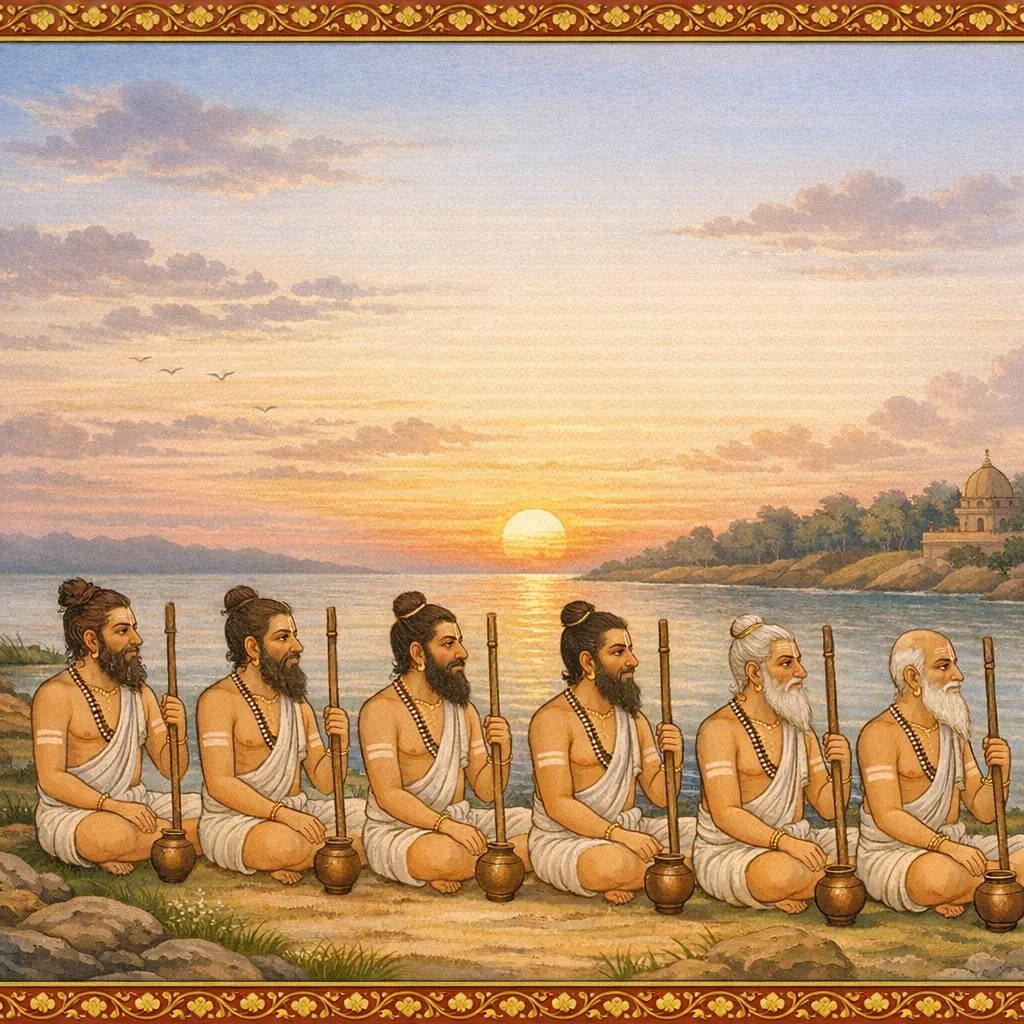
Adhyaya 246
Īśvara instructs Devī to go to Piṅgalī—the sin-destroying Piṅgā River—situated west of Ṛṣi-tīrtha and flowing into the ocean. He sets forth its power in ritual gradations: mere sight (sandarśana) yields merit equal to a great ancestral rite; bathing (snāna) doubles it; tarpaṇa makes it fourfold; and śrāddha bestows immeasurable fruit. An older episode explains the river’s name. Sages who came longing for Somēśvara’s darśana—described as southern and dark-complexioned/ill-formed—bathe at an excellent āśrama by the river and witness their forms turn beautiful, “kāma-sadṛśa” (like the ideal of attractiveness). Amazed, they declare that since they attained “piṅgatva” (a tawny, golden-toned quality), the river shall henceforth be called Piṅgā. A social-ethical assurance follows: those who bathe here with supreme devotion will not have ugly descendants in their lineage. The chapter ends with the sages spreading along the riverbank and establishing tīrthas, marked by austere simplicity—wearing only the yajñopavīta—affirming that sanctity is founded through disciplined presence and ritual naming.
Shlokas
Verse 1
ईश्वर उवाच । ततो गच्छेन्महादेवि पिंगलीं पापनाशिनीम् । ऋषितीर्थात्पश्चिमतो नदीं सागरगामिनीम्
Īśvara said: Then, O Mahādevī, one should go to the Piṅgalī, destroyer of sin—the river lying west of Ṛṣi-tīrtha and flowing onward to the ocean.
Verse 2
तस्याः संदर्शनाद्देवि रूपवाञ्जायते नरः । पुरा महर्षयः प्राप्ताः सोमेश्वरदिदृक्षया
O Devī, merely by beholding her (Piṅgalī), a man becomes possessed of beauty. Long ago, great sages arrived, desiring to see Someśvara.
Verse 3
प्रभासं क्षेत्रमासाद्य नदीतीरे व्यवस्थिताः । दाक्षिणात्या महादेवि कृष्णवर्णा विरूपकाः
Having reached the sacred field of Prabhāsa, they stayed upon the riverbank. O Mahādevī, those sages from the southern region were dark-complexioned and of unattractive appearance.
Verse 4
तत्राश्रमवरे स्नात्वा पश्यन्तो रूपमात्मनः । कामेन सदृशं सर्वे विस्मयं परमं गताः
There, having bathed at that excellent hermitage, they beheld their own forms—each resembling Kāma, the god of beauty—and all were seized with the greatest astonishment.
Verse 5
ततस्ते सहिताः सर्वे विस्मयोत्फुल्ललोचनाः । अत्र स्नाता वयं सर्वे यतः पिंगत्वमागताः । अतः प्रभृति नामास्यास्ततः पिंगा भविष्यति
Then all of them together, their eyes widened in wonder, said: “We have all bathed here, and thus have attained a tawny-golden radiance. Therefore, from this time onward, her name shall be ‘Piṅgā.’”
Verse 6
येत्र स्नानं करिष्यन्ति भक्त्या परमया युताः । न तेषामन्वये कश्चिद्भविष्यति कुरूपवान्
Those who bathe here, endowed with supreme devotion—within their lineage no one will ever be of ugly form.
Verse 7
दर्शनात्पितृमेधस्य लप्स्यते मानवः फलम् । स्नानेन द्विगुणं पुण्यं तर्पणेन चतुर्गुणम्
By mere darśana, a person obtains the fruit of a Pitṛmedha-sacrifice. By bathing, the merit becomes double; and by tarpaṇa (libations), it becomes fourfold.
Verse 8
असंख्यातं फलं तस्य योऽत्र श्राद्धं करिष्यति । एवमुक्त्वा ततः सर्व ऋषयो वरवर्णिनि
The merit of that person who performs the Śrāddha rite here is beyond measure. Having said this, then all the sages (addressing the fair-complexioned lady) …
Verse 9
व्यभजंस्तन्नदीतीरं सर्वे ते मुनिसत्तमाः । यज्ञोपवीतमात्राणि चक्रुस्तीर्थानि सर्वतः
All those best of sages then spread out along that riverbank, and everywhere they established tīrthas—each only the measure of a sacred thread.
Verse 246
इति श्रीस्कांदे महापुराण एकाशीतिसाहस्र्यां संहितायां सप्तमे प्रभासखण्डे प्रथमे प्रभासक्षेत्रमाहात्म्ये पिंगा नदीमाहात्म्यवर्णनंनाम षट्चत्वारिंशदुत्तरद्विशततमोऽध्यायः
Thus ends the two-hundred-and-forty-sixth chapter, called “The Description of the Greatness of the Piṅgā River,” in the Prabhāsa Khaṇḍa—within the Prabhāsa Kṣetra Māhātmya—of the venerable Skanda Mahāpurāṇa, in the Saṃhitā of eighty-one thousand verses.