Adhyaya 223
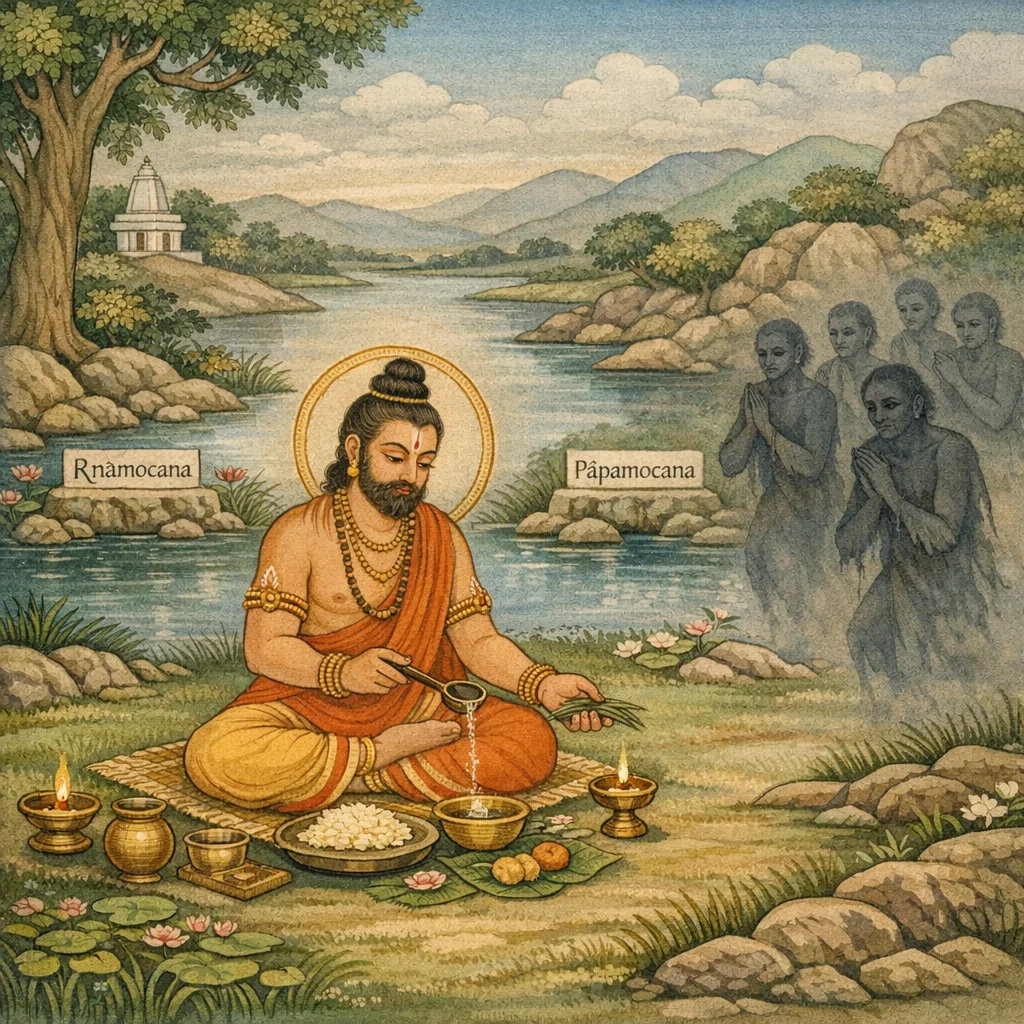
Īśvara instructs Devī on approaching a liṅga revered in the three worlds and the adjoining tīrtha later called Gātrotsarga (known as Pretatīrtha in the Kṛta-yuga). He describes the sacred site’s inner layout near Ṛṇamocana and Pāpamocana, declaring that death there or ritual immersion brings remission of sins and faults. The chapter then affirms a Vaiṣṇava presence: Puruṣottama is said to abide there, and worship of Nārāyaṇa, Balabhadra, and Rukmiṇī grants release from a triad of sins. Śrāddha rites and piṇḍa offerings are praised for freeing ancestors from preta-status and bestowing long-lasting satisfaction. In a framed legend, the sage Gautama meets five dreadful pretas barred from the holy precinct. They explain their names as moral labels born of past misconduct (refusing requests, betrayal, harmful informing, negligent giving), describe impure food-sources for pretas, and list deeds leading to preta-birth—falsehood, theft, violence against cow or Brāhmaṇa, slander, polluting waters, and neglecting rites—along with practices that prevent it: pilgrimage, deity worship, devotion to Brāhmaṇas, scriptural listening, and service to the learned. Gautama performs individualized śrāddha to liberate them; the fifth, Paryuṣita, requires an additional śrāddha at uttarāyaṇa (the northern solstice). The freed being grants a boon that the place will be famed as Pretatīrtha and that descendants of those who perform śrāddha there will not fall into preta-existence; the phalaśruti concludes that hearing and visiting yield vast sacrificial merit.
Shlokas
Verse 1
ईश्वर उवाच । ततो गच्छेन्महादेवि लिंगं त्रैलोक्यपूजितम् । गात्रोत्सर्गमिति ख्यातं तस्य दक्षिणतः स्थितम्
Īśvara said: “Then, O Mahādevī, one should go to the Liṅga worshipped in the three worlds, renowned as ‘Gātrotsarga’; it is situated to the south of that place.”
Verse 2
यत्र गात्रं परित्यक्तं बलभद्रेण धीमता । अन्यैश्चैव महाभागैर्यादवैस्तत्र संयुगे
It is the place where the wise Balabhadra relinquished his body—and likewise other illustrious Yādavas did so there, in that fateful conflict.
Verse 3
यत्र ते यादवाः क्षीणा ब्रह्मशापबलाहिना । एतत्पुरुषोत्तमं क्षेत्रं समन्ताद्धनुषां शतम्
There the Yādavas were destroyed, struck down by the force of Brahmā’s curse. This is the Puruṣottama sacred region, extending a hundred bows’ length in every direction.
Verse 4
यत्र साक्षात्स्वयं देवि तिष्ठते पुरुषोत्तमः । तदेव वैष्णवं क्षेत्रं कलौ पातकनाशनम्
Where Puruṣottama Himself abides in person, O Devī—that indeed is the Vaiṣṇava holy region, a destroyer of sins in the age of Kali.
Verse 5
रहस्यं परमं देवि तीर्थानां प्रवरं हि तत् । पूर्वं कृतयुगे देवि प्रेततीर्थं च संस्मृतम् । कलौ युगे तु संप्राप्ते गात्रोत्सर्गमिति त्वभूत्
O Devī, this is a supreme mystery—indeed the foremost among all tīrthas. In the Kṛta age it was remembered as “Preta-tīrtha”; but when the Kali age arrived, it came to be known as “Gātrotsarga.”
Verse 6
ऋणमोचनपार्श्वे तु मध्ये तु पापमोचनात् । एतन्मध्यं समाश्रित्य मृतः पापैर्विमुच्यते
Near Ṛṇamocana, and in the central tract called Pāpamocana—whoever dies taking refuge in this middle region is freed from sins.
Verse 7
तस्य किं वर्ण्यते देवि यत्रानन्तफलं महत् । अथमेधसहस्रस्य फलं स्नात्वा ह्यवाप्यते
O Goddess, what more can be said of that place, where the mighty fruit is endless? By bathing there, one attains merit equal to that of a thousand Aśvamedha sacrifices.
Verse 8
यत्राश्वत्थं समासाद्य समाधिन्यस्तमानसः । मुमोच दुस्त्यजान्प्राणान्ब्रह्मद्वारेण केशवः
There, having approached the sacred aśvattha tree and fixing his mind in samādhi, Keśava relinquished his hard-to-abandon life-breath through the Brahma-gate.
Verse 9
तत्र नारायणं साक्षाद्बलभद्रं च रुक्मिणीम् । पूजयित्वा विधानेन मुच्यते पातकत्रयात्
There, by duly worshipping Nārāyaṇa Himself, along with Balabhadra and Rukmiṇī, one is released from the threefold category of sins.
Verse 10
तत्र स्नात्वा नरो भक्त्या यः संतर्पयते पितॄन् । प्रेतत्वात्पितरो मुक्ता भवन्ति श्राद्धदायिनः
There, one who bathes with devotion and offers satisfying rites to the Pitṛs (ancestors) frees his forefathers from the state of pretas; they become worthy recipients of śrāddha offerings.
Verse 11
गोघ्नः सुरापो दुर्मेधा ब्रह्महा गुरुतल्पगः । तत्र स्नात्वा नरः सद्यो विपापः संप्रपद्यते
Whether a slayer of a cow, a drinker of liquor, a man of perverted intellect, a killer of a brāhmaṇa, or one who violates the guru’s bed—by bathing there, a person at once becomes free from sin.
Verse 12
बाल्ये वयसि यत्पापं वार्द्धके यौवनेऽपि वा । अज्ञानाज्ज्ञानतो वापि यः करोति नरः प्रिये । तत्र स्नात्वा प्रमुच्येत तीर्थे गात्रप्रमोचने
Whatever sin a person commits in childhood, youth, or old age—whether unknowingly or knowingly, O beloved—by bathing at the tīrtha called Gātra-pramocana, one is released from it.
Verse 13
तत्र पिण्डप्रदानेन पितॄणां जायते परा । तृप्तिर्वर्षशतं यावदेतदाह पुरा हरिः
There, by offering piṇḍas, supreme satisfaction arises for the Pitṛs (ancestors), lasting for a hundred years; thus Hari declared in ancient times.
Verse 14
यः पुनश्चान्नदानं तु तत्र कुर्यात्समाहितः । तस्यान्वयेऽपि देवेशि न प्रेतो जायते नरः
And further, whoever, with a collected mind, performs the gift of food there—O Lady of the gods—even in his lineage no man is born as a preta.
Verse 16
ईश्वर उवाच । शृणु देवि प्रवक्ष्यामि प्रेततीर्थस्य कारणम् । यच्छ्रुत्वा मानवो भक्त्या मुक्तः स्यात्सर्वकिल्बिषैः
Īśvara said: Listen, O Devī; I shall declare the cause of Preta-tīrtha. Hearing it with devotion, a person is freed from all defilements and sins.
Verse 17
पुराऽसीद्गौतमोनाम महर्षिः शंसितव्रतः । भृगुकल्पात्समायातः क्षेत्रे प्राभासिके शुभे
In ancient times there was a great seer named Gautama, renowned for his well-praised vows. He came from Bhṛgu-kalpa to the auspicious sacred region of Prābhāsa.
Verse 18
अयने चोत्तरे पुण्ये श्रीसोमेशदिदृक्षया । दृष्ट्वा सोमेश्वरं देवं स्नात्वा तीर्थेषु कृत्स्नशः
In the holy season of the northern course (Uttarāyaṇa), longing for the auspicious darśana of Śrī Someśa, he beheld the god Someśvara; and, bathing fully in all the tīrthas, he completed the rites in their entirety.
Verse 19
श्रीदेव्युवाच । प्रेततीर्थमिति प्रोक्तं पश्चाद्गात्रविमोचनम् । वद मे देवदेवेश प्रेततीर्थस्य कारणम्
Śrī Devī said: “At first it is spoken of as Preta-tīrtha, and afterwards as Gātra-vimocana. Tell me, O Lord of lords, the reason it is called Preta-tīrtha.”
Verse 20
अथासौ ब्राह्मणो देवि यावत्सीमामुपागतः । तावद्विष्णुप्रियं तत्र ददृशे वैष्णवं वनम्
Then, O Devī, as that brāhmaṇa reached the boundary of the region, he at once beheld there a Vaiṣṇava forest, dear to Viṣṇu.
Verse 21
पुरुषोत्तमनामाढ्यं क्षेत्रं च धनुषां शतम् । तस्मिन्क्षेत्रे स चापश्यत्पंच प्रेतान्सुदारुणान्
It was a region renowned by the name Puruṣottama, extending a hundred bow-lengths; and within that field he saw five exceedingly dreadful pretas.
Verse 22
महावृक्षसमारूढान्महाकायान्महोत्कटान् । ऊर्ध्वकेशाञ्छंकुकर्णान्स्नायुनद्धकलेवरान्
They were perched upon great trees—huge-bodied and most frightful—hair standing upright, with spike-like ears, their bodies bound tight with sinews.
Verse 23
विमांसरुधिरान्नग्नानथ कृष्णकलेवरान् । दृष्ट्वाऽसौ भयसंत्रस्तो विनष्टोऽस्मीत्यचिन्तयत्
Seeing them—without flesh, smeared with blood, naked, and with blackened bodies—he was shaken with fear and thought, ‘I am ruined!’
Verse 24
ध्यात्वाऽह सुचिरं कालं धैर्यमास्थाय यत्नतः । के यूयं विकृताकारा दृष्टाः पूर्वं मया पुरा
After pondering for a long time, he gathered his courage with effort and said: ‘Who are you, of such distorted forms—have you been seen by me before, long ago?’
Verse 25
न कदाचिद्यथा यूयं किमर्थं क्षेत्रमध्यतः । धावमानाः सुदुःखार्ता एतन्मे कौतुकं महत्
‘Never have you been like this—why are you running about in the midst of this sacred region, afflicted with such great misery? This is a great wonder to me.’
Verse 26
प्रेता ऊचुः । वयं प्रेता महाभाग दूरादिह समागताः । श्रुत्वा तीर्थवरं पुण्यं प्रवेशं न लभामहे
The pretas said: “O noble one, we are pretas and have come here from far away. Though we have heard of this most excellent tīrtha, holy and rich in merit, we are unable to gain entry into it.”
Verse 27
गणैरंतर्धानगतैः प्रहारैर्जर्जरीकृताः । लेखको रोहकश्चैव सूचकः शीघ्रगस्तथा
“We are battered and broken by blows from gaṇas who move unseen. Among us are Lekhaka, Rohaka, and also Sūcaka, as well as Śīghraga.”
Verse 28
अहं पर्युषितोनाम पञ्चमः पापकृत्तमः
“I am the fifth, known as ‘Paryuṣita’—the most sinful among those who commit evil deeds.”
Verse 29
गौतम उवाच । प्रेतयोनौ प्रवृत्तानां केन नामानि कृत्स्नशः । युष्माकं निर्मितान्येवमेतन्मे कौतुकं महत्
Gautama said: “For those who have entered the state of preta, by whom are all these names assigned in full? That they are fashioned in this way for you—this is a great curiosity to me.”
Verse 30
प्रेता ऊचुः । याचमानस्य विप्रस्य लिखत्येष धरातले । नोत्तरं पठते किञ्चित्तेनासौ लेखकः स्मृतः
The pretas said: “When a brāhmaṇa begs, this one writes upon the ground, yet reads out no reply at all; therefore he is remembered as ‘Lekhaka’—the Writer.”
Verse 31
द्वितीयो ब्राह्मणभयात्प्रासादमधिरोहति । ततोऽसौ रोहकाख्योऽभूच्छृणु विप्र तृतीयकम्
The second, fearing the brāhmaṇas, climbed up into a lofty mansion; therefore he came to be called “Rohaka” (the Climber). Now listen, O brāhmaṇa, about the third.
Verse 32
सूचिता बहवोऽनेन ब्राह्मणा वित्तसंयुताः । राज्ञे पापेन तेनासौ सूचको भुवि विश्रुतः
With sinful intent he informed the king against many wealthy brāhmaṇas; therefore on earth he became famed as “Sūcaka” (the Informer).
Verse 33
ब्राह्मणैः प्रार्थ्यमानस्तु शीघ्रं धावति नित्यशः । न कदाचिद्ददाति स्म तेनासौ शीघ्रगः स्मृतः
When brāhmaṇas would request him, he would always run off swiftly; he never gave at any time—therefore he is remembered as “Śīghraga” (the Swift-runner).
Verse 34
मया कदन्नं दत्तं च पर्युषितं ब्राह्मणोत्तमे । ब्राह्मणेभ्यः सदा दानं मिष्टान्नेन तु पोषणम् । तस्मात्पर्युषितोनाम संजातोऽहं धरातले
O best of brāhmaṇas, I gave coarse food, and also stale food kept over. Though brāhmaṇas should always be sustained by gifts of wholesome and sweet fare, therefore I was born on earth bearing the name “Paryuṣita”.
Verse 35
गौतम उवाच । न विना भोजनेनैव वर्तन्ते प्राणिनो भुवि । किमाहारा भवन्तो वै वदध्वं मम कौतुकात्
Gautama said: “Creatures on earth cannot live without food. What, then, is your sustenance? Tell me, out of my curiosity.”
Verse 36
प्रेता ऊचुः । प्राप्ते भोजनकाले तु यत्र युद्धं प्रवर्तते । तस्यान्नस्य रसं सर्वं भुंजामो द्विजसत्तम
The pretas said: “When the hour of eating comes, wherever a battle breaks out, we consume the entire ‘essence’ (rasa) of that food, O best of the twice-born.”
Verse 37
नानुलिप्ते धरापृष्ठे यत्र भुंजन्ति मानवाः । भ्रष्टशौचा द्विजश्रेष्ठ तदस्माकं तु भोजनम्
Where people eat upon ground that has not been smeared and ritually purified, with their cleanliness impaired—O best of brāhmaṇas—that indeed is our food.
Verse 38
अप्रक्षालितपादस्तु यो भुंक्ते दक्षिणामुखः । यो वेष्टितशिरा भुंक्ते प्रेता भुंजन्ति नित्यशः
If a person eats without washing his feet, or eats facing south, or eats with his head covered, the pretas continually partake of (and appropriate) that food.
Verse 39
श्राद्धं संपश्यते श्वा चेन्नारी चैव रजस्वला । अन्त्यजः शूकरश्चान्नं तदस्माकं तु भोजनम्
If a dog sees the śrāddha, or if a menstruating woman, an outcaste (antyaja), or a pig comes into view of the food—then that food becomes, indeed, the meal of the pretas.
Verse 40
त्यक्त्वा क्रमागतं विप्रं पूजितं प्रपितामहैः । यो दानं ददतेऽन्यस्मै तस्मै चाऽतुष्टचेतसा
Abandoning the hereditary, family-connected brāhmaṇa—one honored by the forefathers—whoever gives a gift to someone else does so with a dissatisfied heart, and the offering fails to bear its intended fruit.
Verse 41
तस्य दानस्य यत्पुण्यं तदस्माकं प्रजायते । यस्मिन्गृहे सदोच्छिष्टं सदा च कलहो भवेत् । वैश्वदेवविहीने तु तत्र भुंजामहे वयम्
Whatever merit arises from that gift accrues to us (the pretas). In the house where leftovers ever lie about and quarrels ever arise—and where the Vaiśvadeva offering is neglected—there we feed.
Verse 42
गौतम उवाच । युष्माकं कीदृशे गेहे प्रवेशो न च विद्यते । सत्यं वदत माऽसत्यं सत्यं साधुषु संगतम्
Gautama said: In what kind of house do you have no entry? Speak truth, not falsehood—for truth is what accords with the good.
Verse 43
प्रेता ऊचुः । वैश्वदेवोद्भवा यत्र धूमवर्तिः प्रदृश्यते । तस्मिन्गेहे न चास्माकं प्रवेशो विद्यते द्विज
The pretas said: In the house where the smoke-column arising from the Vaiśvadeva offering is seen, O twice-born, we have no entry there.
Verse 44
यस्मिन्गृहे प्रभाते तु क्रियते चोपलेपनम् । विद्यते वेद निर्घोषस्तत्रास्माकं न किंचन
In the house where, at dawn, the purifying smearing of the ground is done, and where the sound of Vedic recitation is present—there we have no power at all.
Verse 45
गौतम उवाच । केन कर्मविपाकेन प्रेतत्वं व्रजते नरः । एतन्मे विस्तरेणैव यथावद्वक्तु मर्हथ
Gautama said: By what maturation of karma does a man attain the state of a preta? Please explain this to me fully and correctly, in detail.
Verse 46
प्रेता ऊचुः । मृषाऽपहारिणो ये च ये चोच्छिष्टा व्रजन्ति च । गोब्राह्मणहताश्चैव प्रेतत्वं ते व्रजन्ति हि
The pretas said: Those who steal by deceit, those who wander in impurity from leftovers, and those who slay cows or brāhmaṇas—such people indeed attain the state of a preta.
Verse 47
पैशुन्यनिरता ये च कूटसाक्ष्यरता नराः । न्यायपक्षे न वर्तंते मृताः प्रेता भवंति ते
Those who delight in slander, who delight in false testimony, and who do not stand on the side of justice—when they die, they become pretas.
Verse 48
श्लेष्ममूत्रपुरीषाणि ये क्षिपन्ति सरोवरे । प्रेतत्वं ते समासाद्य विचरंति च मानवाः
Those who throw phlegm, urine, or feces into a sacred lake fall into the state of a preta and wander thereafter.
Verse 49
दीयमानं तु विप्राणां गोषु विप्रातुरेषु च । मा देहीति प्रजल्पन्तस्ते च प्रेता भवंति च
When gifts are being given to brāhmaṇas—or for cows, or for the support of sick brāhmaṇas—those who protest, “Do not give!”, they too become pretas.
Verse 50
शूद्रान्नेनोदरस्थेन यदि विप्रो म्रियेत वै । प्रेतत्वं यात्यसौ नूनं यद्यपि स्यात्षडंगवित्
If a brāhmaṇa dies with food received from a śūdra still remaining in his stomach, he certainly falls into pretahood—even if he is learned in the six auxiliaries of the Veda.
Verse 51
यस्त्रीन्हले बलीवर्दान्वाहयेन्मदसंयुतः । अमावास्यां विशेषेण स प्रेतो जायते नरः
A man who, in intoxication, yokes three bulls to the plough—especially on the new-moon day—becomes a preta.
Verse 52
नास्तिको निंदकः क्षुद्रो नित्यनैमित्त्यवर्जितः । ब्राह्मणान्द्वेष्टि यो नूनं स प्रेतो जायते नरः
An unbeliever, a slanderer, a petty-minded man—one who abandons daily and occasional rites—and one who hates brāhmaṇas: such a person certainly becomes a preta.
Verse 53
विश्वासघातको यस्तु ब्रह्महा स्त्रीवधे रतः । गोघ्नो गुरुघ्रः पितृहा स प्रेतो जायते नरः
One who betrays trust; one who kills a brāhmaṇa; one who delights in killing women; one who kills cows; one who kills the guru; and one who kills one’s father—such a man becomes a preta.
Verse 54
यस्य नैव प्रदत्तानि एकोद्दिष्टानि षोडश । मृतस्य न वृषोत्सर्गः स प्रेतो जायते नरः
He for whom the sixteen ekoddiṣṭa offerings have not been given, and for whom the rite of releasing a bull (vṛṣotsarga) is not performed after death—such a man becomes a preta.
Verse 55
एतद्धि सर्वमाख्यातं यत्पृष्टाः स्म द्विजोत्तम । भूयो ब्रूहि द्विजश्रेष्ठ यश्चास्ति तव संशयः
All this has indeed been explained, O best of twice-born. Speak again, O foremost brāhmaṇa, whatever doubt still remains in you.
Verse 56
गौतम उवाच । येन कर्मविपाकेनन प्रेतो जायते नरः । तन्मे वदत निःशेषं कौतुकं मेऽत्र विद्यते
Gautama said: “By what fruition of karma does a man not become a preta? Tell me this in full; I am deeply curious about it.”
Verse 57
प्रेता ऊचुः । तीर्थयात्रा रतो यस्तु देवार्चनपरायणः । ब्राह्मणेषु सदा भक्तो न प्रेतो जायते नरः
The pretas said: “A man who delights in pilgrimage to the tīrthas, is steadfast in the worship of the gods, and is ever devoted to the brāhmaṇas—such a man does not become a preta.”
Verse 58
नित्यं शृणोति शास्त्राणि नित्यं सेवति पंडितान् । वृद्धांस्तु पृच्छते नित्यं न स प्रेतो विजायते
One who daily listens to the śāstras, daily serves the learned, and regularly seeks counsel from elders—such a person is never born as a preta.
Verse 59
एतस्मात्कारणात्प्राप्ता वयं सर्वे सुदूरतः । शक्नुमो प्रवेष्टुं च पुण्येऽस्मिन्क्षेत्र उत्तमे
For this very reason we have all come from far away, and we are able to enter this supremely excellent, sacred kṣetra.
Verse 60
निर्विण्णाः प्रेतरूपेण तस्मात्त्वं द्विजसत्तम । गतिर्भव महाभाग सर्वेषां नः प्रयत्नतः
We are weary of this state as pretas; therefore, O best of the twice-born, O fortunate one—by your earnest effort, become the means of deliverance for all of us.
Verse 61
गौतम उवाच । कथं वो जायते मोक्षो वदध्वं कृत्स्नशो मम । कृपयाविष्टचित्तोऽहं यतिष्ये नात्र संशयः
Gautama said: “Tell me in full—how may liberation (mokṣa) arise for you? My heart is stirred by compassion; I shall strive for it—of this there is no doubt.”
Verse 62
प्रेता ऊचुः । प्रभूतकालमस्माकं प्रेतत्वे तिष्ठतां विभो । न त्वभ्येति पुमान्कश्चिदस्माकं यो गतिर्भवेत्
The pretas said: “O lord, for a very long time we have remained in preta-hood. No man approaches us who could become our deliverance.”
Verse 63
तस्मात्त्वं देहि नः श्राद्धं गत्वा क्षेत्रं तु वैष्णवम् । नामगोत्राणि चादाय मोक्षं यास्यामहे ततः
Therefore, please perform śrāddha for us after going to a Vaiṣṇava sacred place; taking our names and lineages (gotras), we shall then attain liberation (mokṣa).
Verse 64
ईश्वर उवाच । ततोऽसौ ब्राह्मणो गत्वा दयाविष्टो हरेर्गृहम् । श्राद्धं च प्रददौ तेषामेकैकस्य पृथक्पृथक्
Īśvara said: Then that brāhmaṇa, filled with compassion, went to the abode of Hari and performed śrāddha for them—each one separately, one by one.
Verse 65
यस्ययस्य यदा श्राद्धं करोति द्विजसत्तमः । स रात्रौ स्वप्न एत्यैनं दर्शने वाक्यमब्रवीत्
Whenever the best of brāhmaṇas performed śrāddha for any one of them, that very one came to him at night in a dream-vision and spoke these words.
Verse 66
प्रसादात्तव विप्रेन्द्र मुक्तोऽहं प्रेतयोनितः । स्वस्ति तेऽस्तु गमिष्यामि विमानं मे ह्युपस्थितम्
By your gracious favor, O foremost of brāhmaṇas, I am freed from the preta state. Blessings be upon you; I shall depart—my celestial chariot is already at hand.
Verse 67
एवं संतारितास्तेन चत्वारस्ते द्विजोत्तमाः
Thus, by him, those four excellent brāhmaṇas were carried across and delivered.
Verse 68
अथासौ ब्राह्मणश्रेष्ठः संप्राप्ते पञ्चमे दिने । प्रददौ विधिपूर्वं तु श्राद्धं पर्युषितस्य च
Then that foremost of brāhmaṇas, when the fifth day arrived, duly performed the śrāddha rites according to rule for Paryuṣita as well.
Verse 69
अथापश्यत स्वप्नान्ते प्राप्तं पर्युषितं नरम् । दीनवाक्यं परिक्लिष्टं निःश्वसन्तं मुहुर्मुहुः
Then, in a dream, he saw Paryuṣita appear as a man—speaking in a pitiable voice, afflicted and distressed, again and again heaving sighs.
Verse 70
पर्युषित उवाच । न मे जाता गतिर्विप्र मंदभाग्यस्य पापिनः । मया हृतं तडागार्थं यद्वित्तं प्रगुणीकृतम्
Paryuṣita said: “O brāhmaṇa, no onward path has arisen for me—sinful and ill-fated as I am. For I seized wealth that had been set aside and carefully accumulated for the purpose of constructing a pond.”
Verse 71
गौतम उवाच । कथं ते जायते मोक्षो वद शीघ्रमशेषतः । करिष्ये नात्र संदेहो यद्यपि स्यात्सुदुर्लभम्
Gautama said: “Tell me quickly and in full—how may mokṣa, liberation, come to you? I shall do it; of this there is no doubt, even if it be exceedingly hard.”
Verse 72
पर्युषित उवाच । अयने चोत्तरे प्राप्ते गत्वा तीर्थं हरिप्रियम् । श्राद्धं त्वं देहि मे नूनं ततो गतिर्भविष्यति
Paryuṣita said: “When uttarāyaṇa, the northern course, arrives, go to the sacred ford called Haripriya, dear to Hari, and unfailingly offer śrāddha for me; then my onward passage will surely be attained.”
Verse 73
ईश्वर उवाच । एवमुक्तः स विप्रेन्द्रस्तेन प्रेतेन वै मुनिः । अयने चोत्तरे प्राप्ते गत्वा तीर्थं हरिप्रियम् । प्रददौ विधिवच्छ्राद्धं ततः पर्युषिताय च
Īśvara said: Thus addressed by that departed spirit, the sage—foremost among brāhmaṇas—when uttarāyaṇa arrived, went to Haripriya Tīrtha and duly performed the śrāddha for Paryuṣita, according to rule.
Verse 74
ततः पर्युषितो रात्रौ स्वप्नान्ते वाक्यमब्रवीत् । प्रसन्नवदनो भूत्वा दिव्यमाल्यवपुर्धरः
Thereafter, at night, at the close of a dream, Paryuṣita spoke—his face serene, bearing a radiant form adorned with divine garlands.
Verse 75
पर्युषित उवाच । मुक्तोऽहं त्वत्प्रसादेन प्रेतभावाद्द्विजोत्तम । स्वस्ति तेऽस्तु गमिष्यामि विमानं मे ह्युपस्थितम्
Paryuṣita said: “By your grace, O best of the twice-born, I have been freed from the state of a preta. May well-being be yours; I depart now, for my vimāna, my celestial chariot, has arrived.”
Verse 76
देवत्वं च मया प्राप्तं समर्थोऽहं द्विजोत्तम । वरं ददामि ते विप्र गृहाण त्वं वरं शुभम्
“I have attained divine status and am now empowered, O best of the twice-born. O brāhmaṇa, I grant you a boon—accept from me this auspicious boon.”
Verse 77
ब्रह्मघ्ने च सुरापे च चौरे भग्नव्रते तथा । निष्कृतिर्विहिता सद्भिः कृतघ्ने नास्ति निष्कृतिः
For the slayer of a brāhmaṇa, for the drinker of liquor, for the thief, and likewise for one who has broken his vows—atonements have been prescribed by the righteous; but for the ungrateful person there is no atonement.
Verse 78
गौतम उवाच । यदि देयो वरोऽस्माकं समर्थोऽसि वरप्रद । यत्र स्थाने मया दृष्टाः प्रेता यूयं सुदुःखिताः । तत्राहं चाश्रमं कृत्वा करिष्ये चोत्तमं तपः
Gautama said: “O bestower of boons, if you are able to grant us a boon, then at the very place where I saw you—these departed spirits—suffering intensely, I shall establish an āśrama and perform the highest austerity.”
Verse 79
निर्गतास्मि गृहं भूयो स्नात्वा तीर्थमिदं महत् । तत्र यो भानवो भक्त्या पितॄनुद्दिश्य भक्तितः
“After bathing in this great tīrtha, I will depart again for my home. And there, O radiant one, whoever offers worship with devotion, dedicating it in faith to the Pitṛs (ancestors)…”
Verse 80
विधिवद्दास्यति श्राद्धं स्नात्वा संतर्प्य देवताः । युष्मत्प्रसादतस्तस्य ह्यन्वयेऽपि कदाचन । मा भूयात्प्रेतभावो हि अपि पापान्वितस्य भोः
“…after bathing and duly satisfying the deities, he will perform the śrāddha according to rule. By your gracious favor, for him—and even for his lineage—may the condition of becoming a preta never arise, even if one is tainted by sin.”
Verse 81
पर्युषित उवाच । गच्छ त्वं चाश्रमं तत्र कुरु ब्राह्मणसत्तम । गमिष्यसि परां सिद्धिं लोके ख्यातिं गमिष्यसि
Paryuṣita said: “Go, O best of brāhmaṇas, and establish your āśrama there. You will attain supreme accomplishment, and you will gain renowned fame in the world.”
Verse 82
तत्र ये मानवा भक्त्या श्राद्धं दास्यंति सत्तमाः । पितॄणां ते विमानस्था यास्यंति त्रिदिवालयम्
“There, those excellent people who offer śrāddha with devotion—those Pitṛs will ascend, seated in celestial cars, to the abode of the gods.”
Verse 83
न तेषां वंशजः कश्चित्प्रेतत्वं च गमिष्यति । प्राहुः सप्तपदीं मैत्रीं पंडिताः स्थिरबुद्धयः
“No descendant of theirs will ever go into the state of a preta. The wise, firm-minded scholars declare that friendship becomes established through ‘seven steps’ (saptapadī).”
Verse 84
मित्रतां तु पुरस्कृत्य किं तद्वक्ष्यामि तच्छृणु । तवाश्रमपदं पुण्यं भविष्यति महीतले
“Honoring friendship as foremost, I shall tell you something—listen to it. Your āśrama-site will become a holy place upon the earth.”
Verse 85
सर्वपापप्रशमनं सर्वदुःखवि नाशनम् । मन्नाम्ना ख्यातिमायातु प्रेततीर्थमिति प्रभो
“May it become renowned by my name as ‘Pretatīrtha’, O lord—a place that pacifies all sins and destroys every sorrow.”
Verse 86
ईश्वर उवाच । तं तथेति प्रतिज्ञाय गतस्तत्र द्विजोत्तमः । यथा वेदोक्तमार्गेंण सर्वं कृत्यं चकार सः
The Lord said: “Saying, ‘So be it,’ and having made that vow, the foremost of the twice-born went there; and, following the path enjoined by the Veda, he performed all the rites that were to be done.”
Verse 87
सोऽपि स्वर्गमनुप्राप्तो हृष्टः पर्युषितः प्रिये । एतत्सर्वं पुरावृत्तं स्थानेऽस्मिन्गात्रमोचने
“And Paryuṣita too reached heaven, rejoicing, O beloved. All this took place in ancient times at this very spot called Gātramocana.”
Verse 88
यः शृणोति नरः सम्यक्सर्वपापैः स मुच्यते । शयनोत्थापने योगे यः पश्येत्पुरुषोत्तमम् । गात्रोत्सर्गे तु गत्वाऽसौ यज्ञायुतफलं लभेत्
Whoever hears this account properly is freed from all sins. Whoever beholds Puruṣottama at the sacred rite of śayanotthāpana, the awakening from repose, attains liberation; and if, at the time of casting off the body, one goes there, one gains merit equal to ten thousand sacrifices.
Verse 223
इति श्रीस्कांदे महापुराण एकाशीतिसाहस्र्यां संहितायां सप्तमे प्रभासखण्डे प्रथमे प्रभासक्षेत्रमाहात्म्ये पुरुषोत्तमतीर्थप्रेततीर्थमाहात्म्यवर्णनंनाम त्रयोविंशत्युत्तरद्विशततमोऽध्यायः
Thus ends, in the holy Skanda Mahāpurāṇa—within the Saṃhitā of eighty-one thousand verses—within the seventh, the Prabhāsa Khaṇḍa, and within the first division, the Prabhāsa-kṣetra Māhātmya, the chapter entitled “The Description of the Greatness of Puruṣottama-tīrtha and Preta-tīrtha,” being Chapter 223.