Adhyaya 4
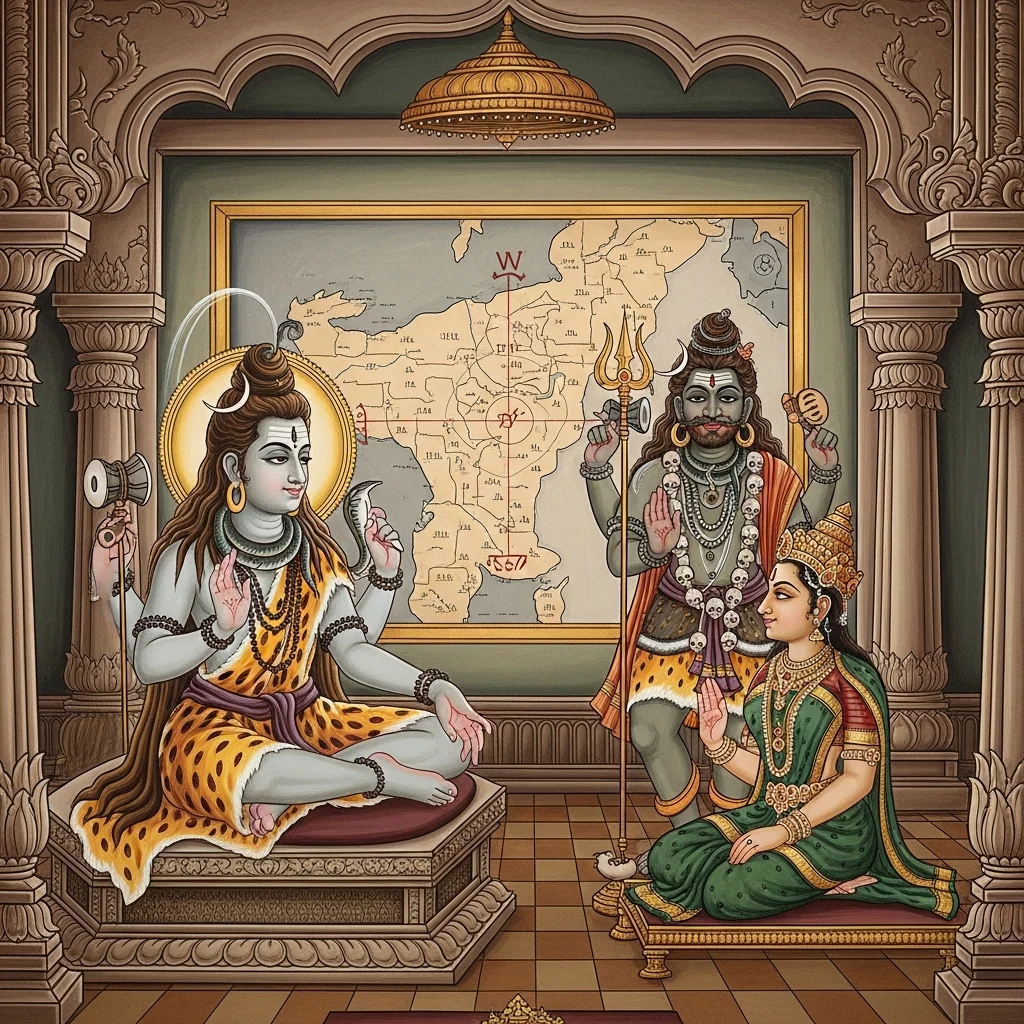
Chapter 4 unfolds as a structured theological dialogue. Devī asks for a fuller account of why Prabhāsa is supreme among tīrthas and why deeds performed there yield inexhaustible merit. Īśvara replies that Prabhāsa is a uniquely beloved (priya) kṣetra where He is perpetually present. He then sets out a three-tier sacred geography—kṣetra, pīṭha, and garbhagṛha—each granting progressively greater fruit. The chapter defines boundaries and cardinal markers, and explains an inner threefold division aligned with Rudra/Viṣṇu/Brahmā, including tīrtha counts and corresponding yātrā types (Raudrī, Vaiṣṇavī, Brāhmī) matched to śakti modes (icchā, kriyā, jñāna). Its soteriological claims intensify: disciplined residence and devoted worship at Prabhāsa are said to surpass other famed pilgrimage sites. A major doctrinal focus centers on Somēśvara and Kālabhairava/Kālāgnirudra—protective roles, principles of purification, and the Śatarudriya as a paradigmatic Śaiva liturgical text. The narrative also lists guardians (Vināyaka, Daṇḍapāṇi, gaṇas) and prescribes pilgrimage etiquette, such as honoring threshold deities and offering specific gifts (e.g., ghṛta-kambala) on calendrically significant nights.
Shlokas
Verse 1
सूत उवाच । एवं मुनीन्द्राः कथिते प्रभावे शंकरेण तु । पुनः पप्रच्छ सा देवी कृतांजलिपुटा सती
Sūta said: O foremost sages, when Śaṅkara had thus explained the potency, Devī Satī, with hands folded in reverent añjali, questioned him again.
Verse 2
देव्युवाच । देवदेव जगन्नाथ क्षेत्रतीर्थमय प्रभो । प्रभासक्षेत्रमाहात्म्यं विस्तरात्कथयस्व मे
The Goddess said: O God of gods, Lord of the universe, O Master who embodies all kṣetras and tīrthas—tell me in detail the greatness (māhātmya) of Prabhāsa kṣetra.
Verse 3
कथं तुष्यसि मर्त्यानां क्षेत्रे तत्र विचेतसाम् । जप्तं दत्तं हुतं यष्टं तपस्तप्तं कृतं च यत् । प्रभासे तु महाक्षेत्रे कस्मात्तत्राक्षयं भवेत्
How are You pleased with mortals in that kṣetra, even when their minds are distracted? And why do japa, gifts, fire-offerings, sacrifices, austerities, and whatever is done in Prabhāsa—the great kṣetra—become imperishable?
Verse 4
जात्यंतरसहस्रेषु यत्पापं पूर्वसंचितम् । तत्कथं क्षयमाप्नोति तन्ममाचक्ष्व शंकर
And the sin accumulated through thousands of other births—how does it come to exhaustion? Tell me that, O Śaṅkara.
Verse 5
यदि प्रभासं सर्वेषां तीर्थानां प्रवरं मतम् । किमन्यैर्बहुभिस्तत्र कर्त्तव्यं तीर्थविस्तरैः
If Prabhāsa is regarded as the foremost among all tīrthas, then what need is there to speak at length of many other tīrthas?
Verse 6
एकं यदि भवेत्तीर्थं मनो निःसंशयं भवेत् । बहुत्वे सति तीर्थानां मनो विचलते नृणाम्
If there were but one tīrtha, the mind would be free of doubt; but when tīrthas are many, people’s minds become unsettled.
Verse 7
तस्मात्सर्वं परित्यज्य तीर्थजालं सविस्तरम् । प्रभासस्यैव माहात्म्यं कथयस्व सुरेश्वर
Therefore, setting aside the vast web of tīrthas in all its detail, tell me—O Lord of the gods—only the greatness of Prabhāsa.
Verse 8
क्षेत्रप्रमाणं सीमां च क्षेत्रसारं हि यत्प्रभो । वक्तुमर्हसि तत्सर्वं परं कौतूहलं हि मे
O Lord, please tell me all of that—the measure of the kṣetra, its boundaries, and its essential sanctity—for my curiosity is exceedingly great.
Verse 9
ईश्वर उवाच । शृणु देवि प्रवक्ष्यामि क्षेत्राणां क्षेत्रमुत्तमम् । सर्वक्षेत्रेषु यत्क्षेत्रं प्रभासं तु प्रियं मम
Īśvara said: Listen, O Devī. I shall declare the best of all kṣetras—the kṣetra which, among all sacred fields, is Prabhāsa, dear to me.
Verse 10
प्रभासे तु परा सिद्धिः प्रभासे तु परा गतिः । यत्र संनिहितो नित्यमहं भद्रे निरन्तरम्
In Prabhāsa is the highest accomplishment; in Prabhāsa is the highest destination—where I, O blessed one, abide forever, unceasingly present.
Verse 11
तस्य प्रमाणं वक्ष्यामि सर्वसीमासमन्वितम् । क्षेत्रं तु त्रिविध प्रोक्तं तत्ते वक्ष्याम्यनुक्रमात्
I shall state its measure along with all its boundaries. The kṣetra is said to be threefold; that I will explain to you in due order.
Verse 12
क्षेत्रं पीठं गर्भगृहं प्रभासस्य प्रकीर्त्यते । यथाक्रमं फलं तस्य कोटिकोटिगुणं स्मृतम्
Prabhāsa is proclaimed as having the kṣetra, the pīṭha, and the garbhagṛha. In that very order, the spiritual fruit is remembered as multiplied by crores upon crores.
Verse 13
क्षेत्रं तु प्रथमं प्रोक्तं तच्च द्वादशयोजनम् । पञ्चयोजनमानेन क्षेत्रपीठं प्रकीर्तितम्
The first is called the “kṣetra,” and it measures twelve yojanas. The “kṣetra-pīṭha” is proclaimed as measuring five yojanas.
Verse 14
गर्भगृहं च गव्यूतिः कर्णिका सा मम प्रिया । क्षेत्रसीमा प्रवक्ष्यामि शृणु देवि यथाक्रमम्
And the garbhagṛha measures a gavyūti; that “karṇikā” is dear to me. Now I shall explain the boundaries of the kṣetra—listen, O Devī, in proper sequence.
Verse 15
आयामव्यासतश्चैव आदिमध्यान्तसंस्थितम् । पूर्वे तप्तोदक स्वामी पश्चिमे माधवः स्मृतः
In its length and breadth, with its beginning, middle, and end duly set, this sacred region is defined thus: on the eastern side is Taptodaka Svāmī, and on the western side Mādhava is remembered as the boundary marker.
Verse 16
दक्षिणे सागरस्तद्वद्भद्रा नद्युत्तरे मता । एवं सीमासमायुक्तं क्षेत्रं द्वादशयोजनम्
To the south lies the ocean, and to the north the Bhadrā river is held as the limit. Thus, furnished with these boundaries, the sacred kṣetra extends for twelve yojanas.
Verse 17
एतत्प्राभासिकं क्षेत्रं सर्वपातकनाशनम् । तन्मध्ये पीठिका प्रोक्ता पञ्चयोजनविस्तृता
This Prābhāsa sacred region destroys all sins. Within it, a central sacred seat (pīṭhikā) is declared, spreading across five yojanas.
Verse 18
न्यंकुमन्यपरेणैव वज्रिण्याः पूर्वतस्तथा । माहेश्वर्या दक्षिणतः समुद्रोत्तरतस्तथा
On the west is Nyaṅkumanī; on the east is Vajriṇī; on the south is Māheśvarī; and on the north is the ocean—thus are its boundaries set.
Verse 19
आयामव्यासतश्चैव पञ्चयोजनविस्तरम् । पीठमेतत्समाख्यातमथो गर्भगृहं शृणु
In length and breadth it extends for five yojanas; this is proclaimed as the sacred seat, the pīṭha. Now hear of the inner sanctum, the garbhagṛha.
Verse 20
दक्षिणोत्तरतो यावत्समुद्रा त्कौरवेश्वरी । पूर्वपश्चिमतो यावद्गोमुखाच्चाश्वमेधिकम् । एतद्गर्भगृहं प्रोक्तं कैलासान्मम वल्लभम्
From south to north it extends from the ocean up to Kauraveśvarī; from east to west, from Gomukha up to Aśvamedhika. This is declared to be the garbhagṛha—the innermost region, beloved to me, dearer even than Kailāsa.
Verse 21
अत्रान्तरे तु देवेशि यानि तीर्थानि भूतले । वापीकूपतडागानि देवतायतनानि च
Within this inner region, O Goddess of the Lords, whatever tīrthas are upon the earth—wells, stepwells (vāpīs), ponds, and also shrines of the deities—are found here.
Verse 22
सरांसि सरितश्चैव पल्वलानि ह्रदास्तथा । तानि मेध्यानि सर्वाणि सर्वपापहराणि च
Lakes and rivers, marshy pools and ponds as well—all of them are purifying, and all are removers of every sin.
Verse 23
यत्र तत्र नरः स्नात्वा स्वर्गलोके महीयते । क्षेत्रस्य प्रथमो भागो मेध्यो माहेश्वरः स्मृतः
Wherever a person bathes here, he is honored in the heavenly world. The first division of this kṣetra is remembered as the purifying Māheśvara portion.
Verse 24
द्वितीयो वैष्णवो भागो ब्रह्मभागस्तृतीयकः । तीर्थानां कोटिरेका तु ब्राह्मे भागे व्यवस्थिता
The second division is the Vaiṣṇava portion; the third is the Brāhma (Brahmā-related) portion. Indeed, a crore and one tīrthas are established in the Brāhma division.
Verse 25
वैष्णवे कोटिरेका तु तीर्थानां वरवर्णिनि । सार्द्धकोटिस्तु संप्रोक्ता रुद्रभागे च मध्यतः
O fair-complexioned goddess, in the Vaiṣṇava division there is said to be a crore of tīrthas and more; and in the Rudra-division, in the central region, a crore and a half is declared.
Verse 26
एवं देवि समाख्यातं तत्क्षेत्रं हि त्रिदैवतम् । गुह्याद्गुह्यतरं क्षेत्रं मम प्रियतरं शुभे
Thus, O Goddess, that holy region has been described as belonging to the three deities. More secret than the secret, that kṣetra is dearest to me, O auspicious one.
Verse 27
तिस्रः कोट्योऽर्द्धकोटिश्च क्षेत्रे प्रोक्ता विभागतः । यात्रा तु त्रिविधा ज्ञेया तां शृणुष्व वरानने
In this sacred region, three crores and a half-crore of tīrthas are stated, according to the divisions. The pilgrimage (yātrā) is to be known as threefold—listen to it, O lovely-faced one.
Verse 28
रौद्री तु प्रथमा यात्रा वैष्णवी च द्वितीयिका । ब्राह्मी तृतीया संख्याता सर्वपातकनाशिनी
The first pilgrimage-route is Raudrī; the second is Vaiṣṇavī; the third is reckoned as Brāhmī. This threefold yātrā destroys all sins.
Verse 29
ब्राह्मे विभागे संप्रोक्ता इच्छाशक्तिर्वरानने । क्रिया च वैष्णवे भागे द्वितीये तु प्रकीर्तिता
In the Brāhmī division, O lovely-faced one, the Power of Will (icchā-śakti) is declared; and in the second, the Vaiṣṇava portion, the Power of Action (kriyā-śakti) is proclaimed.
Verse 30
रौद्रे भागे तृतीये तु ज्ञानशक्तिर्वरानने । यदि पापो यदि शठो यदि नैष्कृतिको नरः
And in the third, the Raudra portion, O lovely-faced one, the Power of Knowledge (jñāna-śakti) is established. Even if a man is sinful, even if he is deceitful, even if he has committed misdeeds—
Verse 31
निर्मुक्तः सर्वपापेभ्यो मध्यभागे वसेत्तु यः । हिमवंतं परित्यज्य पर्वतं गंधमादनम्
Whoever dwells in the middle region becomes freed from all sins. For such a one, even abandoning Himālaya and the mountain Gandhamādana—
Verse 32
कैलासं निषधं चैव मेरुपृष्ठं महाद्युतिम् । रम्यं त्रिशिखरं चैव मानसं च महागिरिम्
(Even) Kailāsa, Niṣadha, the radiant ridge of Meru, the lovely Triśikhara, and the great mountain Mānasā—
Verse 33
देवोद्यानानि रम्याणि नंदनं वनमेव च । स्वर्गस्थानानि रम्याणि तीर्थान्यायतनानि च । तानि सर्वाणि संत्यज्य प्रभासे तु रतिर्मम
The lovely gardens of the gods—Nandana forest as well—the delightful abodes of heaven, and the tīrthas and sanctuaries there: forsaking them all, my joy is in Prabhāsa alone.
Verse 34
यस्तत्र वसते देवि संयतात्मा समाहितः । त्रिकालमपि भुंजानो वायुभक्षसमो भवेत्
O Devī, one who dwells there with self-restraint and steady concentration—even while eating at the three times—becomes as though sustained by air alone, exceedingly pure and lightly nourished.
Verse 35
विघ्नैरालोड्यमानोऽपि यः प्रभासं न मुंचति । स मुंचति जरां मृत्युं जन्मचक्रमशाश्वतम्
Even if shaken and harassed by obstacles, whoever does not abandon Prabhāsa is released from old age and death, and from the unending wheel of repeated births.
Verse 36
जन्मांतरशतैर्देवि योगो वा यदि लभ्यते । मोक्षस्य च सहस्रेण जन्मनां लभ्यते न च
O Devī, even if Yoga is obtained after hundreds of births, liberation (mokṣa) is not obtained even after a thousand births.
Verse 37
प्रभासे तु महादेवि ये स्थिता कृतनिश्चयाः । एकेन जन्मना तेषां मोक्षो नैवात्र संशयः
But, O Mahādevī, those who remain in Prabhāsa with firm resolve—within a single lifetime their liberation is certain; of this there is no doubt here.
Verse 38
प्रभासे तु स्थिता ये वै ब्राह्मणाः संशितव्रताः । मृत्युंजयेन संयुक्तं जपंति शतरुद्रियम्
In Prabhāsa, the Brāhmaṇas steadfast in their vows chant the Śatarudrīya, conjoined with the Mṛtyuñjaya mantra.
Verse 39
कालाग्निरुद्रसांनिध्ये दक्षिणां दिशमाश्रिताः । ज्ञानं चोत्पद्यते तत्र षण्मासाभ्यंतरेण तु
Near the presence of Kālāgnirudra, those who take refuge toward the southern quarter—there, knowledge arises for them within six months.
Verse 40
शिवस्तु प्रोच्यते वेदो नामपर्यायवाचकैः । तस्य चात्मस्वरूपं तु शतरुद्रं प्रकीर्तितम्
By synonymous appellations, Śiva himself is spoken of as the Veda; and the Śatarudra is declared to be his very essential nature.
Verse 41
कल्पेषु वेदाश्च पुनःपुनरावर्तकाः स्मृताः । मंत्राश्चैव तथा देवि मुक्त्वा तु शतरुद्रियम्
Across the kalpas, the Vedas are remembered as returning again and again—and so too the mantras, O Devī—except for the Śatarudrīya.
Verse 42
ईड्यं चैव तु मंत्रेण मामेव हि यजंति ये । प्रभासक्षेत्रमासाद्य ते मुक्ता नात्र संशयः
And those who, having reached Prabhāsa Kṣetra, worship me alone with the laudatory mantra—those are liberated; of this there is no doubt.
Verse 43
समंत्रोऽमंत्रको वापि यस्तत्र वसते नरः । सोऽपि यां गतिमाप्नोति यज्ञैर्दानैर्न साध्यते
With mantra or without mantra, any man who dwells there attains a state that cannot be achieved even by sacrifices and gifts.
Verse 44
अस्मिक्षेत्रे स्वयंभूश्च स्थितः साक्षान्महेश्वरः । रुद्राणां कोटयश्चैव प्रभासे संव्यवस्थिताः
In this sacred field, Maheśvara himself—self-manifest—abides in visible presence; and in Prabhāsa, crores of Rudras are also stationed.
Verse 45
ध्यायमानास्तथोंकारं स्थिताः सोमेशदक्षिणे
Meditating in that very way upon the sacred syllable Oṃ, they remain stationed to the south of Someśvara.
Verse 46
ब्रह्मांडोदरमध्ये तु यानि तीर्थानि सुव्रते । सोमेश्वरं गमिष्यंति वैशाखस्य चतुर्दशी
O noble one, all the sacred fords (tīrthas) that exist within the very womb of the cosmos proceed to Someśvara on the fourteenth lunar day of Vaiśākha.
Verse 47
मनोबुद्धिरहंकारः कामक्रोधौ तथाऽपरे । एते रक्षंति सततं सोमेशं पापनाशनम्
Mind, intellect, ego, and likewise desire and anger, along with other inner forces—these constantly stand guard over Someśa, the destroyer of sin.
Verse 48
न सा गतिः कुरुक्षेत्रे गंगाद्वारे त्रिपुष्करे । या गतिर्विहिता पुंसां प्रभासक्षेत्रवासिनाम्
The destiny gained at Kurukṣetra, at Gaṅgādvāra, or at Tripuṣkara is not equal to the supreme passage ordained for those who dwell in Prabhāsa Kṣetra.
Verse 49
तिर्यग्योनिगताः सत्त्वा ये प्रभासे कृतालयाः । कालेन निधनं प्राप्तास्तेपि यांति परां गतिम्
Even beings born in animal wombs—if they have made their dwelling in Prabhāsa—then, when in time they meet death, those too attain the highest state.
Verse 50
तद्गुह्यं देवदेवस्य तत्तीर्थं तत्तपोवनम् । तत्र ब्रह्मादयो देवा नारायणपुरोगमाः
That is the secret sanctuary of the God of gods; that is the tīrtha, that the grove of austerity. There the gods, beginning with Brahmā—led by Nārāyaṇa—abide and worship.
Verse 51
योगिनश्च तथा सांख्या भगवंतं सनातनम् । उपासते प्रभासं तु मद्भक्ता मत्परायणाः
Yogins and followers of Sāṅkhya likewise worship the eternal Lord; and My devotees—wholly devoted to Me—worship (Him) in Prabhāsa.
Verse 52
अष्टौ मासान्विहारः स्याद्यतीनां संयतात्मनाम् । एके च चतुरो मासानष्टौ वा नियतं वसेत्
For self-restrained renunciants, wandering is permitted for eight months; but some should dwell in disciplined residence for four months—or for eight months.
Verse 53
प्रभासे तु प्रविष्टानां विहारस्तु न विद्यते । अत्र योगश्च मोक्षश्च प्राप्यते दुर्लभो नरैः
For those who have entered Prabhāsa, there is no place for wandering. Here Yoga and Mokṣa—Liberation—are attained, a boon rarely gained by men elsewhere.
Verse 54
तस्मात्प्रभासं संत्यज्य नान्यद्गच्छेत्तपोवनम् । प्रभासं ये न सेवंते मूढास्ते तमसा वृताः
Therefore, having taken refuge in Prabhāsa, one should not go to any other grove of austerity. Those who do not serve Prabhāsa are deluded, shrouded in darkness.
Verse 55
विण्मूत्ररेतसां मध्ये संभवंति पुनःपुनः । कामः क्रोधस्तथा लोभो दंभः स्तंभोऽथ मत्सरः
Amidst impurity—filth, urine, and semen—they arise again and again: desire, anger, greed, hypocrisy, arrogance, and envy.
Verse 56
निद्रा तंद्रा तथाऽलस्यं पैशुन्यमिति ते दश । एते रक्षंति सततं सोमेशं तीर्थनायकम्
Sleep, drowsiness, and sloth, and slander as well—thus the ten are made complete. These ever ‘stand guard’ over Someśa, lord of the tīrtha, leader of the sacred ford.
Verse 57
न प्रभासे मृतः कश्चिन्नरकं याति किल्बिषी । यावज्जीवं नरो यस्तु वसते कृतनिश्चयः
No sinner who dies in Prabhāsa goes to hell. And the man who dwells there for life, with firm resolve in that holy vow…
Verse 58
अग्निहोत्रैश्च संन्यासैराश्रमैश्च सुपालितैः । त्रिदंडैरेकदंडैश्च शैवैः पाशुपतैरपि
By Agnihotra rites, by renunciations, by the well-observed disciplines of the āśramas; by tridaṇḍins and ekadaṇḍins, and also by Śaivas and Pāśupatas—
Verse 59
एतैरन्यैश्च यतिभिः प्राप्यते यत्फलं शुभम् । तत्सर्वं लभ्यते देवि श्रीसोमेश्वरयात्रया
Whatever auspicious fruit is gained by these and other ascetics—everything of that, O Goddess, is obtained by the pilgrimage to Śrī Someśvara.
Verse 61
यत्तद्योगे च सांख्ये च सिद्धांते पंचरात्रिके । अन्यैश्च शास्त्रैर्विज्ञेयं प्रभासे संव्यवस्थितम्
That truth which is to be known through Yoga, through Sāṅkhya, through Siddhānta, through the Pañcarātra, and through other śāstras—stands fully established in Prabhāsa.
Verse 62
लिंगे चैव स्थितं सर्वं जगदेतच्चराचरम् । तस्माल्लिंगे सदा देवः पूजनीयः प्रयत्नतः
Indeed, in the Liṅga is established this entire world of moving and unmoving beings. Therefore the God in the Liṅga should always be worshipped with earnest effort.
Verse 63
ममैव सा परा मूर्तिः श्रीसोमेशाख्यया स्थिता । तेन चैषा त्मनात्मानमाराधनपरो ह्यहम्
That supreme form is indeed Mine, established under the name ‘Śrī Someśa’. Therefore, through this manifestation, I am devoted to worshipping My own Self by My own Self.
Verse 64
अनेकजन्मसाहस्रैर्भ्रममाणस्तु जन्मभिः । कस्तां प्राप्नोति वै मुक्तिं विना सोमेशपूजनात्
Wandering through births by the thousands across countless lives—who indeed attains liberation without the worship of Someśa?
Verse 65
यत्किञ्चिदशुभं कर्म कृतं मानुषबुद्धिना । तत्सर्वं विलयं याति श्रीसोमेश्वरपूजनात्
Whatever inauspicious deed has been done through merely human judgment—all of it goes to dissolution through the worship of Śrī Someśvara.
Verse 66
अनेकजन्मकोटीभिर्जंतुभिर्यत्कृतं ह्यघम् । तत्सर्वं नाशमायाति श्रीसोमेश्वरपूजनात्
Whatever sin a living being has committed across tens of millions of births—all of it comes to destruction through the worship of Śrī Someśvara.
Verse 67
तीर्थानि यानि लोकेऽस्मिन्सेव्यंते पापमोक्षिभिः । तानि सर्वाणि शुद्ध्यर्थं प्रभासे संविशंति हि
All the sacred fords in this world that are frequented by seekers of release from sin—every one of them, for the sake of purification, is said to enter into Prabhāsa indeed.
Verse 68
योऽसौ कालाग्निरुद्रस्तु प्रोच्यते वेदवादिभिः । सोऽयं भैरवनाम्ना तु प्रभासे संव्यवस्थितः
He who is spoken of by the expounders of the Veda as Kālāgnirudra—he is established here at Prabhāsa under the name Bhairava.
Verse 69
जनानां दुष्कृतं सर्वं क्षेत्रमध्ये व्यवस्थितः । भैरवं रूपमास्थाय नाशयामि सुरेश्वरि
Stationed in the very heart of this sacred kṣetra, I—assuming the form of Bhairava—destroy all the evil deeds of people, O Queen of the Gods.
Verse 70
जगत्सर्वं चरित्वा तु स्थितोऽहं सचराचरम् । तेन भैरवनामाहं प्रभासे संव्यवस्थितः
Having traversed the entire universe—moving and unmoving—I have taken my station; therefore I am established at Prabhāsa bearing the name Bhairava.
Verse 71
अग्निना यत्र तप्तं तु दिव्याब्दानां चतुर्युगम् । मेघवाहनकल्पे तु तत्र लिंगं बभूव ह
Where it was scorched by fire for four yugas of divine years—there, in the Meghavāhana Kalpa, a Liṅga came into manifestation.
Verse 72
अग्निमीडेति वेदोक्तप्रभावः सुरसुंदरि । कालाग्निरुद्रनामा च देवैः सर्वैरुदाहृतम्
O beautiful goddess, the potency spoken of in the Veda with the words ‘agnim īḍe’ is proclaimed by all the gods as bearing the name Kālāgnirudra.
Verse 73
अग्नीशानेति देवेशि नामत्रितयमुच्यते । कल्पेकल्पे तु नामानि कथितुं नैव शक्यते । असंख्यत्वाच्च कल्पानां ब्रह्मणा च वरानने
O Lady of the gods, the triad of names is spoken as ‘Agni’ and ‘Īśāna’ (and the like). Yet, from kalpa to kalpa the names cannot truly be fully recounted—because the kalpas are countless, O fair-faced one, even by Brahmā.
Verse 74
एवं चैव रहस्यं च महागोप्यं वरानने । स्नेहान्महत्या भक्त्या च मया ते परिकीर्तितम्
Thus, this secret—most hidden and greatly confidential, O fair-faced one—have I declared to you out of deep affection and devoted love.
Verse 75
एकतस्तु जगत्सर्वं कर्म कांडे प्रतिष्ठितम् । यज्ञदानतपोहोमैः स्वाध्यायैः पितृतर्पणैः
On one side, the whole world is established in the path of ritual action (karma-kāṇḍa)—through sacrifice, charity, austerity, fire-offerings, Vedic study, and offerings of satisfaction to the ancestors.
Verse 76
उपवासैर्व्रतैः कृत्स्नैश्चांद्रायणशतैस्तथा । षड्रात्रैश्च त्रिरात्रैश्च तीर्थादिगमनैः परैः
Even by fasts and complete observances, even by hundreds of Cāndrāyaṇa penances, by six-night and three-night vows, or by undertaking other excellent pilgrimages to tīrthas and the like—that supreme state is not easily attained.
Verse 77
आश्रमैर्विविधाकारैर्यतिभिर्ब्रह्मचारिभिः । वानप्रस्थैर्गृहस्थैश्च वेदकर्मपरायणैः
Nor is it attained by the many forms of āśrama-life—by renunciants and brahmacārins, by forest-dwellers and householders—though devoted to Vedic rites and duties.
Verse 78
अन्यैश्च विविधाकारैर्लोकमार्गस्थितैः शुभैः । न तत्पदं परं देवि शक्यं वीक्षयितुं क्वचित्
And by other auspicious means of various kinds, pursued along the paths of the world as well—O Devī—that supreme state cannot truly be beheld or attained anywhere.
Verse 79
यावन्न चार्चयेद्देवि सोमेशं लिंगनायकम् । लीलया वापि तैर्द्रष्टुं तत्पदं दुर्लभं परम्
O Devī, so long as one does not worship Someśa, the Lord of the Liṅga, then—even with all such practices—to behold that supreme state remains exceedingly difficult to attain, not easily gained even as if in play.
Verse 80
पूजितो यैर्जगन्नाथः सोमेशः किल भैरवः । तिर्यग्योनिगता ये तु पशुपक्षिपिपीलिकाः
Those who have worshipped the Lord of the Universe—Someśa, indeed Bhairava—even if born in non-human wombs as beasts, birds, or even ants, are uplifted by that worship.
Verse 83
मूर्खास्तु पण्डिताश्चापि ये चान्ये कुत्सिता भुवि । ते सर्वे मुक्तिमायांति प्रभासे ये मृताः शुभे
Whether fools or scholars, and even others despised upon the earth—whoever dies in auspicious Prabhāsa, all of them attain liberation.
Verse 84
कालानलस्य रुद्रस्य कालराजेन चाग्निना । दग्धास्ते जन्तवः सर्वे प्रभासे ये मृताः शुभे
By the fire of Kāla—Rudra’s blazing flame—and by the fire of Kālarāja (Yama), all beings who die in auspicious Prabhāsa are consumed, their bondage burned away.
Verse 85
दुर्ल्लभं तु मम क्षेत्रं प्रभासं देवि पापिनाम् । न तत्र लभते मृत्युं पापात्मा लोकवंदिते
But my sacred field, Prabhāsa, is hard for sinners to obtain, O Devī praised by the worlds; there, the sinful-minded one does not easily attain death—the liberating end—within the kṣetra.
Verse 86
मया दक्षिणभागे च विघ्नेशः संप्रतिष्ठितः । उत्तरे दण्डपाणिस्तु क्षेत्रमेतच्च रक्षति
By me, in the southern quarter, Vighneśa has been स्थापित; and in the north, Daṇḍapāṇi protects this sacred region.
Verse 87
तथान्ये गणपाः सर्वे मदाज्ञावशवर्तिनः । क्षेत्रं रक्षंति देवेशि तेषां नामानि मे शृणु
So too, all the other Gaṇa-chiefs, obedient to my command, protect this sacred region, O Lady of the Gods; hear from me their names.
Verse 88
महाबलस्तु चण्डीशो घंटाकर्णस्तु गोमुखः । विनायको महानादः काकवक्त्रः शुभेक्षणः । एकाक्षो दुन्दुभिश्चंडस्तालजंघस्तथैव च
In Prabhāsa are Śiva’s mighty Gaṇas—Mahābala and Caṇḍīśa; Ghaṇṭākarṇa and Gomukha; Vināyaka and Mahānāda; Kākavaktra and Śubhekṣaṇa; also Ekākṣa, Dundubhi, the fierce Caṇḍa, and Tāla-jaṅgha as well.
Verse 90
हस्तिवक्त्रः श्वानवक्त्रो बिडालवदनस्तथा । सिंहव्याघ्रमुखाश्चान्ये वीरभद्रादयस्तथा
Some bore elephant faces; some, dog faces; others, cat-like faces. Still others had the faces of lions and tigers—along with Vīrabhadra and his like.
Verse 91
विनायकं पुरस्कृत्य देव देवं कपर्द्दिनम् । एकादश तथा कोट्यो नियुतानि त्रयोदश
With Vināyaka placed at the fore, the Gaṇas attend upon Kapardin, the God of gods—numbering eleven koṭis and thirteen niyutas.
Verse 92
अर्बुदं च गणानां च प्रभासं क्षेत्रमाश्रिताः । द्वारिद्वारि प्रचंडास्ते शूलमुद्गरपाणयः
An arbuda of Gaṇas has taken refuge in the sacred kṣetra of Prabhāsa. At every gate they stand, exceedingly fierce, bearing tridents and maces in their hands.
Verse 93
प्रभासक्षेत्रं रक्षंति देवदेवस्य वै गृहम् । न कश्चिद्दुष्टबुद्ध्या तु प्रविशेदिति संस्थितिः
They guard Prabhāsa-kṣetra, the very abode of the God of gods. The established rule is this: none should enter with wicked intent.
Verse 94
शतकोटिगणैश्चापि पूर्वद्वारि तु संवृतः । अट्टहासो गणो नाम प्रभासं तत्र रक्षति
At the eastern gate, enclosed by a hundred koṭis of Gaṇas, a Gaṇa named Aṭṭahāsa stands there guarding Prabhāsa.
Verse 95
कालाक्षो भीषणश्चंडो वृतोऽष्टादशकोटिभिः । घंटाकर्णगणो नाम दक्षिणं द्वारमाश्रितः
Kālākṣa—the dreadful and fierce—surrounded by eighteen koṭis of Gaṇas, is stationed at the southern gate, in the troop known as Ghaṇṭākarṇa.
Verse 96
पश्चिमद्वारमाश्रित्य स्थितवान्विष्टरो गणः । दण्डपाणिः स्थितस्तत्र देवदेवस्य चोत्तरे
At the western gate stands the Gaṇa called Viṣṭara; and there, to the north of the God of gods, stands Daṇḍapāṇi.
Verse 97
योगक्षेमं वहन्नित्यं प्रभासे भावितात्मनाम् । भीषणाक्षस्तथैशान्यामाग्नेय्यां छागवक्त्रकः
Ever bearing the yoga-kṣema—welfare and security—of those of disciplined spirit in Prabhāsa, Bhīṣaṇākṣa stands in the north-east; and in the south-east is Chāgavaktraka, the goat-faced one.
Verse 98
नैरृत्यां चंडनादस्तु वायव्यां भैरवाननः । नन्दी चैव महाकालो दण्डपाणिर्विनायकः
In the south-west is Caṇḍanāda; in the north-west is Bhairavānana. And there are Nandī, Mahākāla, Daṇḍapāṇi, and Vināyaka as well.
Verse 99
एतेङ्गरक्षका मध्ये शतकोटिगणैर्वृताः । एवं रक्षंति बहवो ह्यसंख्येया गणेश्वराः
In the midst of these guardians, surrounded by hundreds of crores of Śiva’s gaṇas, countless gaṇa-lords likewise keep constant watch and protection.
Verse 100
कलिकल्मषसंभूत्या येषां चोपहता मतिः । न तेषां तद्भवेद्गम्यं स्थानमर्धेन्दुमौलिनः
Those whose understanding has been struck down by the sins born of the Kali age cannot truly reach that sacred abode of the Lord who bears the crescent moon upon His head.
Verse 101
गंधर्वैः किन्नरैर्यक्षैरप्सरोभिस्तथोरगैः । सिद्धैः संपूज्य देवेशं सोमेशं पापनाशनम्
Gandharvas, Kinnaras, Yakṣas, Apsarases, Nāgas, and Siddhas worship the Lord of gods—Someśa—who destroys sins.
Verse 102
अन्तर्धानं गतैर्नित्यं प्रभासं तु निषेव्यते । सप्तलोकेषु ये सन्ति सिद्धाः पातालवासिनः । प्रदक्षिणं ते कुर्वंति सोमेशं कालभैरवम्
Prabhāsa is ever frequented by those who move in invisibility. The Siddhas dwelling in Pātāla across the seven realms perform pradakṣiṇā, sacred circumambulation, of Someśa—the mighty Kālabhairava.
Verse 103
पृथिव्यां यानि तीर्थानि पुण्यान्यायतनानि च । लाकुलिं भारभूतिं च आषाढिं दण्डमेव च
Whatever sacred tīrthas and holy abodes exist upon the earth—including Lākulī, Bhārabhūti, Āṣāḍhī, and Daṇḍa—
Verse 104
पुष्करं नैमिषं चैव अमरेशं तथापरम् । भैरवं मध्यमं कालं केदारं कणवीरकम्
—Puṣkara, Naimiṣa, Amarēśa and others as well; Bhairava, Madhyama, Kāla; Kedāra and Kaṇavīraka—
Verse 105
हरिचंद्रस्तु शैलेशस्तथा वस्त्रांतिकेश्वरः । अट्टहासं महेन्द्रं च श्रीशैलं च गया तथा
—Haricaṃdra, Śaileśa, and Vastrāṃtikeśvara; Aṭṭahāsa, Mahendra; Śrīśaila, and also Gayā—
Verse 106
एतानि सर्वतीर्थानि देवं सोमेश्वरं प्रभुम् । प्रदक्षिणं प्रकुर्वंति तत्र लिंगं स्तुवंति च
All these tīrthas perform pradakṣiṇā around the Lord, the god Someśvara, and there they also hymn the liṅga in praise.
Verse 107
ब्रह्मा जनार्दनश्चान्ये ये देवा जगति स्थिताः । अग्निलिंगसमीपस्थाः संध्याकाले स्तुवंति च
Brahmā, Janārdana, and the other gods who abide in the world—standing near the Agni-liṅga—offer hymns of praise at the time of twilight.
Verse 108
षष्टिकोटिसहस्राणि षष्टिकोटिशतानि च । सर्वे सोमेश्वरं यांति माघकृष्णचतुर्द्दशीम्
Sixty crores of thousands and sixty crores of hundreds—all of them go to Someśvara on the fourteenth lunar day of the dark fortnight in Māgha.
Verse 109
तस्मिन्काले च यो दद्यात्सोमेशे घृतकम्बलम्
Whoever, at that auspicious time, offers to Someśa, the Lord of Soma, the gift known as the ghṛta-kambala attains great religious merit.
Verse 110
घृतं रसं तिलान्दुग्धं जलं चंद्राधिवासितम् । एकत्र कृत्वा काश्मीरमित्येतद्घृतकंबलम्
Ghee, sweet essence, sesame, milk, and water sanctified by the moon—bringing these together with kāśmīra (saffron)—this is what is called the ghṛta-kambala offering.
Verse 111
शिवरात्र्यां तु कर्त्तव्यमेतद्गोप्यं मम प्रियम् । एवं कृते च यत्पुण्यं गदितुं तन्न शक्यते
This should be performed on Śivarātri; it is a confidential rite, dear to me. When it is done in this way, the merit that arises cannot be adequately described.
Verse 112
तत्र दक्षिणभागे तु स्वयं भूतविनायकम् । प्रथमं पूजयेद्देवि यदीच्छेत्सिद्धिमात्मनः
There, on the southern side, one should first worship Bhūtavināyaka, present in person; O Goddess, if one desires success and siddhi for oneself.
Verse 113
ऊषराणां च सर्वेषां प्रभासक्षेत्रमूषरम् । पीठानां चैव पीठं च क्षेत्राणां क्षेत्रमुत्तमम् । सन्देहानां च सर्वेषामयं संदेह उत्तमः
Among all sacred ūṣaras, Prabhāsakṣetra is the supreme ūṣara; among all pīṭhas, it is the very pīṭha; among all holy fields, it is the highest kṣetra. And among all doubts, this doubt is foremost—fit to be resolved here.
Verse 114
ये केचिद्योगिनः संति शतकोटिप्रविस्तराः । तेषां क्षेत्रे प्रभासे तु रतिर्न्नान्यत्र कुत्रचित्
Whatever yogins there may be—spread across hundreds of crores—among them, true delight is found only in the kṣetra of Prabhāsa, and nowhere else at all.
Verse 115
लिंगादीशानभागे तु संस्थिता सुरसुन्दरि
O celestial beauty, she is stationed there on the Īśāna (northeastern) side of the Liṅga.
Verse 116
मया या कथिता तुभ्यमुमा नाम कला शुभा । सा सती प्रोच्यते देवि दक्षस्य दुहिता पुरा
That auspicious divine portion I spoke to you of, named Umā—O Goddess—is known as Satī, who in former times was Dakṣa’s daughter.
Verse 117
दक्षकोपाच्छरीरं तु संत्यज्य परमा कला । हिमवंतगृहे जाता उमानाम्ना च विश्रुता
Because of Dakṣa’s wrath, that supreme divine portion abandoned her body; then she was born in the house of Himavat and became renowned by the name Umā.
Verse 118
तेन देवि त्वया सार्द्धं तत्रस्था वरदाः स्मृताः । नवकोट्यस्तु चामुंडास्तस्मिन्क्षेत्रे स्थिताः स्वयम्
Therefore, O Goddess, together with you they are remembered as abiding there and as grantors of boons. Indeed, nine crores of Cāmuṇḍās are themselves stationed in that sacred field.
Verse 119
चैत्रे मासि सिताष्टम्यां तत्र त्वां यदि पूजयेत् । एक विंशतिजन्मानि दारिद्र्यं तस्य नो भवेत्
If, in the month of Caitra on the bright eighth lunar day, one worships you there (at Prabhāsa), then for twenty-one births poverty will not befall that devotee.
Verse 120
अमा सोमेन संयुक्ता कदाचिद्यदि लभ्यते । तस्यां सोमेश्वरं दृष्ट्वा कोटियज्ञफलं लभेत्
If ever the new-moon day coincides with Soma (the Moon), then on that occasion, by beholding Someśvara one obtains the fruit of ten million sacrifices.
Verse 121
एतत्क्षेत्रं महागुह्यं सर्वपातकनाशनम् । रुद्राणां कोटयो यत्र एकादश समासते
This sacred region is supremely secret and destroys all sins. Here, the eleven Rudras abide—indeed in crores.
Verse 122
द्वादशात्र दिनेशानां वसवोऽष्टौ समागताः । गन्धर्वयक्षरक्षांसि असंख्याता गणेश्वराः
There the twelve Ādityas and the eight Vasus have assembled; Gandharvas, Yakṣas, and Rākṣasas are present, and countless hosts of gaṇa-lords as well.
Verse 123
उमापि तत्र पार्श्वस्था सर्वदेवैस्तु संस्तुता । नन्दी च गणनाथो यो देवदेवस्य शूलिनः
Umā too stands there at His side, praised by all the gods; and Nandī as well—the leader of the gaṇas of the trident-bearing God of gods.
Verse 124
महाकालस्य ये चान्ये गणपाः संति पार्श्वगाः । गंगा च यमुना चैव तथा देवी सरस्वती
And other gaṇa-attendants of Mahākāla are there, standing nearby; Gaṅgā and Yamunā too, and likewise the goddess Sarasvatī.
Verse 125
अन्याश्च सरितः पुण्या नदाश्चैव ह्रदास्तथा । समुद्राः पर्वताः कूपा वनस्पतय एव च
Other holy streams and rivers are there, and lakes as well; oceans, mountains, wells, and even sacred trees and plants too.
Verse 126
स्थावरं जंगमं चैव प्रभासे तु समागतम् । अन्ये चैव गणास्तत्र प्रभासे संव्यवस्थिताः
At Prabhāsa, both the immovable and the moving creation has gathered; and many other gaṇas too are stationed there in Prabhāsa.
Verse 127
न मया कथिताः सर्व उद्देशेन क्वचित्क्वचित् । भक्त्या परमया युक्तो देवदेवि विनायकम् । तृतीयं पूजयेत्तत्र वांछेत्क्षेत्रफलं यदि
I have not told of them all—only pointed to them here and there. Endowed with supreme devotion, O Devī, one should worship Vināyaka there on the third lunar day, if one seeks the full fruit of that sacred kṣetra.
Verse 128
द्वादशैवं तथा चाष्टौ चत्वारिंशच्च कोटयः । नदीनामग्नितीर्थस्य द्वारे तिष्ठंति भामिनि
Thus, twelve and also eight—and forty koṭis of rivers—stand at the gateway of Agnitīrtha, O lovely one.
Verse 129
निर्माल्यलंघनं किंचिदज्ञाताद्यदि वै कृतम् । तत्सर्वं विलयं याति अग्नितीर्थस्य दर्शनात्
Even if one has unknowingly committed some slight offense—such as disrespecting nirmālya, the sacred remnants of offerings—all of it is dissolved upon beholding Agni-tīrtha.
Verse 131
ये चांतरिक्षे भुवि ये च देवास्तीर्थानि वै यानि दिगंतरेषु । क्षेत्रं प्रभासं प्रवरं हि तेषां सोमेश्वरं देवि तथा वरिष्ठम्
All the gods who dwell in the sky and upon the earth, and all the sacred tīrthas that exist in every direction—among them, O Devī, Prabhāsa is foremost as a holy kṣetra, and Somanātha (Someśvara) is likewise supreme.
Verse 132
ये चांडजाश्चोद्भिजाश्चैव जीवाः सस्वेदजाश्चैव जरायुजाश्च । देवि प्रभासे तु गतासवोऽथ मुक्तिं परं यांति न संशयोऽत्र
O Devī, whatever beings—egg-born, sprout-born, sweat-born, or womb-born—who give up their life in Prabhāsa thereafter attain the highest liberation (mokṣa); of this there is no doubt.
Verse 133
इति निगदितमेतद्देवदेवस्य चित्रं चरितमिदमचिंत्यं देवि ते शंकरस्य । कलिकलुषविदारं सर्वलोकोऽपि यायाद्यदि पठति शृणोति स्तौति नित्यं य इत्थम्
Thus, O Devī, has been declared this wondrous and inconceivable sacred account of Śaṅkara, the God of gods. It shatters the taints of the Kali age; whoever regularly reads it, hears it, or praises it, thus leads all people toward spiritual good.
Verse 989
भूमिदंडश्च चंडश्च शंकुकर्णश्च वैधृतिः । तालचण्डो महातेजा विकटास्यो हयाननः
Bhūmidaṇḍa, Caṇḍa, Śaṃkukarṇa, Vaidhṛti, Tāla-caṇḍa of great radiance, Vikaṭāsya, and Hayānana—these are the names that are mentioned.