Adhyaya 61
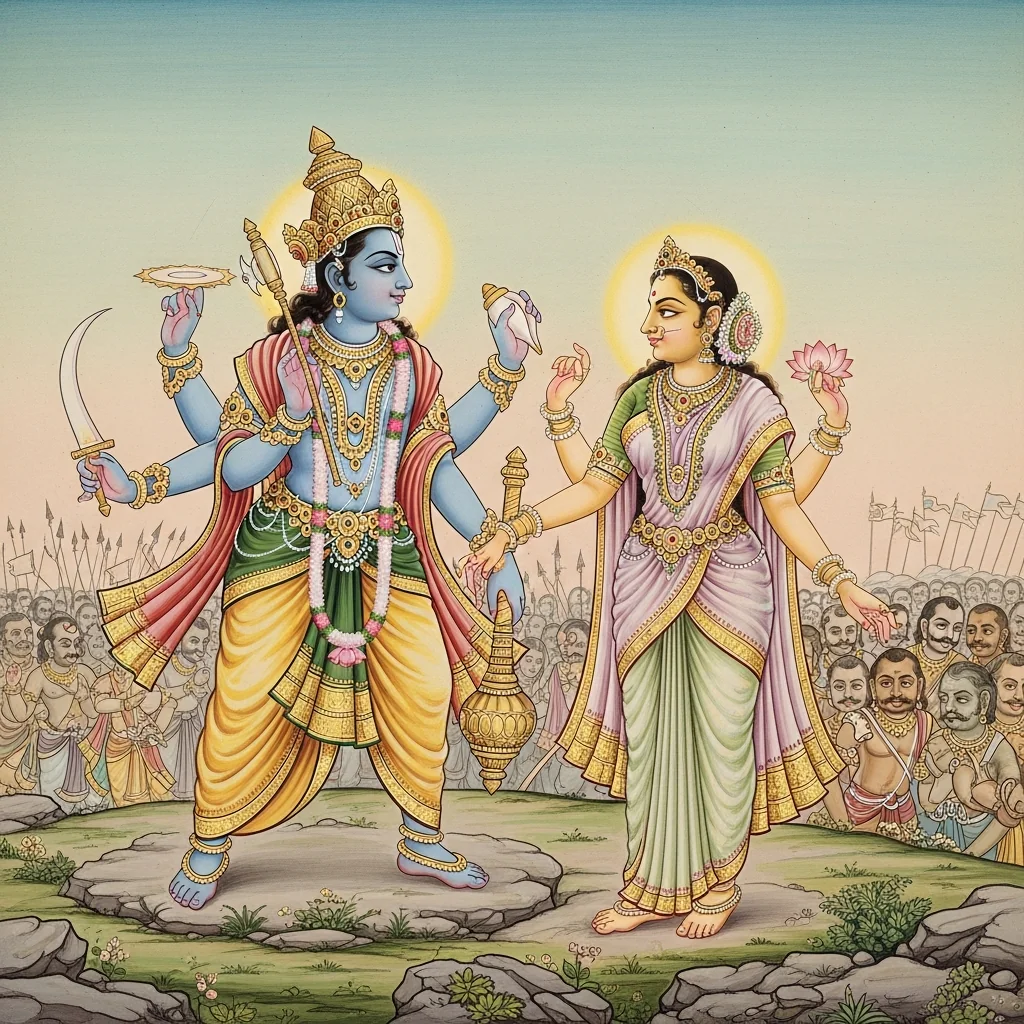
Īśvara delivers a site-bound theological teaching set in the eastern quarter near the shrine of Śrīdaittyasūdana, where a goddess is revered as the kṣetra-dūtī (protective emissary of the sacred field) with a Vaiṣṇavī nature. The chapter recalls a conflict in which mighty daityas, driven by Viṣṇu, move southward and wage a prolonged battle with many kinds of divine weapons. Seeing how hard they are to subdue, Viṣṇu invokes Bhairavī-Śakti, praised as Mahāmāyā, the radiant power. She manifests at once; upon beholding Viṣṇu her eyes expand in a visionary way, and thus she is known as Viśālākṣī, established there as the destroyer of hostile forces. The discourse then connects this manifestation with the paired worship of Umā (Umā-dvaya) in relation to Somēśvara and Daittyasūdana, prescribing a pilgrimage order: first Somēśvara, then Śrīdaittyasūdana. A calendrical observance is emphasized—worship on the third lunar day of Māgha—granting lineage continuity (freedom from childlessness across generations) and, for the daily devotee, enduring health, happiness, and auspicious fortune. It ends with a brief phala-śruti: hearing this account removes demerit and fosters the growth of dharma.
Shlokas
Verse 1
ईश्वर उवाच । ततो गच्छेन्महादेवीं क्षेत्रदूतीं तु वैष्णवीम् । श्रीदैत्यसूदनाद्देवि पूर्वभागे व्यवस्थिताम्
Īśvara said: “Then one should go to the Great Goddess, Vaiṣṇavī, the ‘Messenger of the Sacred Field’ (Kṣetradūtī). O Devī, she is stationed on the eastern side, near Śrī Daityasūdana.”
Verse 2
योगेश्वर्यास्तथैशान्यां धनुषां सप्तके स्थिताम् । महादौर्भाग्यदग्धानां स्थितां भेषजरूपिणीम्
“In the north-east, near Yogeśvarī, she is situated at a distance of seven dhanuṣ (bow-lengths). She stands in the form of a healing remedy for those scorched by great misfortune.”
Verse 3
चाक्षुषस्यांतरे देवि यदा दैत्या बलोत्कटाः । हन्यमाना विष्णुनाऽथ दक्षिणां दिशमाविशन्
O Goddess, in the Manvantara of Cākṣuṣa, when the mighty, forceful Dānavas were being struck down by Viṣṇu, they fled and entered the southern direction.
Verse 4
तत्र वर्षशतं साग्रं दैत्याश्चक्रुर्महाहवम् । विष्णुना सह देवेशि दिव्यास्त्रैश्च पृथग्विधैः
There, for a little more than a hundred years, O Lady of the gods, the Daityas waged a tremendous war with Viṣṇu, employing diverse kinds of celestial weapons.
Verse 5
दुःखवध्यांस्ततो ज्ञात्वा विष्णुः कमललोचनः । सस्मार भैरवीं शक्तिं महामायां महाप्रभाम्
Then lotus-eyed Viṣṇu, realizing that they were difficult to slay, remembered and invoked the Bhairavī Power—Mahāmāyā, radiant with supreme splendor.
Verse 6
सा स्मृता क्षणमात्रेण विष्णुना प्रभविष्णुना । तत्रागता महादेवी आनंदस्फुरितेक्षणा
Remembered by mighty Viṣṇu, she appeared there in an instant—the Great Goddess, her eyes quivering with bliss.
Verse 7
विशाले तु कृते देव्या लोचने विष्णुदर्शनात् । विशालाक्षी ततो जाता तत्रस्था दैत्यनाशिनी
When, upon beholding Viṣṇu, the Goddess made her eyes wide, she then became known as Viśālākṣī; abiding there, she became the destroyer of the Daityas.
Verse 8
अस्मिन्कल्पेसमाख्याता ललितोमा वरानने । उमाद्वयं समाख्यातं सोमेशे दैत्यसूदने
In this present aeon, O fair-faced one, she is spoken of as Lalitā-Umā; and this ‘pair of Umās’ is renowned at Someśa and at Daityasūdana.
Verse 9
पूर्वं सोमेश्वरे पश्येत्पश्चाच्छ्रीदैत्यसूदने । उमा द्वयं पूजयित्वा तीर्थयात्राफलं लभेत्
First one should have darśana at Someśvara, and afterward at the revered Daityasūdana. Having worshipped the two Umās, one obtains the full fruit of a pilgrimage to the tīrthas.
Verse 10
माघे मासि तृतीयायां विधिना योऽर्चयेत्तु ताम् । न संततिविहीनः स्यात्तस्यकोट्यन्वये नरः
Whoever worships her according to rule on the third lunar day in the month of Māgha—no man in his lineage, even through millions of generations, will be without offspring.
Verse 11
यो नित्यमीक्षते तत्र भक्त्या परमया युतः । आरोग्यसुखसौभाग्यसंयुक्तोऽसौ भवेच्चिरम्
One who daily beholds the Deity there, endowed with supreme devotion, remains for a long time united with health, happiness, and good fortune.
Verse 12
इति संक्षेपतः प्रोक्तं माहात्म्यं ललितोद्भवम् । श्रुतं यत्पापनाशाय जायते धर्मवृद्धये
Thus, in brief, the greatness arising from Lalitā has been told. Hearing it brings about the destruction of sins and the increase of dharma.
Verse 61
इति श्रीस्कांदे महापुराण एकाशीतिसाहस्र्यां सहितायां सप्तमे प्रभासखण्डे प्रथमे प्रभास क्षेत्रमाहात्म्ये ललितोमाविशालाक्षी माहात्म्यवर्णनंनामैकषष्टितमोऽध्यायः
Thus ends the sixty-first chapter, called “The Description of the Greatness of Lalitā, Umā, and Viśālākṣī,” in the Prabhāsa Khaṇḍa—within the Prabhāsa-kṣetra Māhātmya—of the Śrī Skanda Mahāpurāṇa (in the eighty-one-thousand-verse compilation).