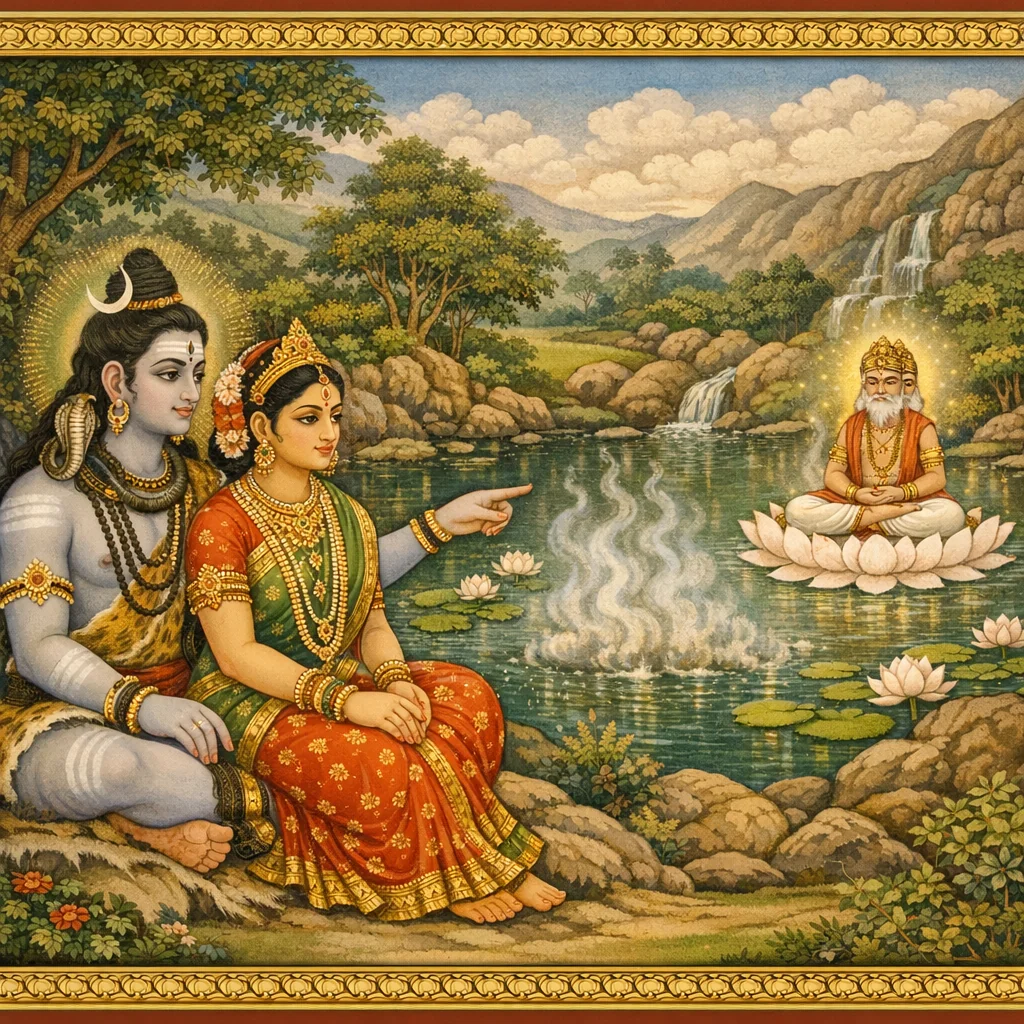
Adhyaya 147
This adhyāya unfolds as a Śiva–Devī dialogue. Īśvara directs Devī to Brahmakuṇḍa at Prabhāsa, an unsurpassed tīrtha said to have been created by Brahmā. Its origin is placed in the time when Somnātha was established by Soma/Śaśāṅka and the devas assembled for the consecration. Asked to provide a self-manifest sign of the deity’s installation, Brahmā enters focused meditation and, by tapas, ritually draws together all tīrthas—of heaven, earth, and the nether realms—into this one basin, hence the name “Brahmakuṇḍa.” The discourse then lists ritual uses and promised results: bathing and pitṛ-tarpaṇa here yield Agniṣṭoma-like merit and heavenly mobility; gifts to learned brāhmaṇas are urged for the removal of sins. Sarasvatī is said to bathe here on pūrṇimā and pratipad, marking the site’s calendrical sanctity. The waters are praised as siddha-rasāyana, a perfected elixir displaying many colors and fragrances—an awe-inspiring wonder (kautuka)—yet their efficacy is conditioned by Mahādeva’s satisfaction. Practical observances are taught—preparing a vessel, heating, and repeated infusion—along with long-term vows: multi-year snāna with mantra-japa and worship of Hiraṇyeśa, Kṣetrapāla (the guardian), and Bhairaveśvara to gain health, longevity, eloquence, and learning. The chapter culminates in expansive phala: diverse sins are destroyed, merit accrues through pradakṣiṇā, fulfillment comes through pūjā, and the phalaśruti promises that faithful listeners are freed from sins and ascend to Brahmaloka.
Shlokas
Verse 1
ईश्वर उवाच । ततो गच्छेन्महादेवि ब्रह्मकुण्डमनुत्तमम् । तस्यैव नैरृते भागे ब्रह्मणा निर्मितं पुरा
Īśvara said: Then, O great Goddess, one should go to the unsurpassed Brahmakuṇḍa. In its south-western quarter, long ago, Brahmā fashioned a sacred feature there.
Verse 2
यदा तु ऋक्षराजेन सोमनाथः प्रति ष्ठितः । तदा ब्रह्मादयो देवाः सर्वे तत्र समागताः । प्रतिष्ठार्थं हि देवस्य शशांकेन निमन्त्रिताः
When Somnātha was installed by the lord of the stars, the Moon, then Brahmā and all the other gods assembled there—invited by the Moon for the very purpose of consecrating the deity.
Verse 3
अथाऽब्रवीन्निशानाथो ब्रह्माणं विनयान्वितः
Then Niśānātha, the Moon, filled with humility, spoke to Brahmā.
Verse 4
कृतं भवद्भिर्जानाति स्थापनं वै यथा जनः । तथा कुरु सुरश्रेष्ठ चिह्नमात्मसमुद्भवम्
“Let people know that this installation was done by you. Therefore, O best of the gods, create a sign—one that arises from your own divine power.”
Verse 5
एवं श्रुत्वा तदा ब्रह्मा ध्यानं कृत्वा तु निश्चलम् । आह्वयत्सर्वतीर्थानि पुष्करादीनि सर्वशः
Hearing this, Brahmā entered steady, unmoving meditation and summoned all the sacred tīrthas—Puṣkara and the rest—from every quarter.
Verse 6
स्वर्गे वै यानि तीर्थानि तथैव च रसातले । तपःसामर्थ्ययोगेन ब्रह्मणाऽकर्षितानि च । अतस्तस्यैव नाम्ना तु ब्रह्मकुण्डं तु गीयते
Whatever tīrthas exist in heaven, and likewise those in Rasātala, the nether regions—Brahmā, by the power of his austerity, drew them here. Therefore it is celebrated by his very name as ‘Brahmakuṇḍa’.
Verse 7
गणानां च सहस्रैस्तु चतुर्दशभिरीक्ष्यते । अतश्चाभक्तियुक्तानां दुष्प्राप्यं तीर्थमुत्तमम्
This supreme tīrtha is beheld by fourteen thousand gaṇas; therefore, for those without bhakti, it is hard to attain.
Verse 8
अथाब्रवीत्सर्वदेवान्ब्रह्मा लोकपितामहः
Then Brahmā, the grandsire of the worlds, addressed all the gods.
Verse 9
अत्र कुण्डे नरः स्नात्वा यः पितॄंस्तर्पयिष्यति । अग्निष्टोमफलं सव लप्स्यते स च मानवः । तत्प्रसादात्स्वर्गलोके विमानेन चरिष्यति
Whoever bathes in this sacred pond and then offers tarpaṇa libations to the Pitṛs (ancestors) gains the full fruit of the Agniṣṭoma sacrifice. By the grace of that merit, that person roams the heavenly world in a celestial vimāna.
Verse 10
गोदानं चाश्वदानं च तथा स्वर्णकमण्डलुम् । दद्याद्विप्राय विदुषे सर्वपापापनुत्तये
For the removal of all sins, one should give a learned brāhmaṇa the gift of a cow, the gift of a horse, and also a golden kamaṇḍalu (water-pot).
Verse 11
पौर्णमास्यां महादेवि तथा च प्रतिपद्दिने । सर्वपापविनाशार्थं तत्र स्नाति सरस्वती
O Great Goddess, on the full-moon day and also on pratipad (the first lunar day), Sarasvatī bathes there for the destruction of all sins.
Verse 12
सिद्धं रसायनं देवि तत्र वै ह्युदकं प्रिये । नानावर्णसमायुक्तमुपदेशेन सिद्ध्यति
O Goddess, beloved, the water there is truly a perfected rasāyana, a sacred elixir. Endowed with many hues, it becomes efficacious through proper instruction (upadeśa).
Verse 13
दारिद्र्यदुःखरुक्छोकान्मानवः सेवते कथम् । ब्रह्मकुण्डमनुप्राप्य कल्पवृक्षमिवापरम्
How could a person still endure poverty, suffering, illness, and grief after reaching Brahmakuṇḍa—like another kalpavṛkṣa, the wish-fulfilling tree?
Verse 14
देव्युवाच । भगवन्विस्तराद्ब्रूहि ब्रह्मकुण्डमहोदयम् । सर्वप्राणिहितार्थाय विस्तराद्वद मे प्रभो
The Goddess said: “O Lord, tell me in detail the great manifestation and glory of Brahmakuṇḍa. For the welfare of all beings, explain it to me fully, O Master.”
Verse 15
ब्रह्मकुंडस्य माहात्म्यं श्रोतुं मे कौतुकं महत् । लोकानां दुःखनाशाय दारिद्यक्षयहेतवे
I have great eagerness to hear the greatness of Brahmakuṇḍa, so that the sorrow of people may be destroyed and poverty may come to an end.
Verse 16
भगवन्मानुषाः सर्वे दुःखशोकनिपीडिताः । भ्रमंति सकलं जन्म रसायनविमोहिताः
O Lord, all human beings are oppressed by suffering and grief; deluded by the pursuit of “rasāyana” elixirs, they wander through their entire lives.
Verse 17
तेषां हिताय मे ब्रूहि निर्वाणं रसमुत्तमम् । आदाविह शरीरं तु अक्षय्यं तु यथा भवेत्
For their welfare, tell me of the supreme “rasa,” the highest essence that leads to nirvāṇa—how, first of all, this body here may become enduring and imperishable.
Verse 18
अष्टसिद्धिसमा युक्तं सर्वविद्यासमन्वितम् । कामरूपं क्रियायुक्तं सर्वव्याधिविवर्जितम्
Endowed with the eight siddhis, furnished with all knowledge, able to assume any desired form and effective in action—free from every disease.
Verse 19
ततस्तु परमं देव निर्वाणं येन वै लभेत् । मानवः कृतकृत्यश्च जायते च यथा प्रभो
Then, O Supreme Lord, tell by what means a human being truly attains the highest nirvāṇa and becomes one who has fulfilled life’s purpose, as You know and ordain, O Master.
Verse 20
तथा कथय मे देव दयां कृत्वा जगत्प्रभो । निर्वाणपरमं कल्पं सर्वभ्रांतिविवर्जितम् । प्रसिद्धं सुखदं दिव्यं समा चक्ष्व महेश्वर
Therefore tell me, O Lord—out of compassion, O Master of the worlds—of that sacred ordinance whose highest end is nirvāṇa, free from all delusion; renowned, bliss-giving, and divine. Explain it fully, O Maheśvara.
Verse 21
ईश्वर उवाच । साधुसाधु महादेवि लोकानां हितकारिणि । मर्त्यलोके महादेवि तीर्थं तीर्थवरं शुभम्
Īśvara said: “Well said, well said, O Mahādevī, benefactress of the worlds. In the mortal realm, O Mahādevī, there is a holy tīrtha, the best of tīrthas, truly auspicious.”
Verse 22
प्रभासं परमं ख्यातं तच्च द्वादशयोजनम् । तत्र सोमेश्वरो देवस्त्रिषु लोकेषु विश्रुतः
Prabhāsa is supremely renowned, extending for twelve yojanas. There, the god Someśvara is celebrated throughout the three worlds.
Verse 23
तस्य पूर्वे समाख्यातः श्रीकृष्णो दैत्यसूदनः । चण्डिका योगिनी तत्र सखीभिः परिवारिता
To its east is famed Śrī Kṛṣṇa, the slayer of demons; and there too is Caṇḍikā the Yoginī, surrounded by her companion-goddesses.
Verse 24
ततः पूर्वे दिशां भागे चतुर्वक्त्रेण निर्मितम् । तीर्थात्तीर्थं वरं दिव्यं सर्वाश्चर्यमयं शुभम्
Further, in the eastern quarter, is a sacred ford established by the Four-faced One (Brahmā)—a divine tīrtha, the best among tīrthas, wholly wondrous and auspicious.
Verse 25
सेवितं सर्वदेवैस्तु सिद्धैः साध्यैर्ग्रहैस्तथा । अप्सरोमुनिभिर्दिव्यैर्यक्षैश्च पन्नगैः सदा
It is ever frequented by all the gods—by Siddhas, Sādhyas, and even the Grahas; by divine apsarases and sages, and always by Yakṣas and Nāgas as well.
Verse 26
सिद्ध्यर्थं सर्वकामार्थं दिव्यभोगावहं शुभम् । ब्रह्मकुण्डमिति ख्यातं ब्रह्मणा निर्मितं यतः
Auspicious and bestowing divine enjoyments—meant for spiritual accomplishment and the fulfillment of all worthy desires—it is known as Brahmakuṇḍa, because it was established by Brahmā.
Verse 27
तस्य वायव्यकोणे तु हिर ण्येशः स्वयं स्थितः । तमाराध्य महादेवं हिरण्येश्वरमुत्तमम्
In its northwestern corner, Hiraṇyeśa himself abides. By worshipping that Mahādeva—Hiraṇyeśvara, the supreme Lord—one attains the promised fruit.
Verse 28
महामन्त्रं जपेत्क्षिप्रं दशांशं होमयेत्सुधीः । होमेन सिद्ध्यते मन्त्रः सत्यं सत्यं वरानने
Let the wise one swiftly recite the great mantra and offer a tenth part as homa. By homa the mantra is perfected—true, true, O fair-faced one.
Verse 29
तस्योत्तरे तु दिग्भागे किञ्चिदीशानमाश्रितः । चतुर्वक्त्रो महादेवि क्षेत्रपो लिंगरूपधृक्
To its north, slightly inclined toward the Īśāna (northeast) quarter, O Great Goddess, stands the four-faced guardian of the sacred field, bearing the form of a liṅga.
Verse 30
तत्स्थानं रक्षते देवि लिंगरूपेण शंकरः । तमाराध्य प्रयत्नेन ततः कुण्डं समाश्रयेत्
O Goddess, that place is protected by Śaṅkara in the very form of a liṅga. Having worshipped Him with earnest effort, one should then resort to the sacred pond (kuṇḍa).
Verse 31
सर्वैश्वर्यमयं देवि नानावर्णविचित्रितम् । कुण्डस्यास्येशदिग्भागे भैरवेश्वरमुत्तमम्
O Goddess, this kuṇḍa is filled with every kind of prosperity and adorned with many variegated colors. On the Īśāna (northeast) side of this kuṇḍa is the supreme Bhairaveśvara.
Verse 32
दुर्गन्धा भासुरा देवि वहते रसरूपिणी । तस्या रसेन संयुक्तं पृथग्वर्णं हि कर्बुरम्
O Goddess, there flows a shining stream of “rasa” (essence), at times foul-smelling. When mingled with that essence, it becomes mottled—indeed, of distinct and separate colors.
Verse 33
मेघवर्णं महादिव्यं राजतं च पुनः शुभम् । कपिलं दुग्धवर्णं च कर्पूराभं सुशोभनम्
It appears cloud-hued, vast and supremely divine; again it appears silvery and auspicious—sometimes tawny, sometimes milk-white, and sometimes camphor-like, most beautiful.
Verse 34
कदा कस्तूरिकाभासं कुंकुमच्छविकावहम् । सौगन्धं चंदनोपेतं कदाचिद्रौधि रोदकम्
At times it appears like musk; at times it bears the radiance of saffron—fragrant and endowed with sandal’s scent; and at times it becomes fierce and tumultuous.
Verse 35
एते रसाश्च विविधा दृश्यंते तत्र सर्वदा । यस्य तुष्टो महादेवः सिद्ध्यते तस्य तत्क्षणात्
These diverse essences are seen there at all times. For whomever Mahādeva is pleased, that person’s aim is accomplished at once.
Verse 36
रजतं क्षिप्यते तत्र सुवर्ण मिव जायते । प्रत्यक्षमेव तत्रैव रसायनमनुत्तमम्
If silver is cast there, it becomes as though gold. There itself, directly perceptible, is an unsurpassed rasāyana (alchemy/elixir).
Verse 37
पश्यंति मानवा देवि कौतुकं तत्क्षणाद्भृशम् । रसं हि परमं दिव्यं तत्रस्थं च कलौ युगे
O Goddess, people behold that great marvel at once. For the supreme, divine essence remains established there, even in the age of Kali.
Verse 38
सिद्धं सिद्धरसं पुंसां व्याधीनां क्षयकारकम् । हेमबीजमयं दिव्यं ब्रह्मकुण्डोद्भवं महत्
It is perfected—this “siddha-rasa” for humankind—bringing the wasting away of diseases. Divine and formed of the “seed of gold,” it is a great substance arisen from Brahma-kuṇḍa.
Verse 39
इदानीं ते प्रवक्ष्यामि मनुष्याणां हिताय वै । दारिद्र्यं क्षयमाप्नोति तत्क्षणाच्च यशस्विनि
Now I shall declare to you—truly for the welfare of humankind, O illustrious one—the rite by which poverty is destroyed and fame arises at that very moment.
Verse 40
आदावेव प्रकुर्वन्ति ताम्रकुम्भं दृढं शुभम् । तीर्थोदकं क्षिपेत्तत्र पत्रैस्ताम्रस्तथा युतम्
At the very outset one should prepare a firm, auspicious copper vessel. Into it one should pour the sacred water of the tīrtha, along with copper leaves/plates.
Verse 41
निक्षिप्य भूमौ तत्कुम्भं ज्वालयेदनलं ततः । चुह्लीरूपेण षण्मासं पाचयेत्तं शनैःशनैः
Placing that pot upon the ground, one should then kindle a fire. In the manner of a hearth, one should heat it slowly and steadily for six months.
Verse 42
पश्चादुद्धृत्य तं कुम्भं पुनरेव जलं क्षिपेत् । मासमेकं पुनः कुर्यान्मासमेकं पुनर्भृशम्
Afterwards, lifting up that pot, one should pour in water again. One should repeat this for one month, and again for another month, with great care.
Verse 43
ततः सर्वाणि खण्डानि एकीकृत्य प्रयत्नतः । पुनरेवोदकेनैव प्लाव्य चावर्तयेत्पुनः
Then, carefully gathering all the pieces into one, one should again flood it with water alone and churn/turn it again and again.
Verse 44
कांचनं जायते तत्र यदि तुष्टो महेश्वरः
Gold is produced there—if Maheśvara (Śiva) is pleased.
Verse 45
सिद्धिं शरीरजां देवि यदीच्छेन्मानवोत्तमः । स स्नानमादितः कृत्वा संवत्सरत्रयं पुनः
O Goddess, if an excellent man desires a bodily siddhi (a perfected attainment of the body), then—having first undertaken the prescribed bathing—he should continue so for three years.
Verse 46
मौनेन नियमेनैव महामंत्रजपान्वितः । पूजयेच्च हिरण्येशं क्षेत्रपालं प्रयत्नतः
Endowed with mauna (sacred silence) and niyama (disciplined observance), and engaged in the japa of a great mantra, he should earnestly worship Hiraṇyeśa—the guardian of the sacred field.
Verse 47
पंचोपचारसंयुक्तं ध्यानधारणसंयुतम् । तीर्थोदकेन पाकं वै पेयं तद्वदुदुम्बरे
Performing worship with the five offerings, joined with meditation and steady concentration, one should prepare the draught with tīrtha-water and drink it; likewise it should be done at the udumbara tree.
Verse 48
एवं वर्षत्रयेणैव दिव्यदेहः प्रजायते । तेजस्वी वलवान्प्राज्ञः सर्वव्याधिविवर्जितः
Thus, in just three years a divine body is attained—radiant, strong, wise, and free from all diseases.
Verse 49
जीवेद्वर्षेशतान्येव त्रीणि दुःखविवर्जितः । वर्षत्रयमविच्छिन्नं यस्तत्र स्नानमाचरेत्
Whoever performs uninterrupted bathing at that sacred place for three continuous years lives for three hundred years, completely free from suffering.
Verse 50
वागीश्वरीं जपेन्नित्यं पूजाहोमसमन्वितः । तस्य प्रवर्तते वाणी सिद्धिः सारस्वती भवेत्
If one daily repeats the mantra of Vāgīśvarī, accompanied by worship and fire-offerings, that person’s speech begins to flow powerfully, and Sarasvatī-like mastery of learning and expression arises.
Verse 51
संस्कृतं प्राकृतं चैवापभ्रंशं भूतभाषितम् । गांगस्रोतःप्रवाहेण उद्गिरेद्गिरमात्मवान् । अश्रान्तां च वरारोहे ह्यविच्छिन्नां च संततम्
Endowed with inner mastery, one would utter speech in Sanskrit, Prakrit, Apabhraṃśa, and even the languages of spirits—pouring forth like the rushing current of the Gaṅgā—tireless, unbroken, and ever-continuous, O fair-hipped one.
Verse 52
वदेद्वादिसहस्रैस्तु न श्रमस्तस्य जायते । तीर्थस्यास्य प्रभावेण सर्वशास्त्रविशारदाः
Even if he were to debate with thousands of disputants, no fatigue would arise in him; by the power of this tīrtha he becomes a master of all śāstras.
Verse 53
पंडिता गर्विताः सर्वे तर्कशास्त्रविशारदाः । आगच्छन्ति समं तात विद्ययोद्धतकन्धराः । न शक्नुवंति ते वक्तुं द्रष्टुं वक्त्रमपि प्रिये
O child, all those proud scholars, skilled in logic and disputation, come together—lofty-necked with the arrogance of learning; yet, O beloved, they cannot speak, nor even look upon his face.
Verse 54
वादिनां च सहस्राणि भनक्त्येवं निरीक्षणात्
Thus, by mere beholding (him/that sacred power), he crushes thousands of disputants.
Verse 55
उद्वाहयति शास्त्राणि विबुद्धार्थानि सत्वरम् । विमलं पाञ्चरात्रं च वैष्णवं शैवमेव च
He swiftly brings forth the śāstras with their meanings fully understood—Vimala’s teaching, the Pāñcarātra tradition, the Vaiṣṇava systems, and the Śaiva doctrines as well.
Verse 56
इतिहासपुराणं च भूततंत्रं च गारुडम् । भैरवं च महातंत्रं कुलमार्गं द्विधा प्रिये
And he also comprehends Itihāsa and Purāṇa, the Bhūta-tantras, the Gāruḍa teachings, Bhairava and other great Tantras, and the Kaula path in its twofold division, O beloved.
Verse 57
रथप्रवरवेगेन वाणी चास्खलिता भवेत् । नश्यंति वादिनः सर्वे गरुडस्येव पन्नगाः
His speech becomes unerring and swift, like the rush of the finest chariot; all opponents vanish like serpents before Garuḍa.
Verse 58
न दारिद्र्यं न रोगश्च न दुःखं मानसं पुनः । राजमान्यो महामानी भवेद्ब्रह्मप्रसादतः
There is no poverty, no disease, and no further sorrow of mind; by Brahmā’s grace he is honored by kings and held in great esteem.
Verse 59
उत्साहबलसंयुक्तो देववज्जीवते सुधीः । दाता भोक्ता च वाग्ग्मी च तीर्थस्यास्य प्रसादतः
By the grace of this tīrtha, the wise—endowed with zeal and strength—lives like a god, becoming a generous giver, a rightful enjoyer of life’s goods, and eloquent in speech.
Verse 60
तैलाभ्यक्तस्य यत्तेजो जायते मनुजेषु च । स्नातमात्रे तथा तेजस्तीर्थस्यैव प्रसादतः
The radiance that arises in people from being anointed with oil—such radiance likewise comes merely by bathing here, by the grace of this very tīrtha.
Verse 61
यत्पापं कुरुते जंतुः पैशुन्यं च कृतघ्नताम् । मित्रद्रोहे च यत्पापं यत्पापं पारदारिकम् । तत्सर्वं विलयं याति कुंडस्नानरतस्य च
Whatever sin a person commits—slander, ingratitude, betrayal of a friend, and the sin of violating another’s spouse—all of it is dissolved for one devoted to bathing in the kuṇḍa.
Verse 62
मुशलं लङ्घयेद् यस्तु यो गास्त्यजति वै द्विजः । तत्पापं क्षयमाप्नोति ब्रह्मकुण्डस्य दर्शनात्
Even the sin of a twice-born (dvija) who transgresses sacred bounds or abandons cows is destroyed merely by the darśana of Brahmakuṇḍa.
Verse 63
पृथिव्यां यानि तीर्थानि दैवतानि तथा पुनः । पूजितानि च सर्वाणि कुण्डस्नानप्रभावतः
By the power of bathing in this kuṇḍa, all the tīrthas on earth—and all the deities as well—are deemed to have been worshipped.
Verse 64
सप्तजन्मार्जितं पापं दर्शनात्क्षयमाव्रजेत्
Sin accumulated across seven births is destroyed merely by darśana, the sacred sight.
Verse 65
यत्पापं गुरुगोघ्ने च परस्वहरणेषु च । तत्पापं क्षयमाप्नोति ब्रह्मकुण्डनिषेवणात्
The sin of killing a guru or a cow, and of stealing another’s property—such sin is destroyed through devoted resort to Brahmakuṇḍa.
Verse 66
प्रदक्षिणं च यः कुर्यात्स्नात्वा कुण्डस्य नामतः । संख्यया पंचदश वै शृणु तस्यापि यत्फलम्
And whoever, after bathing, performs pradakṣiṇā—reverent circumambulation—of this kuṇḍa fifteen times, hear also the fruit of that act.
Verse 67
प्रदक्षिणीकृता तेन सप्तद्वीपा वसुन्धरा । सप्तपातालसहिता तीर्थकोटिभिरावृता
By that person’s pradakṣiṇā (sacred circumambulation), the earth with its seven continents—together with the seven pātālas (netherworlds), encompassed by crores of tīrthas—is as though circumambulated in its entirety.
Verse 68
आहारमात्रं यो दद्यात्तत्र वेदविदां वरे । लक्षभोज्यं कृतं तेन तीर्थस्यास्य प्रभावतः
O best among knowers of the Veda, whoever offers there even a mere portion of food—by the power of this tīrtha—it becomes as though he has fed a hundred thousand persons.
Verse 69
ब्रह्मेश्वरं च संपूज्य हिरण्येश्वरमुत्तमम् । क्षेत्रपालं चतुर्वक्त्रं पूजयेच्चिन्तितं लभेत्
Having duly worshipped Brahmeśvara and the excellent Hiraṇyeśvara, one should worship the four-faced Kṣetrapāla; thereby one obtains the desired object.
Verse 70
एकविंशत्कुलै र्युक्तः सर्वपापविवर्जितः । ब्रह्मलोकं स वै याति नात्र कार्या विचारणा
Together with twenty-one generations of his lineage, free from all sins, he indeed goes to Brahmaloka—of this there is no need for any doubt.
Verse 71
विरंचिकुण्डे स्नात्वा वा यो जपेद्वेदमातरम् । लक्षजाप्यविधानेन स मुक्तः पातकैर्भवेत्
Or, having bathed at Viraṃcikuṇḍa, whoever recites the Mother of the Vedas in accordance with the rite of one hundred thousand repetitions becomes freed from sins.
Verse 72
स एव पुण्यकर्त्ता च स एव पुरुषोत्तमः । यात्रा तत्र कृता येन ब्रह्मकुण्डे वरानने
He alone is truly a doer of merit; he alone is the best among men—he by whom the pilgrimage there has been performed at Brahmakuṇḍa, O fair-faced one.
Verse 73
अष्टाशीतिसहस्राणि ऋषीणामूर्ध्वरेतसाम् । ब्रह्मकुण्डं समाश्रित्य ब्रह्मदेवमुपासते
Eighty-eight thousand sages, steadfast in continence, resorting to Brahmakuṇḍa, worship Brahmā, the divine Lord.
Verse 74
तावद्गर्जंति तीर्थानि त्रैलोक्ये सचराचरे । यावद्ब्रह्मेश्वरं तीर्थं न पश्यन्ति नराः प्रिये
So long do the holy places ‘roar’ throughout the three worlds, with all that moves and does not move, as long as people do not behold the tīrtha of Brahmeśvara, O beloved.
Verse 75
ब्रह्मकुण्डे च पानीयं ये पिबन्ति नराः सकृत् । न तेषां संक्रमेत्पापं वाचिकं मानसं तनौ
Those people who drink the water of Brahmakuṇḍa even once—sin, whether of speech or of mind, does not pass into their body.
Verse 76
ब्रह्मांडोत्तरमध्ये तु यानि तीर्थानि संति वै । तेषां पुण्यमवाप्नोति ब्रह्मकुण्डे प्रदक्षिणात्
Whatever holy places exist in the upper and middle regions of the cosmos—one attains the merit of them all by circumambulating Brahmakuṇḍa.
Verse 77
याज्ञवल्क्यो महात्मा च परब्रह्मस्वरूपवान् । सोऽपि कुंडं न मुंचेत निकुं भस्तु गणस्तथा
Even the great-souled Yājñavalkya, embodying the very nature of the Supreme Brahman, would not forsake this kuṇḍa; likewise Nikuṃbha and his gaṇa.
Verse 78
इति संक्षेपतः प्रोक्तं माहात्म्यं ब्रह्मकुण्डजम् । तव स्नेहेन देवेशि किमन्यत्परिपृच्छसि
Thus, in brief, the greatness arising from Brahmakuṇḍa has been declared. Out of affection for you, O Goddess, what else do you wish to ask?
Verse 79
य इदं शृणुयान्मर्त्यः सम्यक्छ्रद्धासमन्वितः । स मुक्तः पातकैः सर्वैर्ब्रह्मलोकं च गच्छति
Any mortal who hears this account with proper faith is freed from all sins and attains Brahmaloka.