Adhyaya 132
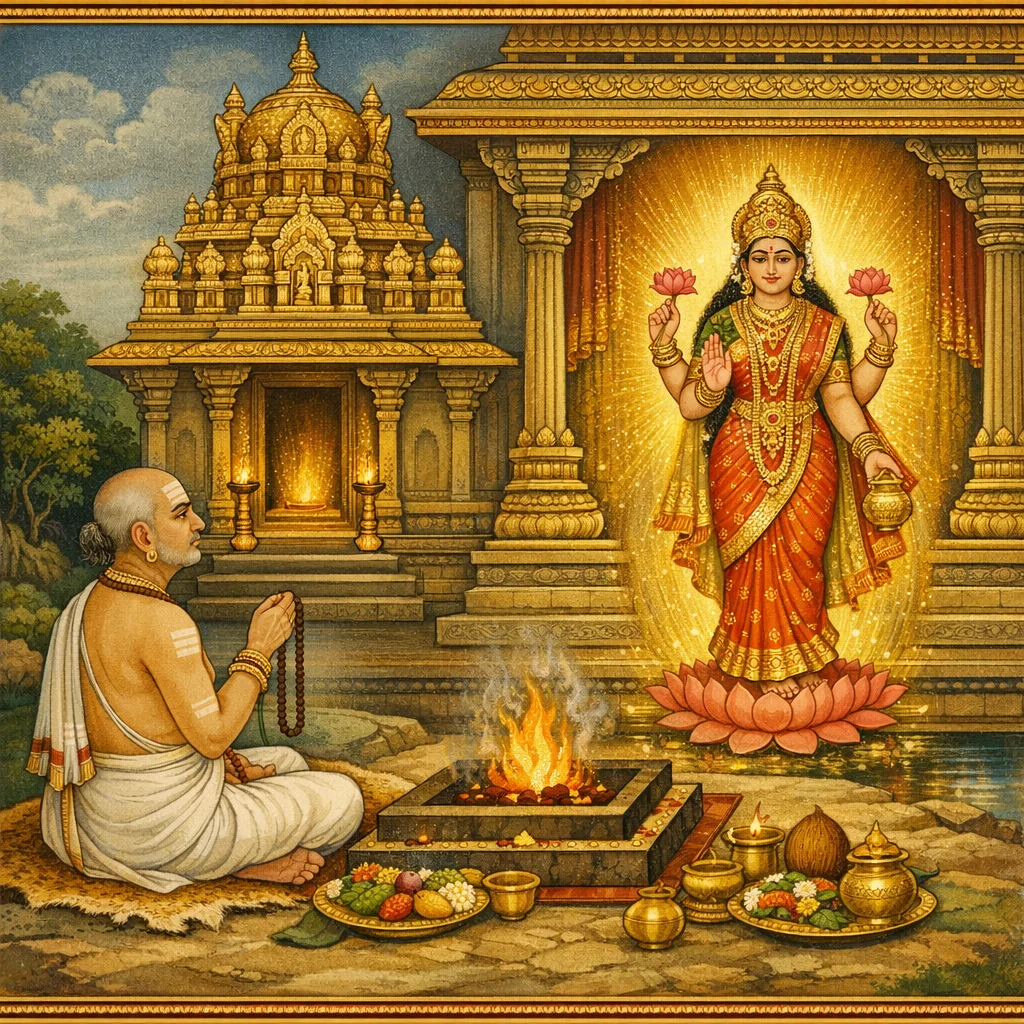
In this chapter, Īśvara speaks to Devī and points to an eminent Vaiṣṇavī śakti located near Prabhāsa in the Somēśa/Īśa-directional sector. The presiding deity of that pīṭha is Siddhalakṣmī, and Prabhāsa is praised as the “first pīṭha” in the cosmic order, filled with yoginīs—earthly and aerial—who move freely with Bhairava, revealing the mythic potency of pīṭha-energy. A list of major pīṭhas is then given—Jālaṃdhara, Kāmarūpa, Śrīmad-Rudra-Nṛsiṃha, Ratnavīrya, Kāśmīra, and others—and knowledge of these sacred seats is linked with mantra-competence (mantravit). The text further identifies a foundational “supporting” pīṭha in Saurāṣṭra called Mahodaya, where Kāmarūpa-like knowledge is said to remain active; there the Goddess is also lauded as Mahālakṣmī, who pacifies sin and grants auspicious success. Ritual instruction follows: worship on Śrīpañcamī with fragrances and flowers removes fear of alakṣmī (misfortune). Near Mahālakṣmī’s presence, facing north, one should undertake mantra-practice with prior dīkṣā and ritual bathing, complete a lakṣa-japa, and perform a tenth-part fire offering (daśāṃśa-homa) using tri-madhu and śrīphala. The phalaśruti declares that Lakṣmī will manifest and bestow the desired siddhi in this world and the next; tṛtīyā, aṣṭamī, and caturdaśī are also marked as especially efficacious times of worship.
Shlokas
Verse 1
ईश्वर उवाच । ततो गच्छेन्महादेवि वैष्णवीं शक्तिमुत्तमाम् । सोमेशादीशदिग्भागे नातिदूरे व्यवस्थिताम्
Īśvara said: “Then, O Mahādevī, one should go to the supreme Vaiṣṇavī Power, situated not far away, in the northeastern quarter from Someśa.”
Verse 2
सिद्धलक्ष्मीति विख्याता ह्यत्र पीठाधिदेवता
Here, the presiding deity of the sacred seat is renowned as Siddhalakṣmī.
Verse 3
ब्रह्माण्डे प्रथमं पीठं यत्प्रभासं व्यवस्थितम् । तत्र देवि महापीठे योगिन्यो भूचराः खगाः । भैरवेण समे तास्तु क्रीडन्ते स्वेच्छया प्रिये
The pīṭha established at Prabhāsa is the first among all in the universe. There, O Devī, in that great pīṭha, the Yoginīs—moving on the earth and through the sky—sport freely, O beloved, together with Bhairava.
Verse 4
जालंधरं महापीठं कामरूपं तथैव च । श्रीमद्रुद्रनृसिंहं च चतुर्थं पीठमुत्तमम्
Jālandhara is a great pīṭha; so too is Kāmarūpa. And Śrīmad-Rudra-Nṛsiṃha is the fourth, an excellent pīṭha.
Verse 5
रत्नवीर्यं महापीठं काश्मीरं पीठमेव च । एतानि देवि पीठानि यो वेत्ति स च मन्त्रवित्
Ratnavīrya is a great pīṭha, and Kāśmīra too is a pīṭha. O Devī, whoever truly knows these pīṭhas is indeed a knower of mantra.
Verse 6
सर्वेषां चैव पीठानामाधारं पीठमुत्तमम् । सौराष्ट्रे तु महादेवि नाम्ना ख्यातं महोदयम् । कामरूपधरं ज्ञानं यत्राद्यापि प्रवर्तते
And the supreme pīṭha that is the very support of all pīṭhas—O Mahādevī—is in Saurāṣṭra, famed by the name Mahodaya. There, knowledge bearing the form of Kāmarūpa is active even to this day.
Verse 7
तत्र पीठे स्थिता देवी महालक्ष्मीति विश्रुता । सर्वपापप्रशमनी सर्वकार्यशुभप्रदा
At that pīṭha resides the Goddess, famed as Mahālakṣmī—she who pacifies all sins and bestows auspiciousness upon every undertaking.
Verse 8
श्रीपञ्चम्यां नरो यस्तु पूजयेत्तां विधानतः । गन्धपुष्पादिभिर्भक्त्या तस्यालक्ष्मीभयं कुतः
On Śrīpañcamī, whoever worships Her according to the proper ordinance, with devotion and offerings of fragrance, flowers, and the like—how could fear of Alakṣmī, misfortune, remain for him?
Verse 9
उत्तरां दिशमास्थाय महाल क्ष्म्यास्तु सन्निधौ । यो जपेन्मन्त्रराज्ञीं तां सिद्धलक्ष्मीति विश्रुताम्
Facing north, in the presence of Mahālakṣmī, whoever recites that queen of mantras—renowned as Siddhalakṣmī—attains its sanctifying, accomplishing power.
Verse 10
लक्षजाप्यविधानेन दीक्षास्नानादिपूर्वकम् । दशांशहोमसंयुक्तं त्रिमधुश्रीफलेसुभिः
By the prescribed observance of one hundred thousand japa repetitions, preceded by dīkṣā (initiation), ritual bathing, and the like, and joined with a homa fire-offering equal to one-tenth of the japa, performed with the auspicious tri-madhu (three sweet offerings) and the sacred śrī-phala (coconut).
Verse 11
एवं प्रत्यक्षतां याति तस्य लक्ष्मीर्न संशयः । ददाति वांछितां सिद्धिमिह लोके परत्र च
Thus Lakṣmī becomes manifest to that devotee—of this there is no doubt—and she grants the desired siddhi, in this world and in the world beyond.
Verse 12
तृतीयायामथा ष्टम्यां चतुर्दश्यां विधानतः । यस्तां पूजयते भक्त्या तस्य सिद्धिः करे स्थिता
On the third, the eighth, and the fourteenth lunar day, according to the proper ordinance, whoever worships Her with devotion—for him success (siddhi) rests in the very palm of the hand.
Verse 132
इति श्रीस्कांदे महापुराण एकाशीतिसाहस्र्यां सहितायां सप्तमे प्रभासखण्डे प्रथमे प्रभासक्षेत्रमाहात्म्ये सिद्धलक्ष्मीमाहात्म्यवर्णनंनाम द्वात्रिंशदुत्तरशततमोऽध्यायः
Thus ends the one-hundred-and-thirty-second chapter, called “The Description of the Greatness of Siddha-Lakṣmī,” in the Prabhāsa Khaṇḍa—within the Prabhāsakṣetra Māhātmya—of the revered Skanda Mahāpurāṇa, the compendium of eighty-one thousand verses.