Adhyaya 332
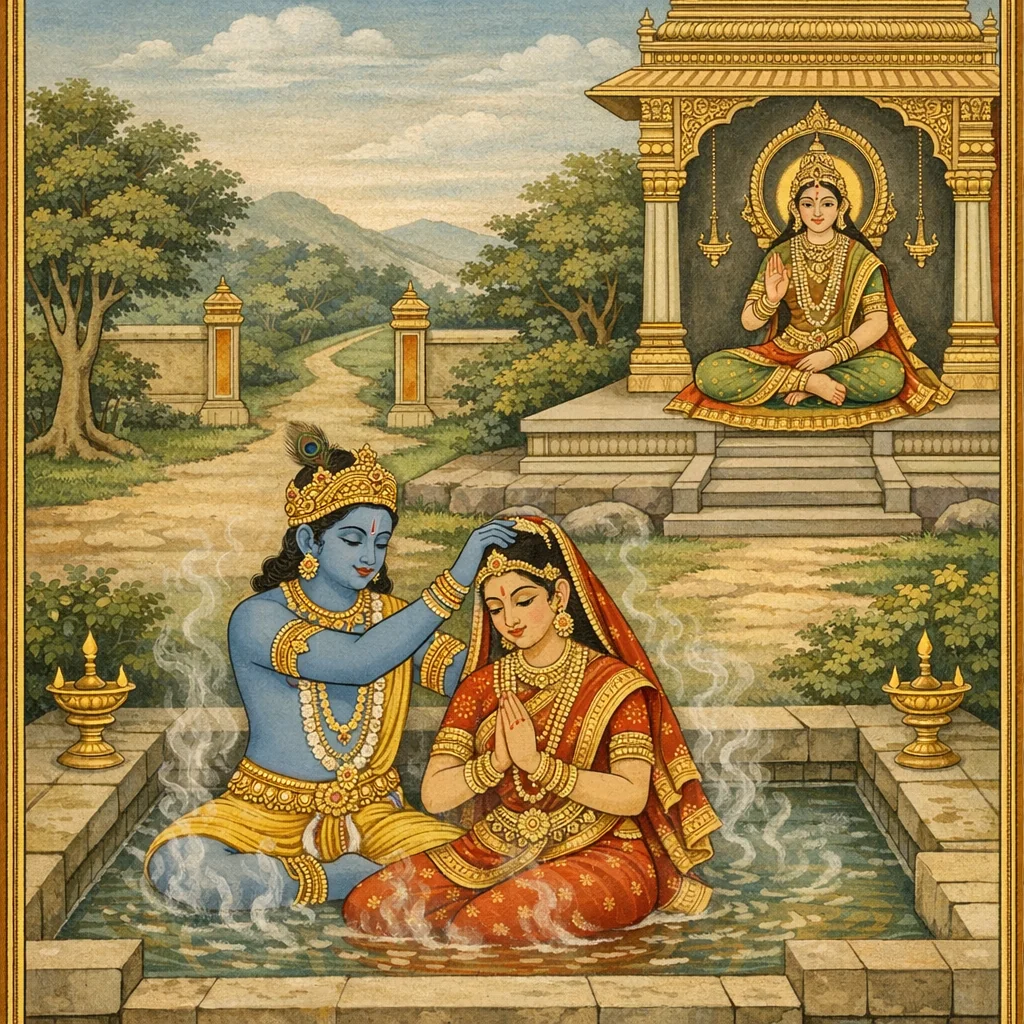
This adhyāya is framed as a theological instruction led by Īśvara, identifying two linked sacred features within Prabhāsa-kṣetra: a set of hot-water ponds (taptodaka-kuṇḍa) to the south at a measured distance, and the eastward placement of the goddess Rukmiṇī at a specified interval. The hot-water kuṇḍa is established as a locus of purification, explicitly said to destroy even the most extreme sin, described as “koṭi-hatyā-vināśana.” A sequential rite is prescribed: first perform snāna (sacred bathing) in the hot-water kuṇḍa, then offer saṃpūjā (complete worship) to Rukmiṇī, praised as the remover of all sins and the bestower of auspiciousness. The phalaśruti adds a social-ethical promise aimed at household stability: for women, disruption or breaking of the marital home (gṛha-bhaṅga) is said not to arise for seven births. Thus pilgrimage practice is presented as a moral economy of merit bound to place, rite, and devotion.
Shlokas
Verse 1
ईश्वर उवाच । तस्माद्दक्षिणदिग्भागे धनुषां पंचभिः प्रिये । तत्र तप्तोदकुंडानि संत्यद्यापि वरानने
Īśvara said: From there, in the southern quarter, at a distance of five bow-lengths, O beloved; there are hot-water ponds there even today, O fair-faced one.
Verse 2
कुण्डतः पूर्वदिग्भागे धनुषां पञ्चविंशतौ । रुक्मिणी संस्थिता देवी सर्वपातकनाशिनी
To the east of the sacred kuṇḍa, at a distance of twenty-five dhanuṣ-lengths, the Goddess Rukmiṇī dwells there—she who destroys all sins.
Verse 3
स्नात्वा तप्तोदके कुण्डे कोटिहत्याविनाशने । ततः संपूजयेद्देवीं रुक्मिणीं रुक्मदायिनीम् । सप्त जन्मानि नारीणां गृहभंगो न जायते
After bathing in the warm-water kuṇḍa—the destroyer of even the sin of a crore of killings—one should then duly worship the Goddess Rukmiṇī, the giver of gold. For women, for seven births, the breaking of the household does not arise.
Verse 332
इति श्रीस्कांदे महापुराण एकाशीतिसाहस्र्यां संहितायां सप्तमे प्रभासखंडे प्रथमे प्रभासक्षेत्रमाहात्म्ये रुक्मिणीमाहात्म्यवर्णनंनाम द्वात्रिंशदुत्तरत्रिशततमोऽध्याय
Thus ends, in the Śrī Skanda Mahāpurāṇa, in the eighty-one-thousand-verse compendium, within the seventh book Prabhāsa Khaṇḍa, in the first division ‘Prabhāsakṣetra Māhātmya’, the chapter called ‘Narration of the Glory of Rukmiṇī’—the 332nd chapter.