Adhyaya 89
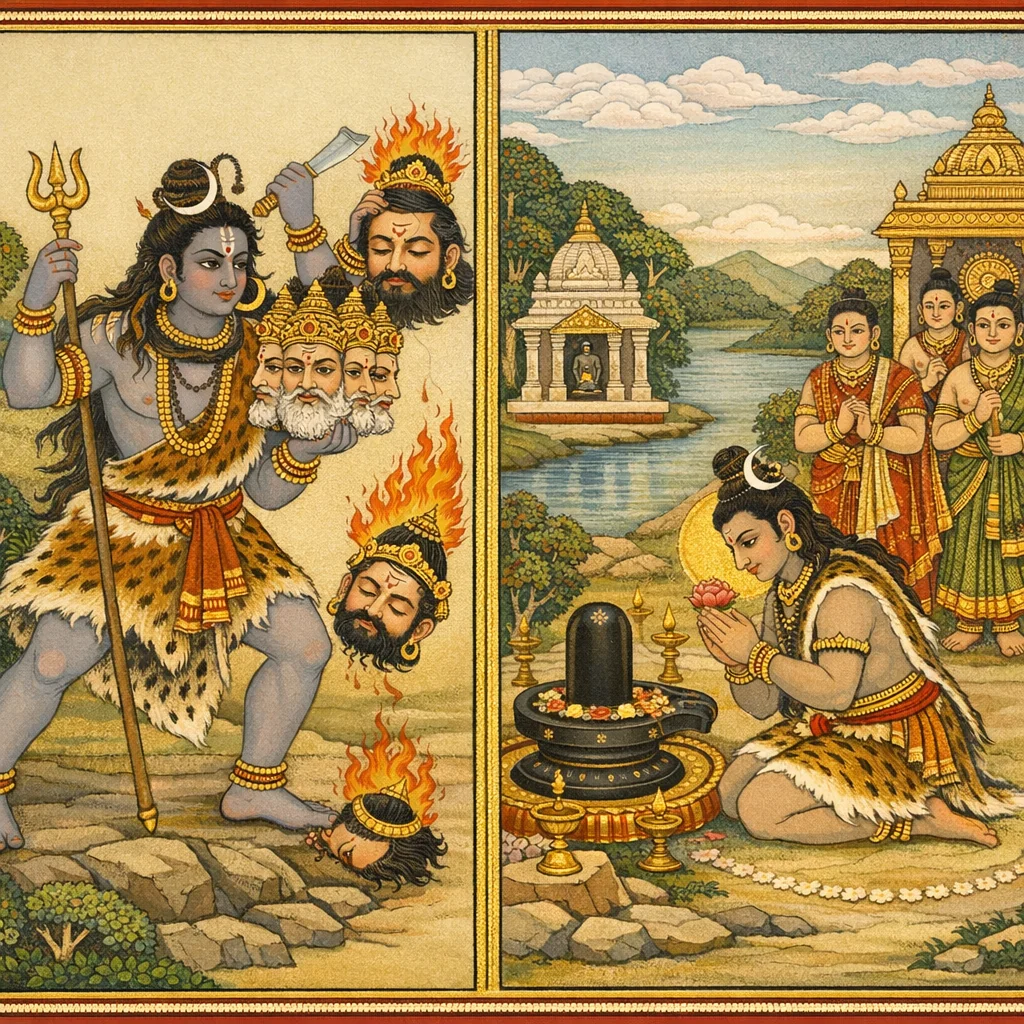
This chapter is cast as Īśvara’s theological instruction to Devī, declaring Kapālīśvara to be the “third Rudra” in the Rudra-sequence of Prabhāsa-kṣetra. Śiva recounts the mythic cause of the shrine’s name: after he severed Brahmā’s fifth head, the skull (kapāla) clung to his hand, establishing his Kāpālika identity. Śiva says he came to Prabhāsa bearing that kapāla and dwelt for a long time in the middle of the kṣetra, worshipping the liṅga across vast stretches of time, thereby sanctifying both the site and the liṅga through sustained divine observance. The chapter also guides pilgrims by locating the shrine west of Budheśvara and marking it by the measure of “seven bows” (dhanuṣāṃ saptake). For protection, Śiva appoints trident-bearing guardians and many gaṇas to keep the holy place safe from harmful dispositions. The prescribed worship includes focused faith, gifting gold to a Veda-proficient brāhmaṇa, and a mantra-procedure connected with Tatpuruṣa. The phala is proclaimed: merely beholding the liṅga removes sins accumulated from birth, with special emphasis on the power of both touch and sight. The chapter ends as a concise statement of Kapālī’s (the third Rudra’s) pāpa-nāśana māhātmya in Prabhāsa.
Shlokas
Verse 1
ईश्वर उवाच । ततो गच्छेद्वरारोहे कपालीश्वरमुत्तमम् । रुद्रं तृतीयं पापघ्नं नीलरुद्रस्यपूर्वतः
Īśvara said: “Then, O fair-thighed one, one should go to the excellent Kapālīśvara—Rudra the third, the destroyer of sins—situated to the east of Nīlarudra.”
Verse 2
बुधेश्वरात्पश्चिमतो धनुषां सप्तके स्थितम् । छिन्नं मया पुरा देवि ब्रह्मणः पंचमं शिरः
“It is situated to the west of Budheśvara, at a distance of seven dhanuṣ. There, long ago, O goddess, I severed Brahmā’s fifth head.”
Verse 3
तत्कपालं करे लग्नं प्रभासक्षेत्रमागतः । ततो वर्षसहस्रं तु संस्थितः क्षेत्रमध्यतः
With that skull fixed in his hand, he came to the holy field of Prabhāsa; and then, for a thousand years, he remained stationed in the very midst of that sacred kṣetra.
Verse 4
कपालधारी दिग्वासाः कपाली तेन च स्मृतः । तन्मया पूजितं लिंगं वर्षाणामयुतं प्रिये
Bearing a skull and clad in the directions (sky-clad), he is therefore remembered as Kapālī. That liṅga was worshipped by me, O beloved, for ten thousand years.
Verse 5
कपालिरूपमास्थाय कपालीशस्ततः स्मृतः । सर्वपापहरो नृणां दर्शनात्स्पर्शनादपि
Assuming the form of Kapālī, he is therefore known as Kapālīśa. For human beings he removes all sins—even by mere seeing, and even by touch.
Verse 6
मया तत्र नियुक्ता वै रक्षार्थं शूलपाणयः । गणाः सहस्रशो देवि पापिनां दुष्टचेतसाम्
There, indeed, I appointed for protection thousands upon thousands of gaṇas bearing the trident, O Goddess—against sinners of wicked intent.
Verse 7
तस्मात्सर्वप्रयत्नेन सम्यक्छ्रद्धासमन्वितः । पूजयेत्तं महादेवं कपालिनमनामयम्
Therefore, with every effort and with proper faith, one should worship that Mahādeva—Kapālin, the dispeller of affliction and disease.
Verse 8
हिरण्यं तत्र दातव्यं ब्राह्मणे वेदपारगे । पूजयित्वा विधानेन सम्यक्तत्पुरुषाणुना
There, gold should be given as a gift to a Brāhmaṇa learned in the Vedas—after worshipping in due manner, properly, with the (Tatpuruṣa) anu-mantra.
Verse 9
जन्मप्रभृति यत्पापं प्राणिभिः समुपार्जितम् । षडशीतिमुखे दृष्ट्वा तल्लिंगं तु व्यपोहति
Whatever sin living beings have accumulated since birth—on seeing that liṅga of the Eighty-six-faced Lord, it is indeed driven away.
Verse 10
इति संक्षेपतः प्रोक्तं माहात्म्यं पापनाशनम् । कपालिरुद्रदेवस्य तृतीयस्य वरानने
Thus, in brief, has been declared the sin-destroying greatness of Kapālirudra-deva, the third among them, O fair-faced one.
Verse 89
इति श्रीस्कांदे महापुराण एकाशीतिसाहस्र्यां संहितायां सप्तमे प्रभासखण्डे प्रथमे प्रभासक्षेत्रमाहात्म्य एकादशरुद्रमाहात्म्ये कपा लीश्वरमाहात्म्यवर्णनंनामैकोननवतितमोऽध्यायः
Thus, in the holy Skanda Mahāpurāṇa, in the collection of eighty-one thousand, in the seventh—Prabhāsa Khaṇḍa—within the first division, the Prabhāsa-kṣetra Māhātmya, within the Ekādaśa-rudra Māhātmya, concludes the eighty-ninth chapter, titled “The Description of the Greatness of Kapālīśvara.”