Adhyaya 317
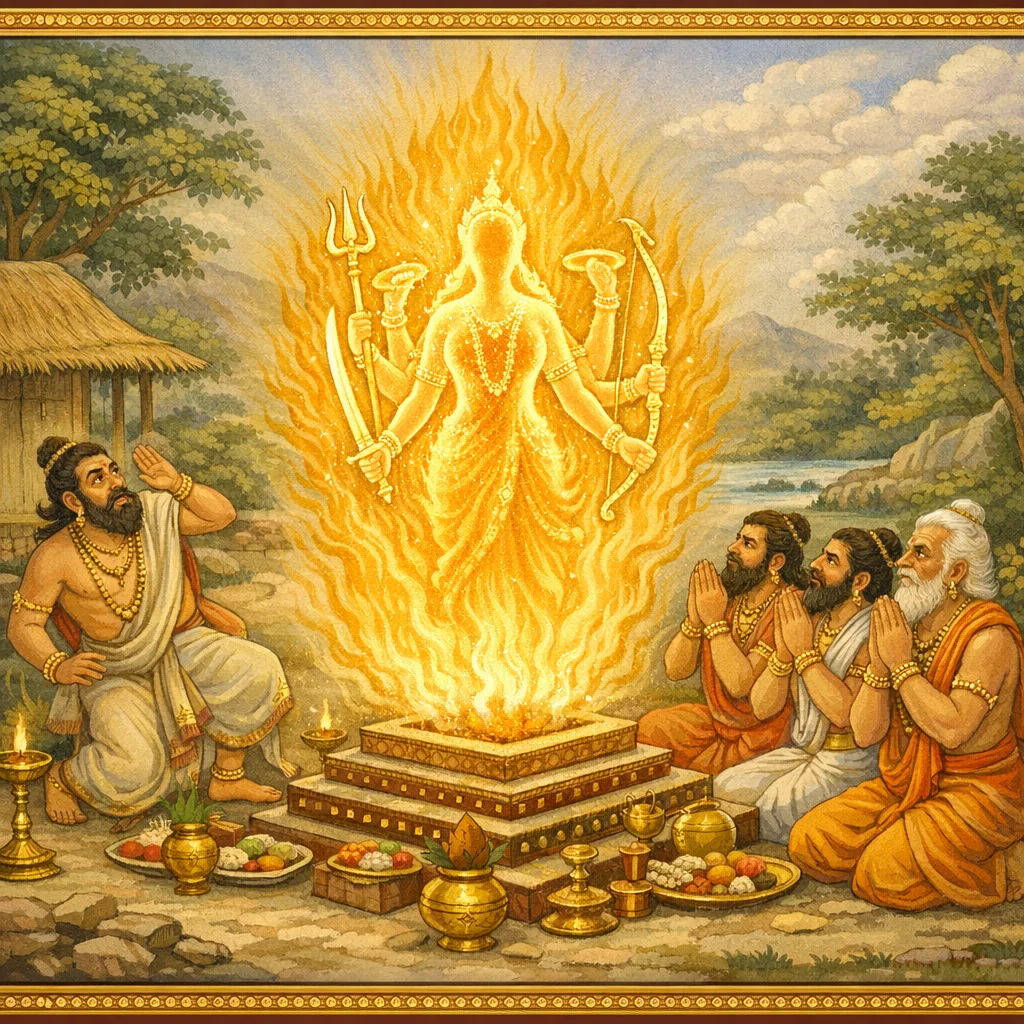
Īśvara narrates to Devī the origin of a goddess connected with a particular sacred spot in Prabhāsa, identified through directional markers. On a sanctified riverbank, eminent ṛṣis assemble to perform an elaborate Vedic yajña amid resonant Vedic recitation, ritual music, incense, offerings, and learned officiants. Powerful daityas, skilled in illusion, arise to disrupt the sacrifice, spreading panic and scattering the participants. An adhvaryu remains steady, safeguards the rite, and offers a protective oblation; from that consecrated act a radiant Śakti manifests, armed and formidable, destroys the disturbers, and restores ritual order. The sages praise the goddess, and she grants a boon. They ask her to dwell there forever for the welfare of ascetics and the continuance of sacrifice; thus she receives the name Kaṇṭakaśoṣiṇī, “she who dries up thorns/afflictions,” as one who neutralizes harmful forces. The chapter ends with a worship guideline for the 8th or 9th lunar day and a phalaśruti promising freedom from fear of rākṣasas and piśācas and the attainment of supreme siddhi.
Shlokas
Verse 1
ईश्वर उवाच । ततो गच्छेन्महादेवि देवीं कंटकशोषिणीम् । उत्तरेण देवकुलाद्दक्षिणेनोन्नतात्स्थितात्
Īśvara said: “Then, O great goddess, one should go to the Goddess Kaṇṭakaśoṣiṇī. She is situated to the north of Devakula and to the south of the place called Unnata.”
Verse 2
तस्योत्पत्तिं प्रवक्ष्यामि शृणु ह्येकमनाः प्रिये । उन्नताद्दक्षिणे भागे यजंते द्विजसत्तमाः
“I shall explain her origin—listen with single-minded attention, O beloved. To the southern side of Unnata, the best of the twice-born perform sacrifices (yajña).”
Verse 3
भृगुरत्रिर्मरीचिश्च भरद्वाजोऽथ कश्यपः । कण्वो मंकिश्च सावर्णिर्जातूकर्ण्यस्तथैव च
“Bhṛgu, Atri, and Marīci; Bharadvāja and also Kaśyapa; Kaṇva, Maṃki, Sāvarṇi, and likewise Jātūkarṇya—”
Verse 4
वत्सश्चैव वसिष्ठश्च पुलस्त्यः पुलहः क्रतुः । मनुर्यमोंऽगिरा विष्णुः शातातपपराशरौ
And Vatsa and Vasiṣṭha; Pulastya, Pulaha, and Kratu; Manu, Yama, Aṅgiras, Viṣṇu, and also Śātātapa and Parāśara—
Verse 5
शांडिल्यः कौशिकश्चैव गौतमो गार्ग्य एव च । दाल्भ्यश्च शौनकश्चैव शाकल्यो गालवस्तथा
Śāṇḍilya and Kauśika; Gautama and also Gārgya; Dālbhya and Śaunaka; Śākalya, and likewise Gālava—
Verse 6
जाबालिर्मुद्गलश्चैव ऋष्यशृंगो विभांडकः । विश्वामित्रः शतानंदो जह्नुर्विश्वावसुस्तथा
Jābāli and Mudgala; Ṛṣyaśṛṅga and Vibhāṇḍaka; Viśvāmitra, Śatānanda, Jahnu, and likewise Viśvāvasu—
Verse 7
एते चान्ये च मुनयो यजंते विविधैर्मखैः । यज्ञवाटं च निर्माय ऋषितोयातटे शुभे
These sages—and others as well—perform sacrifices of many kinds. Having constructed a sacrificial enclosure, they worship on the auspicious bank of the river called Ṛṣitoyā.
Verse 8
देवगन्धर्वनृत्यैश्च वेणुवीणानिनादितम् । वेदध्वनितघोषेण यज्ञहोमाग्निहोत्रजैः
It resounded with dances of gods and Gandharvas, and with the sounds of flute and vīṇā; with the reverberation of Vedic recitation, and with the rites born of sacrifice—oblations, homa, and the daily agnihotra.
Verse 9
धूपैः समावृतं सर्वमाज्यगंधिभिरर्चितम् । शोभितं मुनिभिर्दिव्यैश्चातुर्वेद्यैर्द्विजोत्तमैः
All of it was enveloped in incense, worshipped with the fragrant scent of ghee; and it was adorned by divine sages—excellent twice-born, masters of the four Vedas.
Verse 10
एवंविधं प्रदेशं तु दृष्ट्वा दैत्या महाबलाः । समुद्रमध्यादायाता यज्ञविध्वंसहेतवे
Seeing such a place, mighty Daityas came forth from the midst of the ocean, intending to bring about the destruction of the sacrifice.
Verse 11
मायाविनो महाकायाः श्यामवर्णा महोदराः । लंबभ्रूश्मश्रुनासाग्रा रक्ताक्षा रक्तमूर्धजाः
They were sorcerous beings—huge of body, dark in hue, and pot-bellied; with drooping brows, heavy moustaches, and prominent noses, with red eyes and hair of a ruddy color.
Verse 12
यज्ञं समागताः सर्वे दैत्याश्चैव वरानने । तान्दृष्ट्वा मुनयः सर्वे रौद्ररूपान्भयंकरान्
O fair-faced Goddess, all those Daityas came to the sacrifice; and seeing them—terrible, wrathful in form—the sages were struck with fear.
Verse 13
केचिन्निपतिता भूमौ तथान्ये ऽग्नौ स्रुचीकराः । पत्नीशालां समाविष्टा हविर्धानं तथा परे
Some fell down upon the ground; others rushed toward the fire, seizing the ladles. Some entered the hall of the officiants’ wives, and others forced their way into the store of oblations.
Verse 14
ऋत्विजस्तु सदोमध्ये स्थिता वाचंयमास्तथा
And the priests stood in the midst of the sadas (sacrificial hall), restraining their speech, composed and silent.
Verse 15
एवं देवि यदा वृत्तं मुनीनां च महात्मनाम् । तदाध्वर्युर्महातेजा धैर्यमालम्ब्य सादरः
Thus, O Goddess, when this had occurred to the sages and great souls, then the Adhvaryu—radiant with great splendor—steadfastly took hold of courage and acted with reverent resolve.
Verse 16
अग्निहोत्रं हविष्यं च हविर्विन्यस्य मन्त्रवित् । सुसमिद्धं जुहावाग्निं रक्षसां नाशहेतवे
The knower of mantras arranged the agnihotra and the oblation; and into the well-kindled fire he poured offerings, as the very means for the destruction of the rākṣasas.
Verse 17
हुते हविषि देवेशि तत्क्षणादेव चोत्थिता । शक्तिः शक्तित्रिशूलाढ्या चर्महस्ता महोज्ज्वला
O Goddess, when the oblation had been offered, at that very instant Śakti arose—resplendent—bearing a spear and trident, with a hide held in her hand, blazing with great radiance.
Verse 18
तया ते निहता दैत्या यज्ञविध्वंसकारिणः । ततस्तां विविधैः स्तोत्रैर्मुनयस्तुष्टुवुस्तदा
By her those Daityas—destroyers of the sacrificial rite—were slain. Thereupon the sages praised her at once with many kinds of hymns.
Verse 19
प्रसन्ना भूयसी देवी तानृषीन्प्रत्युवाच ह । वरं वृणुध्वं मुनयो दास्यामि वरमुत्तमम्
Greatly pleased, the Goddess spoke to those sages: “Choose a boon, O munis; I shall grant you an excellent boon.”
Verse 20
ऋषय ऊचुः । कृतं वै सकलं कार्यं यज्ञा नो रक्षितास्त्वया । यदि देयो वरोऽस्माकं त्वया चासुरमर्द्दिनि
The sages said: “Indeed, all that needed to be done has been accomplished; our sacrifices have been protected by you. If a boon is to be granted to us by you, O slayer of the asuras…”
Verse 21
अस्मिन्स्थाने सदा तिष्ठ मुनीनां हितकाम्यया । कंटकाः शोषिता दैत्यास्तेन कंटकशोषिणी । अद्यप्रभृति नामास्तु तेन देवि सदा त्विह
“Abide forever in this place, O Goddess, out of a wish to benefit the sages. Since the demons—those ‘thorns’—have been dried up (destroyed) by you, therefore let your name here be ‘Kaṇṭakaśoṣiṇī’ (She Who Dries Up the Thorns). From this day onward, O Devi, let that be your name, and remain here always.”
Verse 22
ईश्वर उवाच । एवं भविष्यतीत्युक्त्वा सा देव्यन्तर्हिता तदा । अष्टम्यां वा नवम्यां वा पूजयिष्यति मा नवः
Īśvara said: “Having said, ‘So shall it be,’ the Goddess then disappeared from sight. On the eighth lunar day or on the ninth, a person will worship me (here).”
Verse 23
राक्षसेभ्यः पिशाचेभ्यो भयं तस्य न जायते । प्राप्नुयात्परमां सिद्धिं मानवो नात्र संशयः
Fear of rākṣasas and piśācas will not arise for that devotee. The person attains the highest accomplishment—of this there is no doubt.
Verse 317
इति श्रीस्कांदे महापुराण एकाशीतिसाहस्र्यां संहितायां सप्तमे प्रभासखण्डे प्रथमे प्रभासक्षेत्रमाहात्म्ये कंटकशोषणीमाहात्म्यवर्णनंनाम सप्तदशोत्तरत्रिशततमोऽध्यायः
Thus ends, in the Śrī Skanda Mahāpurāṇa—within the collection of eighty-one thousand verses—in the seventh, the Prabhāsa Khaṇḍa, and in the first division, the Prabhāsakṣetra Māhātmya, the chapter entitled “Description of the Greatness of Kaṇṭakaśoṣiṇī,” being Chapter 317.