Adhyaya 335
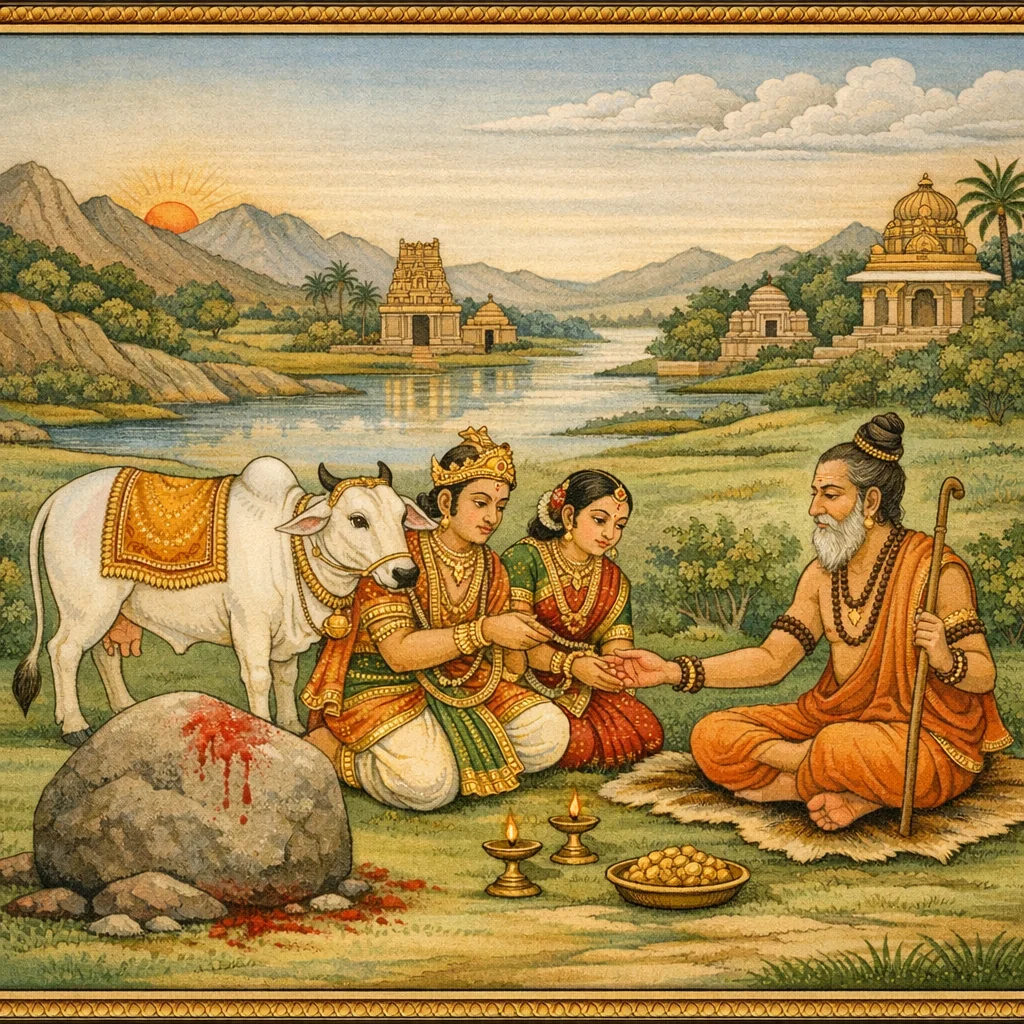
Chapter 335 records Īśvara’s geographically precise guidance to Devī: the pilgrim should go west to an auspicious bank of the Nyankumatī River, then proceed south to the “great” tīrtha called Śaṅkhāvartta. The place is marked by a distinctive image-bearing stone (citrāṅkitā śilā) linked to a self-manifest presence (svayaṃbhū) described as “red-wombed” (raktagarbhā); even after being “cut,” a visible redness remains, showing that sanctity endures in the very landscape. The chapter declares the site a Viṣṇu-kṣetra and connects its origin to an older episode in which Viṣṇu slays “Śaṅkha,” portrayed as a stealer of the Vedas (vedāpahārī). The water-body is said to be “śaṅkha-shaped,” giving a morphological explanation for the tīrtha’s name and authority. A phala statement follows: bathing here frees one from the burden of brahmahatyā, and even a Śūdra is said to attain successive births as a brāhmaṇa. The route then continues eastward to Rudragayā, where those seeking the full fruit of pilgrimage are instructed to perform cow-gifting (godāna), uniting purification, merit, and righteous giving in a single sacred itinerary.
Shlokas
Verse 1
ईश्वर उवाच । ततः पश्चिमतो गच्छेन्न्यंकुमत्यास्तटे शुभे । दक्षिणां दिशमाश्रित्य स्थितं तीर्थं महाप्रभम्
Īśvara said: Then one should go westward to the auspicious bank of the Nyaṃkumatī. Facing south, there stands a tīrtha of great radiance.
Verse 2
शंखावर्त्तमितिख्यातं यत्र चित्रांकिता शिला । स्वयंभूता महादेवि रक्तगर्भा सुशोभना
O Great Goddess, that place is renowned as Śaṃkhāvartta, where a stone is seen bearing wondrous marks. Self-manifest (svayambhū) and splendid, it holds within a red-hued core.
Verse 3
छिन्ने त्वद्यापि तत्रैव सुरक्तं संप्रदृश्यते । विष्णुक्षेत्रं हि तत्प्रोक्तं शंखो यत्र हतः पुरा
Even now, when it is cut, a bright-red hue is seen there itself. Indeed, that place is declared to be Viṣṇu’s sacred domain (kṣetra), where Śaṃkha was slain in ancient times.
Verse 4
वेदापहारी देवेशि विष्णुना प्रभविष्णुना । कृतं शखोदकं तीर्थं शंखाकारं तु दृश्यते
O Lady of the Lord, the Veda-stealing one was subdued by Viṣṇu, the mighty all-pervader. There the tīrtha called Śaṅkhodaka was established, and it is seen to be shaped like a conch (śaṅkha).
Verse 5
तत्र स्नात्वा नरो देवि मुच्यते ब्रह्महत्यया । सप्त जन्मानि विप्रत्वं शूद्रस्यापि प्रजा यते
O Goddess, one who bathes there is released from the sin of brahma-hatyā. Even if born a śūdra, one attains brahminhood for seven births.
Verse 6
पूर्वं तत्रैव गत्वा च ततो रुद्रगयां व्रजेत् । गोदानं तत्र देयं तु सम्यग्यात्राफलेप्सुभिः
Having first gone there, one should then proceed to Rudragayā. Those who seek the full fruit of pilgrimage should certainly give the gift of a cow there.
Verse 335
इति श्रीस्कान्दे महापुराण एकाशीतिसाहस्र्यां संहितायां सप्तमे प्रभासखण्डे प्रथमे प्रभासक्षेत्रमाहात्म्ये शंखावर्त्ततीर्थमाहात्म्यवर्णनंनाम पञ्चत्रिंशदुत्तरत्रिशत तमोऽध्यायः
Thus ends, in the Śrī Skanda Mahāpurāṇa, in the collection of eighty-one thousand verses, in the seventh book called the Prabhāsa Khaṇḍa, within the first Prabhāsakṣetra Māhātmya, the chapter entitled “Description of the Greatness of Śaṃkhāvartta Tīrtha,” being Chapter 335.