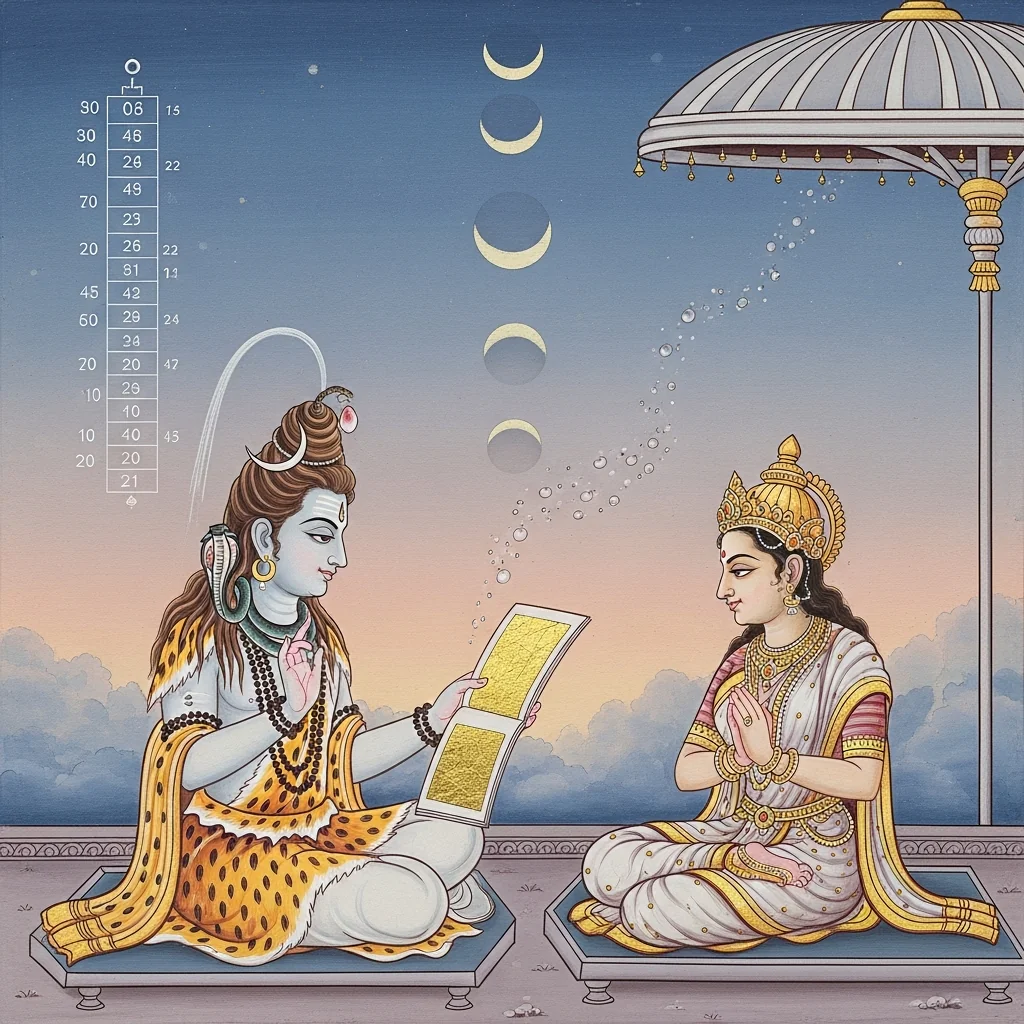
Adhyaya 19
Chapter 19 unfolds as a technical dialogue: Devī asks why the moon is not always full, and Īśvara explains the sixteenfold structure of time and lunar phases, from amā (new moon) to pūrṇimā (full moon), as the ṣoḍaśa kalā/tithi divisions. In this way, ritual timing is aligned with the cosmic rhythm. Īśvara then sets out a graded system of time-measures—from truṭi, lava, nimeṣa, kāṣṭhā, kalā, and muhūrta, up through day and night, fortnight, month, ayana, year, yuga, manvantara, and kalpa—showing the continuity between sacred observance and vast cosmic duration. He places these measures within a metaphysical teaching in which māyā/śakti is the operative power enabling creation, maintenance, and dissolution, and affirms the cyclic return of all that arises to its source. The discourse turns to Devī’s question about Soma’s lāñchana (mark) despite his amṛta-origin and devotional honor. Īśvara attributes the mark to Dakṣa’s curse and frames it within immense cosmological recurrence: countless moons, brahmāṇḍas, and kalpas arise and dissolve, while the supreme Īśvara alone is singular as the governor of sarga and saṃhāra. The latter portion lists temporal placements across kalpas and manvantaras, recalls earlier manifestations, and sketches the sequence of Viṣṇu’s avatāras—including Kalki as a future corrective force—within the logic of dharma’s restoration through cosmic time.
Shlokas
Verse 1
देव्युवाच । यद्येवं सकलश्चंद्रः कथं न विधृतस्त्वया । अन्तभावे कलानां तत्कारणं कथय प्रभो
Devī said: If this is so—if the Moon is complete—why did you not hold him in his fullness? Tell me, O Lord, the reason for the disappearance (waning) of his digits, his kalās.
Verse 2
ईश्वर उवाच । अमा षोडशभेदेन देवि प्रोक्ता महाकला । संस्थिता परमा माया देहिनां देह धारिणी
Īśvara said: O Devī, Amā is declared to be the Great Kalā, differentiated in sixteen ways. She abides as the supreme Māyā, upholding embodied beings by sustaining their very bodies.
Verse 3
अमादिपौर्णमास्यंता या एव शशिनः कलाः । तिथयस्ताः समाख्याताः षोडशैव प्रकीर्तिताः
From Amā (new moon) up to the full-moon end—those very phases of the Moon are called “tithis”; they are proclaimed to be precisely sixteen.
Verse 4
अमा सूक्ष्मा परा शक्तिः सा त्वं देवि प्रकीर्तिता । प्रलयोत्पत्तियोगेन स्थिताः कालक्रमोदिताः
Amā is subtle, the supreme Power; and that Power is proclaimed to be you, O Devī. Through the linkage of dissolution and creation, the measures of time stand forth, arising in their proper sequence.
Verse 5
षोडशैव स्वरा ये तु आद्याः सृष्टयंतकाः प्रिये । कालस्यावयवास्ते च विज्ञेयाः कालवेदिभिः
O beloved, those sixteen primordial sounds (svaras) that begin creation and bring it to completion—let the knowers of Time understand them as the very limbs of Time.
Verse 6
त्रुटिर्लवो निमेषश्च कला काष्ठा मुहूर्तकम् । रात्र्यहःपक्षमासाश्च अयनं वत्सरं युगम्
Truṭi, lava, nimeṣa, kalā, kāṣṭhā, and muhūrta; then night and day, fortnight and month; then ayana (half-year), year, and yuga—these are the gradations of time.
Verse 7
मन्वतरं तथा कल्पं महाकल्पं च षोडश । कला विसर्जनी या तु जीवमाश्रित्य वर्तते
There are manvantaras, kalpas, and the great kalpa, and again the sixteenfold scheme. That kalā called “Visarjanī” operates by taking the jīva (individual soul) as her support.
Verse 9
सा सृजत्यखिलं विश्वं विषुवद्वयसंयुतम् । तथा संवरणी या तु विश्वं संहरते प्रिये । नेत्रपाताच्चतुर्भागस्त्रुटिकालो निगद्यते । तस्माच्च द्विगुणं विद्धि निमिषं तन्महेश्वरि
She creates the entire universe together with the two equinoxes; and likewise, the kalā called “Saṃvaraṇī” withdraws the universe, O beloved. A truṭi is said to be a quarter of the time of a blink; and know, O Maheśvarī, that a nimeṣa is twice that.
Verse 10
निमिषैस्त्रिंशद्भिः काष्ठा ताभिर्विंशतिभिः कला । विंशतिकलो मुहूर्तः स्याद्दिनं पंचदशैस्तु तैः
Thirty nimeṣas make one kāṣṭhā; twenty kāṣṭhās make one kalā. Twenty kalās make one muhūrta; and fifteen such muhūrtas constitute a day.
Verse 11
दिनमाना निशा ज्ञेया अहोरात्रं द्वयाद्भवेत् । तैः पंचदशभिः पक्षो द्विपक्षो मास उच्यते
Night is to be understood as equal in measure to day; from that pair arises the complete day-and-night (ahorātra). With fifteen days there is a fortnight (pakṣa), and two fortnights are called a month.
Verse 12
मासैश्चैवायनं षड्भिर्वर्षं स्यादयनद्वये । चत्वारिंशच्च लक्षाणि लक्षाणां त्रितयं पुनः
With six months there is an ayana (half-year); with two ayanas a year comes to be. Then are spoken of forty lakṣas, and again three “lakṣas of lakṣas”.
Verse 13
विंशतिश्च सहस्राणि ज्ञेयं सौरं चतुर्युगम् । चतुर्युगैकसप्तत्या मन्वंतरमुदाहृतम्
Know that a Caturyuga, measured in solar years, is twenty thousand (units); and a Manvantara is declared to consist of seventy-one such Caturyugas.
Verse 14
ऐंद्रमेतद्भवेदायुः समासांतं च कीर्तितम् । चतुर्दशेन्द्रैः प्रलीनैः कल्पं ब्रह्मदिनं भवेत्
This is said to be the life-span of an Indra, described up to its completion in years; and when fourteen Indras have passed away, that period becomes a Kalpa—the “day of Brahmā”.
Verse 15
रात्रिश्च तावती चैव चतुर्युगसहस्रिका । अनेन दिनमानेन शताब्दं जीवति प्रिये
And the night is of the same measure, consisting of a thousand Caturyugas. By this measure of day, O beloved, (Brahmā) lives for a hundred years.
Verse 16
ममैव निमिषार्द्धेन सहस्राणि चतुर्द्दश । विनश्यंति ततो विष्णोरसंख्याताः पितामहाः
In but half a wink of Mine, fourteen thousand such cycles perish; and beyond that, countless ‘grandfathers’—the Brahmās of Viṣṇu—also pass away.
Verse 17
एवं क्रमेण देवेशि समुत्पन्नमिदं जगत् । शशिसूर्यविभागेन चित्ररूपमनंतकम्
Thus, step by step, O Goddess of the Lord, this world has arisen—endless and manifold in form—through the differentiations of Moon and Sun.
Verse 18
कला देवि यदाद्यंतमनादिमजमव्ययम् । तदान्वितः शशी तस्यामधोमुखमवस्थितः
O Devī, the ‘Kalā’ is that which has beginning and end, while (the Supreme) is beginningless, unborn, and undecaying. Associated with that Kalā, the Moon is stationed there with its face turned downward.
Verse 19
एवं क्षयोदयं ज्ञेयं चंद्रार्काभ्यामवस्थितम् । सृष्टिक्रमं मया प्रोक्तं संहारमधुना शृणु
Thus should the waning and waxing be understood as established by the Moon and the Sun. I have explained the sequence of creation; now hear from me about dissolution.
Verse 21
अहोरात्रं मुहूर्तेन मुहूर्तं तु कलाहतम् । कलां काष्ठा हतां कृत्वा काष्ठां निमिषभाजिताम्
A day-and-night is reckoned by muhūrtas, and a muhūrta is divided into kalās. Dividing a kalā into kāṣṭhās, and a kāṣṭhā into nimīṣas—thus is time measured.
Verse 22
निमिषं च लवैर्हत्वा लवं त्रुटिविभाजितम् । तदतीतं प्रशांतं च निर्विकारमलक्षणम्
A nimīṣa is further divided into lavas, and a lava is divided into truṭis. Yet That which transcends these is serene—changeless and without defining marks.
Verse 23
तस्य चेयं परा माया कला शिरसि धारिता । सा शक्तिर्देवदेवस्य विश्वाकारा परा प्रिये । मोहयित्वा तु संतानं संसारयति पार्वति
Of That supreme reality, this is the higher Māyā—Kalā—borne upon its head. That supreme power of the God of gods, taking the form of the universe, O beloved, bewilders the offspring and makes them wander in saṃsāra, O Pārvatī.
Verse 24
एवमेतज्जगद्देवि उत्पत्तिस्थितिलक्षणम् । यत्रैवोत्पद्यते कृत्स्नं पुनस्तत्रैव लीयते
Thus, O Goddess, this entire universe is marked by creation and continuance: wherever it arises in full, into that very source it again dissolves.
Verse 25
सेयं मायामयी शक्तिः शुद्धाशुद्धस्वरूपिणी । चंद्ररूपा स्थिता सा तु तव देवि प्रकाशयेत्
This very Power, made of māyā and bearing both the pure and the impure as its modes, abides in the form of the Moon; indeed, O Goddess, it manifests for you.
Verse 26
देव्युवाच । पंचाग्निनोपसन्तप्ता वर्षकोटीरनेकधा । तत्तपः सफलं जातं मेऽद्य देव जगत्पते
The Goddess said: ‘Scorched by the discipline of the five fires for many crores of years in various ways—today, O God, Lord of the world, that austerity of mine has borne fruit.’
Verse 27
सृष्टियोगो मया ज्ञातः संहारश्च महेश्वर । चन्द्रोत्पत्तिस्वरूपं च कलामानं तथैव च
O Maheśvara, I have understood the method of creation and also dissolution, as well as the nature of the Moon’s origin—and likewise the measure of its phases.
Verse 28
अधुना मम देवेश सन्देहो हृदि संस्थितः । कौतूहलं परं देव कथयस्व महेश्वर
Now, O Lord of gods, a doubt has settled in my heart. O God—my curiosity is great; tell me, O Maheśvara.
Verse 29
अमृतादेव संभूतः सर्वाह्लादकरः शशी । प्रियश्च तव देवेश वल्लभश्चंद्रमास्तथा
The Moon, born indeed from nectar, brings delight to all. O Lord of gods, Candramā is dear to you—indeed, your beloved.
Verse 31
सर्वौषधीनामधिपः पितॄणां प्रीणनं परम् । तदाश्रयश्च त्वद्भक्तस्त्व त्सेवातत्परः शशी
He is the lord of all healing herbs, and the supreme satisfier of the Pitṛs. Depending upon that divine order, the Moon is your devotee, wholly intent on your service.
Verse 32
तथापि सकलंकोऽयं कौतुकं कुरुते मम । देवि ब्रह्मांडसंघट्टमालामंडितशेखरः
Yet even so, this ‘marked one’ arouses my wonder—O Goddess—he whose crest is adorned with a garland formed from the collision of cosmic spheres.
Verse 33
शीर्षे तव निविष्टस्य कष्टं चंद्रस्य चेद्यदि । तर्हि नाथ न शोच्या वै संसारे दुःखभागिनः
If even the Moon, enthroned upon your head, must endure hardship, then, O Lord, surely none in this world who share in sorrow are to be pitied.
Verse 34
न चास्ति त्रिषु लोकेषु न चैतत्संभविष्यति । यत्र शक्तो भवत्कर्तुं दुःखस्यास्य च संक्षयम्
There is none in the three worlds—and there never will be—who is able to bring about the ending of this suffering.
Verse 35
सर्वेषां वर्तते शंका यथा मम महेश्वर । उत्पन्नं कारणं किंतद्येन सोमस्य लांछनम्
O Maheśvara, a doubt arises in everyone—just as it arises in me: what was the cause that produced the blemish-mark upon Soma, the Moon?
Verse 36
किमेतत्कारणं देव कथयस्व महेश्वर । अमृते संभवो यस्य कथं तस्यापि लांछनम्
O God, O Maheśvara—tell me, what is this cause? If his origin is from amṛta, the nectar of immortality, how could even he bear a blemish?
Verse 37
प्रियश्च तव देवेश लांछनं चापि तिष्ठति । कौतूहलं परं देव तत्त्वं मे वक्तुमर्हसि
O Deveśa, though Soma is dear to you, the blemish still remains. My curiosity is great, O Deva—please declare to me the true principle behind it.
Verse 38
एवमुक्तः स पार्वत्या देवदेवो महेश्वरः । उवाच परमप्रीतः प्रेम्णा शैलसुतां प्रभुः
Thus addressed by Pārvatī, Maheśvara—the God of gods—spoke. The Lord, greatly pleased, replied with affection to the Daughter of the Mountain.
Verse 39
ईश्वर उवाच । किं ते देवि महाशंकाद्योत्पन्ना वरवर्णिनि । ममोपरि न कर्त्तव्या निरुद्विग्ना भव प्रिये । पितुस्तव प्रभावेन लांछनं शशिनोऽभवत्
Īśvara said: “O Devī, fair-hued one, why has such a great doubt arisen in you? Do not cast suspicion upon me; be at ease, beloved. By the power of your father, the Moon came to bear this blemish.”
Verse 40
भावित्वात्कर्मणो देवि दक्षस्याज्ञाव्यतिक्रमात् । समं वर्त्तस्व भार्याभिरित्युक्तः शशलांछनः
“O Devī, as destined karma came to fruition—and through transgressing Dakṣa’s command—the Moon, ‘marked with the hare’, was told: ‘Live equally with your wives.’”
Verse 41
तद्वाक्यमन्यथा चक्रे ततः शप्तः शशी प्रिये । इदं पृष्टं तु यद्देवि त्वया लांछनकारणम्
“Beloved, the Moon acted otherwise than those words; therefore Śaśī was cursed. And this, O Devī, is what you asked me—the cause of the Moon’s blemish.”
Verse 42
कल्पेकल्पे पृथग्भावं कारणैरस्ति भामिनि । असंख्यातं च तद्वक्तुं शक्यं नैव मया प्रिये
“O radiant one, in each and every kalpa the situation differs, with differing causes. And since they are countless, beloved, it is not possible for me to recount them all.”
Verse 43
असंख्येयाश्चन्द्रमसः संभवंति पुनःपुनः । विनश्यंति च देवेशि सर्वमन्वन्तरान्तरम्
O Deveśī, countless moons arise again and again, and they too perish—so does everything, from one manvantara to the next.
Verse 44
असंख्याताश्च कल्पाख्या असंख्याताः पितामहाः । हरयश्चाप्यसंख्याता एक एव महेश्वरः
Countless are the cycles called kalpas; countless are the Pitāmahas (Brahmās); countless too are the Haris (Viṣṇus)—yet Maheśvara is one alone.
Verse 45
कोटिकोट्ययुतान्यत्र ब्रह्माण्डानि मम प्रिये । जलबुद्बुदवद्देवि संजातानि तु लीलया
O beloved Goddess, here countless crores upon crores of universes arise—O Devī—like bubbles upon water, brought forth effortlessly as a mere divine play (līlā).
Verse 46
तत्रतत्र चतुर्वक्त्रा ब्रह्माणो हरयो भवाः । सृष्टाः प्रधानेन तदा लब्धा शंभोस्तु संनिधिः
Here and there, four-faced Brahmās, Haris (Viṣṇus), and Bhavas (Rudras) are produced through Pradhāna (primordial nature); yet in every such realm, the nearness of Śambhu is attained as the indwelling presence.
Verse 47
लयं चैव तथान्योन्यमाद्यंतं प्रकरोति च । सर्गसंहारसंस्थानां कर्त्ता देवो महेश्वरः
He brings about dissolution (laya) as well, and the mutual interweaving of beginnings and ends; for of creation, destruction, and the ordering of worlds, the doer is the god Maheśvara.
Verse 48
सर्गे च रजसा पृक्तः सत्त्वस्थः परिपालने । प्रतिसर्गे तमोयुक्तः सोऽहं देवि त्रिधा स्थितः
In creation I am joined with rajas; in protection I abide in sattva; and in re-creation and withdrawal I am united with tamas—thus, O Devī, I stand in a threefold manner.
Verse 49
तस्मान्माहेश्वरो ब्रह्मा ब्रह्मणोऽधिपतिः शिवः । सदाशिवो भवेद्विष्णुर्ब्रह्मा सर्वात्मको ह्यतः
Therefore, Brahmā is Māheśvara in nature, and Śiva is the overlord even of Brahmā. Sadāśiva becomes Viṣṇu; thus Brahmā, too, is pervaded by the Self of all—the one Supreme.
Verse 50
स एव भगवान्रुद्रो विष्णुर्विश्व जगत्प्रभुः । अस्मिन्नण्डे त्विमेलोका अन्तर्विश्वमिदंजगत्
That very Blessed Lord is Rudra; He is also Viṣṇu, the sovereign of the universe and the worlds. Within this cosmic egg are these realms; within it is contained this entire inner universe.
Verse 51
चन्द्रसूर्यग्रहा देवि ब्रह्माण्डेऽस्मिन्मनस्विनि । संख्यातुं नैव शक्यन्ते ये भविष्यंति ये गताः
O Devī, O strong-minded one, in this brahmāṇḍa the moons, suns, and planets cannot be counted—those that have passed and those that are yet to come.
Verse 52
अस्मिन्वाराहकल्पे तु वर्तमाने मनस्विनि । षडतीता महादेवि रोहिणीपतयः पुरा
In this present Vārāha-kalpa, O wise one, O Mahādevī, formerly six lords of Rohiṇī have already passed.
Verse 53
सप्तमोऽयं महादेवि वर्ततेऽमृतसंभवः । दक्षशापेन यो देवि संक्षीणो दृश्यतेऽधुना
O Mahādevī, this is the seventh—the Moon, born of nectar, now continues in his course; and by Dakṣa’s curse, O Devī, he is seen at present as waning.
Verse 54
अथ द्वितीये संप्राप्ते परार्द्धे चैव वेधसः । तस्य त्रिंशत्तिमे कल्पे पितृ कल्पेति विश्रुते
Then, when the second parārdha of Brahmā (Vedhas) had arrived, in his thirtieth kalpa—renowned as the Pitṛ-kalpa—these reckonings of time are spoken.
Verse 55
स्वायंभुवेंऽतरे प्राप्ते तस्यादौ त्वं सती किल । तस्मिन्काले महादेवि योभूद्दक्षः पिता तव
When the Svāyambhuva Manvantara arrived, at its very beginning you indeed became Satī. At that time, O Great Goddess, Dakṣa was born as your father.
Verse 56
प्राणात्प्रजापतेर्जन्म तस्य दक्षस्य कीर्तितम् । अस्मिन्मन्वन्तरे देवि दक्षः प्राचेतसोऽभवत्
It is recounted that Dakṣa was born from the life-breath (prāṇa) of Prajāpati. And in this Manvantara, O Goddess, Dakṣa became known as Prācetasa.
Verse 57
अंगुष्ठाद्दक्षिणाद्दक्षो भविष्यत्यधुना प्रिये । युगेयुगे भवन्त्येते सर्वे दक्षादयो द्विजाः
O beloved, from the right thumb Dakṣa will now come into being. In every age, all these—Dakṣa and the others—are born again and again as dvija, the twice-born sages.
Verse 58
पुनश्चैव विनश्यन्ति विद्वांस्तत्र न मुह्यति । तस्यापमानात्त्वं देवि देहं तत्यक्थ वै पुरा
And again they pass away; the wise are not deluded by this. Because of his insult, O Goddess, you once indeed abandoned your body.
Verse 59
तावद्वियुक्तोऽहं देवि त्वया मुक्तोऽभवं पुरा । यावद्वराहकल्पस्य चाक्षुषस्यान्तरं प्रिये
For that long, O Goddess, I was separated from you; formerly I was bereft of you—until the Cākṣuṣa Manvantara of the Varāha Kalpa, O beloved.
Verse 60
एकविंशो मनुश्चायं कल्पे वाराहसंज्ञके । कल्पेकल्पे महादेवि भवेन्नामान्तरं तव
In this Varāha-named Kalpa, this Manu is the twenty-first. And in each and every Kalpa, O Great Goddess, your name becomes different.
Verse 61
अस्मिन्कल्पे तु वाराहे हिमवत्तपसार्ज्जिते । संभूता पार्वती देवि चाक्षुषस्यांतरे गते
But in this Varāha Kalpa—won through the austerities of Himavat—you were born as Pārvatī, O Goddess, after the Cākṣuṣa Manvantara had passed.
Verse 62
ब्रह्मणो दिनमेकं तु षण्मासेन तवावधिः । त्वं वियुक्ता मया सार्द्धं दक्षकोपेन भामिनि
One day of Brahmā amounts to six months by your measure. O passionate one, because of Dakṣa’s anger you were separated from me as well.
Verse 63
तव क्रोधेन ये शप्ता ऋषयो वै मया पुरा । तेऽपि देवि त्वया सार्द्धं जाता वैवस्वतेंतरे
O Goddess, the sages whom I once cursed because of your anger were also born again together with you in the Vaivasvata Manvantara.
Verse 64
भृगुरंगिरा मरीचिस्तु पुलस्त्यः पुलहः क्रतुः । अत्रिश्चैव वसिष्ठश्च अष्टौ ते ब्रह्मणः सुताः
Bhṛgu, Aṅgiras, Marīci, Pulastya, Pulaha, Kratu, Atri, and Vasiṣṭha—these eight are the sons of Brahmā.
Verse 65
दक्षस्य यज्ञे ते शप्ताः पूर्वं स्वायंभुवेन्तरे । जाता देवि पुनस्ते वै कल्पेस्मिंश्चाक्षुषे गते
At Dakṣa’s sacrifice they were formerly cursed in the Svāyambhuva Manvantara; yet, O Goddess, they were indeed born again in this very Kalpa, after the Cākṣuṣa Manvantara had passed.
Verse 66
देवस्य महतो यज्ञे वारुणीं बिभ्रतस्तनुम् । ब्रह्मणो जुह्वतः शुक्रमग्नौ पूर्वं प्रजेप्सया
Formerly, at the great sacrifice of the mighty God, while (one) bore the form of Vāruṇī, Brahmā—desiring progeny—offered his seed into the fire.
Verse 67
ऋषयो जज्ञिरे पूर्वं सूर्यबिंबसमप्रभाः । पितुस्तव समीपं ते वरणाय तव प्रिये । प्रस्थापिता मया पूर्वं तत्त्वं जानासि सुव्रते
Formerly, sages were born, radiant like the orb of the sun. Beloved, I once sent them to your father to seek you in marriage. You know this truth, O you of excellent vows.
Verse 68
अथ किं बहुनोक्तेन वच्मि ते प्रश्नमुत्तमम् । द्वितीये तु परार्द्धेऽस्मिन्वर्त्तमाने च वेधसः
What is the use of speaking at length? I shall tell you the highest matter you have asked. In this present second half of Brahmā’s lifespan, as this cosmic era unfolds…
Verse 69
श्वेतकल्पात्समारभ्य यावद्वाराहगोचरम् । समतीताश्च ये चन्द्रास्ताञ्छृणुष्व वरानने
From the Śveta Kalpa onward, up to the range of the Vārāha (Kalpa), listen, O fair-faced one, to the moons—the lunar months and cycles—that have wholly passed.
Verse 70
चतुःशतानि देवेशि षड्विंशत्यधिकानि तु । गतानि शीतरश्मीनां सप्तविंशोऽधुना प्रिये
O Lady of the gods, four hundred and twenty-six cycles of the cool-rayed Moon have passed; now, beloved, the twenty-seventh is in progress.
Verse 71
वैवस्वतेंऽतरे प्राप्ते यश्चायं वर्ततेऽधुना । त्रेतायुगे तु दशमे दत्तात्रेयपुरःसरः
When the Vaivasvata Manvantara arrived—this very one now in progress—then, in the tenth Tretā-yuga, with Dattātreya going before as the leader…
Verse 72
संजातो रोहिणीनाथो योऽधुना वर्त्तते प्रिये । तस्योत्पत्तिप्रसंगेन विष्णोर्मानुषसंभवान्
Beloved, the lord of Rohiṇī—the Moon who exists now—has been born; and in connection with the account of his birth, I shall speak of Viṣṇu’s incarnations that arise in human form.
Verse 73
देहावतारान्वक्ष्यामि प्रारंभात्प्रथमान्प्रिये । पञ्चमः पंचदश्यां स त्रेतायां तु बभूव ह
Beloved, I shall recount the embodied descents (avatāras) from the very beginning, the earliest of them. The fifth occurred in the fifteenth count, and truly it took place in the Tretā age.
Verse 74
मांधाता चक्रवर्त्तित्वे तस्योतथ्यपुरःसरः । एकोनविंशत्रेतायां सर्वक्षत्रांतकोऽभवत्
Māndhātṛ attained imperial sovereignty as a cakravartin, with Utathya going before him as guide. In the nineteenth Tretā cycle, the destroyer of all kṣatriyas came to be.
Verse 75
जामदग्न्यस्तथा षष्ठो विश्वामित्रपुरःसरः । चतुर्विंशे युगे रामो वसिष्ठेन पुरोधसा
The sixth incarnation was Jāmadagnya (Paraśurāma), with Viśvāmitra at the forefront. In the twenty-fourth yuga, Rāma was born, with Vasiṣṭha serving as his royal priest.
Verse 76
सप्तमो रावणस्यार्थे जज्ञे दशरथात्मजः । अष्टमे द्वापरे विष्णुरष्टाविंशे पराशरात्
The seventh incarnation was born as Daśaratha’s son for the sake of destroying Rāvaṇa. In the eighth Dvāpara, Viṣṇu was born as the twenty-eighth manifestation, from Parāśara.
Verse 77
वेदव्यासस्ततो जज्ञे जातूकर्ण्यपुरःसरः । तत्रैव नवमो विष्णुरदितेः कश्यपात्मजः
Then Vedavyāsa was born, with Jātūkarṇya at the forefront. There itself, the ninth manifestation of Viṣṇu was born as Aditi’s child—Kāśyapa’s son.
Verse 78
देवक्यां वसुदेवात्तु ब्रह्मगर्गपुरःसरः । एकविंशतमस्यास्य द्वापरस्यांशसंक्षये । नष्टे धर्मे तदा जज्ञे विष्णुर्वृष्णिकुले स्वयम्
In Devakī, from Vasudeva, He was born, with Brahmā and Garga as the foremost witnesses and authorities. When this twenty-first Dvāpara had exhausted its allotted portion and dharma had waned, then Viṣṇu Himself was born in the Vṛṣṇi clan.
Verse 79
कर्तुं धर्मव्यवस्थानमसुराणां प्रणाशनः । पूर्वजन्मनि विष्णुः स प्रमतिर्नाम वीर्यवान्
To establish the order of dharma and to destroy the asuras—in a former birth, that very Viṣṇu was the mighty one named Pramati.
Verse 80
गोत्रेण वै चंद्रमसः संध्यामिश्रे भविष्यति । कल्किर्विष्णुयशानाम पाराशर्यप्रतापवान्
By lineage he will belong to the lunar gotra (Cāndramasa) and will arise in Saṃdhyāmiśra. He will be Kalki, the glorious one of Viṣṇuyaśā’s line, mighty with the splendor of Pārāśarya.
Verse 81
दशमो भाव्यसंभूतो याज्ञवल्क्यपुरःसरः । अनुकर्षश्च वै सेनां हस्त्यश्वरथसंकुलाम्
The tenth incarnation will arise in the future, with Yājñavalkya at the forefront; and he will draw along an army crowded with elephants, horses, and chariots.
Verse 82
प्रगृहीतायुधैर्विप्रैर्भृशं शतसहस्रशः । निःशेषाञ्छूद्रराज्ञस्तांस्तदा स तु करिष्यति
With brāhmaṇas who have taken up weapons—by the hundreds of thousands—he will then completely eliminate those Śūdra-kings, leaving none remaining.
Verse 83
पाखंडान्म्लेच्छजातींश्च दस्यूंश्चैव सहस्रशः । नात्यर्थं धार्मिका ये च ब्रह्मब्रह्मद्विषः क्वचित्
Heretics, barbarous tribes, and bandits—by the thousands—along with those who are not truly righteous, and, at times, those who hate Brahman and the brāhmaṇas.
Verse 84
प्रवृत्तचक्रो बलवाञ्च्छूराणामंतको बली । अदृश्यः सर्वभूतानां पृथिवीं विचरिष्यति
With his wheel (of power) set in motion, strong and mighty— a death-bringer to the wicked— unseen by all beings, he will roam the earth.
Verse 85
मानवस्य तु सोंऽशेन देवस्य भुवि वै प्रभुः । क्षपयित्वा तु तान्सर्वान्भाविनार्थेन नोदितान् । गंगायमुनयोर्मध्ये निष्ठां प्राप्स्यति सानुगः
That Lord—an earthly manifestation with a human portion of the Divine—will destroy all those who have been incited by the destiny of the coming age. Then, together with his followers, he will attain final establishment in the region between the Gaṅgā and the Yamunā.
Verse 86
ततो व्यतीते कल्कौ तु सामात्ये सहसैनिके । नृपेष्वपि च नष्टेषु तदात्वप्रहराः प्रजाः
Then, when Kalki has passed on—along with his ministers and his army—and when even the kings have perished, the people will become violent, striking one another in that time.
Verse 87
रक्षणे विनिवृत्ते च हत्वा चान्योन्यमाहवे । परस्परहतास्ताश्च निराक्रंदाः सुदुःखिताः
When protection and order have ceased, they will kill one another in battle. Slain by one another, they will lie without even a cry, overwhelmed by misery.
Verse 88
क्षीणे कलियुगे चास्मिन्दशवर्षसहस्रके । स संध्यांशे तु निःशेषे कृतं वै प्रतिपत्स्यति
When this Kali-yuga of ten thousand years is exhausted, and when its twilight-portion has wholly come to an end, then indeed the Kṛta-yuga will begin again.
Verse 89
यदा चंद्रश्च सूर्यश्च तथा तिष्यबृहस्पती । एकराशौ समेष्यंति प्रपत्स्यति तदा कृतम्
When the Moon and the Sun, and also Tiṣya together with Bṛhaspati, converge in a single zodiacal sign, then the Kṛta-yuga will set in.
Verse 90
अभिजिन्नाम नक्षत्रं जयंतीनाम शर्वरी । मुहूर्तो विजयो नाम यत्र जातो जनार्द्दनः
The nakṣatra was called Abhijit; the night was called Jayantī; the muhūrta was named Vijaya—at that very time Janārdana was born.
Verse 91
देव्युवाच । नोक्तं यथावदखिलं भृगुशापविचेष्टितम् । पूर्वावतारान्मे ब्रूहि नोक्तपूर्वान्महेश्वर
Devī said: “You have not yet explained in full, as is proper, the entire course of events arising from Bhṛgu’s curse. Tell me, O Maheśvara, of the earlier incarnations—those not previously narrated.”
Verse 92
ईश्वर उवाच । यदा तु पृथिवी व्याप्ता दानवैर्बलवत्तरैः । ततः प्रभृति शापेन भृगुनैमित्तिकेन ह
Īśvara said: “When the earth became overrun by mighty Dānavas, then—from that time onward, because of the curse occasioned by Bhṛgu—the divine course unfolded thus.”
Verse 93
जज्ञे पुनःपुनर्विष्णुः कर्त्तुं धर्मव्यवस्थितिम् । धर्मान्नारायणः साध्यः संभूतश्चाक्षुषेंतरे
Thus Viṣṇu was born again and again to re-establish the order of dharma. From Dharma, Nārāyaṇa—(as) Sādhya—manifested, and he arose in the Cākṣuṣa Manvantara.
Verse 94
यज्ञं प्रवर्तयामास स च वैवस्वतेंऽतरे । प्रादुर्भावे तदा तस्य ब्रह्मा चासीत्पुरोहितः
He set the sacrifice in motion, and this occurred in the Vaivasvata Manvantara. At that manifestation, Brahmā himself served as his officiating priest.
Verse 95
चतुर्थ्यां तु युगाख्यायामापन्नेषु सुरेष्विह । संभूतः स समुद्रात्तु हिरण्यकशिपोर्वधे
In the fourth age-cycle spoken of here, when the gods had fallen into distress, He arose from the ocean, for the slaying of Hiraṇyakaśipu.
Verse 96
द्वितीयो नरसिंहोऽभूद्रुद्रस्तस्य पुरःसरः । लोकेषु बलिसंस्थेषु त्रेतायां सप्तमे युगे
The second manifestation was Narasiṃha, with Rudra going before Him. When the worlds were established under Bali’s rule, this occurred in the seventh yuga of the Tretā age.
Verse 97
दैत्यैस्त्रैलोक्य आक्रांते तृतीयो वामनोभवत् । संक्षिप्यात्मानमंगेषु बृहस्पतिपुरःसरः
When the Daityas had overrun the three worlds, the third manifestation became Vāmana. Contracting His form within His limbs, He proceeded with Bṛhaspati as His forerunner.
Verse 98
त्रेतायुगे तु दशमे दत्तात्रेयो बभूव ह । नष्टे धर्मे चतुर्थांशे मार्कंडेयपुरःसरः । एते दिव्यावतारा वै मानुष्ये कथिताः पुरा
In the Tretā age, in the tenth yuga, Dattātreya indeed manifested—when one quarter of dharma had perished—with Mārkaṇḍeya going before. These are truly the divine descents that were of old recounted among men.