Adhyaya 290
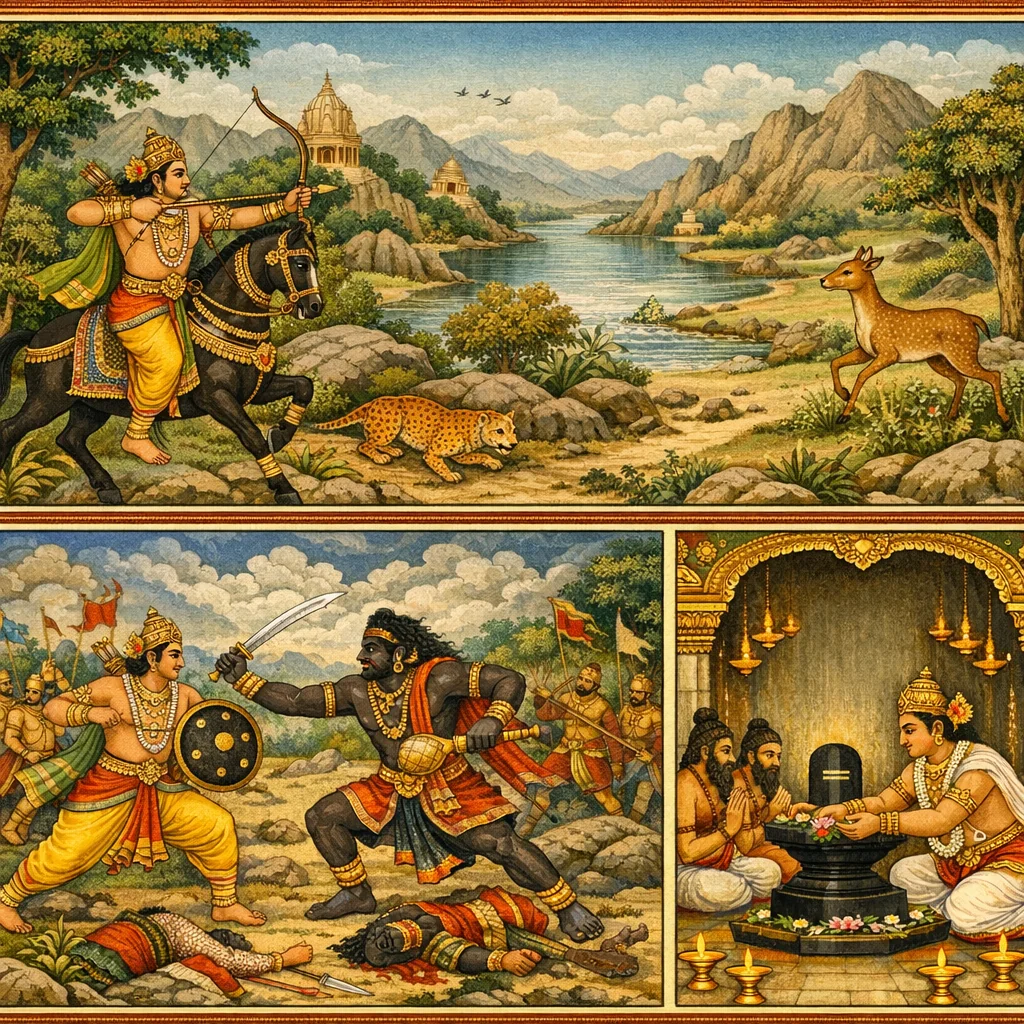
This chapter unfolds as a dialogue between Śiva and Devī. Śiva points to an excellent sacred spot connected with Kubera, where Kubera once attained the rank of Dhanada, lord of wealth. Devī asks how a brāhmaṇa could fall into thief-like conduct and yet later become Kubera. Śiva recounts the former life of a brāhmaṇa, Devaśarman, who lived at Prabhāsa on the bank of the Nyanku-matī: absorbed in household concerns, he abandons home out of greed to seek riches; his wife is portrayed as morally unstable, and their son Duḥsaha is born amid misfortune, later sinking into vice and social rejection. Duḥsaha attempts theft in a Śiva temple, but through his dealings with a nearly extinguished lamp and its wick he inadvertently performs a kind of lamp-service (dīpa-sevā). Discovered by a temple-servant, he flees in fear and is later violently slain by guards. Reborn in Gandhāra as the notorious king Sudurmukha, he remains ethically compromised, yet continues a habitual, non-mantric worship of a hereditary liṅga, frequently offering lamps. While hunting, driven by prior impressions (pūrva-saṃskāra), he comes to Prabhāsa, is killed in battle on the Nyanku-matī bank, and through Śiva worship his sins are said to be destroyed. He is then reborn as the radiant Vaiśravaṇa (Kubera), installs a liṅga near the Nyanku-matī, and offers an extended stotra to Mahādeva. Śiva appears and grants boons—friendship, the office of a Dikpāla, and lordship over wealth—declaring the place renowned as Kuberanagara. The liṅga installed to the west is remembered as Somanātha (here linked with Umānātha). A concluding phalaśruti states that worship performed properly on Śrīpañcamī bestows enduring Lakṣmī (prosperity) for up to seven generations.
Shlokas
Verse 1
ईश्वर उवाच । ततो गच्छेन्महादेवि कुबेरस्थानमुत्तमम् । यत्र सिद्धः पुरा देवि कुबेरो धनदोऽभवत्
Īśvara said: Then, O Great Goddess, one should go to the excellent place called Kubera’s abode, where long ago Kubera attained perfection and became Dhanada, the giver of wealth.
Verse 2
ब्राह्मणश्चौररूपेण तत्र स्थानेऽवसत्पुरा । स च मे भक्तियोगेन पुरा वै धनदः कृतः
A brāhmaṇa once lived in that place in the guise of a thief; and by devotion to me, through bhakti-yoga, he was indeed formerly made into Dhanada, the giver of wealth.
Verse 3
देव्युवाच । कथं स ब्राह्मणो भूत्वा चौररूपो नराधमः । तन्मे कथय देवेश धनदः स यथाऽभवत्
The Goddess said: How did that brāhmaṇa—becoming a thief, the lowest of men—come to be Dhanada? Tell me, O Lord of the gods, how that happened.
Verse 4
ईश्वर उवाच । तस्मिन्नर्थे महादेवि यद्वृत्तं चौत्तमेंऽतरे । कथयिष्यामि तत्सर्वं शिवमाहात्म्यसूचकम्
Īśvara said: Concerning that matter, O Great Goddess, and what occurred in that excellent interval, I shall tell all of it—an account that points to the greatness of Śiva.
Verse 5
कश्चिदासीद्द्विजो देवि देवशर्मेति विश्रुतः । प्रभासक्षेत्रनिलयो न्यंकुमत्यास्तटेऽवसत्
O Goddess, there once lived a Brahmin renowned by the name Devaśarmā. Dwelling in the sacred field of Prabhāsa, he resided upon the bank of the river Nyaṅkumatī.
Verse 6
पुत्रक्षेत्रकलत्रादिव्यापारैकरतः सदा । विहायाथ स गार्हस्थ्यं धनार्थं लोभ मोहितः । प्रचचार महीमेतां सग्रामनगरांतराम्
Ever absorbed only in dealings concerning son, land, wife, and the like, he then abandoned the duties of householder life. Deluded by greed for wealth, he wandered over this earth, moving through villages and towns.
Verse 7
भार्या तस्य विलोलाक्षी तस्य गेहाद्विनिर्गता । स्वच्छंदचारिणी नित्यं नित्यं चानंगमोहिता
His wife, fickle-eyed, left his home. Moving as she pleased, she remained constantly—again and again—ensnared by passion.
Verse 8
तस्यां कदाचित्पुत्रस्तु शूद्राज्जातो विधेर्वशात् । दुष्टात्माऽतीव निर्मुक्तो नाम्ना दुःसह इत्यतः
From her, at one time, a son was born of a Śūdra—by the force of fate. Wicked in nature and utterly unrestrained, he was therefore named Duḥsaha (“Hard to Bear”).
Verse 9
सोऽथ कालेन महता नामकर्मप्रवर्तितः । व्यसनोपहतः पापस्त्यक्तो बन्धुजनैस्तथा
Then, in the course of much time, he grew into his name and deeds. Struck down by vices, sinful, he was likewise abandoned by his own kinsmen.
Verse 10
पूजोपकरणं द्रव्यं स कस्मिंश्चिच्छिवालये । बहुदोषामुखे दृष्ट्वा हर्तुकामोऽविशत्ततः
In a certain Śiva-temple, he saw materials and implements meant for worship lying exposed, vulnerable to many faults. Desiring to steal them, he entered there.
Verse 11
यावद्दीपो गतप्रायो वर्त्तिच्छेदोऽभवत्किल । तावत्तेन दशा दत्ता द्रव्यान्वेषणकारणात्
Just as the lamp was nearly spent and its wick was cut off, at that very moment he was struck down—because he was searching for valuables.
Verse 12
प्रबुद्धश्चोत्थितस्तत्र देवपूजाकरो नरः । कोऽयं कोयमिति प्रोच्चैर्व्याहरत्परिघायुधः
There the man who performed worship to the deity awoke and sprang up. Bearing a club as his weapon, he cried aloud, “Who is this? Who is this?”
Verse 13
स च प्राणभयान्नष्टः शूद्रजश्चापि मूढधीः । विनिन्दन्नात्मनो जन्म कर्म चापि सुदुःखित
And he fled in fear for his life; born of a Śūdra and dull of mind, he lamented—censuring his own birth and his deeds—overwhelmed with sorrow.
Verse 14
पुरपालैर्हतोऽवन्यां मृतः कालादभूच्च सः । गंधारविषये राजा ख्यातो नाम्ना सुदुर्मुखः
Slain by the city-guards in the wilderness, he died when his time came. Thereafter he became a king in the land of Gandhāra, famed by the name Sudurmukha.
Verse 15
गीतवाद्यरतस्तत्र वेश्यासु निरतो भृशम् । प्रजोपद्रवकृन्मूर्खः सर्वधर्मबहिष्कृतः
There he became addicted to song and music, and was deeply given to courtesans. A fool who oppressed the people, he stood cast out from all dharma.
Verse 16
किन्त्वर्चयन्सदैवासौ लिंगं राज्यक्रमागतम् । पुष्पस्रग्धूपनैवेद्यगंधादिभिरमन्त्रवत्
Yet he would always worship the Liṅga that had come down through the royal succession, offering flowers, garlands, incense, food-offerings (naivedya), perfumes, and the like—though without mantras.
Verse 17
मुख्येषु च सदा काले देवतायतनेषु च । दद्यात्स बहुलान्दीपान्वर्तिभिश्च समुज्ज्वलान्
And at the principal times, in the temples of the deities, he would give many lamps—brightly blazing with wicks.
Verse 18
कदाचिन्मृगयासक्तो बभ्राम स च वीर्यवान् । प्रभास क्षेत्रमागात्य पूर्वसंस्कारभावितः
Once, intent on the hunt, that valiant man wandered about and came to the sacred field of Prabhāsa, drawn onward by the force of former impressions (saṃskāras).
Verse 19
परैरभिहतो युद्धे न्यंकुमत्यास्तटे शुभे । शिवपूजाविधानेन विध्वस्ताशेषपातकः
Struck down by others in battle on the auspicious bank of the Nyaṃkumatī, he had all his sins destroyed through the proper observance of Śiva-worship.
Verse 20
ततो विश्रवसश्चासौ पुत्रोऽभूद्भुवि विश्रुतः । यः स एव महातेजाः सर्वयज्ञाधिपो बली
Thereafter, on earth, he became the renowned son of Viśravas—he who is that very mighty one, greatly radiant, the lord of all sacrifices.
Verse 21
कुबेर इति धर्मात्मा श्रुतशीलसमन्वितः । लिंगं प्रतिष्ठयामास न्यंकुमत्याश्च पूर्वतः
That dharmic one, endowed with learning and noble conduct, famed as ‘Kubera,’ established a Liṅga to the east of the Nyaṃkumatī.
Verse 22
कौबेरात्पश्चिमे भागे सोमनाथेति विश्रुतम् । संपूज्य च यथेशानं न्यंकुमत्यास्तटे शुभे । स्तोत्रेणानेन चास्तौषीद्भक्त्या तं सर्वकामदम्
To the west of Kaubera lies what is renowned as ‘Somanātha.’ There, on the auspicious bank of the Nyaṃkumatī, having duly worshipped Īśāna as is fitting, he praised Him with this hymn in devotion—the Lord who bestows all desired aims.
Verse 23
मूर्तिः क्वापि महेश्वरस्य महती यज्ञस्य मूलोदया तुम्बी तुंगफलावती च शतशो ब्रह्माण्डकोटिस्तथा । यन्मानं न पितामहो न च हरिर्ब्रह्माण्डमध्यस्थितो जानात्यन्यसुरेषु का च गणना सा संततं वोऽवतात्
Somewhere there stands a vast manifestation of Maheśvara—the primal source from which yajña arises—like a towering gourd-vine laden with lofty fruits, and like hundreds of crores of universes. Its measure is not known to Pitāmaha (Brahmā), nor to Hari (Viṣṇu) who abides in the midst of the cosmos—what then can other gods ever count? May that supreme Form protect you always.
Verse 24
नमाम्यहं देवमजं पुराणमु पेन्द्रमिन्द्रावरराजजुष्टम् । शशांकसूर्याग्निसमाननेत्रं वृषेन्द्रचिह्नं प्रलयादिहेतुम्
I bow to the God—Aja, unborn and primordial—revered even by Upendra (Viṣṇu) and by Indra, lord of the gods; whose eyes are like the moon, the sun, and fire; who bears the emblem of the bull; the very cause of pralaya, dissolution, and also of all beginnings.
Verse 25
सर्वेश्वरैकत्रिबलैकबन्धुं योगाधिगम्यं जगतोऽधिवासम् । तं विस्मयाधारमनंतशक्तिं ज्ञानोद्भवं धैर्यगुणाधिकं च
I bow to Him who is the one Lord of all, the sole refuge and kinsman of the three worlds; who is realized through yoga; who is the indwelling abode of the universe—He who is the very ground of wonder, of endless power, born of pure knowledge, and overflowing in the virtue of steadfastness.
Verse 26
पिनाकपाशांकुशशूलहस्तं कपर्दिनं मेघसमानघोषम् । सकालकण्ठं स्फटिकावभासं नमामि शंभुं भुवनैकनाथम्
I bow to Śambhu, the one Lord of the worlds—whose hands bear the Pināka bow, the noose, the goad, and the trident; the matted-haired One whose roar is like thunderclouds; whose throat bears the mark of Kāla, and whose radiance is crystal-clear.
Verse 27
कपालिनं मालिनमादिदेवं जटाधरं भीमभुजंगहारम् । प्रभासितारं च सहस्रमूर्तिं सहस्रशीर्षं पुरुषं विशिष्टम्
I bow to the Skull-bearer (Kapālin), the Garlanded One (Mālin), the Primordial God (Ādideva); the wearer of matted locks, adorned with a fearsome serpent as necklace; the Illuminator—of a thousand forms, a thousand heads—the exalted, supreme Puruṣa.
Verse 28
यदक्षरं निर्गुणमप्रमेयं सज्योतिरेकं प्रवदंति संतः । दूरंगमं वेद्यमनिंद्यवन्द्यं सर्वेषु हृत्स्थं परमं पवित्रम्
That Imperishable Reality—beyond qualities and beyond measure—holy ones proclaim as the one Light itself: far-reaching yet knowable, blameless and worthy of reverence, dwelling in the hearts of all, supremely purifying.
Verse 29
तेजोनिभं बालमृगांकमौलिं नमामि रुद्रं स्फुरदुग्रवक्त्रम् । कालेन्धनं कामदमस्तसंगं धर्मासनस्थं प्रकृतिद्वयस्थम्
I bow to Rudra, radiant like blazing light, crowned with the young moon; whose fierce face flashes with power—He who consumes Time as fuel, grants rightful desires, is free from attachment, is seated upon the throne of Dharma, and stands beyond the dual play of nature.
Verse 30
अतीन्द्रियं विश्वभुजं जितारिं गुणत्रयातीतमजं निरीहम् । तमोमयं वेदमयं चिदंशं प्रजापतीशं पुरुहूतमिन्द्रम् । अनागतैकध्वनिरूपमाद्यं ध्यायंति यं योगविदो यतीन्द्राः
Beyond the senses, embracing the universe, conqueror of foes; beyond the three guṇas, unborn and actionless—dark as mystery yet made of the Veda, a portion of pure Consciousness; Lord of the Prajāpatis, the much-invoked ‘Indra’; the Primordial One whose very form is the single, unborn sound of the Unmanifest—Him the masters of yoga, the foremost ascetics, meditate upon.
Verse 31
संसारपाशच्छिदुरं विमुक्तः पुनः पुनस्त्वां प्रणमामि देवम्
Freed by You, the cutter of the bonds of worldly existence, I bow to You again and again, O God.
Verse 32
निरूपमास्यं च बलप्रभावं न च स्वभावं परमस्य पुंसः । विज्ञायते विष्णुपितामहाद्यैस्तं वामदेवं प्रणमाम्यचिंत्यम्
Neither the form, nor the power and majesty, nor even the essential nature of that Supreme Person is fully known—even by Viṣṇu, Brahmā, and the others. To that Vāmadeva, the unthinkable One, I bow.
Verse 33
शिवं समाराध्य तमुग्रमू्र्त्तिं पपौ समुद्रं भगवानगस्त्यः । लेभे दिलीपोऽप्यखिलांश्च कामांस्तं विश्वयोनिं शरणं प्रपद्ये
Having duly worshiped Śiva in that fierce form, the blessed Agastya drank up the ocean; and even King Dilīpa obtained all his desires. To that source-womb of the universe, I take refuge.
Verse 34
देवेन्द्रवन्द्योद्धर मामनाथं शम्भो कृपाकारुणिकः किल त्वम् । दुःखाऽर्णवे मग्नमुमेश दीनं समुद्धर त्वं भव शंकरोऽसि
O Śambhu, revered even by Indra—lift me up, for I am without refuge. Truly You are compassion and mercy itself. O Lord of Umā, I am sunk in the ocean of sorrow, wretched—raise me up, for You are Śaṅkara, the giver of auspiciousness.
Verse 35
संपूजयन्तो दिवि देवसंघा ब्रह्मेन्द्ररुद्रा विहरंति कामम् । तं स्तौमि नौमीह जपामि शर्वं वन्देऽभिवंद्यं शरणं प्रपन्नः
In heaven, the hosts of gods—Brahmā, Indra, and Rudra—worship Him and sport according to their desire. Him, Śarva (Śiva), I praise; here I bow to Him, I repeat His name in japa, and I worship the One worthy of all reverence, having taken refuge in Him.
Verse 36
स्तुत्वैवमीशं विरराम यावत्तावत्स रुद्रोऽर्कसहस्रतेजाः । ददौ च तस्मै वरदोंऽधकारिर्वरत्रयं वैश्रवणाय देवः । सख्यं च दिक्पालपदं चतुर्थं धनाधिपत्यं च दिवौकसां च
When he had thus praised the Lord and ceased, that Rudra—radiant like a thousand suns—Śiva, the slayer of Andhaka and the giver of boons, granted Vaiśravaṇa (Kubera) three boons: friendship with Him; as the fourth, the rank of a Guardian of a Direction; and lordship over the wealth of the celestials.
Verse 37
यस्मादत्र त्वया सम्यङ्न्यंकुमत्यास्तटे शुभे । आराधितोऽहं विधिवत्कृत्वा मूर्त्तिं महीमयीम्
Since here, upon the auspicious bank of Nyaṅkumatī, you have duly worshipped Me in the proper manner, having fashioned an image made of earth,
Verse 38
तस्मात्तवैव नाम्ना तत्स्थानं ख्यातं भविष्यति । कुबेरनगरेत्येवं मम प्रीतिप्रदायकम्
Therefore that place shall become renowned by your very name—thus as “Kuberanagara”—and it will be a source of delight to Me.
Verse 39
त्वया प्रतिष्ठितं लिंगमस्मात्स्थानाच्च पश्चिमे । उमानाथस्य विधिवत्सोमनाथेति तत्स्मृतम्
The liṅga you established, to the west of this place, was duly set up for Umānātha (Śiva, Lord of Umā); therefore it is remembered as “Somanātha.”
Verse 40
श्रीपंचम्यां विधानेन यस्तच्च पूजयिष्यति । सप्तपुरुषावधिर्यावत्तस्य लक्ष्मीर्भविष्यति
Whoever worships that (Somanātha liṅga) on Śrīpañcamī in the prescribed manner—prosperity (Lakṣmī) shall remain with him, extending up to seven generations.
Verse 290
इति श्रीस्कान्दे महापुराण एकाशीतिसाहस्र्यां संहितायां सप्तमे प्रभासखंडे प्रथमे प्रभासक्षेत्रमाहात्म्ये न्यंकुमतीमाहात्म्ये कुबेरनगरोत्पत्तिकुबेरस्थापितसोमनाथमाहात्म्यवर्णनंनाम नवत्युत्तरद्विशततमोऽध्यायः
Thus ends, in the Śrī Skanda Mahāpurāṇa—within the collection of eighty-one thousand (verses)—in the seventh, the Prabhāsa Khaṇḍa; in the first division, the Māhātmya of Prabhāsakṣetra; in the Māhātmya of Nyaṅkumatī—the chapter entitled “The account of the origin of Kuberanagara and the description of the greatness of Somanātha established by Kubera,” being Chapter 290.