Adhyaya 5
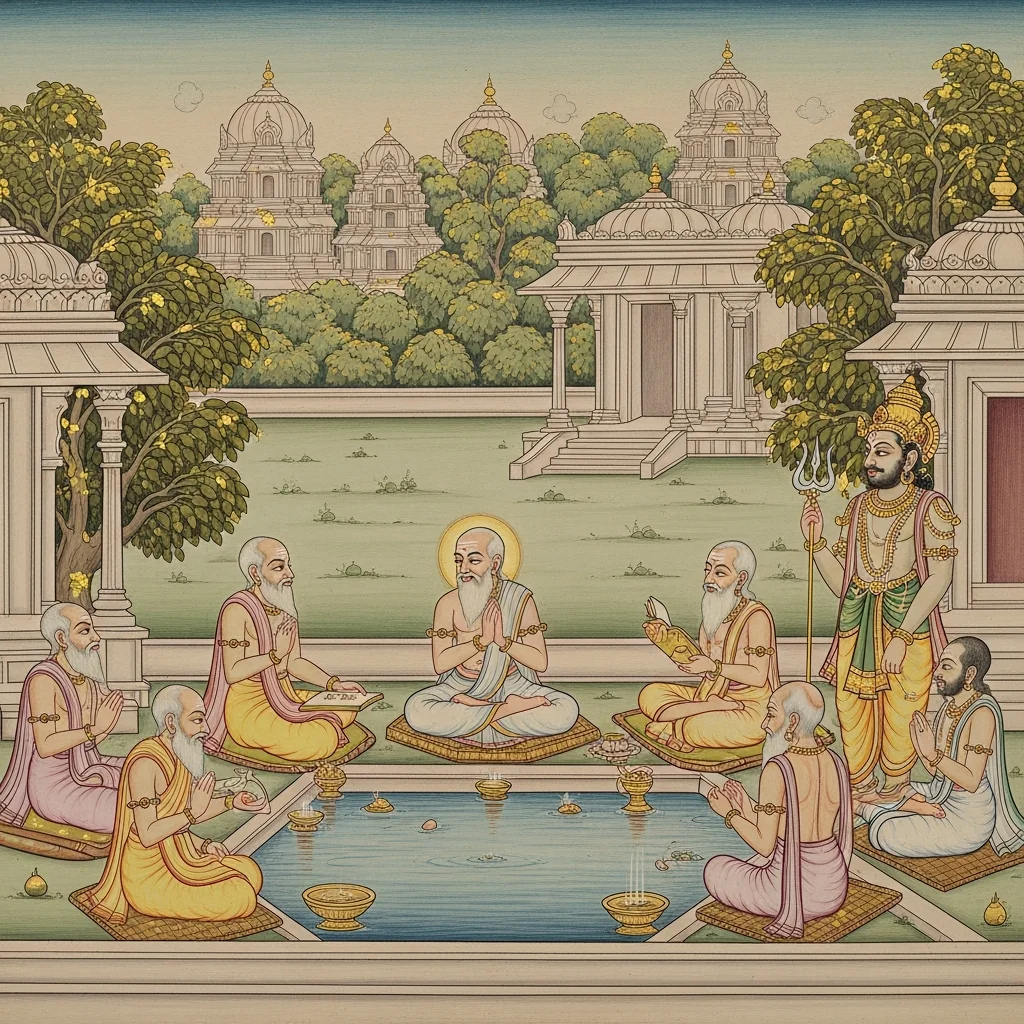
Chapter 5 unfolds as a theological dialogue: after Sūta’s framing, Devī asks for a fuller account of Prabhāsa-kṣetra’s greatness. Īśvara replies with an origin-and-merit teaching, declaring Prabhāsa to be his beloved kṣetra and a place of supreme attainment (para-gati) for yogins and the detached who relinquish life there. The chapter lists renowned ṛṣis—Mārkaṇḍeya, Durvāsas, Bharadvāja, Vasiṣṭha, Kaśyapa, Nārada, Viśvāmitra—who do not leave the kṣetra, stressing unbroken liṅga-worship. It also describes vast gatherings engaged in japa and worship at sacred sites such as Agni-tīrtha, Rudreśvara, Kampardīśa, Ratneśvara, Arka-sthala, Siddheśvara, Mārkaṇḍeya, and Sarasvatī/Brahma-kunda, using numbers to convey ritual abundance and sanctity. In phalaśruti fashion it proclaims that darśana of the “moon-crested” Lord yields the full fruit praised in Vedānta; snāna and pūjā grant yajnaphala; piṇḍa/śrāddha greatly uplift ancestors; and even casual contact with the waters is efficacious. It notes protective and obstructive agencies (gaṇas Vibhrama and Sambhrama, Vināyaka-like upasargas and “ten faults”) and prescribes devoted sight of Daṇḍapāṇi as the cure for obstacles. The conclusion universalizes access: all varṇas, whether desire-driven or desireless, who die in Prabhāsa attain Śiva’s divine realm, while Mahādeva’s qualities remain beyond speech.
Shlokas
Verse 1
सूत उवाच । इत्येवमुक्ते विप्रेंद्रा शंकरेण महात्मना । पुनः पप्रच्छ सा देवी हर्षसंपूर्णमानसा
Sūta said: When the great-souled Śaṅkara had spoken thus, O best of brāhmaṇas, the Goddess—her mind filled with joy—questioned him again.
Verse 2
देव्युवाच । देवदेव जगन्नाथ सर्वप्राणहिताय वै । प्रभासक्षेत्रमाहात्म्यं विस्तराद्वद मे प्रभो
The Goddess said: O God of gods, Lord of the world—indeed for the welfare of all beings—tell me in detail, O Master, the greatness of Prabhāsa-kṣetra.
Verse 3
ईश्वर उवाच । अन्यद्दृष्टांतरूपं ते कथयामि यशस्विनि । येन सृष्टं महादेवि क्षेत्रमेतन्मम प्रियम्
Īśvara said: O illustrious one, I shall tell you another account, in a different form; by it, O great Goddess, this sacred field, dear to me, was brought into being.
Verse 4
या गतिर्ध्यायतां नित्यं निःसंगानां च योगिनाम् । सैवं संत्यजतां प्राणान्प्रभासे तु परा गतिः
The very goal attained by ever-meditating, unattached yogins—this same supreme destination is granted to those who relinquish their life-breath in Prabhāsa.
Verse 5
अनेककल्पस्थायी च मार्कंडेयो महातपाः । सोऽपि देवं विरूपाक्षं प्रभासे तु सदाऽर्चति
Mārkaṇḍeya, the great ascetic who endures through many aeons—even he continually worships the god Virūpākṣa in Prabhāsa.
Verse 6
अटित्वा सर्वतीर्थानि प्रभासं नैव मुंचति । दुर्वासाश्च महातेजा लिंगस्याराधनोद्यतः । न मुंचति क्षणं देवि तत्क्षेत्रं शशिमौलिनः
Having wandered through all the sacred fords, he does not abandon Prabhāsa. Even the great-lustred Durvāsā, intent on worship of the Liṅga—O Goddess—does not leave, even for a moment, that sacred region of the Moon-crested Lord (Śiva).
Verse 7
भरद्वाजो मरीचिश्च मुनिश्चोद्दालकस्तथा । क्रतुश्चैव वसिष्ठश्च कश्यपो भृगुरेव च
Bharadvāja, Marīci, the sage Uddālaka; Kratu, Vasiṣṭha, Kaśyapa, and Bhṛgu as well—(all these great seers are present there).
Verse 8
दक्षश्चैव तु सावर्णिर्यमश्चांगिरसस्तथा । शुको विभांडकश्चैव ऋष्यशृंगोऽथ गोभिलः
So too Dakṣa, Sāvarṇi, Yama, and Aṅgirasa; Śuka, Vibhāṇḍaka, Ṛṣyaśṛṅga, and then Gobhila—(these also abide in that sacred region).
Verse 9
गौतमश्च ऋचीकश्च अगस्त्यः शौनको महान् । नारदो जमदग्निश्च विश्वामित्रोऽथ लोमशः
Gautama and Ṛcīka; Agastya; the great Śaunaka; Nārada; Jamadagni; Viśvāmitra; and then Lomaśa—these too are present there.
Verse 10
अन्ये च ऋषयश्चैव दिव्या देवर्षयस्तथा । न मुंचंति महाक्षेत्रं लिंगस्याराधनोद्यताः
And other sages too, and divine devarṣis as well—intent on worship of the Liṅga—do not abandon that great sacred region.
Verse 11
अहं तत्रैव तिष्ठामि लिंगाराधनतत्परः । न मुंचामि महाक्षेत्रं सत्यंसत्यं वरानने
I myself abide there alone, wholly devoted to the worship of the Liṅga. I do not leave that great sacred region—this is truth, truth, O fair-faced one.
Verse 12
सर्वतीर्थानि देवेशि मया दृष्टानि भूतले । प्रभासेन समं क्षेत्रं नैव दृष्टं कदाचन
O Lady of the Gods, I have seen all the tīrthas upon the earth; yet never at any time have I seen a sacred region equal to Prabhāsa.
Verse 13
देवि षष्टिसहस्राणि याज्ञवल्क्यपुरस्कृताः । जपं कुर्वंति रुद्राणां चन्द्रभागां व्यवस्थिताः
O Goddess, sixty thousand sages, with Yājñavalkya at their head, remain stationed on the banks of Candrabhāgā, performing japa of the Rudra-mantras.
Verse 14
चत्वारिंशत्सहस्राणि ऋषीणामूर्द्ध्वरेतसाम् । देविकातटमाश्रित्य जपंति शतरुद्रियम्
Forty thousand sages of restrained vitality (ūrdhvaretas), taking refuge on the bank of Devikā, recite the Śatarudrīya.
Verse 15
कोटयश्चैव पंचाशन्मुनीनामूर्द्ध्वरेतसाम् । उमापतिं समासाद्य लिंगं तत्रैव संस्थितम्
And fifty crores of sages of restrained vitality, having approached Umāpati (Śiva), remain right there—established at that very Liṅga.
Verse 16
रुद्राणां कोटि जाप्यं तु कृतं तत्रैव तैः पुरा । कोटिस्तत्रैव संसिद्धास्तस्मिंल्लिंगे न संशयः
In that very place, in ancient times, they performed the japa of a crore of Rudra-mantras. And there itself a crore attained perfection—about that Liṅga there is no doubt.
Verse 17
शतं चैव सहस्राणां देवेशं शशिभूषणम् । पूजयंति महासिद्धा मम क्षेत्रनिषेविणः
Hundreds and thousands of great Siddhas—those who dwell in and serve my sacred region—worship the Lord of gods, Śiva, adorned with the moon.
Verse 18
वेदांतेषु च यत्प्रोक्तं फलं चैव महर्षिभिः । तत्फलं सकलं तत्र चंद्रभूषणदर्शनात्
Whatever fruit the great seers have declared in the Vedāntas—one gains that entire fruit there simply by beholding the Moon-adorned Lord (Śiva).
Verse 19
अग्नितीर्थे ऋषीणां तु कोटिः साग्रा स्थिता शुभे । रुद्रेश्वरे स्मृतं लक्षं कंपर्द्दीशे तथैव च
At Agnitīrtha, in that auspicious holy place, a koṭi (and more) of Ṛṣis abide. At Rudreśvara, a hundred thousand are remembered, and likewise at Kaṃparddīśa.
Verse 20
रत्नेश्वरे सहस्रं तु ऋषीणामूर्द्ध्वरेतसाम् । अर्कस्थले महापुण्ये कोटिः साग्रा स्थिता शुभे
At Ratneśvara, a thousand sages—steadfast in disciplined continence (ūrdhvareta)—abide. And at the greatly meritorious Arkasthala, in that auspicious place, a koṭi (and more) dwell.
Verse 21
षष्टिश्चैव सहस्राणि तत्र सिद्धेश्वरे स्थिताः । सप्त चैव सहस्राणि मार्कंडेये तु संस्थिताः
There, at Siddheśvara, sixty thousand abide; and at Mārkaṇḍeya, likewise, seven thousand are established.
Verse 22
सरस्वत्यां ब्रह्मकुण्डेऽसंख्याता मुनयः स्मृताः । दशार्बुदसहस्राणि कोटित्रितयमेव च
At Sarasvatī’s Brahmakuṇḍa, the munis are remembered as innumerable—reckoned as ten thousand arbudas, and also three koṭis.
Verse 23
ऋषयस्तत्र तिष्ठंति यत्र प्राची सरस्वती । ब्रह्महत्या गता यत्र शंकरस्य च तत्क्षणात्
The Ṛṣis dwell precisely where the Sarasvatī flows eastward. There, in that very instant, Śaṅkara’s sin of brahma-hatyā departed.
Verse 24
कायः सुवर्णतां प्राप कपालं पतितं करात् । ज्ञात्वैवं शंकिना पूर्वं कृतं तत्र महातपः
His body attained a golden radiance, and the skull-bowl fell from his hand. Knowing this, Śaṅkha (Śaṅkhi) formerly performed great austerity there.
Verse 25
तुष्टः श्रीशंकरो देवो लिंग वासवरेण तु । कोटियज्ञफलं स्नाने प्राच्यां लिंगस्य पूजने
Pleased, the blessed Lord Śaṅkara (Śiva) declared: by bathing there and by worshipping the Liṅga in the eastern (Sarasvatī-facing) quarter, one obtains the fruit of a crore of sacrifices.
Verse 26
पिंडे गयाशतगुणममासोमयुते दिने । भूतायां पिंडदस्तत्र कुलकोटिं समुद्धरेत्
Offering a piṇḍa (funerary oblation) there yields merit a hundred times greater than at Gayā, especially when performed on the new-moon day conjoined with Monday. If one offers piṇḍa there on the Bhūtā tithi, he uplifts even a crore of his lineage.
Verse 27
ये चात्र मलनाशाय निमङ्क्ष्यंति च मानवाः । दशगोदानजं पुण्यं तेषामपि भविष्यति
And those people who bathe here to wash away impurity—upon them too will accrue the merit that arises from gifting ten cows.
Verse 28
पादेन वा क्रीडमाना जलं लिप्संति ये नरा । तेषामपि श्राद्धफलं विधिवत्संभविष्यति । तत्र लिंगानि पूज्यानि शूलभेदादिकानि तु
Even those men who, merely playing with their feet, happen to splash or take in the water—for them too the fruit of śrāddha will duly arise. There, the liṅgas are to be worshipped—such as Śūlabheda and the others.
Verse 29
एवं विकल्प्य लिंगानि अश्वमेध फलानि तु । दर्शनेनापि सर्वेषां स्पर्शाद्धि द्विगुणं फलम्
Thus, in diverse forms, these liṅgas bestow the fruits of the Aśvamedha sacrifice. For each of them, even mere darśana grants merit; yet by touch, the fruit is said to become double.
Verse 31
तेषां तुष्टो जगन्नाथः शंकरो नीललोहितः । त्रिंशत्कोटिगणस्तत्र प्राचीं रक्षंति सर्वतः
Pleased with them, the Lord of the world—Śaṅkara, the Blue-and-Red One (Nīlalohita)—there appoints hosts of gaṇas, thirty koṭis in number, who guard the eastern quarter on every side.
Verse 32
महापापसमाचारः पापिष्ठो वाऽति किल्बिषी । घुणाक्षरमिव प्राणान्प्राच्यां मुक्त्वा शिवं व्रजेत्
Even one whose conduct is steeped in great sin—utterly wicked and heavily tainted—if he relinquishes his life there in the eastern quarter, he goes to Śiva, like a worm-eaten letter vanishing back into its source.
Verse 33
दधिकंबलदानं तु तत्र देयं द्विजोत्तमे । कथितं पापशमनं सारात्सारतरं ध्रुवम्
But there, O best of the twice-born, one should offer the gift of a dadhikambala, a “curd-blanket.” It is declared to quell sin—surely the quintessence beyond quintessence.
Verse 34
अधुना संप्रवक्ष्यामि हिरण्याश्च महोदयम् । दुर्वाससा तपस्तप्तं तत्र सूर्यः प्रतिष्ठितः
Now I shall proclaim the great rise and glory of Hiraṇyā. There, through the tapas—ascetic austerities—performed by Durvāsas, Sūrya, the Sun, became established in that place.
Verse 35
कोटिरेका तु तत्रैव ऋषीणामूर्द्ध्वरेतसाम् । चतुर्विंशतितत्त्वानामधिको बलरूपधृक्
There itself abide ascetic seers—those of uplifted seed—numbering a crore and one. And that Presence is said to surpass the twenty‑four principles, bearing the very form of power and strength.
Verse 36
यत्र तिष्ठति देवेशि भृगुकोटिसमन्वितः । अन्यत्र ब्राह्मणानां तु कोट्या यच्च फलं लभेत्
O Goddess, where that sacred Presence stands together with a crore of Bhṛgus, whatever fruit one might gain elsewhere by honoring a crore of brāhmaṇas is attained here with far greater ease and excellence.
Verse 38
ब्रह्मस्थाने तथैकेन भोजितेन तु तत्फलम् । एवं ज्ञात्वा महादेवि तत्र तिष्ठामि निर्वृतः । कोटिर्भिर्देवऋषिभिर्देवैः सह समावृतः । तीर्थानि तत्र तिष्ठंति अंतर्भूतानि वै कलौ
In that Brahmā-sthāna, even by feeding just one worthy person, that very fruit is obtained. Knowing this, O Mahādevī, I dwell there in perfect contentment, surrounded by crores of divine seers and gods. In the Kali age, all tīrthas abide there—indeed, they are gathered and contained within that place.
Verse 39
तत्र क्षेत्रे महारम्ये यत्र सोमेश्वरः स्थितः । मम देवि गणौ द्वौ तु विभ्रमः संभ्रमः परः
In that most delightful sacred field where Someśvara abides, O Devī, there are two attendants of mine: Vibhrama and the other, Saṁbhrama.
Verse 40
तौ चात्र क्षेत्रसंस्थानां लोकानां भ्रमविभ्रमैः । योजयंति सदा चित्तं विकल्पानैक्यसंकुलम्
And here, by their confusion and delusion, those two continually entangle the minds of people dwelling in the sacred region, crowding them with a multitude of wavering alternatives.
Verse 41
विनायकोपसर्गाश्च दश दोषास्तथा परे । एवं क्षेत्रं तु रक्षंति पापिनां दुष्टचेतसाम्
Vināyaka’s afflictions, and ten other faults besides—thus they guard this sacred region, keeping it protected from sinners of wicked intent.
Verse 42
दंडपाणिं तु ये भक्त्या पश्यंतीह नरोत्तमाः । न तेषां जायते विघ्नं तत्र क्षेत्रनिवासिनाम्
But those best of men who, with devotion, behold Daṇḍapāṇi here—no obstacle arises for them as residents of that sacred region.
Verse 43
ब्राह्मणाः क्षत्रिया वैश्याः शूद्रा वै वर्णसंकराः । अकामा वा सकामा वा प्रभासे ये मृताः शुभे
Brāhmaṇas, Kṣatriyas, Vaiśyas, Śūdras, and even those of mixed social origin—whether desireless or desire-driven—who die in auspicious Prabhāsa,
Verse 44
चंद्रार्द्धमौलिनः सर्वे ललाटाक्षा वृषध्वजाः । शिवे मम पुरे दिव्ये जायंते तत्र मानवाः
All of them become like the Lord with the half-moon on His crest, with the eye upon the forehead, and bearing the bull as His emblem; in my divine city of Śiva, O Śivā, those human beings are born.
Verse 45
यस्तत्र वसते विप्रः संयतात्मा समाहितः । त्रिकालमपि भुंजानो वायुभक्षसमो भवेत्
A brāhmaṇa who dwells there, self-restrained and collected in contemplation—even if he eats three times a day—becomes as though he lived on air alone.
Verse 46
मेरोः शक्या गुणा वक्तुं द्वीपानां च गुणास्तथा । समुद्राणां च सर्वेषां शक्या वक्तुं गुणाः प्रिये
O beloved, one may be able to describe the qualities of Meru, and likewise the qualities of the continents, and even the qualities of all the oceans—
Verse 47
आदिदेवस्य देवेशि महेशस्य महाप्रभोः । शक्या नैव गुणा वक्तुं वर्षाकोटिशतैरपि
But, O Goddess of the gods, the qualities of Maheśa—the great Lord, the primordial Deva—cannot be spoken of, even in hundreds of crores of years.