Adhyaya 297
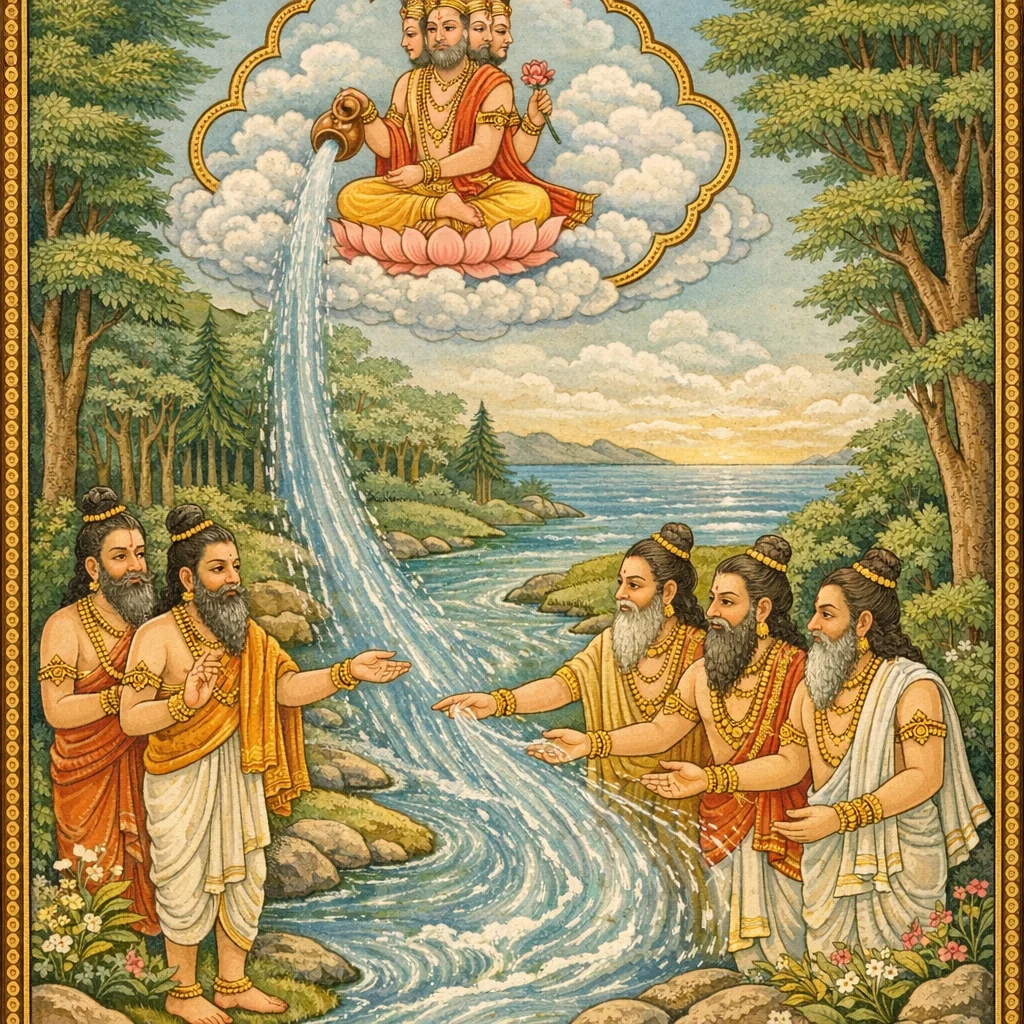
Devī asks Īśvara to explain the origin and renown of the sacred water called Ṛṣitoyā, and how it came to the auspicious Devadāruvana. Īśvara relates that many ascetic ṛṣis, displeased that the local waters did not kindle ritual joy like the great rivers, went to Brahmā in Brahmaloka and praised him with hymns as creator, protector, and dissolver. Granting their request for a sin-destroying river fit for consecratory bathing (abhiṣeka), Brahmā surveys the embodied river-deities—Gaṅgā, Yamunā, Sarasvatī, and others—gathers them into his kamaṇḍalu, and compassionately releases them toward the earth. Those waters become known as Ṛṣitoyā, beloved of the ṛṣis and said to remove all pāpa; they reach Devadāruvana and are guided by Veda-knowing sages onward to the ocean. The chapter further notes that Ṛṣitoyā is generally accessible, yet hard to obtain at three specific loci—Mahodaya, Mahātīrtha, and near Mūlacāṇḍīśa. It also sets a time-based equivalence of river-flows (Gaṅgā in the morning, Yamunā in the evening, Sarasvatī at midday, etc.) to order bathing and śrāddha observance, concluding with a brief phala: it removes sins and grants desired results.
Shlokas
Verse 1
देव्युवाच । देवदेव जगन्नाथ संसारार्णवतारक । सविस्तरं तु मे ब्रूहि ऋषितोयामहोदयम्
Devī said: O God of gods, Lord of the universe, savior who ferries beings across the ocean of saṃsāra—tell me in detail the glorious manifestation and greatness of Ṛṣitoyā.
Verse 2
ऋषितोयेति तन्नाम कथं ख्यातं धरातले । कथं सा पुनरायाता देवदारुवने शुभे
How did she become known on earth by the name “Ṛṣitoyā”? And how did she come again to the auspicious Devadāru forest?
Verse 3
ईश्वर उवाच । शृणु देवि प्रवक्ष्यामि सावधाना वचो मम । माहात्म्यमृषितोयायाः सर्वपातकनाशनम्
Īśvara said: Listen, O Devī; I shall explain—be attentive to my words—the greatness of Ṛṣitoyā, which destroys all sins.
Verse 4
देवदारुवने पुण्य ऋषयस्तपसा युताः । निवसंति वरारोहे शतशोथ सहस्रशः
In the holy Devadāru forest, sages endowed with austerities dwell, O fair-hipped one—by the hundreds and indeed by the thousands.
Verse 6
ते सर्वे चिंतयामासुः समेत्य च परस्परम् । सरस्वती महापुण्या शिरस्याधाय वाडवम्
All of them assembled together and deliberated with one another. The supremely holy Sarasvatī, bearing the Vāḍava fire upon her head, was the matter that weighed upon their minds.
Verse 7
प्रभासं चिरकालेन क्षेत्रं चैव गमिष्यति । वापीकूपतडागादि मुक्त्वा सागरगामिनीम्
In the course of time she too will go to Prabhāsa Kṣetra—leaving behind wells, stepwells, ponds and the like—and become a river that flows onward to the ocean.
Verse 8
नाह्लादं कुरुते चेतः स्नानदानजपेषु च । ब्रह्माणं प्रार्थयिष्यामो गत्वा ब्रह्मनिकेतनम्
Our minds no longer find delight in sacred bathing, in charity, or in japa. Let us go to Brahmā’s own abode and, in prayer, seek his guidance.
Verse 9
ईश्वर उवाच । एवं निमन्त्र्य ते सर्वे ऋषयस्तपसोज्ज्वलाः । गतास्ते ब्रह्मलोकं तु द्रष्टुं देवं पितामहम् । तुष्टुवुर्विविधैः स्तोत्रैर्ब्रह्माणं कमलोद्भवम्
Īśvara said: Thus, having conferred together, all those sages—radiant with austerity—went to Brahmaloka to behold the divine Grandfather. There they praised Brahmā, the Lotus-born, with hymns of many kinds.
Verse 10
ऋषय ऊचुः । नमः प्रणवरूपाय विश्व कर्त्रे नमोनमः । तथा विश्वस्य रक्षित्रे नमोऽस्तु परमात्मने
The sages said: Salutations to you who are the very form of Praṇava (Oṃ); salutations again and again to the Maker of the universe. Likewise, salutations to the Protector of the world—to the Supreme Self.
Verse 11
तथा तस्यैव संहर्त्रे नमो ब्रह्मस्वरूपिणे । पितामह नमस्तुभ्यं सुरज्येष्ठ नमोऽस्तु ते
Likewise, salutations to Him who withdraws that very universe—salutations to Him whose nature is Brahman. O Pitāmaha, obeisance to You; O eldest among the gods, may salutations be to You.
Verse 12
चतुर्वक्त्र नमस्तुभ्यं पद्मयोने नमोऽस्तु ते । विरंचये नमस्तुभ्यं विधये वेधसे नमः
O four-faced One, salutations to You; O lotus-wombed One, may salutations be to You. O Virañci, obeisance to You; to Vidhātṛ, to Vedhas—salutations.
Verse 13
चिदानन्द नमस्तुभ्यं हिरण्यगर्भ ते नमः । हंसवाहन ते नित्यं पद्मासन नमोऽस्तुते
O embodiment of consciousness and bliss, salutations to You; O Hiraṇyagarbha, salutations to You. O ever Swan-mounted One, O lotus-seated One—may salutations be to You.
Verse 14
एवं संस्तुवतां तेषामृषीणामूर्ध्वरेतसाम् । उवाच परमप्रीतो ब्रह्मा लोक पितामहः
As those sages—masters of continence—praised him in this way, Brahmā, the Grandfather of the worlds, greatly pleased, spoke.
Verse 15
स्वागतं वै द्विजश्रेष्ठा युष्माकं कृतवानहम् । स्तोत्रेणानेन दिव्येन वृणुध्वं वरमुत्तमम्
Welcome, O best of the twice-born—your coming is honored by me. By this divine hymn, choose an excellent boon.
Verse 16
ऋषय ऊचुः । अभिषेकाय नो देव नदी पापप्रणाशिनी । विलोक्यते सुरश्रेष्ठ देहि नो वरमुत्तमम्
The sages said: O God, for our sacred ablutions (abhiṣeka) we seek a river that destroys sins. O best among the gods, grant us this supreme boon.
Verse 17
ईश्वर उवाच । इत्युक्तस्तैस्तदा ब्रह्मा मुनिभिस्तपसोज्ज्वलैः । वीक्षांचक्रे तदा सर्वा मूर्तिमत्यश्च निम्नगाः
Īśvara said: Thus addressed by the sages radiant with austerity, Brahmā then surveyed all the rivers—those embodied streams that flow downward.
Verse 18
गङ्गा च यमुना चैव तथा देवी सरस्वती । चन्द्रभागा च रेवा च शरयूर्गंडकी तथा
There were the Gaṅgā and the Yamunā, and likewise the goddess Sarasvatī; also the Candrabhāgā, the Revā (Narmadā), the Śarayū, and the Gaṇḍakī—all these sacred rivers were present there.
Verse 19
तापी चैव वरारोहे तथा गोदावरी नदी । कावेरी चन्द्रपुत्री च शिप्रा चर्मण्वती तथा
And the Tāpī as well, O fair-hipped lady, and the river Godāvarī; the Kāverī, the Candraputrī, the Śiprā, and likewise the Carmaṇvatī—all were present.
Verse 20
सिन्धुश्च वेदिका चैव नदाः सर्वे वरानने । मूर्तिमत्यः स्थिताः सर्वाः पवित्राः पापनाशिनी
The Sindhu and the Vedikā as well—indeed, all the rivers, O lovely-faced one, stood there embodied; all were holy, destroyers of sin.
Verse 21
दृष्ट्वा पितामहः सर्वा गत्वरा धरणीं प्रति । देवदारुवने रम्ये प्रभासे क्षेत्र उत्तमे । कमण्डलौ कृता दृष्टिर्विविशुस्ताः कमण्डलुम्
Seeing them all, Pitāmaha (Brahmā) turned his attention toward the earth. In the delightful deodāra grove at Prabhāsa, the supreme sacred field, he fixed his gaze upon his kamaṇḍalu; and those rivers entered into the kamaṇḍalu.
Verse 22
।ब्रह्मोवाच । धृताः सर्वा महापुण्या नद्यो ब्रह्मकमण्डलौ । प्रविष्टाः पृथिवीं यांतु ऋषीणामनुकम्पया
Brahmā said: “All these greatly meritorious rivers are held within Brahmā’s kamaṇḍalu. Having entered it, let them go forth to the earth, out of compassion for the ṛṣis.”
Verse 23
प्रहिणोमि यद्येकां च ह्यन्या रुष्यति मे द्विजाः । तस्मात्सर्वाः प्रमोक्ष्यामि कमण्डलुकृतालयाः
“If I send forth only one, the others may become displeased with me, O twice-born ones. Therefore I shall release them all—those who have made the kamaṇḍalu their dwelling.”
Verse 24
ईश्वर उवाच । ततो ब्रह्मा मुमोचाऽथ तत्रस्थाश्च महापगाः । मुक्त्वा ब्रह्मा मुनीन्सर्वान्प्रोवाचेदं पुनःपुनः
Īśvara said: Then Brahmā released them, and the mighty rivers that were there flowed forth. Having thus set all the sages at ease, Brahmā spoke these words again and again.
Verse 25
ऋषिभिः प्रार्थ्यमानेन नद्यो मुक्ता मया यतः । तोयरूपा महावेगा अभिषेकाय सत्वराः
“Because I was entreated by the ṛṣis, I have released these rivers. Taking the form of water, swift and great in their current, they hasten for the purpose of consecration (abhiṣeka).”
Verse 26
ऋषितोयेति नाम्ना सा भविष्यति धरातले । ऋषीणां वल्लभा देवी सर्वपातकनाशिनी
On the earth she shall be known by the name “Ṛṣitoyā”. Beloved of the sages, that goddess-river destroys all sins.
Verse 27
ईश्वर उवाच । एवं देवि समायाता देवदारुवने नदी । ऋषितोयेति विख्याता पवित्रा च वरानने
Īśvara said: Thus, O Devī, the river arrived in the Devadāru grove. She became renowned as “Ṛṣitoyā”, and she is holy, O lovely-faced one.
Verse 28
तूर्यदुंदुभिनिर्घोषैर्वेदमङ्गलनिःस्वनैः । समुद्रं प्रापिता देवी ऋषिभिर्वेदपारगैः
Amid the resounding blasts of trumpets and kettledrums, and the auspicious Vedic chants, the Goddess was ceremonially led to the ocean by sages who had mastered the Vedas.
Verse 29
सर्वत्र सुलभा देवी त्रिषु स्थानेषु दुर्लभा । महोदये महातीर्थे मूलचंडीशसन्निधौ
The Goddess is easy to access everywhere; yet She is uniquely rare to attain in these three places—at Mahodaya, the great tīrtha, and in the presence of Mūlacaṇḍīśa.
Verse 30
समुद्रेण समेता तु यत्र सा पूर्ववाहिनी । यत्रर्षितोया लभ्येत तत्र किं मृग्यते परम्
Where she meets the ocean and flows eastward, and where Ṛṣitoyā is obtained—what higher goal need be sought beyond that?
Verse 31
मनुष्यास्ते सदा धन्यास्तत्तोयं तु पिबंति ये । अस्थीनि यत्र लीयंते षण्मासाभ्यन्तरेण तु
Blessed indeed are those who drink that sacred water; for in that place even bones are said to dissolve within six months.
Verse 32
प्रातःकाले वहेद्गंगा सायं च यमुना तथा
In the morning it flows as Gaṅgā; and in the evening likewise as Yamunā.
Verse 33
नदीसहस्रसंयुक्ता मध्याह्ने तु सरस्वती । अपराह्णे वहेद्रेवा सायाह्ने सूर्यपुत्रिका
At midday it is Sarasvatī, joined with a thousand rivers; in the afternoon it flows as Revā; and by late evening it becomes Sūryaputrikā.
Verse 34
एवं जानन्नरो यस्तु तत्र स्नान विचक्षणः । आचरेद्विधिना श्राद्धं स तस्याः फलभाग्भवेत्
Knowing this, the discerning man who bathes there and performs Śrāddha according to rule becomes a sharer in its full spiritual fruit.
Verse 35
एवं संक्षेपतः प्रोक्तमृषितोयामहोदयम् । सर्वपापहरं नृणां सर्वकामफलप्रदम्
Thus, in brief, the greatness of Ṛṣitoyā at Mahodaya has been stated—removing all sins of people and granting the fruits of all rightful desires.
Verse 85
तेषां निवसतां तत्र बहुकालो गतः प्रिये । पुत्रपौत्रैः प्रवृद्धास्ते दारुकं व्याप्य संस्थिताः
Dear one, as they dwelt there, a long time passed. They flourished with sons and grandsons, spreading through Dāruka and settling there.
Verse 297
इति श्रीस्कांदे महापुराण एकाशीतिसाहस्र्यां संहितायां सप्तमे प्रभासखंडे प्रथमे प्रभासक्षेत्रमाहात्म्य ऋषितोयामाहात्म्यवर्णनंनाम सप्तनवत्युत्तरद्विशततमोऽध्यायः
Thus ends, in the Śrī Skanda Mahāpurāṇa—within the saṃhitā of eighty-one thousand ślokas—the two-hundred-and-ninety-seventh chapter, entitled “Description of the Greatness of Ṛṣitoyā,” in the seventh, the Prabhāsa-khaṇḍa, in the first division, the Māhātmya of Prabhāsa Kṣetra.