Adhyaya 90
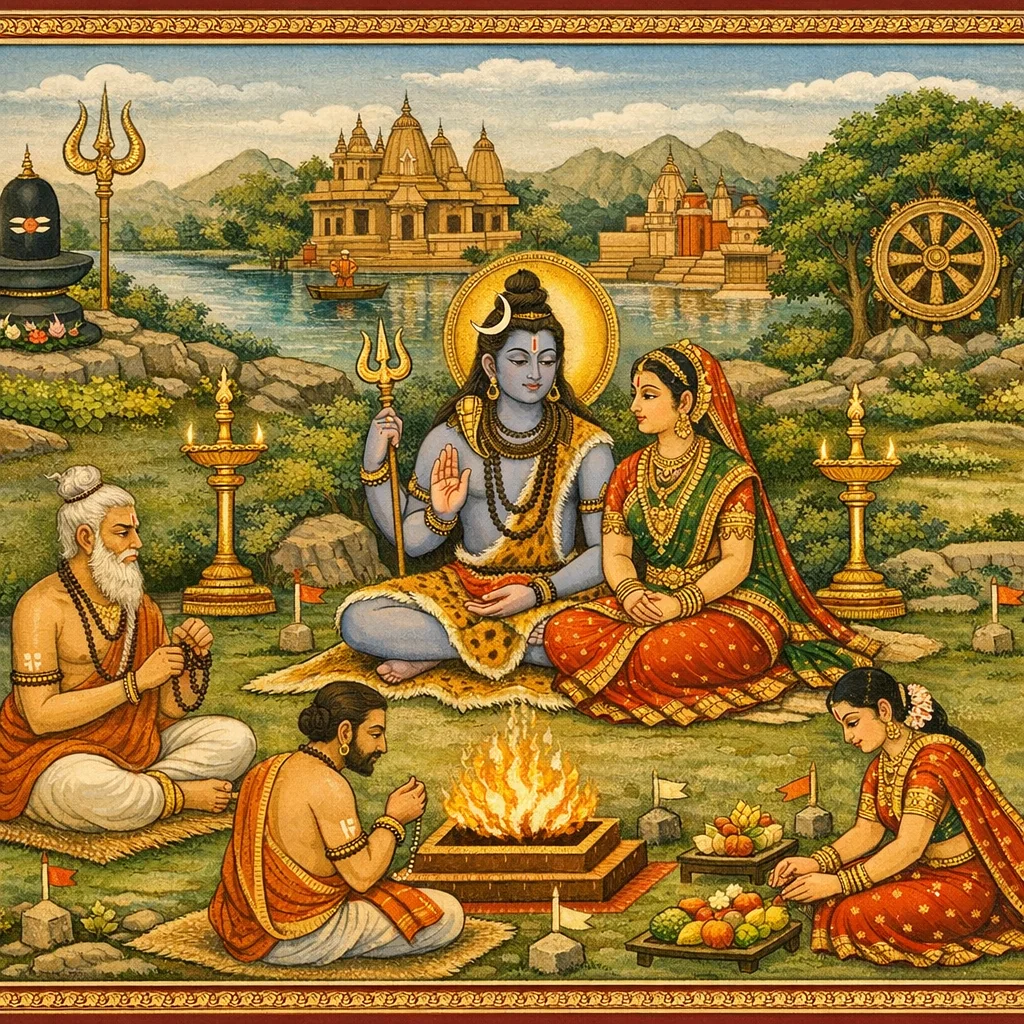
Chapter 90 records Īśvara’s teaching to Devī about a supremely sacred Rudra-shrine, the Vṛṣabheśvara kalpa-liṅga, auspicious and beloved of the gods. Its greatness is established through successive kalpas in which the same liṅga bears different names according to its worshippers and the fruits bestowed: it was Brahmeśvara when Brahmā worshipped long and creation followed; Raivateśvara when King Raivata gained victory and prosperity by its power; Vṛṣabheśvara when Dharma, in bull-form (Śiva’s vehicle), adored it and received the promise of nearness/union; and in the Varāha-kalpa it became associated with King Ikṣvāku, whose disciplined tri-kāla worship won sovereignty and lineage, giving the epithet Ikṣvākvīśvara. The chapter defines the kṣetra’s extent by directions in dhanu units and declares that bathing, japa, bali, homa, pūjā, and stotra performed there become imperishable. A strong phalaśruti proclaims that keeping vigil near the liṅga with brahmacarya and devotional arts, feeding brāhmaṇas, and worship on specific lunar dates (especially the night of Māgha kṛṣṇa-caturdaśī; also aṣṭamī/caturdaśī) yields great merit, equal to an embedded “tīrtha-octad”: Bhairava, Kedāra, Puṣkara, Drutijaṅgama, Vārāṇasī, Kurukṣetra, Mahākāla, and Naimiṣa. It further prescribes ancestor rites such as piṇḍa-dāna at new moon, and the ritual bathing of the liṅga with dadhi, kṣīra, ghṛta, pañcagavya, kuśa-water, and aromatics, said to cleanse even grave transgressions and confer Vedic stature. The chapter concludes that hearing this māhātmya benefits both the learned and the unlearned.
Shlokas
Verse 1
ईश्वर उवाच । ततो गच्छेन्महादेवि चतुर्थं रुद्रमुत्तमम् । वृषभेश्वरनामानं कल्पलिंगं सुरप्रियम्
Īśvara said: Then, O Mahādevī, one should go to the excellent fourth Rudra—named Vṛṣabheśvara—whose liṅga is of wondrous potency and beloved of the gods.
Verse 2
बालरूपी महादेवि यत्र ब्रह्मा स्वयं स्थितः । तस्यैव चोत्तरे भागे धनुषां त्रितये स्थितम्
O Mahādevī, in that place—where Brahmā himself abides in the form of a divine child—on its northern side, at a distance of three bow-lengths, this sacred shrine is situated.
Verse 3
आद्यं महाप्रभावं हि नापुण्यो वेद मानवः । तस्यैव कल्पनामानि सांप्रतं प्रब्रवीमि ते
Indeed, one who lacks merit does not comprehend its primordial, mighty power. Therefore, I shall now tell you its appointed names across the different kalpas.
Verse 4
पूर्वकल्पे महादेवि ब्रह्मेश्वर इति स्मृतः । ब्रह्मणाराधितः पूर्वं वर्षाणामयुतं प्रिये
O Mahādevī, in a former kalpa it was remembered by the name “Brahmeśvara”. Beloved, in earlier times Brahmā worshipped it for ten thousand years.
Verse 5
सृष्टिकामेन देवेन ततस्तुष्टो महेश्वरः । चतुर्विधां भूतसृष्टिं ततश्चक्रे पितामहः
When the god Brahmā, longing for creation, worshipped in devotion, Maheśvara (Śiva) was pleased. Thereupon Pitāmaha (Brahmā) brought forth the fourfold creation of beings.
Verse 6
ब्रह्मणस्त्वीशभावेन गतस्तुष्टिं यतो हरः । तेन ब्रह्मेश्वरं नाम तस्मिंल्लिंगे पुराऽभवत्
Because Hara (Śiva) was pleased by Brahmā’s lordly devotion, in ancient times that liṅga came to bear the name “Brahmeśvara”.
Verse 7
ततो द्वितीयकल्पे तु संप्राप्ते वरवर्णिनि । रैवतेश्वरनामेति प्रख्यातं धरणीतले
Then, O fair-complexioned one, when the second kalpa arrived, it became renowned upon the earth by the name “Raivateśvara”.
Verse 8
रैवतो नाम राजाऽभूद्ब्रह्मांडे सचराचरे । जगद्योनिर्जिगायेदं तल्लिंगस्य प्रभावतः
In this Brahmāṇḍa, with all moving and unmoving beings, there was a king named Raivata. By the power of that liṅga, he conquered this world, the very source of the world.
Verse 9
रैवतेश्वरनामाभूत्तेन लिंगं महाप्रभम् । पुनस्तृतीयकल्पे तु संप्राप्ते वरवर्णिनि
Thus that greatly glorious liṅga came to be called “Raivateśvara”. And again, O fair one, when the third kalpa arrived…
Verse 10
वृषभेश्वरनामाभूत्तस्य लिंगस्य भामिनि । ममैव वाहनं योऽसौ धर्मोयं वृषरूपधृक्
O radiant lady, that liṅga then came to be called Vṛṣabheśvara. For that very Bull—who bears the form of Dharma—is indeed my own vehicle.
Verse 11
तेन तत्पूजितं लिंगं दिव्याब्दानां सहस्रकम् । ततस्तुष्टेन देवेशि नीतः सायुज्यतां वृषः
That liṅga was worshipped by him for a thousand divine years. Then, O Goddess of the gods, the pleased Lord led Vṛṣa (the Bull) to sāyujya—complete union with the divine.
Verse 12
तेन तल्लिंगमभवद्वृषभेशेति भूतले । ततश्चतुर्थे संप्राप्ते वाराहेकल्प संज्ञिते
Because of that event, that Liṅga became celebrated on earth by the name Vṛṣabheśa. Then, when the fourth age-cycle—known as the Vārāha Kalpa—arrived, its greatness continued to be proclaimed.
Verse 13
अष्टाविंशतिमे तत्र त्रेतायुगमुखे तदा । इक्ष्वाकुर्नाम राजाऽभूत्सूर्यवंशविभूषणः
There, in the twenty-eighth turn, at the dawn of the Tretā Yuga, there arose a king named Ikṣvāku—an ornament of the Solar dynasty.
Verse 14
स लिंगं पूजयामास त्रिकालं भक्तिभावितः । एकाहारो जिताहारो भूभिशायी जितेंद्रियः
Filled with devotion, he worshipped the Liṅga three times each day. He lived on a single daily meal, disciplined his intake, slept upon the ground, and mastered his senses.
Verse 15
एवं काले बहुविधे ततस्तुष्टो महेश्वरः । ददौ राज्यं महोदग्रं संततिं पुत्र पौत्रिकीम्
After a long time spent in many kinds of disciplines, Maheśvara was pleased. He granted a greatly flourishing kingdom and an unbroken lineage of sons and grandsons.
Verse 16
इक्ष्वाक्वीश्वरनामाभूत्तेनेदं लिंगमुत्तमम् । यस्तं पूजयते भक्त्या देवं वृषभवाहनम्
Because of him, this supreme Liṅga came to be known as Ikṣvākvīśvara. Whoever worships that God—Śiva, the One whose vehicle is the Bull—with devotion receives the promised merit.
Verse 17
सप्तजन्मकृतैः पापैर्मुच्यते नात्र संशयः । त्रिंशद्धनुष्प्रमाणेन तस्य क्षेत्रचतुर्द्दिशम्
He is freed from sins accumulated over seven births—of this there is no doubt. The sacred precinct extends in the four directions to the measure of thirty bow-lengths.
Verse 18
स्नानं जाप्यं बलिं होमं पूजां स्तोत्रमुदीरणम् । तस्मिंस्तीर्थे तु यः कुर्यात्तत्सर्वं चाक्षयं भवेत्
Bathing, mantra-recitation, offerings, fire-sacrifice, worship, and the chanting of hymns—whatever a person performs at that tīrtha becomes imperishable in merit.
Verse 19
चतुष्कोणांतरा क्षेत्रमेवं मात्राप्रमाणतः । एकरात्रोषितो भूत्वा तस्य लिंगस्य सन्निधौ
Thus, by measure, the sacred area is defined as a quadrangular precinct. Having stayed for one night in the presence of that Liṅga, the pilgrim gains the stated fruits.
Verse 20
ब्रह्मचर्येण जागर्त्ति स पापैः संप्रमुच्यते । होमजाप्यसमाधिस्थो नृत्यगीतादिवादनैः
Keeping brahmacarya and keeping vigil through the night, one is wholly released from sins. Abiding in homa, japa, and meditative absorption—and also through dance, song, and instrumental music offered in devotion—one attains the purifying fruit.
Verse 21
गोघ्नो वा ब्रह्महा पापी मुच्यते दुष्कृतैर्नरः । यः संप्रीणयते विप्रांस्तत्र भोज्यैः पृथग्विधैः
Even a sinner—whether a killer of a cow or a slayer of a brāhmaṇa—is released from evil deeds, if there he gratifies brāhmaṇas with various kinds of food.
Verse 22
एकस्मिन्भोजिते विप्रे कोटिर्भवति भोजिता । भैरवं चैव केदारं पुष्करं द्रुतिजंगमम्
There, when even a single brāhmaṇa is fed, it is as though a crore have been fed. There too are present Bhairava, Kedāra, Puṣkara, and the swiftly-moving tīrtha Drutijaṅgama.
Verse 23
वाराणसी कुरुक्षेत्रं महा कालं च नैमिषम् । एतत्तीर्थाष्टकं देवि तस्मिंल्लिंगे व्यवस्थितम्
Vārāṇasī, Kurukṣetra, Mahākāla, and Naimiṣa—O Devī—this entire group of eight sacred tīrthas is established within that very Liṅga.
Verse 24
माघे कृष्णचतुर्द्दश्यां तत्र यो जागृयान्निशि । संपूज्य विधिना देवं स तीर्थाष्टफलं लभेत्
On the Kṛṣṇa Caturdaśī night of Māgha, whoever keeps vigil there and worships the Lord according to rule obtains the full fruit of the eight tīrthas.
Verse 25
ददाति तत्र यः पिण्डं नष्टेन्दौ शिवसंनिधौ । तृप्यन्ति पितरस्तस्य यावद्ब्रह्मदिनान्तकम्
Whoever offers a piṇḍa there, on the new-moon day, in Śiva’s very presence—his ancestors remain satisfied until the end of Brahmā’s day.
Verse 26
दधिक्षीर घृतेनैव पंचगव्यकुशोदकैः । कुंकुमागरुकर्पूरैस्तल्लिगं पूजयेन्निशि
At night one should worship that Liṅga with curd, milk, and ghee; with pañcagavya and water sanctified by kuśa; and with saffron, agaru, and camphor.
Verse 27
संमंत्र्याघोरमंत्रेण ध्यात्वा देवं सदाशिवम् । एवं कृत्वा महादेवि मुच्यते पंचपातकैः
Having duly invoked with the Aghora mantra and meditated on the Lord Sadāśiva, O Mahādevī—by doing so one is freed from the five great sins.
Verse 28
अष्टम्यां च चतुर्द्दश्यां दध्ना संस्नापयेद्यदि । स ब्राह्मणश्चतुर्वेदो जायते नात्र संशयः
If on the Aṣṭamī and on the Caturdaśī one bathes the Lord with curd, then one is born a brāhmaṇa, versed in the four Vedas—of this there is no doubt.
Verse 29
क्षीरेण स्नापयेद्देवि यदि तं वृषभेश्वरम् । सप्तधेनुसहस्राणां स फलं विंदते महत्
O Devī, if one bathes Vṛṣabheśvara with milk, one attains the great fruit equivalent to gifting seven thousand cows.
Verse 30
जन्मांतरेण यत्पापं सांप्रतं यत्कृतं प्रिये । तत्सर्वं नाशमायाति घृतस्नानेन भामिनि
O beloved—whatever sin was committed in another birth, and whatever has been done now: by bathing the Lord with ghee (ghṛta), all of it comes to destruction, O radiant one.
Verse 31
पंचगव्येन यो देवि स्नापयेद्वृषभेश्वरम् । स दहेत्सर्वपापानि सर्वयज्ञफलं लभेत्
O Devī, whoever bathes Vṛṣabheśvara with pañcagavya burns away all sins and gains the fruit of all sacrifices (yajña).
Verse 32
तद्दृष्ट्वा ब्रह्महा गोघ्नः स्तेयी च गुरुतल्पगः । शरणागतघाती च मित्रविश्रंभघातकः
On beholding that sacred presence (the Liṅga), even a slayer of a brāhmaṇa, a killer of a cow, a thief, one who violates the teacher’s bed, one who murders a person seeking refuge, and one who betrays a trusting friend—are shaken by its power and torn away from evil.
Verse 33
दुष्टपापसमाचारो मातृहा पितृहा तथा । मुच्यते सर्वपापैस्तु तल्लिंगाराधनोद्यतः
Even one of wicked conduct steeped in sin—yes, even a slayer of mother or father—becomes freed from all sins, if he is intent on worshipping that very Liṅga.
Verse 34
कार्तिकं सकलं यस्तु पूजयेद्ब्रह्मणा सह । ब्रह्मेश्वरं महालिंगं स मुक्तः पातकैर्भवेत्
Whoever, throughout the entire month of Kārtika, worships the great Liṅga of Brahmeśvara together with Brahmā—he becomes released from sins.
Verse 35
तेन दत्तं भवेत्सर्वं गुरवस्तेन तोषिताः । श्राद्धं कृतं गयातीर्थे तेन तप्तं महत्तपः । येन देवाधिदेवोऽसौपूजितो वृषभेश्वरः
By that person (who worships here), it is as though all gifts have been given; by him the gurus are satisfied; by him the śrāddha at the Gayā-tīrtha has been performed; by him great austerity has been undertaken—because he has worshipped Vṛṣabheśvara, the God of gods.
Verse 36
इति ते कथितं देवि माहात्म्यं देवपूजितम् । वृषभेश्वरदेवस्य कल्पलिंगस्य भामिनि
Thus, O Goddess, have I told you the renowned greatness—worshipped even by the gods—of Lord Vṛṣabheśvara’s Kalpaliṅga, O lovely one.
Verse 37
यः शृणोति महादेवि माहात्म्यं दैवदेवतम् । मूर्खो वा पंडितो वाऽपि स याति परमां गतिम्
Whoever hears this sacred greatness, O Mahādevī—whether ignorant or learned—attains the supreme goal.
Verse 90
इति श्रीस्कांदे महापुराण एकाशीतिसाहस्र्यां संहितायां सप्तमे प्रभासखंडे प्रथमे प्रभासक्षेत्रमाहात्म्य एकादशरुद्रमाहात्म्ये वृषवाहनेश्वरमाहाम्यवर्णनंनाम नवतितमोऽध्यायः
Thus ends the ninetieth chapter, entitled “The Description of the Greatness of Vṛṣavāhaneśvara,” in the Prabhāsa Khaṇḍa, within the Prabhāsakṣetra Māhātmya and the Ekādaśa-rudra Māhātmya, of the Śrī Skanda Mahāpurāṇa (in the Ekāśītisāhasrī Saṃhitā).