Adhyaya 273
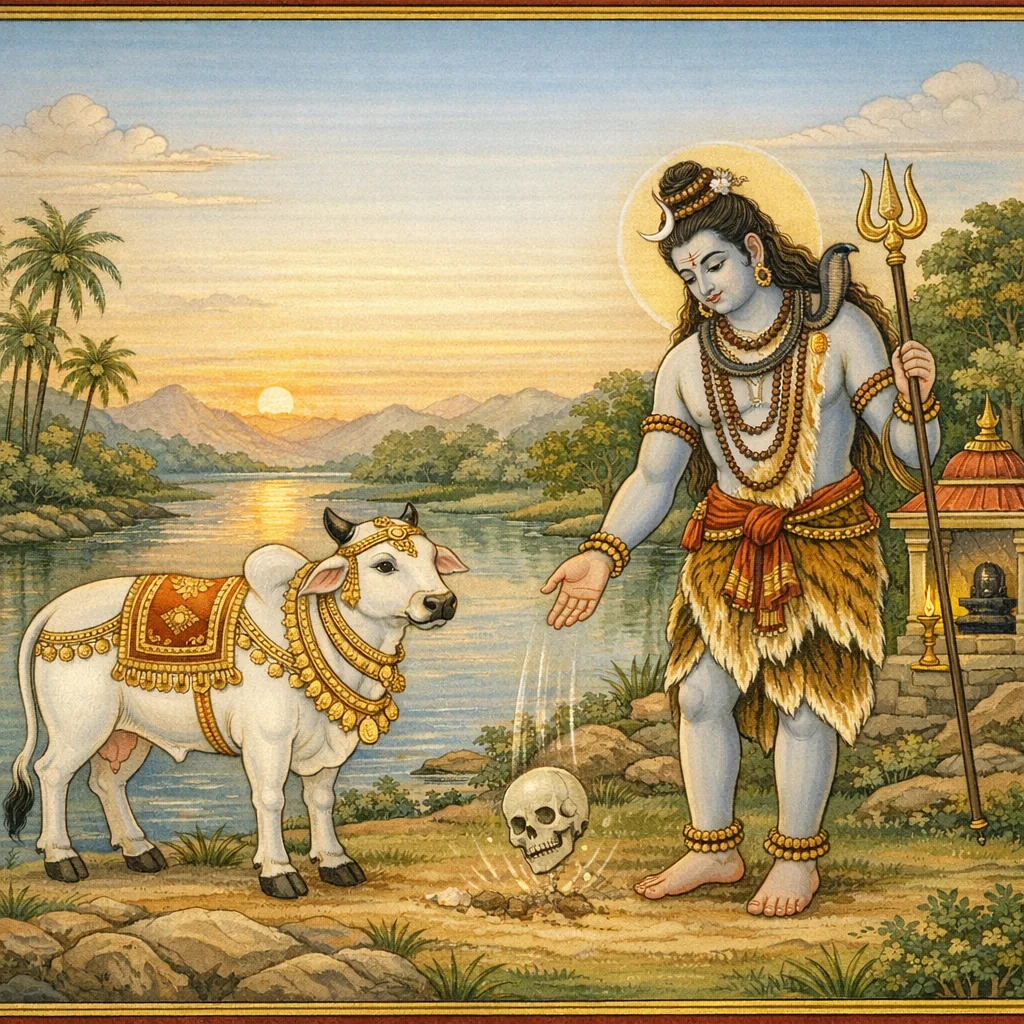
Īśvara speaks to Devī, praising Śaṇḍa-tīrtha as an unsurpassed sacred ford that pacifies all sin and grants desired results. He then recounts its origin: in an earlier age Brahmā had five heads, and in a certain circumstance Īśvara severed one; the flowing blood and wondrous signs sanctified the spot, where great palm trees arose and the place came to be remembered as a palm-grove. The skull (kapāla) clung to Īśvara’s hand, and both he and his bull Nandin became dark in body, so they set out on pilgrimage, troubled by the transgression. No place could lift the burden until they reached Prabhāsa and beheld the east-facing Sarasvatī. When the bull bathed, it instantly turned white; at the same moment Īśvara was freed from the sin of killing (hatyā). Then the kapāla fell from his hand, and the site was established as the Kapālamocana liṅga. The chapter further enjoins śrāddha offerings near Prācī Devī (Sarasvatī), declaring great satisfaction for the ancestors—especially when performed on the Kṛṣṇa-pakṣa Caturdaśī of Āśvayuja with proper procedure, worthy recipients, and gifts such as food, gold, curds, and blankets. The naming of Śaṇḍa-tīrtha is explained through the bull’s transformation.
Shlokas
Verse 1
ईश्वर उवाच । ततो गच्छेन्महादेवि शंडतीर्थमनुत्तमम् । सर्वपापोपशमनं सर्वकामफलप्रदम्
Īśvara said: “Then, O great Goddess, one should go to the unsurpassed Śaṇḍatīrtha—an allaying of every sin, and a giver of the fruits of all desired aims.”
Verse 2
तस्योत्पत्तिं प्रवक्ष्यामि शृणुष्वैकमनाः प्रिये । पुरा पंचशिरा आसीद्ब्रह्मा लोकपितामहः
I shall explain its origin—listen with a single-pointed mind, O beloved. In former times Brahmā, the grandsire of the worlds, was five-headed.
Verse 3
शिरस्तस्य मया छिन्नं कस्मिंश्चित्कारणांतरे । तत्र गंधवती जाता ब्रह्मणः सा च शोणितैः
For some reason, I severed one head of his. From that (act) there arose a foul-smelling (condition), and there was also Brahmā’s blood.
Verse 4
तत्रोद्गता महातालास्तेन तालवनं स्मृतम् । अथ करतले लग्नं कपालं ब्रह्मणो मम
There great palmyra trees sprang up; therefore it came to be known as Tālavana. Then Brahmā’s skull became stuck fast upon the palm of my hand.
Verse 5
शरीरं कृष्णतां यातं मम चैव वृषस्य च । अथ तीर्थान्यनेकानि गतोहं पापशंकया
My body—and that of my bull as well—turned dark. Then, fearing sin, I went to many sacred fords (tīrthas).
Verse 6
न क्वचिद्व्रजते पापं ततः प्रभासमागतः । क्षेत्रे तत्र मया दृष्टा प्राची देवी सरस्वती
Sin did not depart anywhere (else). Therefore I came to Prabhāsa. In that sacred field I beheld the goddess Sarasvatī, facing the east.
Verse 7
तत्र मे वृषभः स्नातुं प्रविष्टो जलमध्यतः । तत्क्षणाच्छ्वेतता प्राप्तो मुक्तोहमपि हत्यया
There my bull entered the midst of the waters to bathe. In that very moment he became white again—and I too was freed from the sin of slaying Brahmā.
Verse 8
करमध्ये च मे लग्नं कपालं पतितं तदा । कपालमोचनश्चासौ लिंगरूपी स्थितोऽभवत्
Then the skull that had been stuck in the middle of my hand fell away. That holy place, known as Kapālamocana, became established there in the form of a liṅga.
Verse 9
तत्रापि यो ददेच्छ्राद्धं प्राचीदेव्यास्तु संनिधौ । मातृकं पैतृकं चैव तृप्तं कुलशतं तथा
Whoever, in that very place, offers a Śrāddha in the presence of Goddess Prācī—both the maternal and paternal lines become satisfied; indeed, a hundred generations of one’s family are gratified.
Verse 10
भवेच्च तस्य तृप्तिस्तु यावत्कल्पास्तु सप्ततिः । मास आश्वयुजे देवि कृष्णपक्षे चतुर्दशी । तत्र दद्यात्तु यः श्राद्धं दक्षिणामूर्तिमाश्रितः
Their satisfaction endures for as many as seventy kalpas. O Goddess, on the fourteenth day of the dark fortnight in the month of Āśvayuja, whoever offers Śrāddha there, taking refuge in Dakṣiṇāmūrti, attains this fruit.
Verse 11
यथावित्तोपचारेण सुपात्रे च यथाविधि । यावद्युगसहस्रं तु तृप्ताः स्युस्ते पितामहाः
With offerings suited to one’s means, and in the proper manner to a worthy recipient, one’s forefathers remain satisfied for a thousand yugas.
Verse 12
अन्नसुवर्णदानं च दधिकंबलमेव च । तत्र देयं विधानेन सर्वपापोपशुद्धये
There, one should duly offer gifts of food and gold, and also curds and blankets, according to proper rule, for the complete purification from all sins.
Verse 13
कृष्णरूपी वृषो देवि यदा श्वेतत्वमागतः । शंडतीर्थमितिख्यातं तेन त्रैलोक्यपूजितम्
O Goddess, when the bull that was black in form attained whiteness, that place became renowned as Śaṃḍatīrtha; by that very event it is worshipped throughout the three worlds.