Adhyaya 165
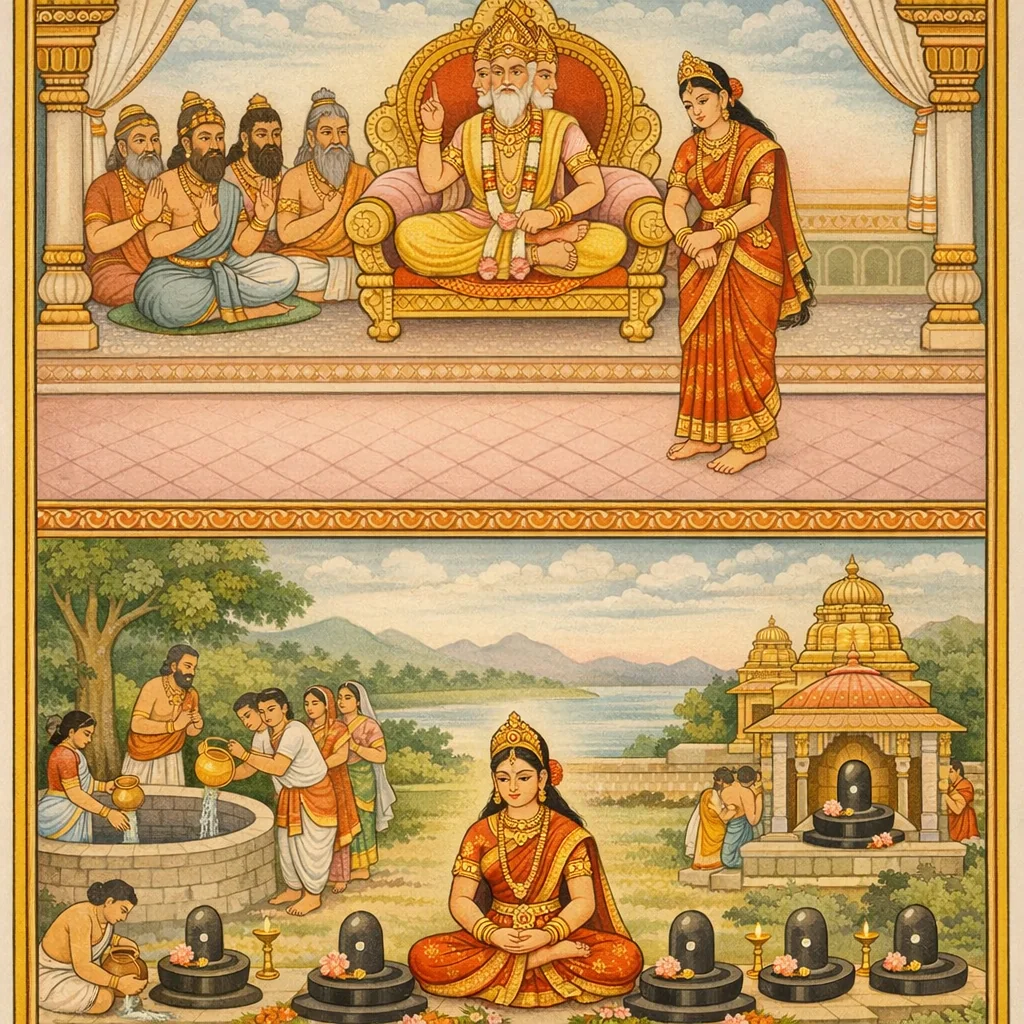
This adhyāya unfolds as a Śiva–Devī dialogue, explaining Savitrī’s bond with Prabhāsa Kṣetra and showing how ritual urgency can create ethical and theological strain. Śiva recounts Brahmā’s resolve to perform a great yajña at Puṣkara, where dīkṣā and homa require a patnī (ritual spouse). Delayed by household duties, Savitrī is absent; Indra brings a suitable pastoral maiden who becomes Gāyatrī, and the sacrifice proceeds. Savitrī then arrives with other goddesses, confronts Brahmā before the assembly, and utters a sequence of śāpas (curses): upon Brahmā (restricted annual worship, notably in Kārtikī), upon Indra (future humiliation and bondage), upon Viṣṇu (suffering of spouse-separation in a mortal incarnation), upon Rudra (conflict in the Daruvana episode), and upon Agni and various ritual specialists—critiquing desire-driven action and procedural expediency. Viṣṇu offers a formal stuti to Savitrī; she grants countervailing boons and permits the yajña to be completed, while Gāyatrī affirms the efficacy of japa, prāṇāyāma, dāna, and the mitigation of ritual faults, especially in Prabhāsa and Puṣkara. The chapter concludes by locating Savitrī at Prabhāsa near Someshvara and prescribing local observances: worship over a fortnight, bathing at Pāṇḍu-kūpa with darśana of five Pāṇḍava-installed liṅgas, and recitation of Brahma-sūktas near Savitrī’s site on the Jyeṣṭha full moon. The promised fruit is release from sin and attainment of the highest state.
Shlokas
Verse 1
ईश्वर उवाच । ततो गच्छेन्महादेवि सावित्रीं लोकमातरम् । महा पापप्रशमनीं सोमेशादीशदिक्स्थिताम्
Īśvara said: Then, O Great Goddess, one should go to Sāvitrī, the Mother of the worlds—she who allays grievous sins—situated in the direction beginning with (the quarter of) Someśa.
Verse 2
संयतात्मा नरः पश्येत्तत्र तां नियतात्मवान्
A man of self-restraint and disciplined mind should behold Her there.
Verse 3
ब्रह्मणा यष्टुकामेन सावित्री सहधर्मिणी । कृता तां बलतो ज्ञात्वा गायत्रीं कोपमाविशत्
When Brahmā, desiring to perform a sacrifice, took Sāvitrī as his lawful consort, Gāyatrī—realizing that this had been done by force—was seized by anger.
Verse 4
ततः संत्यज्य सा देवी ब्रह्माणं कमलोद्भवम् । सपत्नीरोषसन्तप्ता प्रभासं क्षेत्रमाश्रिता
Then that Goddess, leaving Brahmā the lotus-born, tormented by the anger arising from a co-wife’s rivalry, took refuge in the sacred field of Prabhāsa.
Verse 5
तपः करोति विपुलं देवैरपि सुदुःसहम् । तत्र स्थले स्थिता देवी साऽद्यापि प्रियदर्शना
There she performs immense austerity—an ordeal hard to endure even for the gods; abiding in that very spot, the Goddess remains there even today, gracious to behold.
Verse 6
श्रीदेव्युवाच । किमर्थं सा परित्यक्ता सावित्री ब्रह्मणा पुरा । गायत्री च कथं प्राप्ता केन चास्य निवेदिता
The Blessed Goddess said: “For what reason was Sāvitrī formerly abandoned by Brahmā? And how did Gāyatrī come to him—by whom was she presented to him?”
Verse 7
कीदृशीं तां च गायत्रीं लब्धवान्पद्मसंभवः । यस्तां पत्नीं समुत्सृज्य तस्यामेव मनो दधौ
And what was that Gāyatrī like, whom the lotus-born Brahmā obtained—he who, casting aside his wife, fixed his mind upon her alone?
Verse 8
कस्य सा दुहिता देव किमर्थं च विवाहिता । एतन्मे कौतुकं सर्वं यथावद्वक्तुमर्हसि
O Lord, whose daughter was she, and for what purpose was she married? All this is my curiosity—please tell it properly, as it truly happened.
Verse 9
ईश्वर उवाच । शृणु देवि प्रवक्ष्यामि सावित्र्याश्चरितं महत् । यथा सा ब्रह्मणा त्यक्ता गायत्री च विवाहिता
Īśvara said: “Listen, O Goddess; I shall recount the great account of Sāvitrī—how she was abandoned by Brahmā, and how Gāyatrī was married.”
Verse 10
पुरा बुद्धिः समुत्पन्ना ब्रह्मणोऽव्यक्तजन्मनः । इति वेदा मया प्रोक्ता यज्ञार्थं नात्र संशयः
Formerly, an intention arose in Brahmā—whose birth is unmanifest—“The Vedas have been declared by me for the sake of sacrifice (yajña); of this there is no doubt.”
Verse 11
यज्ञैः संतर्पिता देवा वृष्टिं दास्यंति भूतले । ततश्चौषधयः सर्वा भविष्यंति धरातले
Satisfied by sacrifices, the gods will grant rain upon the earth; and then all medicinal herbs and crops will flourish upon the ground.
Verse 12
तस्मात्संजायते शुक्रं शुक्रात्सृष्टिः प्रवर्तते । सृष्ट्यर्थं सर्वलोकानां ततो यज्ञं करोम्यहम्
From that arises generative potency; from that potency creation proceeds. Therefore, for the sake of bringing forth all the worlds, I undertake the sacred sacrifice (yajña).
Verse 13
दृष्ट्वा मां यज्ञ आसक्तं ये च विप्रा धरातले । ते यज्ञान्प्रचरिष्यंति शतशोऽथ सहस्रशः
Seeing me devoted to sacrifice, the brahmins upon the earth will propagate sacrifices—by the hundreds, and even by the thousands.
Verse 14
एवं स निश्चयं कृत्वा यज्ञार्थं सुरसुंदरि । तीर्थं निवेशयामास पुष्करं नाम नामतः
Thus, having formed his resolve for the sake of the sacrifice, O divine maiden, he established a sacred ford (tīrtha) there—renowned by name as Puṣkara.
Verse 15
यज्ञवाटो महांस्तत्र आसीत्तस्य महात्मनः । तत्र देवर्षयः सर्वे देवाः सेन्द्रपुरोगमाः
There, for that great-souled one, a vast sacrificial enclosure (yajñavāṭa) stood; and there assembled all the divine seers, along with the gods led by Indra.
Verse 16
समायाता महादेवि यज्ञे पैतामहे तदा । पुण्यास्तेऽपि द्विजश्रेष्ठास्तत्रर्त्विजः प्रजज्ञिरे
Then, O great goddess, they gathered for that Paitāmaha sacrifice; and there, those meritorious best of the twice-born became the officiating priests (ṛtvijas).
Verse 17
सावित्री लोकजननी पत्नी तस्य महात्मनः । गृहकार्ये समासक्ता दीक्षा कालव्यतिक्रमात् । अध्वर्युणा समाहूता सावित्री वाक्यमब्रवीत्
Sāvitrī, the Mother of the worlds and the wife of that great-souled one, was absorbed in household duties; and as the time of dīkṣā (consecration) was being overstepped, she was summoned by the Adhvaryu priest—whereupon Sāvitrī spoke these words.
Verse 18
सावित्र्युवाच । अद्यापि न कृतो वेषो न गृहे गृहमण्डनम् । लक्ष्मीर्नाद्यापि संप्राप्ता न भवानी न जाह्नवी
Sāvitrī said: “Even now my attire has not been prepared, nor has the household been adorned. Lakṣmī has not yet arrived—nor Bhavānī, nor Jāhnavī.”
Verse 19
न स्वाहा न स्वधा चैव तथा चैवाप्यरुंधती । इन्द्राणी देवपत्न्योऽन्याः कथमेकाकिनी व्रजे
“Neither Svāhā nor Svadhā is here, nor Arundhatī; nor Indrāṇī and the other wives of the gods. How can I go there alone?”
Verse 20
उक्तः पितामहो गत्वा पुलस्त्येन महात्मना । सावित्री देव नायाति प्रसक्ता गृहकर्मणि
Then the great-souled Pulastya went and informed Pitāmaha: “O god, Sāvitrī is not coming—she is occupied with household work.”
Verse 21
त्वत्पत्नी किमिदं कर्म फलेन संप्रवर्तते । तच्छ्रुत्वा दीक्षितो वाचं शिखी मुंडी मृगाजिनी
“What is this conduct of your wife—what result can come from it?” Hearing those words, the consecrated one—wearing the tuft (śikhā), shaven-headed, clad in a deer-skin—reacted.
Verse 22
पत्नीकोपेन संतप्तः प्राह देवं पुरंदरम्
Burning with anger over his wife, he spoke to the god Purandara (Indra).
Verse 23
गच्छ मद्वचनाच्छक्र पत्नीमन्यां कुतश्चन । गृहीत्वा शीघ्रमागच्छ न स्यात्कालात्ययो यथा
“Go, O Śakra, at my command—bring from somewhere another wife, and return quickly, so that the appointed time is not overstepped.”
Verse 24
जगाम बलहा तूर्णं वचनात्परमेष्ठिनः । अपश्यमानः कांचित्स्त्रीं या योग्या हंसवाहने
At the command of Parameṣṭhin (Brahmā), Balahā went swiftly, seeking a woman fit to be joined with the Swan-borne Lord (Brahmā) for the sacred rite.
Verse 25
अथ शापाद्बिभीतेन सहस्राक्षेण धीमता । दृष्टा गोपालकन्यैका रूपयौवनशालिनी
Then the wise Sahasrākṣa (Indra), fearful because of a curse, saw a cowherd maiden—radiant with beauty and youthful grace.
Verse 26
बिभ्रती तत्र पूर्णं सा कुम्भं कन्येत्यचोदयत् । तां गृहीत्वा ततः शक्रः समायाद्यत्र दीक्षितः । देवदेवश्चतुर्वक्त्रो विष्णुरुद्रसमन्वितः
There she stood carrying a filled water-pot; (Indra) urged her, saying, “Maiden!” Taking her with him, Śakra went to the place where the consecration was underway—where the four-faced Lord of gods (Brahmā) was present, accompanied by Viṣṇu and Rudra.
Verse 27
संप्रदानं तु कृतवान्कन्याया मधुसूदनः
Then Madhusūdana (Viṣṇu) performed the saṃpradāna—the formal rite of giving the maiden away.
Verse 28
प्रेरितः शंकरेणैव ब्रह्मा देवर्षिभिस्तथा । परिणीयतां ततो दीक्षां तस्याश्चक्रे यथात्मनः
Urged by Śaṅkara and the divine seers, Brahmā had her duly wedded and performed her dīkṣā (consecration), just as he would for himself.
Verse 29
ततः प्रवर्तितो यज्ञः सर्वकामसमन्वितः
Thereafter the yajña was set in motion—endowed with the power to fulfill all worthy desires.
Verse 30
अत्रिर्होतार्चिकस्तत्र पुलस्त्योऽध्वर्युरेव च । उद्गाताऽथो मरीचिश्च ब्रह्माहं सुरपुंगवः
There Atri served as Hotṛ and also as the Ṛc-reciter; Pulastya was the Adhvaryu; Marīci was the Udgātṛ; and I, foremost among the gods, was the Brahmā-priest, overseer of the rite.
Verse 31
सनत्कुमारप्रमुखाः सदस्यास्तस्य निर्मिताः । वस्त्रैराभरणैर्युक्ता मुकुटैरंगुलीयकैः
Sanatkumāra and others were appointed as members of the assembly for that rite, adorned with garments and ornaments—crowns and rings.
Verse 32
भूषिता भूषणोपेता एकैकस्य पृथक्पृथक् । त्रयस्त्रयः पृष्ठतोऽन्ये ते चैवं षोडशर्त्विजः
They were splendidly adorned—each one bearing ornaments distinct from the others. Behind them stood others in groups of three; thus were arrayed the sixteen ṛtvij, the officiating priests.
Verse 33
प्रोक्ता भवद्भि र्यज्ञेऽस्मिन्ननुगृह्योऽस्मि सर्वदा । पत्नी ममेयं गायत्री यज्ञेऽस्मिन्ननुगृह्यताम्
“In this yajña you have spoken and guided; by you I am ever favored. This is my wife, Gāyatrī—may she too be graciously accepted in this sacrifice.”
Verse 34
मृदुवस्त्रधरां साक्षात्क्षौमवस्त्रावगुण्ठिताम् । निष्क्रम्य पत्नीशालात ऋत्विग्भिर्वेदपारगैः
Clad in soft garments and veiled in linen, she came forth from the wives’ hall, accompanied by the ṛtvij, priests well-versed in the Vedas.
Verse 35
औदुम्बरेण दण्डेन संवृतो मृगचर्मणा । तया सार्धं प्रविष्टश्च ब्रह्मा तं यज्ञमण्डपम्
Bearing a staff of udumbara wood and wrapped in a deer-skin, Brahmā entered that sacrificial pavilion together with her.
Verse 36
ईश्वर उवाच । एतस्मिन्नेव काले तु संप्राप्ता देवयोषितः । संप्राप्ता यत्र सावित्री यज्ञे तस्मिन्निमंत्रिताः
Īśvara said: At that very time the celestial ladies arrived—coming to the very yajña to which Sāvitrī had been invited.
Verse 37
भृगोः ख्यात्यां समुत्पन्ना विष्णुपत्नी यशस्विनी । आमन्त्रिता सा लक्ष्मीश्च तत्रायाता त्वरान्विता
Lakṣmī—the glorious consort of Viṣṇu, born of Bhṛgu and Khyāti—being invited, hastened to that place.
Verse 38
तत्र देवी महाभागा योगनिद्रादिभूषिता । देवी कांतिस्तथा श्रद्धा द्युतिस्तुष्टिस्तथैव च
There came the greatly fortunate Goddess, adorned with Yoga-nidrā and the rest—also the goddesses Kānti, Śraddhā, Dyuti, and Tuṣṭi.
Verse 39
सती या दक्षतनया उमा या पार्वती शुभा । त्रैलोक्यसुन्दरी देवी स्त्रीणां सौभाग्यदायका
She who is Satī, daughter of Dakṣa—she who is auspicious Umā, Pārvatī—the Goddess, beauty of the three worlds, bestower of good fortune upon women.
Verse 40
जया च विजया चैव गौरी चैव महाधना । मनोजवा वायुपत्नी ऋद्धिश्च धनदप्रिया
Also came Jayā and Vijayā, and Gaurī, and Mahādhanā; Manojavā, the wife of Vāyu; and Ṛddhi, beloved of the Lord of wealth.
Verse 41
देवकन्यास्तथाऽयाता दानव्यो दनुवंशजाः । सप्तर्षीणां तथा पत्न्य ऋषीणां च तथैव च
There also arrived celestial maidens, and Dānava women born in the line of Danu; likewise the wives of the Seven Ṛṣis, and the wives of other sages as well.
Verse 42
प्लवा मित्रा दुहितरो विद्याधरगणास्तथा । पितरो रक्षसां कन्यास्तथाऽन्या लोकमातरः
Plavā and Mitrā, the daughters as well, and the hosts of Vidyādharas; the Pitṛs; the maidens of the Rākṣasas; and other Mothers of the worlds too—all assembled there.
Verse 43
वधूभिश्चैव मुख्याभिः सावित्री गन्तुमिच्छति । अदित्याद्यास्तथा देव्यो दक्षकन्याः समागताः
Sāvitrī wished to go, attended by the foremost brides; and the goddesses beginning with Aditi—the daughters of Dakṣa—also assembled there.
Verse 44
ताभिः परिवृता सार्धं ब्रह्माणी कमलालया । काश्चिन्मोदकमादाय काश्चित्पूपं वरानने
Surrounded by those ladies, Brahmā’s consort—Brahmāṇī, the lotus-dwelling goddess—set forth with them: some carried sweet modakas, and others bore pūpas (cakes), O fair-faced one.
Verse 45
फलानि तु समादाय प्रयाता ब्रह्मणोऽन्तिकम् । आढकीश्चैव निष्पावान्राजमाषांस्तथाऽपराः
Taking fruits, they proceeded to the presence of Brahmā. Some carried āḍhakī (pulses), others niṣpāva beans, and still others rāja-māṣa (a choice variety of beans).
Verse 46
दाडिमानि विचित्राणि मातुलिंगानि शोभने । करीराणि तथा चान्या गृहीत्वा करमर्दकान्
Some took variegated pomegranates and lovely citrons (mātuliṅga), O radiant one; others also carried karīra fruits, and, having gathered them, karamardaka fruits as well.
Verse 47
कौसुंभं जीरकं चैव खर्जूरं चापरास्तथा । उततीश्चापरा गृह्य नालिकेराणि चापराः
Others brought kausuṃbha (safflower) and cumin, and likewise dates; some carried utatī, and others brought coconuts.
Verse 48
द्राक्षया पूरितं चाम्रं शृङ्गाराय यथा पुरा । कर्बुराणि विचित्राणि जंबूकानि शुभानि च
And mangoes filled with grapes—just as in former times for delight—were brought, along with variegated karbura fruits and auspicious jambu fruits too.
Verse 49
अक्षोडामलकान्गृह्य जंबीराणि तथा पराः । बिल्वानि परिपक्वानि चिर्भटानि वरानने
Taking walnuts and āmalakas, others brought jambīra lemons as well; O fair-faced one, there were fully ripe bilva fruits and cirbhaṭas (melons).
Verse 50
अन्नपानाधिकाराणि बहूनि विविधानि च । शर्करापुत्तलीं चान्या वस्त्रे कौसुम्भके तथा
Many and varied provisions of food and drink were brought. Another carried sugar confections, and likewise garments dyed with kausumbha (safflower).
Verse 51
एवमादीनि चान्यानि गृह्य पूर्वे वरानने । सावित्र्या सहिताः सर्वाः संप्राप्तास्तु तदा शुभाः
Thus, O fair-faced one, taking many other such items, all those noble ladies arrived there then—together with Sāvitrī—in an auspicious manner.
Verse 52
सावित्रीमागतां दृष्ट्वा भीतस्तत्र पुरंदरः । अधोमुखः स्थितो ब्रह्मा किमेषा मां वदिष्यति
Seeing Sāvitrī arrive, Purandara (Indra) there became afraid. Brahmā stood with his face cast down, thinking, “What will she say to me?”
Verse 53
त्रपान्वितौ विष्णुरुद्रौ सर्वे चान्ये द्विजातयः । सभासदस्तथा भीतास्तथैवान्ये दिवौकसः
Viṣṇu and Rudra were filled with embarrassment; all the other twice-born ones were so as well. The members of the assembly also became afraid—likewise the other heavenly beings.
Verse 54
पुत्रपौत्रा भागिनेया मातुला भ्रातरस्तथा । ऋतवो नाम ये देवा देवानामपि देवताः
Sons and grandsons, sisters’ sons, maternal uncles, and brothers as well—along with the deities called the Seasons (Ṛtus), who are revered even among the gods—were all present there.
Verse 55
विलक्षास्तु तथा सर्वे सावित्री किं वदिष्यति । ब्रह्मवाक्यानि वाच्यानि किं नु वै गोपकन्यया
All of them stood perplexed: “What will Sāvitrī say? How can the solemn words of Brahmā be spoken—indeed, how could they be uttered by a cowherd maiden?”
Verse 56
मौनीभूतास्तु शृण्वानाः सर्वेषां वदतां गिरः । अध्वर्युणा समाहूता नागता वरवर्णिनी
They fell silent, listening to the voices of all who spoke. Though summoned by the Adhvaryu priest, the beautiful lady did not come.
Verse 57
शक्रेणान्या तथाऽनीता दत्ता सा विष्णुना स्वयम् । अनुमोदिता च रुद्रेण पित्रा दत्ता स्वयं तथा
Then Śakra (Indra) brought another woman. Viṣṇu himself gave her in marriage; Rudra approved it, and her father too bestowed her with his own hand.
Verse 58
कथं सा भविता यज्ञः समाप्तिं वा कथं व्रजेत् । एवं चिन्तयतां तेषां प्रविष्टा कमलालया
“How will this sacrifice proceed, and how will it reach completion?”—as they pondered thus, the Lady who dwells in the lotus entered the hall.
Verse 59
वृतो ब्रह्मा भार्यया स ऋत्विग्भिर्वेदपारगैः । हूयन्ते चाग्नयस्तत्र ब्राह्मणैर्वेदपारगैः
Brahmā, accompanied by his wife, was attended by officiating priests well-versed in the Vedas; and there the sacred fires were duly invoked by Brahmins who had mastered Vedic lore.
Verse 60
पत्नीशाले तथा गोपी रौप्यशृंगा समेखला । क्षौमवस्त्रपरीधाना ध्यायन्ती परमेश्वरम्
In the patnīśālā, the wives’ pavilion, the cowherd maiden stood—adorned with silver ornaments and a girdle, clothed in fine linen—meditating upon the Supreme Lord.
Verse 61
पतिव्रता पतिप्राणा प्राधान्येन निवेशिता । कृपान्विता विशालाक्षी तेजसा भास्करोपमा
She was a pativratā, devoted to her husband and holding him as her very life; she was seated in a place of honor—compassionate, large-eyed, and radiant with splendor like the sun.
Verse 62
द्योतयंती सदस्तत्र सूर्यस्येव यथा प्रभा । ज्वलमानस्तथा वह्निर्भ्रमंते चर्त्विजस्तथा
She illumined the sacrificial hall there, like the sun’s own radiance. The fire too blazed brilliantly, and the officiating priests moved about in due order.
Verse 63
पशूनामवदानानि गृह्णंति द्विजसत्तमाः । प्राप्ता भागार्थिनो देवा विलंबसमयोऽभवत्
The best of Brahmins took up the allotted portions of the sacrificial animals. The gods, seeking their shares, had arrived—yet a delay had occurred.
Verse 64
कालहीनं न कर्तव्यं कृतं न फलदं भवेत् । वेदेष्वयमधीकारो दृष्टः सर्वो मनीषिभिः
A rite should not be performed out of its proper time; if done untimely, it yields no fruit. This rule of ritual eligibility and timing is seen throughout the Vedas, as all sages have recognized.
Verse 65
प्रवर्ग्ये क्रियमाणे तु ब्राह्मणैर्वेदपारगैः । क्षीरद्वये हूयमाने मंत्रेणाध्वर्युणा तथा
When the Pravargya rite was being performed by Brāhmaṇas who had mastered the Vedas, and when the two milk-offerings were being poured into the fire with mantra by the Adhvaryu priest as prescribed—
Verse 66
उपहूतोपहूतेन आगतेषु द्विजन्मसु । क्रियमाणे तथा भक्ष्ये दृष्ट्वा देवी क्रुधान्विता । उवाच देवी ब्रह्माणं सदोमध्ये तु मौनिनम्
When the twice-born had arrived in response to invitations and counter-invitations, and when the food was being prepared, the Goddess, seeing it, was filled with anger. In the midst of the assembly-hall she spoke to Brahmā, who sat there in silence.
Verse 67
किमेवं बुध्यते देव कृतमेतद्विचेष्टितम् । मां परित्यज्य यः कामात्कृतवानसि किल्बिषम्
O Deva, how could you think and act in this way? Abandoning me out of desire, you have committed a sinful transgression.
Verse 68
न तुल्या पादरजसा समा साऽधिशिरः कृता
She is not equal even to the dust of the feet; yet she has been placed as an equal—indeed, set above the head.
Verse 69
यद्वदंति नराः सर्वे संगताः सदसि स्थिताः । आश्चर्यं च प्रभूणां तु कुरुते यं यमिच्छति
What all the people gathered and seated in the assembly say is this: the mighty can produce whatever wonder they wish, as they wish.
Verse 70
भवता रूपलोभेन कृतं कर्म विगर्हितम्
Driven by greed for beauty, you have done a deed that is blameworthy.
Verse 71
न पुत्रेषु कृता लज्जा पौत्रेषु च न ते विभो । कामकारकृतं मन्ये ह्येतत्कर्म विगर्हितम्
You felt no shame before your sons, nor even before your grandsons, O Lord. I deem this censurable act to have been done under the compulsion of desire.
Verse 72
पितामहोऽसि देवानामृषीणां प्रपितामहः । कथं न ते त्रपा जाता आत्मनः पश्यतस्तनुम्
You are the Grandfather of the gods, the great-grandfather of the sages. How did shame not arise in you, even as you looked upon your own body?
Verse 73
लोकमध्ये कृतं हास्यमिह चैव विगर्हितः । यद्येष ते स्थितो भावस्तिष्ठ देव नमोऽस्तु ते
In the midst of the world you have become a laughingstock, and here as well you are censured. If this is the attitude fixed in you, then remain as you are, O Deva—homage to you.
Verse 74
अहं कथं सखीनां तु दर्शयिष्यामि वै मुखम् । भर्त्रा मे विहिता पत्नी कथमेतदहं वदे
How can I show my face to my companions? How can I say this—that I have been assigned as a wife by my husband?
Verse 75
ब्रह्मोवाच । ऋत्विग्भिरहमाज्ञप्तो दीक्षा कालोऽतिवर्तते । पत्नीं विना न होमोत्र शीघ्रं पत्नीमिहानय
Brahmā said: “The officiating priests have instructed me—the time for consecration is passing. Here, the homa cannot be performed without a wife; quickly bring the wife here.”
Verse 76
शक्रेणैषा समानीता दत्ता चैवाऽथ विष्णुना । गृहीता च मया त्वं हि क्षमस्वैकं मया कृतम् । न चापराध्यं भूयोऽन्यं करिष्ये तव सुव्रते
She was brought by Śakra, and indeed given by Viṣṇu; and I accepted her. O virtuous one, forgive this single act done by me. I will not commit any other offense against you again.
Verse 77
ईश्वर उवाच । एवमुक्ता तदा क्रुद्धा ब्रह्माणं शप्तुमुद्यता । यदि मेऽस्ति तपस्तप्तं गुरवो यदि तोषिताः
Īśvara said: Thus addressed, she grew wrathful and readied herself to curse Brahmā: “If I have truly performed tapas, if my teachers have indeed been satisfied…”
Verse 78
सर्वब्राह्मणशालासु स्थानेषु विविधेष्वपि । न तु ते ब्राह्मणाः पूजां करिष्यंति कदाचन
“In all Brahmin halls and in various places, Brahmins will never perform worship for you.”
Verse 79
ऋते वै कार्तिकीमेकां पूजां सांवत्सरीं तव । करिष्यंति द्विजाः सर्वे सत्येनानेन ते शपे । एतद्बुद्ध्वा न कोपोस्तु हतो हन्ति न संशयः
“Except for the single annual worship in Kārtika, all the twice-born will not worship you. By this truth I swear to you. Knowing this, let there be no anger—one who is struck strikes back, without doubt.”
Verse 80
सावित्र्युवाच । भोभोः शक्र त्वयानीता आभीरी ब्रह्मणोऽन्तिकम् । यस्मादीदृक्कृतं कर्म तस्मात्त्वं लप्स्यसे फलम्
Sāvitrī said: “O Śakra, it was you who brought the cowherd-woman Ābhīrī to Brahmā. Since you caused such a deed to be done, you will receive its result.”
Verse 81
यदा संग्राममध्ये त्वं स्थाता शक्र भविष्यसि । तदा त्वं शत्रुभिर्बद्धो नीतः परमिकां दशाम्
“When you, O Śakra, stand in the midst of battle, then you will be bound by enemies and carried into the worst condition.”
Verse 82
अकिंचनो नष्टसुतः शत्रूणां नगरे स्थितः । पराभवं महत्प्राप्य अचिरादेव मोक्ष्यसे
Bereft of all means, your ‘son’ lost, dwelling in the city of enemies—after enduring great humiliation, you shall be released before long.
Verse 83
शक्रं शप्त्वा तदा देवी विष्णुं चाऽथ वचोब्रवीत्
Having cursed Śakra, the Goddess then spoke words to Viṣṇu as well.
Verse 84
गुरुवाक्येन ते जन्म यदा मर्त्ये भवि ष्यति । भार्याविरहजं दुःखं तदा त्वं तत्र भोक्ष्यसे
By your preceptor’s command, when you are born among mortals, you shall there experience the sorrow that arises from separation from your wife.
Verse 85
हृतां शत्रुगणैः पत्नीं परे पारे महोदधेः । न च त्वं ज्ञायसे सीतां शोकोपहचेतनः
When hosts of enemies carry off your wife to the far shore of the great ocean, you will not recognize her—your awareness overwhelmed by grief.
Verse 86
भ्रात्रा सह परां काष्ठामापदं दुःखितस्तथा । पशूनां चैव संयोगश्चिरकालं भविष्यति
Along with your brother, you will reach the very extremity of hardship, afflicted with sorrow; and for a long time there will also be association with cattle—a pastoral, wandering life.
Verse 87
तथाऽह रुद्रं कुपिता यदा दारुवने स्थितः । तदा ते मुनयः क्रुद्धाः शापं दास्यंति ते हर
Likewise, when Rudra stands in Dāruvana and (they) are inflamed with wrath, those sages too, angered, will pronounce a curse upon you, O Hara.
Verse 88
भोभोः कापालिक क्षुद्र पत्न्योऽस्माकं जिहीर्षसि । तदेतद्भूषितं लिंग भूमौ रुद्र पतिष्यति
“Ho there, you vile Kāpālika! You seek to steal away our wives. Therefore this adorned liṅga, O Rudra, shall fall upon the ground.”
Verse 89
विहीनः पौरुषेण त्वं मुनिशापाच्च पीडितः । गंगातीरे स्थिता पत्नी सा त्वामाश्वासयिष्यति
Deprived of manly vigor and tormented by the sages’ curse, your wife—dwelling on the bank of the Gaṅgā—will console you.
Verse 90
अग्ने त्वं सर्वभक्षोऽसि पूर्वं पुत्रेण मे कृतः । भ्रूणहा धर्म इत्येष कथं दग्धं दहाम्यहम्
O Agni, you are the devourer of all; formerly you were made thus by my son. But “the slayer of an embryo is outside dharma”—how can I burn what has already been burned?
Verse 91
जातवेदस रुद्रस्त्वां रेतसा प्लावयिष्यति । मेध्येषु च कृतज्वाला ज्वालया त्वां ज्वलिष्यति
O Jātavedas, Rudra will inundate you with his seed; and the flame kindled in the sacrificial rites will blaze against you with its blazing fire.
Verse 92
ब्राह्मणानृत्विजः सर्वान्सावित्री ह्यशपत्तदा
Then Sāvitrī indeed cursed all the Brāhmaṇas who served as officiating priests.
Verse 93
प्रतिग्रहाग्निहोत्राश्च वृथा दारा वृथाश्रमाः । सदा क्षेत्राणि तीर्थानि लोभादेव गमिष्यथ
“Your taking of gifts and your agnihotra will be fruitless; fruitless will be your households, fruitless your hermitages. And you will forever go to sacred fields and tīrthas only out of greed.”
Verse 94
परान्नेषु सदा तृप्ता अतृप्ताः स्वगृहेषु च । अयाज्ययाजनं कृत्वा कुत्सितस्य प्रतिग्रहम्
Ever satisfied by food belonging to others, yet dissatisfied in their own homes—having performed priestly rites for those unfit to be officiated for, and having accepted gifts from the ignoble.
Verse 95
वृथा धनार्जनं कृत्वा व्यवश्चैव तथा वृथा । मृतानां तेन प्रेतत्वं भविष्यति न संशयः
Having amassed wealth in vain, and having lived in vain as well—by that, for the departed, the state of being a wandering spirit (preta) will arise; of this there is no doubt.
Verse 96
एवं शक्रं तथा विष्णुं रुद्रं वै पावकं तथा । ब्रह्माणं ब्राह्मणांश्चैव सर्वांस्तानशपत्तदा
Thus, at that time, she cursed Śakra (Indra), Viṣṇu, Rudra, Pāvaka (Agni), Brahmā, and the Brāhmaṇas—all of them.
Verse 97
शापं दत्त्वा तथा तेषां तदा सावस्थिता स्थिरा
Having thus pronounced the curse upon them, she then stood firm, steadfast and unmoved.
Verse 98
लक्ष्मीः प्राह सखीं तां च इन्द्राणी च वरानना । अन्या देव्यस्तथा प्राहुः साऽह स्थास्यामि नात्र वै । तत्र चाहं गमिष्यामि यत्र श्रोष्ये न तु ध्वनिम्
Lakṣmī spoke, and fair-faced Indrāṇī spoke to that friend; the other goddesses also spoke. She said, “I shall not remain here. I will go to that place where I shall hear no sound at all.”
Verse 99
ततस्ताः प्रमदाः सर्वाः प्रयाताः स्वं निकेतनम् । सावित्री कुपिता तासां पुनः शापाय चोद्यता
Then all those celestial ladies departed to their own abodes. Sāvitrī, angered at them, was again stirred to pronounce a curse.
Verse 100
यस्मान्मां संपरित्यज्य गतास्ता देवयोषितः । तासामपि तथा शापं प्रदास्ये कुपिता भृशम्
“Since those divine women have gone away, abandoning me, I too—greatly enraged—shall likewise bestow a curse upon them.”
Verse 101
नैकत्र वासो लक्ष्म्यास्तु भविष्यति कदाचन । रुद्रापि चंचला तावन्मूर्खेषु च वसिष्यसि
“Lakṣmī shall never dwell in one place for long. And you, though called ‘Rudrā’ (the auspicious lady), shall remain fickle—and you shall dwell among fools.”
Verse 102
म्लेच्छेषु पर्वतीयेषु कुत्सिते कुष्ठिते तथा । वाचाटे चावलिप्ते च अभिशस्ते दुरात्मनि । एवंविधे नरे तुभ्यं वसतिः शापकारिता
By this curse, your dwelling shall be among men such as these: Mlecchas, mountain-dwellers, the vile, the diseased with leprosy, the talkative, the arrogant, the condemned, and the wicked-souled.
Verse 103
शापं दत्त्वा ततस्तस्या इन्द्राणीमशपत्तदा
Having thus delivered that curse, she then, at that time, cursed Indrāṇī.
Verse 104
त्वष्टुर्वाचा गृहीतेन्द्रे पत्यौ ते दुष्टकारिणि । नहुषाय गते राज्ये दृष्ट्वा त्वां याचयिष्यति
“O wicked-doer! When your husband Indra is seized by Tvaṣṭṛ’s curse, and when the sovereignty passes to Nahūṣa, he will see you and then seek you (with improper desire).”
Verse 105
अहमिन्द्रः कथं चैषा नोपतिष्ठति चालसा । सर्वान्देवान्हनिष्यामि लप्स्ये नाहं शचीं यदि
“I am Indra—how is it that this insolent one does not attend upon me? If I do not obtain Śacī, I will slay all the gods!”
Verse 106
नष्टा त्वं च तदा शस्ता वने महति दुःखिता । वसिष्यसि दुराचारे शापेन मम गर्विते
“Then you will be cast away and driven into a great forest, afflicted with sorrow. O arrogant, wicked-behaved one—you shall dwell there by my curse.”
Verse 107
देवभार्यासु सर्वासु तदा शापमयच्छत
Then she pronounced a curse upon all the wives of the gods.
Verse 108
न चापत्यकृता प्रीतिः सर्वास्वेव भविष्यति । दह्यमाना दिवारात्रौ वंध्याशब्देन दुःखिताः
“And in none of them will there be the joy that comes from having children. Burning with grief day and night, they will suffer from the reproachful name ‘barren’.”
Verse 109
गौरीमेवं तथा शप्त्वा सा देवी वरवर्णिनी । उच्चै रुरोद सावित्री भर्तृ यज्ञाद्बहिः स्थिता
Having thus cursed Gaurī, that goddess of excellent complexion—Sāvitrī—stood outside her husband’s sacrifice and wept aloud.
Verse 110
रोदमाना तु सा दृष्टा विष्णुना च प्रसादिता । मा रोदीस्त्वं विशालाक्षि एह्यागच्छ सदः शुभे
Seeing her weeping, Viṣṇu consoled her: “Do not weep, O wide-eyed one; come—enter the auspicious sacrificial hall.”
Verse 111
प्रविष्टा च शुभे यागे मेखलां क्षौमवाससी । गृहाण दीक्षां ब्रह्माणि पादौ ते प्रणमे शुभे
She entered the auspicious sacrifice, wearing a girdle and linen garments. “O Brahmā’s consort, accept the consecration (dīkṣā); O auspicious one, I bow at your feet.”
Verse 112
एवमुक्ताऽब्रवीदेनं नाहं कुर्यां वचस्तव । तत्राहं च गमिष्यामि यत्र श्रोष्ये न च ध्वनिम्
Thus addressed, she said to him: “I will not do as you say. I shall go to a place where I will not even hear a sound (of this).”
Verse 113
एतावदुक्त्वा व्यरमदुच्चैः स्थाने क्षितौ स्थिता
Having said only this much, she desisted and remained there, standing upon the earth in a lofty place.
Verse 114
विष्णुस्तदग्रतः स्थित्वा बद्ध्वा च करसंपुटम् । तुष्टाव प्रणतो भूत्वा भक्त्या परमया युतः
Then Viṣṇu stood before her, joined his palms in reverence, bowed down, and praised her with supreme devotion.
Verse 115
विष्णुरुवाच । नमोऽस्तु ते महादेवि भूर्भुवःस्वस्त्रयीमयि । सावित्रि दुर्गतरिणि त्वं वाणी सप्तधा स्मृता
Viṣṇu said: “Homage to you, O Great Goddess—embodiment of the threefold Veda and of Bhūr, Bhuvaḥ, and Svaḥ. O Sāvitrī, who carries beings across distress, you are remembered as Speech in seven forms.”
Verse 116
सर्वाणि स्तुतिशास्त्राणि लक्षणानि तथैव च । भविष्या सर्वशास्त्राणां त्वं तु देवि नमोऽस्तु ते
“All treatises of praise and all marks and characteristics as well—indeed, you, O Goddess, are to become the very source and future of every śāstra. Homage to you.”
Verse 117
श्वेता त्वं श्वेतरूपासि शशांकेन समानना । शशिरश्मिप्रकाशेन हरिणोरसि राजसे । दिव्यकुंडलपूर्णाभ्यां श्रवणाभ्यां विभूषिता
O radiant one, white in form, your face is like the moon. With the splendor of moonbeams you shine upon the deer-skin (as seat or garment). Your two ears are adorned with perfect, divine earrings.
Verse 118
त्वं सिद्धिस्त्वं तथा ऋद्धिः कीर्तिः श्रीः संततिर्मतिः । संध्या रात्रि प्रभातस्त्वं कालरात्रिस्त्वमेव च
You are Siddhi, attainment, and you are Ṛddhi, prosperity; you are fame, Śrī, lineage, and understanding. You are twilight, night, and dawn—and truly you are also Kālarātri, the Night of Time.
Verse 119
कर्षुकाणां यथा सीता भूतानां धारिणी तथा । एवं स्तुवंतं सावित्री विष्णुं प्रोवाच सुव्रता
As the sītā, the furrow, is for ploughmen, so she is the supporter of all beings. Thus, while Viṣṇu was praising her, Sāvitrī—steadfast in sacred vows—spoke to him.
Verse 120
सम्यक्स्तुता त्वया पुत्र अजेयस्त्वं भविष्यसि । अवतारे सदा वत्स पितृमातृसु वल्लभः
“My son, you have praised me rightly; you shall become unconquerable. And in your descents (avatāras), dear child, you will always be beloved to fathers and mothers.”
Verse 121
अनेन स्तवराजेन स्तोष्यते यस्तु मां सदा । सर्वदोषविनिर्मुक्तः परं स्थानं गमिष्यति
“Whoever always praises me with this ‘King of Hymns’ shall be freed from all faults and will attain the supreme abode.”
Verse 122
गच्छ यज्ञं चिरं तस्य समाप्तिं नय पुत्रक
Go, my son, and bring that long-pending sacrifice to its completion.
Verse 123
कुरुक्षेत्रे प्रयागे च भविष्ये यज्ञकर्मणि । समीपगा स्थिता भर्तुः करिष्ये तव भाषितम्
At Kurukṣetra and at Prayāga, and in the future during sacrificial rites, remaining near my husband, I shall carry out what you have spoken.
Verse 124
एवमुक्तो गतो विष्णुर्ब्रह्मणः सद उत्तमम् । सावित्री तु समायाता प्रभासे वरवर्णिनि
Thus addressed, Viṣṇu departed for Brahmā’s most excellent abode. And Savitrī, O fair-complexioned one, arrived at Prabhāsa.
Verse 125
गतायामथ सावित्र्यां गायत्री वाक्यमब्रवीत्
Then, when Savitrī had gone, Gāyatrī spoke these words.
Verse 126
शृण्वंतु मुनयो वाक्यं मदीयं भर्तृसन्निधौ । यदहं वच्मि संतुष्टा वरदानाय चोद्यता
Let the sages hear my words in the presence of my lord. What I speak, being satisfied, I am moved to declare for the granting of boons.
Verse 127
ब्रह्माणं पूजयिष्यंति नरा भक्तिसमन्विताः । तेषां वस्त्रं धनं धान्यं दाराः सौख्यं सुताश्च वै
Men endowed with devotion will worship Brahmā. For them there will be clothing, wealth, grain, spouses, happiness, and indeed children.
Verse 128
अविच्छिन्नं तथा सौख्यं गृहं वै पुत्रपौत्रिकम् । भुक्त्वाऽसौ सुचिरं कालं ततो मोक्षं गमिष्यति
Unbroken happiness likewise, and a household blessed with sons and grandsons—having enjoyed these for a very long time, then he will attain liberation.
Verse 129
शक्राहं ते वरं वच्मि संग्रामे शत्रुभिः सह । तदा ब्रह्मा मोचयिता गत्वा शत्रुनिकेतनम्
O Śakra, I tell you a boon: in battle together with your enemies, then Brahmā will be your deliverer, going to the enemies’ stronghold.
Verse 130
सपुत्रशत्रुनाशात्त्वं लप्स्यसे च परं मुदम् । अकंटकं महद्राज्यं त्रैलोक्ये ते भविष्यति
By the destruction of the enemy along with his sons, you will obtain supreme joy; and an untroubled, great sovereignty across the three worlds will be yours.
Verse 131
मर्त्यलोके यदा विष्णो ह्यवतारं करिष्यसि । भ्रात्रा सह परं दुःखं स्वभार्या हरणं च यत्
And when, O Viṣṇu, you will take an incarnation in the mortal world—together with your brother you will face great sorrow, namely the abduction of your own wife.
Verse 132
हत्वा शत्रुं पुनर्भार्यां लप्स्यसे सुरसन्निधौ । गृहीत्वा तां पुनः प्राज्यं राज्यं कृत्वा गमिष्यसि
Having slain the enemy, you shall regain your wife in the presence of the gods. Taking her back and establishing once more a flourishing kingdom, you shall then depart from this world.
Verse 133
एकादश सहस्राणि कृत्वा राज्यं पुनर्दिवम् । ख्यातिस्ते विपुला लोके चानुरागो भविष्यति
Having ruled for eleven thousand years, you shall return again to heaven. Your fame in the world will be vast, and devotion and affection toward you will arise.
Verse 134
गायत्री ब्राह्मणांस्तांश्च सर्वानेवाब्रवीदिदम्
Then Gāyatrī addressed all those brāhmaṇas and spoke these words.
Verse 135
युष्माकं प्रीणनं कृत्वाऽ तृप्तिं यास्यंति देवताः । भवंतो भूमिदेवा वै सर्वे पूज्या भविष्यथ
By bringing you satisfaction, the deities themselves attain contentment. Truly, you are ‘gods upon the earth’; all of you shall become worthy of worship.
Verse 136
युष्माकं पूजनं कृत्वा दत्त्वा दानान्यनेकशः । प्राणायामेन चैकेन सर्वमेतत्तरिष्यथ
By worshipping you, by offering many kinds of gifts, and even by a single practice of prāṇāyāma, you shall cross beyond all these (faults and difficulties).
Verse 137
प्रभासे तु विशेषेण जप्त्वा मां वेदमातरम् । प्रतिग्रहकृतान्दोषान्न प्राप्स्यध्वं द्विजोत्तमाः
But at Prabhāsa in particular, by chanting me—the Mother of the Vedas—you excellent brāhmaṇas shall not incur the faults produced by accepting gifts.
Verse 138
पुष्करे चान्नदानेन प्रीताः सर्वे च देवताः । एकस्मिन्भोजिते विप्रे कोटिर्भवतिभोजिता
At Puṣkara too, by the gift of food all the deities are pleased. When a single brāhmaṇa is fed, it is as though a crore have been fed.
Verse 139
ब्रह्महत्यादिपापानि दुरितानि च यानि च । तरिष्यंति नराः सर्वे दत्ते युष्मत्करे धने
All people shall cross beyond sins such as brahmahatyā and whatever other evils there are, when wealth is given into your hands.
Verse 140
महीयध्वे तु जाप्येन प्राणायामैस्त्रिभिः कृतैः । ब्रह्महत्यासमं पापं तत्क्षणादेव नश्यति
But you shall be greatly honored through japa; when three prāṇāyāmas are performed, sin equal to brahmahatyā perishes that very instant.
Verse 141
दशभिर्जन्मजनितं शतेन तु पुरा कृतम् । त्रियुगं तु सहस्रेण गायत्री हंति किल्बिषम्
With ten recitations Gāyatrī destroys sins born in this life; with a hundred, those committed earlier; with a thousand, the impurities of three yugas are destroyed.
Verse 142
एवं ज्ञात्वा सदा पूज्या जाप्ये च मम वै कृते । भविष्यध्वं न सन्देहो नात्र कार्या विचारणा
Knowing this, ever honor and worship me, and perform the japa of my mantra. You shall attain the promised fruit—without doubt; here no deliberation is needed.
Verse 143
ओंकारेण त्रिमात्रेण सार्धेन च विशेषतः । पूज्याः सर्वे न सन्देहो जप्त्वा मां शिरसा सह
Especially through the three-mora Oṃkāra (praṇava), together with its appended form: having recited me in japa and ritually placed it upon the head, all become worthy of honor—without doubt.
Verse 144
अष्टाक्षरस्थिता चाहं जगद्व्याप्तं मया त्विदम् । माताऽहं सर्ववेदानां वेदैः सर्वैरलङ्कता
“I abide in the sacred eight-syllabled form, and this entire world is pervaded by me. I am the Mother of all the Vedas, adorned and attested by all Vedic revelation.”
Verse 145
जत्वा मां परमां सिर्द्धि पश्यन्ति द्विजसत्तमाः । प्राधान्यं मम जाप्येन सर्वेषां वो भविष्यति
“By worshipping or reciting me, the best among the twice-born behold the supreme attainment. Through the japa of my mantra, pre-eminence and distinction among all will come to you.”
Verse 146
गायत्रीसारमात्रोऽपि वरं विप्रः सुयन्त्रितः । नायंत्रितश्चतुर्वेदः सर्वाशी सर्वविक्रयी
“Even a brāhmaṇa who knows only the essence of Gāyatrī is superior, if he is well-disciplined. But one who is undisciplined—even if he knows the four Vedas—becomes a devourer of everything and a seller of everything, one who turns dharma into merchandise.”
Verse 147
यस्माद्भवतां सावित्र्या शापो दत्तो सदे त्विह । अत्र दत्तं हुतं चापि सर्वमक्षयकारकम् । दत्तो वरो मया तेन युष्माकं द्विजसत्तमाः
“Since Sāvitrī has laid a curse upon you in this very place, whatever is given here in charity and whatever is offered here into the sacred fire becomes of inexhaustible fruit. Therefore I have granted this boon to you, O best of the twice-born.”
Verse 148
अग्निहोत्रपरा विप्रास्त्रिकालं होमदायिनः । स्वर्गं ते तु गमिष्यंति एकविंशतिभिः कुलैः
“Those brāhmaṇas devoted to the Agnihotra, who offer homa at the three times each day, shall indeed go to heaven—together with twenty-one generations of their families.”
Verse 149
एवं शक्रे च विष्णौ च रुद्रे वै पावके तथा । ब्रह्मणो ब्रह्मणानां च गायत्री सा वरं ददौ । तस्मिन्काले वरं दत्त्वा ब्रह्मणः पार्श्वगाऽभवत्
“Thus, to Śakra (Indra), to Viṣṇu, to Rudra, and likewise to Pāvaka (Agni)—and to Brahmā and the brāhmaṇas—Gāyatrī granted a boon. Having bestowed that boon at that time, she became one who abides at Brahmā’s side.”
Verse 150
हरिणा तु समाख्यातं लक्ष्म्याः शापस्य कारणम् । युवतीनां च सर्वासां शापस्तासां पृथक्पृथक्
“Hari then explained the cause of Lakṣmī’s curse, and also the various separate curses that befell all those young women, each in her own way.”
Verse 151
लक्ष्म्यास्तदा वरं प्रादाद्गायत्री ब्रह्मणः प्रिया
“Then Gāyatrī, beloved of Brahmā, granted a boon to Lakṣmī.”
Verse 152
अकुत्सिताः सदा पुत्रि तव वासेन शोभने । भविष्यति न संदेहः सर्वेभ्यः प्रीतिदायकाः
“They will never be despised, O daughter; by your dwelling among them, O beautiful one, without doubt they will become pleasing and dear to all.”
Verse 153
ये त्वया वीक्षिताः सर्वे सर्वे वै पुण्यभाजनाः । तेषां जातिः कुलं शीलं धर्मश्चैव वरानने
“All those upon whom you have cast your gaze—every one of them—are truly vessels of merit. Their birth, lineage, conduct, and dharma as well, O fair-faced one, will be made auspicious and upheld.”
Verse 154
परित्यक्तास्त्वया ये तु ते नरा दुःखभागिनः । सभायां ते न शोभन्ते मन्यन्ते न च पार्थिवैः
Those men whom you abandon become heirs to sorrow. In royal assemblies they do not shine, and kings do not hold them in esteem.
Verse 155
आशिषश्चैव तेषां तु कुर्वते वै द्विजोत्तमाः । सौजन्यं तेषु कुर्वन्ति नप्ता भ्राता पिता गुरुः
And for them the best of the twice-born (Brahmins) offer blessings; toward them show kindness the grandson, the brother, the father, and the teacher.
Verse 156
बांधवोऽसि न संदेहो न जीवेऽहं त्वया विना । त्वयि दृष्टे प्रसन्ना मे दृष्टिर्भवति शोभना । मनः प्रसीदतेऽत्यर्थं सत्यंसत्यं वदामि ते
You are my kinsman—there is no doubt. I cannot live without you. When I behold you, my sight becomes clear and radiant; my mind is deeply calmed. Truly, truly, I speak this to you.
Verse 157
एवंविधानि वाक्यानि त्वया दृष्ट्या निरीक्षिते । सज्जनास्ते वदिष्यन्ति जनानां प्रीतिदायकाः
When you are beheld with such a gracious, compassionate glance, the good will speak such words—words that bestow joy upon all.
Verse 158
इन्द्राणि नहुषः प्राप्य स्वर्गं त्वां याचयिष्यति । अदृष्ट्वा तु हतः पापो अगस्त्यवचनाद्द्रुतम्
O Indrāṇī, Nahuṣa, having attained heaven, will beg you. But if he fails to behold you with due reverence, that sinner will swiftly be struck down by Agastya’s word.
Verse 159
सर्पत्वं समनुप्राप्य प्रार्थयिष्यति तं मुनिम् । दर्पेणाहं विनष्टोऽस्मि शरणं मे मुने भव
Having fallen into the state of a serpent, he will beseech that sage: “Through pride I am ruined; O muni, become my refuge.”
Verse 160
वाक्येन तेन तस्यासौ नृपस्य भगवानृषिः । कृत्वा मनसि कारुण्यमिदं वचनमब्रवीत्
Hearing the king’s words, the venerable sage, letting compassion arise within his heart, spoke this reply.
Verse 161
उत्पत्स्यति कुले राजा त्वदीये कुरुनंदन । सार्पं कलेवरं दृष्ट्वा प्रश्नैस्त्वामुद्धरिष्यति
O joy of the Kurus, a king will arise in your own lineage. Seeing your serpentine body, he will, by his questions, deliver you from that condition.
Verse 162
सोऽप्यजगरतां त्यक्त्वा पुनः स्वर्गं गमिष्यति । अश्वमेधे कृते भर्त्रा सह यासि पुनर्दिवि । प्राप्स्यसे वर दानेन ममानेन सुलोचने
He too, casting off the state of a great serpent, shall go again to heaven. When your husband performs the Aśvamedha sacrifice, you shall once more ascend with him to the celestial world. By this boon granted by me, O fair-eyed one, you shall attain it.
Verse 163
देवपत्न्यस्तदा सर्वास्तुष्टया परिभाषिताः । अपत्यैरपि हीनाः स्युर्नैव दुःखं भविष्यति
Then all the wives of the gods, addressed by the Goddess with satisfaction, would be free from sorrow—even if they were bereft of children.
Verse 164
इति दत्त्वा वरान्देवी गायत्री लोकसंमता । जगामादर्शनं देवी सर्वेषां पश्यतां तदा
Thus, having granted the boons, the Goddess Gāyatrī—revered by all the worlds—vanished from sight at that very moment, even as everyone looked on.
Verse 165
सावित्री तु तदा देवी प्रभासं क्षेत्रमागता । कृतस्मरस्य शृङ्गे तु श्रीसोमेश्वरपूर्वतः
Then the Goddess Sāvitrī came to the sacred field of Prabhāsa—upon the peak called Kṛtasmarā, to the east of the revered Someśvara.
Verse 166
मन्वन्तरे चाक्षुषे च द्वितीये द्वापरे शुभे । तत्र यज्ञः समारब्धो ब्रह्मणा लोककारिणा
In the auspicious Dvāpara age of the second Manvantara (Cākṣuṣa), Brahmā—the benefactor of the worlds—began a sacrifice there (at Prabhāsa).
Verse 167
यज्ञे याता महात्मानो देवाः सप्तर्षयो वराः । स्वायंभुवे तु ये शस्ताः शप्तास्ते चाभवन्पुरा
To that sacrifice came the great-souled gods and the excellent Seven Sages. Those renowned in the Svāyambhuva age had, in ancient times, also fallen under a curse.
Verse 168
तस्मात्कालात्समारभ्य प्रभासं क्षेत्रमाश्रिताः
From that time onward, they took refuge and became established in the sacred region of Prabhāsa.
Verse 169
सावित्री लोकजननी लोकानुग्रहकारिणी । यस्तां पूजयते भक्त्या पक्षमेकं निरंतरम् । ब्रह्मपूजाविधानेन तस्य पुत्रो ध्रुवो भवेत्
Sāvitrī is the Mother of the worlds and the bestower of grace upon beings. Whoever worships her with devotion for one uninterrupted fortnight, following the rite of Brahmā-worship, will surely obtain a steadfast and enduring son.
Verse 170
पाण्डुकूपे नरः स्नात्वा दृष्ट्वा लिंगानि पञ्च वै । पाण्डवैः स्थापितानीह दृष्ट्वा यज्ञफलं लभेत्
Having bathed at Pāṇḍu-kūpa and having beheld the five liṅgas established here by the Pāṇḍavas, a person gains the merit of a sacrifice.
Verse 171
ज्येष्ठस्य पूर्णिमायां तु सावित्रीस्थलसंनिधौ । पठेद्यो ब्रह्मसूक्तानि मुच्यते सर्वपातकैः
On the full-moon day of Jyeṣṭha, near the holy site of Sāvitrī, whoever recites the Brahma-sūktas is freed from all sins.
Verse 172
एतत्ते सर्वविख्यातमाख्यातं कल्मषापहम् । यश्चेदं शृणुयाद्भक्त्या स गच्छेत्परमं पदम्
This, renowned everywhere, has been told to you as a destroyer of impurity. Whoever hears it with devotion attains the supreme state.