Adhyaya 236
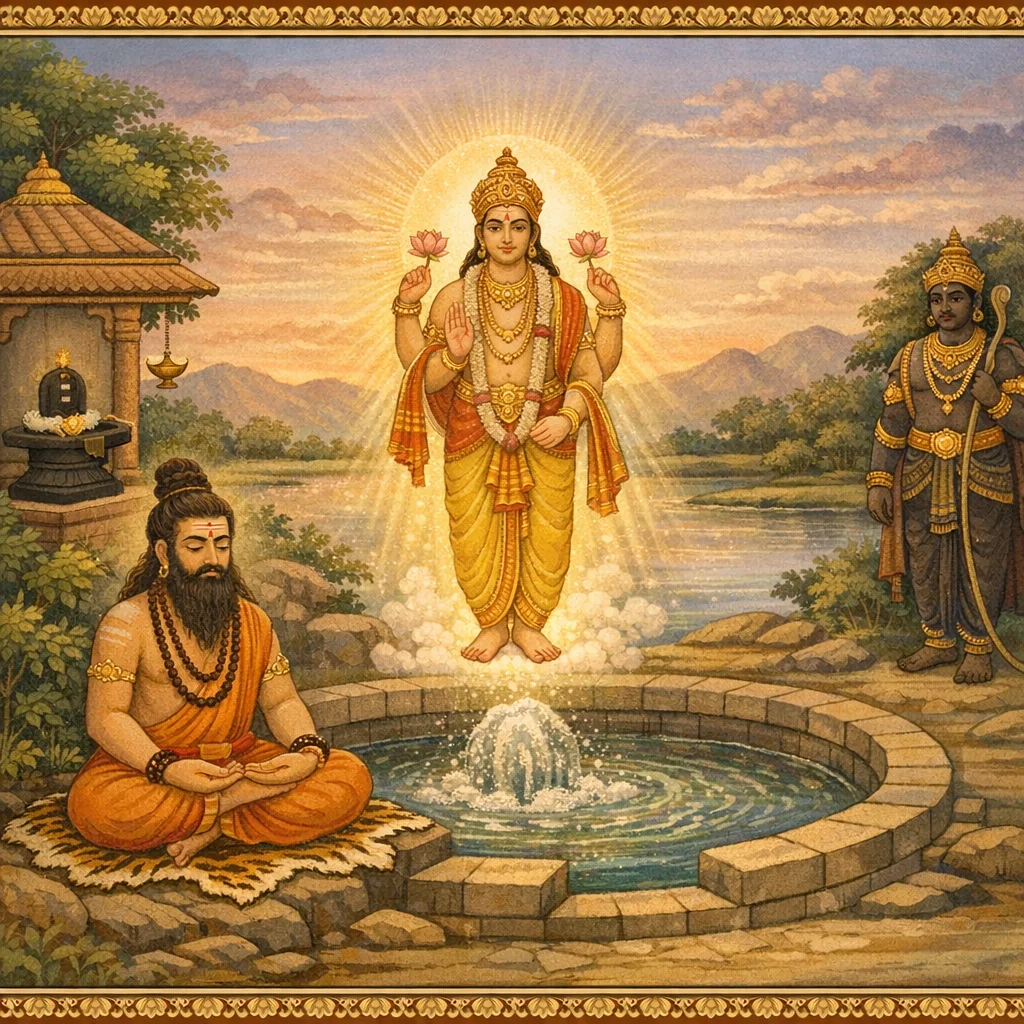
Adhyāya 236 recounts the founding and praised efficacy of the Durvāsā-Āditya (Sūrya) shrine within Prabhāsa-kṣetra. Pilgrims are instructed to approach this holy place where the sage Durvāsas performed a thousand-year tapas, marked by strict restraint and worship of Sūrya. Sūrya appears and offers a boon; Durvāsas asks that the deity abide there perpetually as long as the earth endures, that the site gain renown, and that divine proximity remain with the installed image. Sūrya grants the request. Sūrya then summons Yamunā (as a river-form) and Dharma-rāja Yama to take part in the sacred order of the kṣetra, assigning protective and regulatory roles—especially the safeguarding of devotees and householding brāhmaṇas. The chapter situates the sacred landscape: Yamunā’s emergence by an underground course, mention of a kuṇḍa and the “Dundubhi”/Kṣetrapāla connection, and the ritual fruits of bathing and offerings to ancestors. The latter portion prescribes calendrical observances: worship of Durvāsā-arka on Māgha śukla saptamī, bathing in the Mādhava month with Sūrya-pūjā, and recitation of Sūrya’s thousand names near the shrine. Its phalaśruti promises multiplied merit, relief from grave faults, fulfillment of aims, protection, health, and prosperity. The chapter concludes with boundary and eligibility rules, defining the sacred extent as half a gavyūti and excluding those devoid of Sūrya-bhakti.
Shlokas
Verse 1
ततो गच्छेन्महादेवि दुर्वासादित्यमुत्तमम् । यत्र दुर्वाससा तप्तं तपो वर्षसहस्रकम् । निराहारो जिताहारः सूर्याराधनतत्परः
Then, O Great Goddess, one should go to the excellent shrine of Durvāsāditya, where Durvāsas performed austerity for a thousand years—fasting, mastering his intake, and wholly devoted to the worship of Sūrya, the Sun.
Verse 2
एवं कालेन महता दिव्यतेजा जनाधिपः । प्रत्यक्षं दर्शनं गत्वा प्राह सूर्यो महामुनिम्
Thus, after a long time, the radiant lord (Durvāsas), a ruler among men, attained a direct vision; and Sūrya appeared and spoke to the great sage.
Verse 3
सूर्य उवाच । मा ब्रह्मन्साहसं कार्षीर्वरं वरय सुव्रत । अप्राप्यमपि दास्यामि यत्ते मनसि वर्तते
Sūrya said: “O Brahmin, do not act rashly. Choose a boon, O man of excellent vow. Even what is difficult to obtain, I shall grant—whatever abides in your mind.”
Verse 4
दुर्वासा उवाच । प्रसन्नो यदि मे देव वरार्हो यदि चाऽप्यहम् । अत्र स्थाने त्वया स्थेयं यावत्तिष्ठति मेदिनी
Durvāsā said: “If you are pleased with me, O Lord, and if I am indeed worthy of a boon, then dwell in this very place as long as the earth endures.”
Verse 5
दुर्वासादित्यना माऽत्र लोके ख्यातिं च गच्छतु । मया प्रतिष्ठिता या तु प्रतिमा तव सुन्दरी
“And in this world, let the name ‘Durvāsā-Āditya’ become renowned here. And let your beautiful image—the pratimā I have installed—be likewise celebrated and revered.”
Verse 6
तस्यां सांनिध्यमेवास्तु तव देव जगत्पते । सांनिध्यं कुरुत चात्र यमुना दुहिता तव । त्वत्सुतस्तु महातेजा धर्मराजो महाबलः
In that sacred image, let Your presence truly abide, O God, Lord of the world. And here as well, let Yamunā, Your daughter, establish her presence; and let Your son—Dharmarāja, mighty and greatly radiant—also abide here.
Verse 7
सूर्य उवाच । एतत्सर्वं मुनिश्रेष्ठ त्वयोक्तं संभविष्यति । तीर्थानां कोटिरन्या च गंगादीनां महामुने
Sūrya said: “O best of sages, all that you have spoken shall indeed come to pass. And, O great seer, there shall also be another crore of tīrthas—beginning with the Gaṅgā and the rest—associated with this place.”
Verse 8
आगमिष्यति ते स्थानं निश्चितं वचनान्मम । अत्र स्थाने मया ब्रह्मन्स्थातव्यं सह दैवतैः
Your place shall surely come to be, by the certainty of my word. O Brahmin, in this place I must dwell together with the deities.
Verse 9
आदित्यानां प्रभावैस्तु ब्रह्मांडोदरवासिनाम् । तेषां माहात्म्यसंयुक्तः स्थास्ये चात्र महामुने
Indeed, by the powers of the Ādityas who dwell within the cosmic sphere, O great sage, I shall abide here too, endowed with their greatness (māhātmya).
Verse 10
सवितॄणां सहस्रेण दृष्टेनैव तु यत्फलम् । तत्फलं कोटिगुणितं दुर्वासादित्यदर्शनात्
Whatever merit arises merely from beholding a thousand Sūryas, that very merit becomes multiplied a crore-fold by the darśana of Durvāsā-Āditya.
Verse 11
लप्स्यंते प्राणिनः सर्वे यज्ञकोटिफलं तथा । एवमुक्त्वा तदा सूर्यः सस्मार तनयां निजाम् । तथा च धर्मेराजानं सर्वप्राणिनियामकम्
“All living beings shall obtain the fruit of a koṭi (a crore) of sacrifices as well.” Having spoken thus, Sūrya then remembered his own daughter, and also Dharmarāja, the king who restrains and governs all creatures.
Verse 12
स्मृतमात्रा तत्र भित्त्वा पातालतलमुद्ययौ । सा नदीरूपिणी देवी तीर्थकोटिसमन्विता
The moment she was remembered, she rose up there, breaking through the surface of Pātāla, the netherworld. That Goddess, taking the form of a river, emerged endowed with a koṭi (a crore) of tīrthas.
Verse 13
यमश्च तत्र भगवान्कालदंडधरस्तदा । ऊचतुः प्रणयोपेतौ सूर्यं भुवनसाक्षिणम्
Then Yama too—the venerable Lord who bears the staff of Time—spoke there with affectionate reverence, addressing Sūrya, the witness of all the worlds.
Verse 14
यम उवाच । आज्ञापयतु मां देवो यमुनां च जगत्प्रभुः । कार्यं यद्भाविनोऽर्थस्य तत्करिष्ये न संशयः
Yama said: “Let the Lord of the world command me—and Yamunā as well. Whatever must be done for the sake of what is to come, that I shall accomplish without doubt.”
Verse 15
सूत उवाच । अत्र क्षेत्रे स्वरूपेण स्थातव्यं वचनान्मम । पापिनां प्राणिनां चात्र रक्षा कार्या प्रयत्नतः
Sūta said: “In this sacred region you must remain in your own manifested form, according to my word; and here you must diligently provide protection even to sinful beings.”
Verse 16
सूर्यभक्ताः सदा रक्ष्या ब्राह्मणा गृहमेधिनः । त्वं चापि यमुने चात्र कोटितीर्थेन संयुता
The devotees of Sūrya must ever be protected—especially the brāhmaṇas who uphold the dharma of the householder. And you too, O Yamunā, are to be established here, joined with Koṭitīrtha.
Verse 17
वस त्वं भव सुप्रीता स्थाने दुर्वाससोद्भवे । इत्येवमुक्त्वा देवेशस्तत्र दुर्वाससोंऽतिके
“Dwell here and be well-pleased, in this place that arose through Durvāsas.” Having spoken thus, the Lord of the gods remained there near Durvāsas.
Verse 18
पश्यतां सर्वदेवानामंतर्द्धानमगात्प्रभुः । दुर्वासास्तु तदा हृष्टो यावत्पश्यति स्वाश्रमम्
While all the gods looked on, the Lord vanished from sight. Then Durvāsas, delighted, went on until he beheld his own hermitage.
Verse 19
तावत्पातालमार्गेण यमुना प्रादुराभवत् । यमश्च भगवांस्तत्र दृष्टः क्षेत्रपरूपधृक्
Just then, Yamunā manifested by a subterranean path. And the venerable Yama was seen there, assuming the form of the kṣetra’s guardian.
Verse 20
ईश्वर उवाच । इत्थं समभवत्तत्र यमुनोद्भेदमुत्तमम् । कुण्डमादित्यतो याम्ये दुंदुभिस्तत्र पूर्वतः
Īśvara said: “Thus, in that place occurred the excellent emergence of Yamunā. To the south of Āditya there is a pond, and to its east is the tīrtha called Duṃdubhi.”
Verse 21
क्षेत्रपालो महादेवि यतो दुंदुभिनिःस्वनः । तत्र स्नात्वा महाकुण्डे यः संतर्पयते पितॄन्
O great Goddess, where the sound of the Duṃdubhi is heard—there abides Kṣetrapāla, guardian of the sacred ground. Having bathed there in the great pond, whoever offers tarpaṇa to satisfy the Pitṛs…
Verse 22
दश वर्षाणि पञ्चैव तृप्तिं यांति पितामहः । पिंडदानेन दत्तेन पितॄणां तुष्टिमावहेत् । नरके तु स्थितानां च मुक्तिर्भूयान्न संशयः
The ancestors attain satisfaction for fifteen years. By the offering of piṇḍas one brings contentment to the Pitṛs; and even for those who abide in hell, liberation becomes abundant—of this there is no doubt.
Verse 23
माघे मासि सिते पक्षे सप्तम्यां संयतात्मवान् । दुर्वासार्कं च संपूज्य मुच्यते ब्रह्महत्यया
In the month of Māgha, in the bright fortnight, on the seventh lunar day, the self-restrained devotee who duly worships Durvāsārka (Durvāsā’s Sun) is released from the sin of brahma-hatyā, the gravest crime of slaying a brāhmaṇa.
Verse 24
स्नात्वा तु यमुना कुण्डे माधवे मासि मानवः । पूजयेद्भक्तिभावेन रविं गगनभूषणम्
Having bathed in the Yamunā-kuṇḍa in the month of Mādhava (Vaiśākha), one should worship Ravi—the Sun, ornament of the sky—with a heart of devotion.
Verse 25
पठेत्सहस्रं नाम्ना तु दुर्वासादित्यसंनिधौ । षण्मासान्मुच्यते जंतुर्यद्यपि ब्रह्महा नरः
In the presence of Durvāsāditya one should recite the ‘thousand names’ (sahasranāma). Within six months a being is freed—even if he is a man guilty of brahma-hatyā.
Verse 26
सर्वमंगलमांगल्यं सर्वपापप्रणाशनम् । दुर्वासादित्यनामानं सूर्यं को नु न पूजयेत्
The Sun who bears the name Durvāsāditya is the auspiciousness of all that is auspicious and the destroyer of every sin—who indeed would not worship that Sun?
Verse 27
न तदस्ति भयं किंचिद्यदनेन न शाम्यति । दर्शनेनापि सूर्यस्य तत्र दुर्वाससः प्रिये
Beloved of Durvāsā, there is no fear whatsoever that is not pacified by this; indeed, even by merely beholding the Sun there, fear is calmed.
Verse 28
संपद्यंते तथा कामाः सर्व एव यथेप्सिताः । बंध्यानां पुत्रफलदं भीतानां भयनाशनम्
Thus all desires are fulfilled exactly as wished; it grants the fruit of a son to the barren and destroys the fear of the frightened.
Verse 29
भूतिप्रदं दरिद्राणां कुष्ठिनां परमौषधम् । बालानां चैव सर्वेषां ग्रहरक्षोनिवारणम् । महापापोपशमनं दुर्वासादित्यदर्शनम्
The sight of Durvāsāditya bestows prosperity upon the poor, is the supreme medicine for those afflicted with leprosy, wards off planetary afflictions and harmful spirits for all children, and pacifies even great sins.
Verse 30
हेमाश्वस्तत्र दातव्यः सूर्यमुद्दिश्य भामिनि । ब्राह्मणे वेदसंयुक्ते तेन दत्ता मही भवेत्
O fair lady, there one should gift a golden horse, dedicating it to the Sun; when given to a brāhmaṇa learned in the Vedas, that gift is as though the very earth has been bestowed.
Verse 31
यस्तत्र पूजयेद्देवं क्षेत्रपालं च दुन्दुभिम् । स पुत्रपशुमान्धीमाञ्छ्रीमान्भवति मानवः
Whoever worships the Deity there—together with the Kṣetrapāla and Dundubhi—becomes a person blessed with sons and cattle, endowed with wisdom, and prosperous.
Verse 32
न भयं जायते तस्य त्रिविधं वरवर्णिनि । अर्धगव्यूतिमात्रं तु तत्र क्षेत्रं रवेः स्मृतम्
O lady of excellent complexion, in him no threefold fear arises; and the sacred domain of Ravi (the Sun) there is said to extend only for half a gavyūti.
Verse 33
न तत्र प्रविशेज्जन्तुः सूर्यभक्तिविवर्जितः । इत्येतत्कथितं देवि माहात्म्यं सूर्यदैवतम्
No creature should enter that sacred place if devoid of devotion to Sūrya. Thus, O Devī, has been declared this Māhātmya in which the Sun is the presiding divinity.
Verse 236
इति श्रीस्कांदे महापुराण एकाशीतिसाहस्र्यां संहितायां सप्तमे प्रभासखण्डे प्रथमे प्रभासक्षेत्रमाहात्म्ये दुर्वासादित्यमाहात्म्यवर्णनंनाम षट्त्रिंशदुत्तरद्विशततमोऽध्यायः
Thus ends, in the Śrī Skanda Mahāpurāṇa—within the Saṃhitā of eighty-one thousand verses, in the seventh book called the Prabhāsa Khaṇḍa, in the first division named the Prabhāsakṣetra Māhātmya—the chapter entitled “The Description of the Greatness of Durvāsā and Āditya,” being Chapter 236.