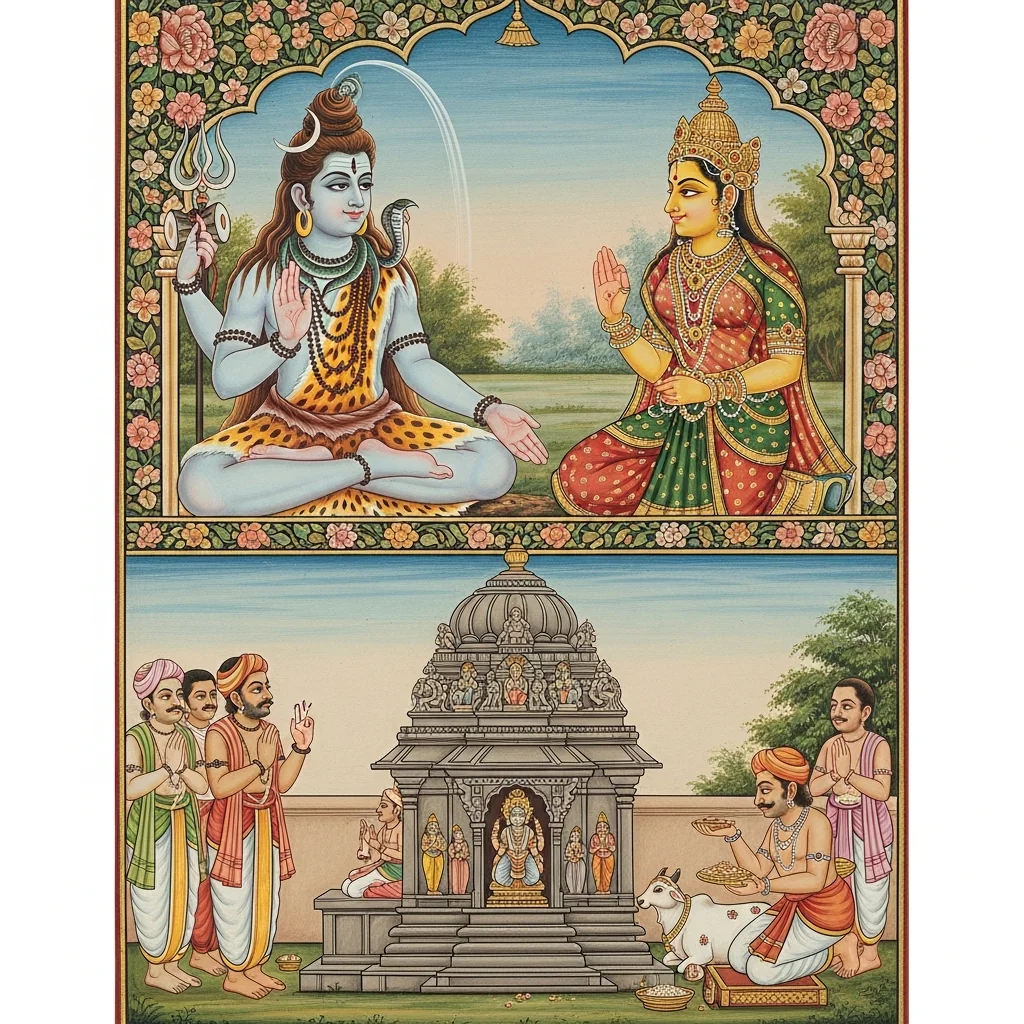
Adhyaya 53
Set within a Śiva–Devī dialogue, the chapter directs the pilgrim to Kapileśvara, an eminent liṅga situated not far to the east along the stated route. This liṅga is praised as mahāprabhāva, and it is explicitly declared that mere darśana—beholding it in reverence—destroys demerit. The shrine’s sanctity is traced to the austerities of the royal sage Kapila, who established (pratiṣṭhā) Mahādeva there and attained the highest siddhi. The text further affirms unbroken divine proximity at this liṅga (deva-sānnidhya), underscoring the site’s enduring ritual efficacy. A calendrical observance is then prescribed: on the bright fortnight’s fourteenth lunar day (śukla-caturdaśī), a disciplined devotee who beholds Soma/Someśa as Kapileśvara seven times for the welfare of all worlds gains merit equal to the gift of a cow (go-dāna-phala). Finally, one who donates a tila-dhenu—a symbolic cow made of sesame—at that tīrtha with focused attention is promised residence in heaven for as many yugas as there are sesame seeds, as the chapter’s phalaśruti and ethical incentive.
Shlokas
Verse 1
ईश्वर उवाच । ततो गच्छेन्महादेवि कपिलेश्वरमुत्तमम् । तस्यैव पूर्वदिग्भागे नातिदूरे व्यव स्थितम्
Īśvara said: “Then, O great goddess, one should proceed to the excellent Kapileśvara. It is situated not very far, in the eastern quarter of that very place.”
Verse 2
लिंगं महाप्रभावं तु दर्शनात्पापनाशनम् । कपिलोनाम राजर्षिर्यत्र तप्त्वा महातपः
“The liṅga there is of great power; by its very sight sins are destroyed. It is the place where the royal sage named Kapila performed mighty austerities.”
Verse 3
संप्राप्तः परमां सिद्धिं प्रतिष्ठाप्य महेश्वरम् । देवसांनिध्यमीशानं तस्मिंल्लिंगे सदा हरिः
Having installed Maheśvara, he attained the supreme siddhi. That liṅga is a seat of divine presence—Īśāna is there, and Hari too abides there always.
Verse 4
शुक्लपक्षे चतुर्दश्यां सर्वलोकहितार्थतः । सप्तकृत्वो महादेवं सोमेशं कपिलेश्वरम् । यः पश्येत्प्रयतो भूत्वा स गोदानफलं लभेत्
On the fourteenth lunar day of the bright fortnight, for the welfare of all worlds, whoever—disciplined and intent—beholds seven times Mahādeva, Someśa, Kapileśvara, gains merit equal to the gift of a cow.
Verse 5
तिलधेनुं च यो दद्यात्तस्मिंस्तीर्थे समाहितः । तिलसंख्यायुगान्येव स स्वर्गे वसति प्रिये
And whoever, with a focused mind, gives a “tiladhenu” (a sesame-cow) at that tīrtha—O beloved—dwells in heaven for as many yugas as there are sesame seeds.
Verse 53
इति श्रीस्कान्दे महापुराण एकाशीतिसाहस्र्यां संहितायां सप्तमे प्रभासखण्डे प्रथमे प्रभासक्षेत्रमाहात्म्ये कपिलेश्वरमाहात्म्यवर्णनं नाम त्रिपञ्चाशोऽध्यायः
Thus, in the revered Skanda Mahāpurāṇa, in the Saṃhitā of eighty-one thousand verses, within the seventh book—the Prabhāsa Khaṇḍa—within the first division, the Prabhāsa Kṣetra Māhātmya, ends the fifty-third chapter called “The Description of the Greatness of Kapileśvara.”