Adhyaya 227
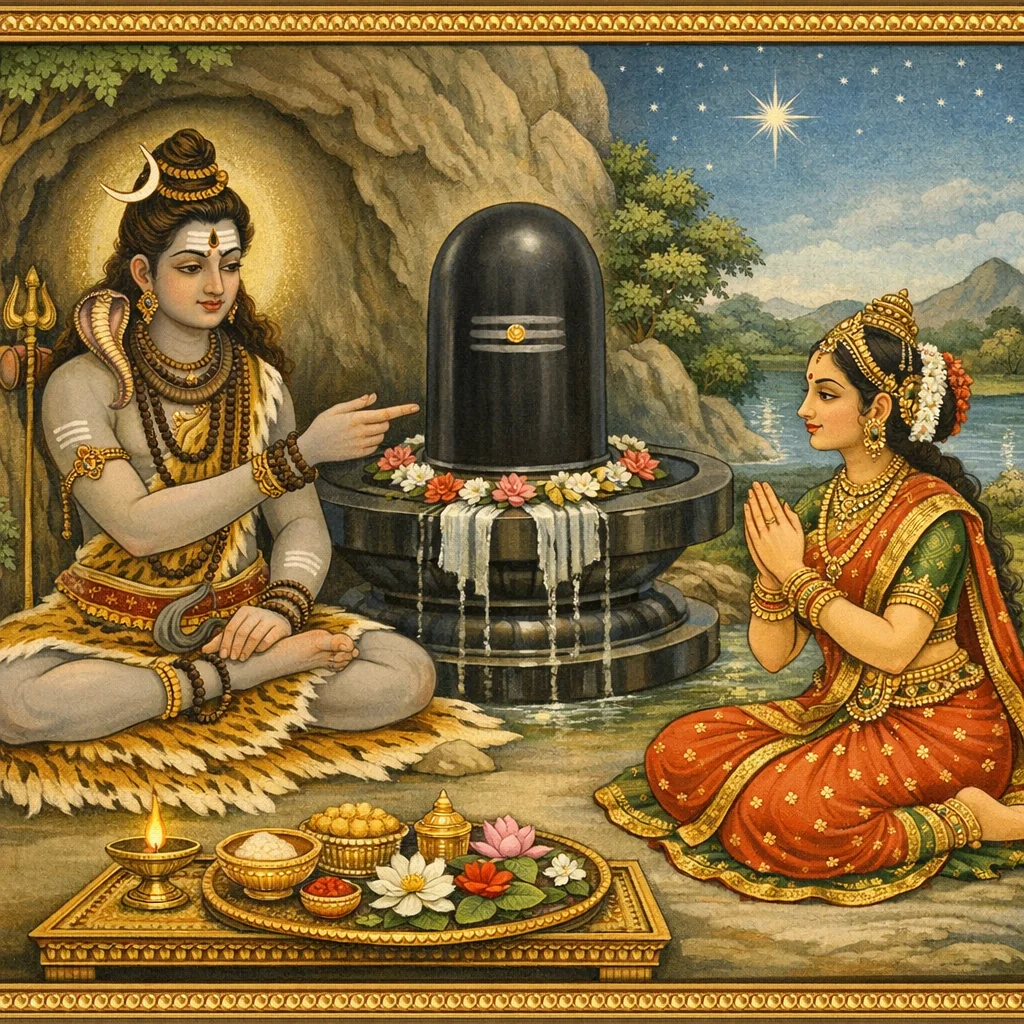
In this chapter, Īśvara instructs Devī to proceed to the liṅga established by Balabhadra. This liṅga is praised as a remover of great sin (mahāpāpa-hara) and as a “mahāliṅga” bestowing the great fruit of spiritual accomplishment (mahāsiddhi-phala); its installation is explicitly credited to Balabhadra, performed according to proper rite (vidhinā) for the sake of purification from sin (pāpa-śuddhi). A devotional procedure is then set forth: worship with sequential offerings such as fragrance and flowers (gandha-puṣpādi). Observed during the third Revati-yoga, the devotee is said to attain “yogeśa-pada,” an exalted yogic state. The colophon identifies this as the 227th chapter of the first section (Prabhāsakṣetramāhātmya) within the Prabhāsa Khaṇḍa of the Skanda Mahāpurāṇa.
Shlokas
Verse 1
ईश्वर उवाच । ततो गच्छेन्महादेवि बलभद्रप्रतिष्ठितम् । लिंगं महापापहरं गात्रोत्सर्गात्तदुत्तरे
Īśvara said: Then, O Great Goddess, one should go to the liṅga consecrated by Balabhadra—an eraser of great sins—located to the north of Gātrotsarga.
Verse 2
महालिंगं महादेवि महासिद्धि फलप्रदम् । बलभद्रेण विधिना स्थापितं पापशुद्धये
O Great Goddess, it is a great liṅga, bestowing the fruits of great attainments. Balabhadra established it according to proper rite, for the purification of sin.
Verse 3
यस्तं पूजयते भक्त्या गन्धपुष्पादिभिः क्रमात् । तृतीयारेवतीयोगे स योगेशपदं लभेत्
Whoever worships that (liṅga) with devotion, in due order with fragrance, flowers, and the like—on the third lunar day when it coincides with Revatī—attains the state of a lord of yoga.
Verse 227
इति श्रीस्कांदे महापुराण एकाशीतिसाहस्र्यां संहितायां सप्तमे प्रभासखण्डे प्रथमे प्रभासक्षेत्रमाहात्म्ये बलभद्रेश्वरमाहात्म्य वर्णनंनाम सप्तविंशत्युत्तरद्विशततमोऽध्यायः
Thus ends the two-hundred-and-twenty-seventh chapter, called “The Description of the Greatness of Balabhadreśvara,” in the Prabhāsa-khaṇḍa—within the Prabhāsakṣetra-māhātmya—of the Śrī Skanda Mahāpurāṇa, in the Saṃhitā of eighty-one thousand verses.