Adhyaya 153
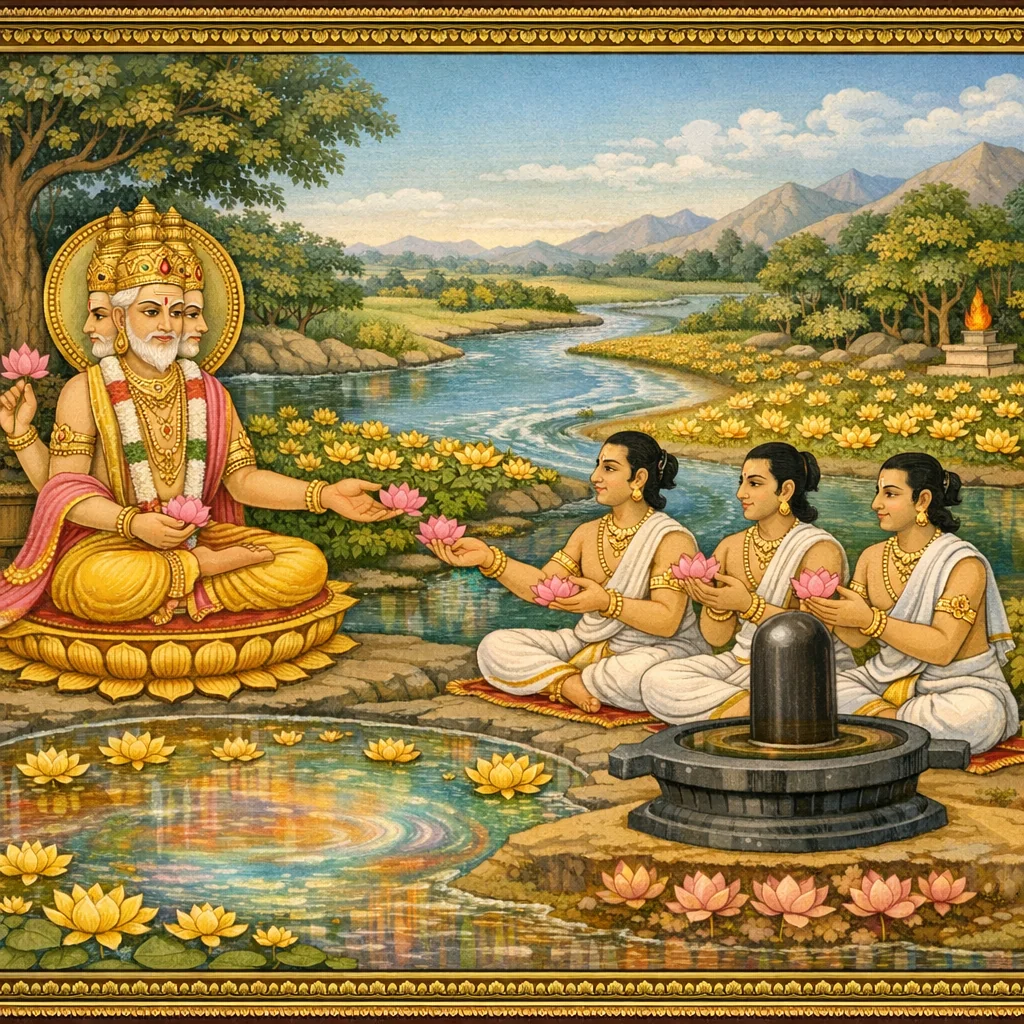
Īśvara tells Devī of Hiraṇyeśvara’s location and saving power: a supreme liṅga set northwest of Brahmakuṇḍa, near Kṛtasmarā, Agnitīrtha, Yameśvara, and the northern oceanic region. It belongs to the wider sacred landscape around Brahmakuṇḍa, where the renowned “five Bhairavas” are also mentioned. Brahmā performed fierce tapas on the liṅga’s eastern side and began an excellent yajña. Devas and ṛṣis arrived to claim their allotted shares, but the sacrifice stalled when the dakṣiṇā (honorarium and gifts for the priests) proved insufficient. Brahmā appealed to Mahādeva; by divine prompting Sarasvatī was invoked for the gods’ welfare and became kāñcana-vāhinī, the gold-bearing stream. Flowing westward, she produced countless golden lotuses, filling the land up to Agnitīrtha. Brahmā distributed these golden lotuses as dakṣiṇā, completed the yajña, and hid the remaining lotuses beneath the earth, installing the liṅga above them—hence the name Hiraṇyeśvara, worshipped with divine golden lotuses. The chapter adds tīrtha lore: Brahmakuṇḍa’s water appears multi-colored and, because of the submerged lotuses, is said to turn gold-like for a moment. The phalaśruti concludes that seeing or worshipping Hiraṇyeśvara removes wrongdoing and dispels poverty; worship on Māgha caturdaśī equals honoring the entire cosmos; and hearing or reciting this account with devotion leads to devaloka and freedom from sins.
Shlokas
Verse 1
ईश्वर उवाच । ततो गच्छेन्महादेवि हिरण्येश्वरमुत्तमम् । ब्रह्मकुण्डस्य वायव्ये धनुषां द्वितये स्थितम्
Īśvara said: “Then, O Great Goddess, one should go to the excellent Hiraṇyeśvara, situated to the northwest of Brahmakuṇḍa, at a distance of two bow-lengths.”
Verse 2
सर्वपापप्रशमनं दारिद्र्यौघविनाशनम् । कृतस्मराच्च परतो ह्यग्नितीर्थाच्च पूर्वतः
It is the pacifier of all sins and the destroyer of torrents of poverty—lying to the west of Kṛtasmarā and to the east of Agnitīrtha.
Verse 3
यमेश्वराच्च नैरृत्ये समुद्रस्योत्तरे तथा । तस्य लिंगस्य प्राग्भागे ब्रह्मा तेपे महत्तपः । आराधयामास तदा देवदेवं त्रिलोचनम्
To the southwest of Yameśvara and likewise to the north of the sea—there, on the eastern side of that liṅga, Brahmā performed great austerity and then worshipped the God of gods, the three-eyed Lord.
Verse 4
ततस्तुष्टो महादेवो ब्रह्मन्ब्रूहि वरो मम
Then Mahādeva, being pleased, said: “O Brahman, speak—your boon is granted by me.”
Verse 5
ब्रह्मोवाच । यदि तुष्टोऽसि मे देव याज यामीति मे मतिः । स्थानं च यन्महापुण्यं तन्ममाख्यातुमर्हसि
Brahmā said: “If you are pleased with me, O Lord, my wish is to perform a yajña, a sacred sacrifice. And you should declare to me that supremely meritorious holy place.”
Verse 6
ईश्वर उवाच । कृतस्मराद्ब्रह्मकुंडं यमेशात्सागरावधि । एतदंतरमासाद्य पापी चापि विमुच्यते
Īśvara said: “From Kṛtasmarā to Brahmakuṇḍa, and from Yameśvara to the ocean’s edge—whoever reaches and abides within this sacred tract in between, even if sinful, is released from sin.”
Verse 7
वहेद्विषुवती तत्र सदा पुण्यात्मनां नृणाम् । यत्र तत्र कुरु विभो मनसा ते यथेप्सितम्
May the river Viṣuvatī flow there always for men of righteous soul. O mighty Lord, do, wherever you will, whatever your mind desires.
Verse 8
इत्युक्तः स तदा ब्रह्मा प्रारेभे यज्ञमुत्तमम्
Thus addressed, Brahmā then commenced an excellent sacrifice.
Verse 9
ततो भागार्थिनो देवा इन्द्राद्यास्तत्र चागताः । ऋषयो भागकामास्तु सर्वे तत्र समागताः
Then the gods—Indra and the rest—came there seeking their allotted shares in the sacrifice. The sages too, desiring their portions, all assembled there.
Verse 10
ततो यज्ञागतेभ्यः स दक्षिणामददात्पुनः । ततोऽथ दक्षिणा क्षीणा दीयमाना यशस्विनि
Then he again bestowed sacrificial gifts (dakṣiṇā) upon those who had come for the yajña. Thereupon, O illustrious one, the dakṣiṇā was depleted even as it was being given.
Verse 11
ततोब्रह्मा बहूद्विग्नो दध्यौ वै मनसा तदा । बद्धाञ्जलिपुटो भूत्वा इदं वचनमब्रवीत्
Then Brahmā, greatly distressed, reflected within his mind. With hands joined in reverence, he spoke these words.
Verse 12
भगवन्वै विरूपाक्ष क्रतुर्नैव समाप्यते । दक्षिणाहै न्यतो देव न याति परिपूर्णताम्
O Blessed One, O Virūpākṣa, this sacrificial rite cannot be brought to completion. Deprived of the requisite dakṣiṇā, O God, it does not attain full perfection.
Verse 13
दक्षिणासहिताः सर्वे यथा यांति तथा कुरु । पितामहवचः श्रुत्वा कृत्वा ध्यानं तदा मया
“See that all depart as is proper, duly furnished with dakṣiṇā—do so that it may be accomplished.” Having heard the words of Pitāmaha (Brahmā), I then entered meditation.
Verse 14
स्मृता सरस्वती देवी देवानां हितकाम्यया । आगता सा महापुण्या उक्ता देवी मया तदा
With the welfare of the gods in mind, Goddess Sarasvatī was remembered and invoked. That supremely meritorious Devī came forth; and then I addressed the Goddess.
Verse 15
पद्मयोनेर्धनं क्षीणं क्रतुर्वै न समाप्यते । तस्मान्मम प्रसादेन भव काञ्चनवाहिनी
Padmayoni’s (Brahmā’s) wealth is exhausted, and therefore the sacrifice cannot be completed. Hence, by my grace, become Kāñcanavāhinī—she who bears a stream of gold.
Verse 16
सरस्वत्यास्ततः स्रोत उत्थितं पश्चिमामुखम् । काञ्चनानां तु पद्मानि उच्छ्रितानि सहस्रशः
Then from Sarasvatī a current arose, flowing westward; and thousands upon thousands of golden lotuses sprang up, rising aloft.
Verse 17
काञ्चनेन प्रवाहेण तोयं सारस्वतं शुभम् । दैत्यसूदनमासाद्य अग्नितीर्थावधि प्रिये । पूरयामास पद्मैश्च कोटिशश्च समंततः
With a golden current, the auspicious Sarasvatī waters flowed on. Reaching Daityasūdana and extending up to Agnitīrtha, O beloved, it filled the region on every side with lotuses—by crores.
Verse 18
काञ्चनानि तु तान्येव दत्त्वा विप्रेषु दक्षिणाम् । यज्ञं निर्वर्तयामास हृष्टो ब्रह्मा द्विजैः सह
Using those very pieces of gold as dakṣiṇā for the brāhmaṇas, Brahmā—delighted—completed the sacrifice together with the twice-born priests.
Verse 19
शेषाणि यानि पद्मानि तानि निःक्षिप्य भूतले । तदूर्ध्वं स्थापयामास लिगं तु कनके श्वरम्
Whatever golden lotuses remained, he cast them upon the ground; and above them he established a liṅga known as Kanakeśvara.
Verse 20
तत्र लिंगं प्रतिष्ठाप्य सर्वदेवनमस्कृतम् । ऋषिभ्यो दक्षिणां प्रादादेकैकस्य यथाक्रमम् । काञ्चनानां च पद्मानां प्रत्येकमयुतं ददौ
There he installed the liṅga revered by all the gods, and gave dakṣiṇā to the sages—each one in due order. And to each he granted ten thousand golden lotuses.
Verse 21
ततः शेषाणि पद्मानि निहितानि धरातले । ब्रह्मकुण्डस्य मध्ये तु नापुण्यो लभते नरः
Thereafter, the remaining lotuses were placed upon the earth. But in the midst of Brahmakuṇḍa, no person without merit gains access or benefit.
Verse 22
तत्कुण्डतोयमद्यापि नानावर्णं प्रदृश्यते । तत्राधः पद्मसंयोगान्नीरं स्वर्णायते क्षणात्
Even today, the water of that sacred pool appears in many hues. There, by contact with the lotus-bed below, the water turns golden in an instant.
Verse 23
हिरण्मयानि पद्मानि अधः कृत्वा प्रजापतिः । लिंगमूर्ध्वं प्रतिष्ठाप्य स्वयं पूजितवांस्तदा । हिरण्यकमलैर्दिव्यैर्हिरण्येशस्ततोऽभवत्
Prajāpati arranged golden lotuses beneath, and establishing the liṅga upright, he worshipped it himself at that time. Then, through those divine golden lotuses, the Lord became renowned as Hiraṇyeśa (Hiraṇyeśvara).
Verse 24
सर्वपापप्रशमनं तथा दारिद्र्यनाशनम् । दृष्ट्वा हिरण्मयेशानं सर्वपापैः प्रमुच्यते
It pacifies all sins and destroys poverty. By merely beholding Hiraṇmayeśāna, the Golden Lord, one is released from every sin.
Verse 25
माघ मासे चतुर्दश्यां यस्तल्लिंगं प्रपूजयेत् । पूजितं तेन सकलं ब्रह्माण्डं सचराचरम्
Whoever worships that liṅga on the fourteenth lunar day in the month of Māgha—by him the entire universe, moving and unmoving, is as though worshipped.
Verse 26
सर्वदानानि दत्तानि सर्वे देवाश्च तोषिताः । ब्रह्माण्डं तेन दत्तं स्याद्येन तल्लिंगमर्चितम्
All gifts are deemed to have been given and all the gods satisfied by the one who worships that liṅga; indeed, it is as though he has donated the entire universe.
Verse 27
एतन्मया ते कथितं स्नेहेन वरवर्णिनि । न कस्यचिन्मयाऽख्यातं महागोप्यं वरानने
Out of affection, O fair-complexioned one, I have told you this. I have not disclosed this great secret to anyone else, O beautiful-faced lady.
Verse 28
य इदं शृयुयाद्भक्त्या पठेद्वा भक्तिसंयुतः । स गच्छेद्देवलोकं तु मुक्तः सर्वैस्तु पातकैः
Whoever hears this with devotion, or recites it endowed with devotion, goes to the world of the gods—freed from all sins.
Verse 29
इति ते चातिविख्याताः पवित्राः पञ्च भैरवाः । ब्रह्मकुण्डसमीपस्थाः कथितास्तव सुन्दरि
Thus have I told you, O beautiful one, of the five Bhairavas—highly renowned and purifying—who dwell near Brahmakuṇḍa.
Verse 153
इति श्रीस्कांदे महापुराण एकाशीतिसाहस्र्यां संहितायां सप्तमे प्रभास खण्डे प्रथमे प्रभासक्षेत्रमाहात्म्ये ब्रह्मकुण्डमाहात्म्ये हिरण्येश्वरमाहात्म्यवर्णनंनाम त्रिपञ्चाशदुत्तरशततमोऽध्यायः
Thus ends, in the holy Skanda Mahāpurāṇa—within the compilation of eighty-one thousand ślokas—the one-hundred-and-fifty-third chapter, entitled “The Description of the Greatness of Hiraṇyeśvara,” in the seventh Prabhāsa Khaṇḍa, in the first part, Prabhāsakṣetra Māhātmya, within the Brahmakuṇḍa Māhātmya.