Adhyaya 333
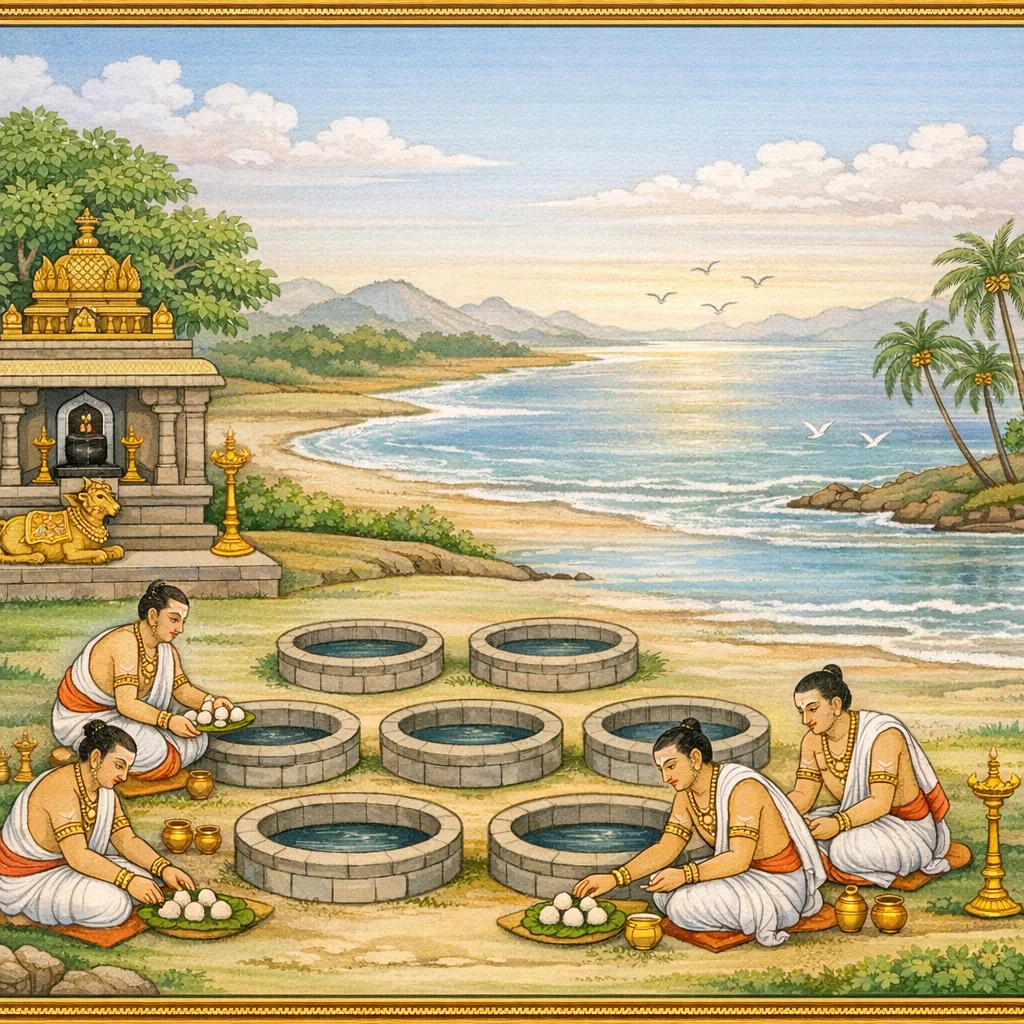
Īśvara describes a sequence of sacred sites in Prabhāsa-kṣetra, arranged around the Bhadrā river and the nearby seacoast. A renowned liṅga called Durvāseśvara is praised for powerful sin-purifying efficacy and for bestowing happiness; bathing on the new-moon day (amāvāsyā) and offering piṇḍa to the ancestors are said to bring them extensive satisfaction. He further states that many liṅgas were installed by ṛṣis, and that pilgrims are freed from faults by seeing, touching, and worshiping them. The chapter marks the kṣetra’s boundary localities: a perimeter place named Madhumatī, and to the south-west a site called Khaṇḍaghaṭa. Near the seashore stands Pingeshvara, and seven wells are mentioned where, on festival occasions, the ancestors’ “hands” are said to be visible—underscoring the power of śrāddha here. Performing śrāddha at this place is declared to yield merit multiplied beyond Gayā. Finally, the Bhadrā confluence (framed east–west) is identified, and its sanctity is equated with Gaṅgā–Sāgara, weaving local geography into pan-Indic ritual esteem.
Shlokas
Verse 1
ईश्वर उवाच । बलभद्राच्च पूर्वेण स्थिता चासीत्सरिद्वरा । दुर्वासेश्वरनामेति बललिंगं प्रतिष्ठितम्
Īśvara said: To the east of the Balabhadrā River there was a most excellent river-bank and stream; there the powerful liṅga was स्थापित, known by the name Durvāseśvara.
Verse 2
सर्वपापप्रशमनं दृष्टं सर्वसुखावहम् । स्नात्वा चास्य त्वमावास्यां पिंडदानं ददाति यः
It is seen to pacify all sins and to bring every happiness. And whoever, having bathed here, offers piṇḍa-dāna on the new-moon day (amāvāsyā)…
Verse 3
कल्पकोटिशतं साग्रं पितॄणां तृप्तिमावहेत् । दुर्वासेश्वरनामानं तत्र पूज्य विधानतः
It brings satisfaction to the ancestors (pitṛs) for a full hundred crores of kalpas. There, Durvāseśvara—so named—should be worshipped according to proper rule.
Verse 4
कोटियज्ञफलं प्राप्य सर्वान्कामा नवाप्नुयात् । तत्र लिंगान्यनेकानि ऋषिभिः स्थापितानि तु
Attaining the fruit of a crore of sacrifices, one obtains all desired aims. There, indeed, many liṅgas have been established by the ṛṣis.
Verse 5
दृष्ट्वा स्पृष्ट्वा पूजयित्वा मुक्तः स्यात्सर्वकिल्बिषैः । इत्येतत्कथितं देवि क्षेत्राद्यं तं यथाक्रमम्
Having seen it, touched it, and worshipped it, one becomes freed from all sins. Thus, O Goddess, this sacred site and its details have been described in due sequence.
Verse 6
भद्रायाः पश्चिमात्पूर्वं यथानुक्रममादितः । श्रुतं पापोपशमनं कोटियज्ञफलप्रदम्
Beginning from the west of the Bhadrā and proceeding eastward in due order, you have heard of that which removes sin and grants the fruit of a crore of sacrifices.
Verse 7
अथ क्षेत्रस्य परिधिस्थानं मधुमतीति च । तस्मान्नैरृत्यदिग्भागे स्थानं खंडघटेति च
Now, the boundary-station of the kṣetra is also called Madhumatī. From there, in the south-western direction, there is a place known as Khaṇḍaghaṭa as well.
Verse 8
तत्र पिंगेश्वरो देवः समुद्रतटसन्निधौ । कूपानां सप्तकं तत्र पितॄणां यत्र पाणयः । दृश्यंतेऽद्यापि देवेशि यत्र पर्वणिपर्वणि
There, near the shoreline of the ocean, stands the deity Piṅgeśvara. In that very place is a group of seven wells, where the hands of the Pitṛs (ancestral spirits) are seen—visible even today, O Goddess, on each and every sacred lunar occasion.
Verse 9
तत्र श्राद्धं नरः कृत्वा गयाकोटिगुणं फलम् । लभते नाऽत्र सन्देहः सोमामा यदि जायते
A man who performs śrāddha there attains fruit a crore times greater than that of Gayā—of this there is no doubt—especially when the sacred occasion of Somāmāvāsyā (the new-moon day falling on a Monday) occurs.
Verse 10
तत्रैव नातिदूरे तु भद्रायाः संगमः स्मृतः । पश्चिमात्संगमात्पूर्वः संगमः समुदाहृतः
There itself, not far away, is remembered the confluence of the Bhadrā. It is declared to be the ‘eastern confluence,’ lying to the east of the ‘western confluence.’
Verse 11
यत्पुण्यं लभते देवि पूर्व पश्चिमसंगमे । गंगासागरयोस्तत्र तद्भद्रासंगमे लभेत्
O Goddess, whatever merit is gained at the eastern and western confluences—there, at Gaṅgā-sāgara where the Gaṅgā meets the ocean—that very same merit is obtained at the confluence of the Bhadrā.
Verse 333
इति श्रीस्कान्दे महापुराण एकाशीतिसाहस्र्यां संहितायां सप्तमे प्रभास खण्डे प्रथमे प्रभासक्षेत्रमाहात्म्ये तप्तोदकस्वामिमाहात्म्ये मधुमत्यां पिंगेश्वरभद्रामाहात्म्यवर्णनंनाम त्रयस्त्रिंशदुत्तरत्रिशततमोऽध्यायः
Thus ends, in the Śrī Skanda Mahāpurāṇa—within the compilation of eighty-one thousand verses—within the seventh, the Prabhāsa Khaṇḍa; in the first, the Prabhāsakṣetra Māhātmya; in the Taptodaka-svāmi Māhātmya, the chapter entitled “The Description of the Greatness of Piṅgeśvara and Bhadrā at Madhumatī,” being Chapter 333.