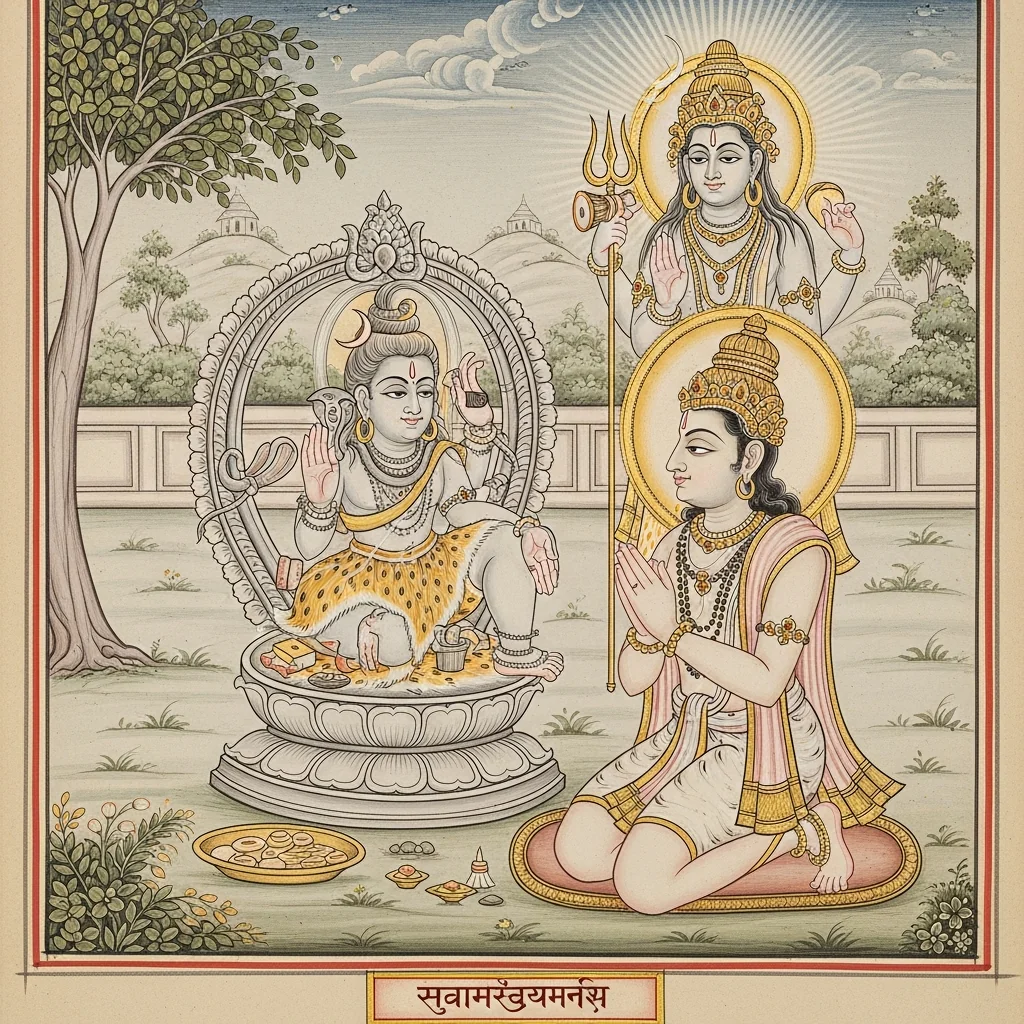
Adhyaya 46
Īśvara instructs Devī to go north to a supremely powerful liṅga known as Budheśvara, praised as a destroyer of all sins through mere darśana (sacred sight). The account establishes the shrine’s sanctity by attributing its founding to Budha (Mercury), who performs prolonged austerities and worship of Sadāśiva for four yuga-like spans (“four years of ten-thousands”), until he attains a direct vision of Śiva. Pleased, Śiva grants Budha the rank of a graha, a planetary regulator. Proper worship of this liṅga—especially on Saumyāṣṭamī, the eighth lunar day associated with Budha—is said to yield merit equal to the Rājasūya sacrifice. The phalaśruti promises protection from misfortune, family ill-luck, separation from what is desired, and fear of enemies, and concludes that reverently hearing this māhātmya leads one toward the highest state (parama pada).
Shlokas
Verse 1
ईश्वर उवाच । ततो गच्छेन्महादेवि तस्यैवोत्तरतः स्थितम् । लिंगं महाप्रभावं तु बुधेश्वरमिति श्रुतम्
Īśvara said: Then, O Great Goddess, one should go to the liṅga situated just to the north of that spot. That liṅga is of great power and is renowned as Budheśvara.
Verse 2
धनुषां द्वितये चैव नातिदूरे व्यवस्थितम् । सर्वपाप हरं लिंगं दर्शनादेव भामिनि
At a distance of just two bow-lengths, not far away, stands that liṅga. Merely by seeing it, O radiant one, it removes all sins.
Verse 3
बुधेन चैव देवेशि तत्र तप्तं महातपः । स्थापितं विमलं लिंगं समाराध्य सदाशिवम्
O Goddess of the Lord, there Budha performed great austerities; and after duly worshipping Sadāśiva, he established a spotless liṅga.
Verse 4
वर्षायुतानि चत्वारि संपूज्य तु विधानतः । अनन्यचेताः शांतात्मा प्रत्यक्षीकृतवान्भवम्
Worshipping according to the ordained rite for four myriads of years, single-minded and serene of soul, he caused Bhava (Śiva) to manifest before him.
Verse 5
ततस्तुष्टमना देवो ग्रहत्वं तस्य तद्ददौ । तं संपूज्य विधानेन सोमपुत्रप्रतिष्ठितम् । सौम्याष्टम्यां विशेषेण राजसूयफलं लभेत्
Then the god, pleased at heart, granted him the rank of a graha (planet). Whoever worships, as enjoined, the Budheśvara liṅga established by the Moon’s son Budha—especially on Saumyāṣṭamī—attains the fruit of a Rājasūya sacrifice.
Verse 6
न दौर्भाग्यं कुले तस्य न चैवेष्टवियोजनम् । शत्रुतो न भयं तस्य भवेत्तस्यप्रसादतः
By his grace there is no misfortune in that person’s family, nor any separation from what is dear. For him there is no fear of enemies—such is the favor of that Lord.
Verse 7
इति संक्षेपतः प्रोक्तं माहात्म्यं बुधदैवतम् । श्रुत्वाऽभिनंद्य प्रयतः प्राप्नोति परमं पदम्
Thus, in brief, the greatness of the deity Budha has been declared. Whoever hears it, reverently assents, and remains disciplined attains the supreme state.
Verse 46
इति श्रीस्कान्दे महापु राण एकाशीतिसाहस्र्यां संहितायां सप्तमे प्रभासखण्डे प्रथमे प्रभासक्षेत्रमाहात्म्ये बुधेश्वरमाहात्म्यवर्णनंनामषट्चत्वारिंशोऽध्यायः
Thus ends the forty-sixth chapter, entitled “The Description of the Greatness of Budheśvara,” in the first Prabhāsa-kṣetra Māhātmya, within the seventh Prabhāsa Khaṇḍa of the Śrī Skanda Mahāpurāṇa, in the compilation of eighty-one thousand verses.