Adhyaya 23
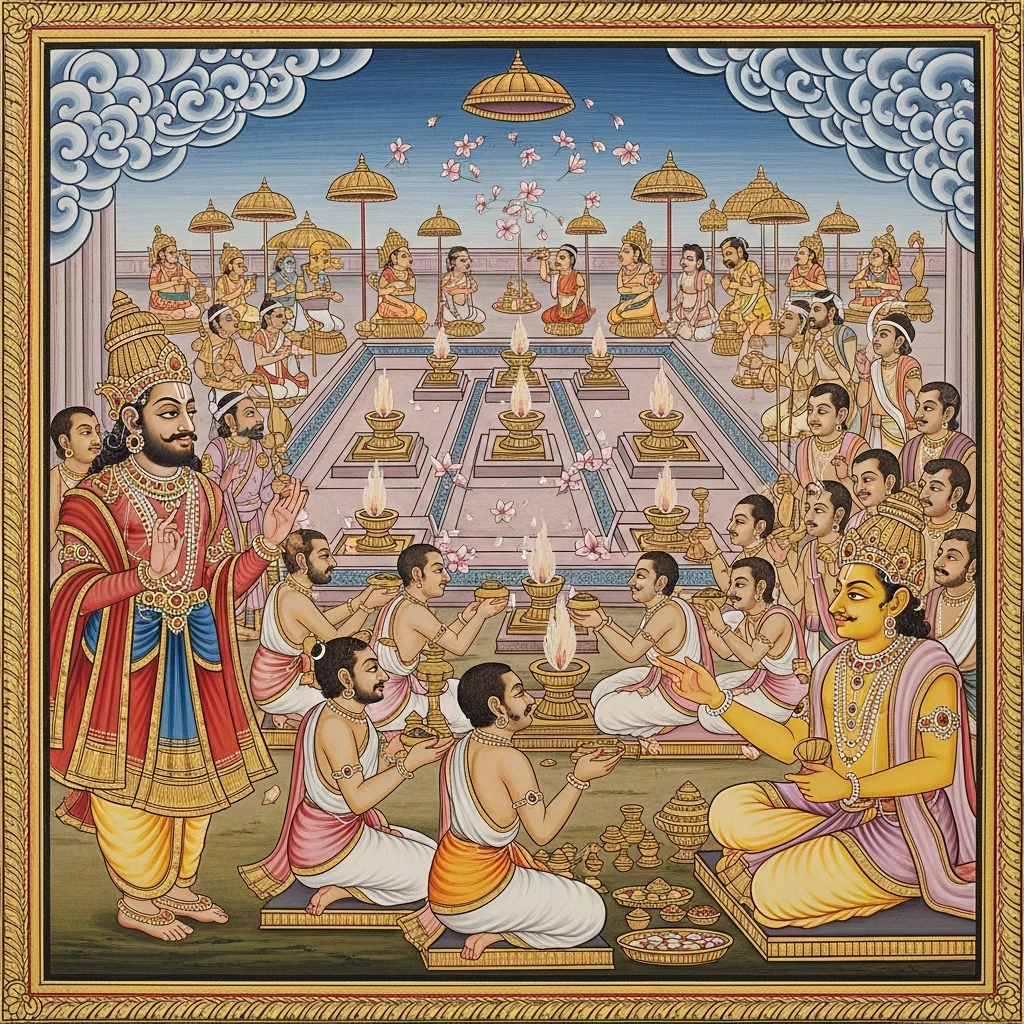
Chapter 23 recounts a ritual-historical sequence at Prabhāsa-kṣetra. Soma (Candra), having received an exalted liṅga from Śambhu, settles at Prabhāsa in devotion and wonder. He entrusts Viśvakarman (Tvaṣṭṛ), the divine artisan, to guard the liṅga and determine its proper site, while he returns to Candraloka to marshal vast resources for a great yajña. The minister Hemagarbha manages the arrangements: he summons brāhmaṇas with their sacred fires, secures vehicles and abundant gifts, and proclaims a universal invitation extending to devas, dānavas, yakṣas, gandharvas, rākṣasas, the kings of the seven islands, and dwellers of the nether realms. At Prabhāsa, ritual structures rise swiftly—maṇḍapas, yūpas, and many kuṇḍas—followed by standard preparations (samid fuel, kuśa grass, flowers, ghee, milk; golden ritual vessels) in festival-like plenty. Hemagarbha reports readiness to Soma and to Brahmā. Brahmā arrives with sages, with Bṛhaspati as purohita, explains his recurring role at Prabhāsa across kalpas (and its name-variants), and directs the brāhmaṇas to assist the consecration, noting a prior fault and the need for restoration. A detailed liturgical ordering then unfolds: multiple maṇḍapas, assignment of ṛtvij offices, Soma’s dīkṣā with Rohiṇī as patnī, distribution of mantra-japa by Vedic branches, construction of kuṇḍas in prescribed geometries by direction, and the raising of dhvajas and sacred trees. In the climax, Brahmā enters the ground, reveals the liṅga, sets it upon a brahma-śilā, performs mantra-nyāsa, and completes the pratiṣṭhā of Somēśa. Auspicious signs appear—smokeless fire, divine drums, a rain of flowers—followed by lavish dakṣiṇā, royal grants and gifts, and Soma’s continuing thrice-daily worship of the installed deity.
Shlokas
Verse 1
ईश्वर उवाच । ततः शांतमना भूत्वा चंद्रमा विस्मयान्वितः । शंभुभक्त्या परीतात्मा प्रभासक्षेत्रमास्थितः
Īśvara said: Then Candra, becoming tranquil in mind and filled with wonder, his inner being suffused with devotion to Śambhu, took his station in the sacred field of Prabhāsa.
Verse 2
पूर्वोक्तं यत्तु देवेन स तथा कृतवान्विभुः । गत्वा सागरमध्ये तु गृहीत्वा लिंगमुत्तमम्
What the God had spoken earlier, that mighty one carried out accordingly: he went into the midst of the ocean and took up the excellent Liṅga.
Verse 3
विश्वकर्म्माणमाहूय सहितं परिचारकैः । आदिदेश स्वयं सोमस्त्वष्टारं देवशिल्पिनम्
Summoning Viśvakarman together with his attendants, Soma himself gave instructions to Tvaṣṭṛ, the divine artisan.
Verse 4
चंद्र उवाच । विश्वकर्मन्निदं लिंगं मम दत्तं तु शंभुना । गृहाण त्वं महाबाहो युक्तस्थाने निवेशय
Candra said: “O Viśvakarman, this Liṅga was given to me by Śambhu. Take it, mighty-armed one, and install it in a proper and fitting place.”
Verse 5
रक्षस्व तावद्गन्तास्मि स्वकीयं भवनं विभो । यज्ञार्थमानयिष्यामि यज्ञोपकरणानि च
“Guard it for the time being, O lord. I shall go to my own abode and bring, for the sake of the sacrifice, the sacrificial requisites as well.”
Verse 6
ईश्वर उवाच । इत्युक्त्वा च तदा चंद्रश्चंद्र लोकं जगाम ह । गत्वा तत्र महादेवि चंद्रलोकंमहाप्रभम्
Īśvara said: Having spoken thus, Candra then went to the world of the Moon. Reaching there, O Mahādevī, that splendid lunar realm…
Verse 7
कोटियोजनविस्तीर्णं सदामृतमयं शुभम् । तत्राहूय महादेवि प्रतीहारं सुमेधसम्
Vast over crores of yojanas, ever filled with nectar and auspicious—there, O Mahādevī, he summoned a wise doorkeeper (pratīhāra).
Verse 8
मंत्रिणं हेमगर्भांगं बृहस्पतिसमं धिया । यज्ञोपस्करसंभारं सर्वमादाय सत्वराः
He also summoned a minister of golden-bodied form, whose intellect was like that of Bṛhaspati; and, taking up all the gathered implements of the yajña, they set out in haste.
Verse 9
प्रभासक्षेत्रं गच्छंतु ममादेशपरायणाः । साग्निभिर्ब्राह्मणैः सार्द्धं गच्छंतु क्षेत्रमुत्तमम्
Let them go to Prabhāsa Kṣetra, devoted to my command. Let them go to that supreme holy field together with the Brāhmaṇas and with the sacred fires.
Verse 10
शीघ्रं संपाद्यतां सर्वं यथा यज्ञः प्रवर्तते । सर्वेषामेव विप्राणां चंद्रलोकनिवासिनाम्
“Let everything be arranged swiftly, so that the yajña may begin—providing for all the Brāhmaṇas, who by their sacred life are worthy of Candraloka, the lunar world.”
Verse 11
पृथक्पृथग्विमानं तु देयं तेषां महाधनम् । गवां च दशलक्षाणां सवत्सानां पयोमुचाम्
“To each of them, a separate splendid conveyance should be given, along with great wealth; and ten million milk-giving cows, each with her calf.”
Verse 12
हेमभारैर्भूषितानां कामधेनूपमत्विषाम् । अश्वानां श्यामकर्णानां सपादं लक्षमेव च
“(Give) horses adorned with loads of gold, radiant like Kāmadhenū; and also one hundred and twenty-five thousand horses with dark ears.”
Verse 13
दंतिनामयुतं चैव घंटाभरणशोभितम् । सहस्राणि च चत्वारि रथानां वातरंहसाम्
And ten thousand elephants, splendid with bell-ornaments; and four thousand chariots, swift as the wind.
Verse 14
लक्षं तु करभाणां च मणिमाणिक्यसंयुतम् । सैन्यानां कोटिरेका तु चतुरंगबलान्विता
And a hundred thousand camels adorned with gems and rubies; and an army exceeding a crore, furnished with the fourfold divisions—elephants, chariots, cavalry, and infantry.
Verse 15
अग्निशौचानि वस्त्राणि ब्राह्मणार्थं तथैव च । विभूषणानि दिव्यानि ऋत्विगर्थं शुभानि च
Fire-purified (ritually clean) garments should likewise be given for the brāhmaṇas; and auspicious, divine ornaments for the officiating priests (ṛtviks).
Verse 16
नानाभक्ष्याणि भोज्यानि पानानि विविधानि च । लक्षं कर्मकराणां तु दासीनां लक्षमेव च
(Provide) many kinds of foods to eat, meals to be served, and diverse drinks; and a hundred thousand workers, and likewise a hundred thousand maidservants.
Verse 17
दारुवंशावधि प्रोक्तं यत्किंचित्स्वं मदाज्ञया । अन्यद्यद्ब्राह्मणा ब्रूयुस्तत्सर्वं तत्र नीयताम्
Whatever has been specified—down to timber and bamboo—by my command as necessary supplies, and whatever else the brāhmaṇas may request: let all of that be taken there.
Verse 18
देवानां दानवानां तु यक्षगंधर्वरक्ष साम् । सप्तद्वीपक्षितीशानां सप्तपातालवासिनाम्
Of the gods, and also of the dānavas; of yakṣas, gandharvas, and rākṣasas; of the kings of the seven continents, and of those dwelling in the seven netherworlds—
Verse 19
नानानृपसहस्राणां घोषणा क्रियतां मुहुः । सर्वेषां घोषणा कार्या प्रभासागमनं प्रति
Let proclamation be made again and again to thousands of diverse kings; proclamation should be made to all, regarding the journey to Prabhāsa.
Verse 20
इत्युक्त्वा मंत्रिणं तत्र चंद्रमास्त्वरयाऽन्वितः । ब्रह्मलोकं स गतवान्यज्ञार्थं ब्रह्मणोंतिकम्
Having spoken thus to his minister, Candramā (the Moon), urged on by haste, departed for Brahmaloka—going into the presence of Brahmā for the sake of arranging the sacrifice.
Verse 21
सोऽपि चंद्रमसो मंत्री हेमगर्भो महाप्रभः । सोमाज्ञां शिरसा कृत्वा यज्ञसंभारसंभृतः
Then that minister of Candramā—Hemagarbha, radiant with great splendor—bowed his head to Soma’s command and set about gathering the requisites for the sacrifice.
Verse 22
प्रभासं क्षेत्रमागत्य यज्ञार्थं यत्नवानभूत् । तथैव चाह्वयांचक्रे भूर्भुवःस्वर्निवासिनः
Arriving at the sacred field of Prabhāsa, he became intent on the sacrificial work; and likewise he summoned the dwellers of Bhūḥ, Bhuvaḥ, and Svaḥ (the three worlds).
Verse 23
श्रुत्वा तु घोषणां सर्वे शीघ्रं तत्र समाययुः । रवियोजनपर्यंतं क्षेत्रमालोक्य तत्र तत्
Hearing the proclamation, they all hastened and assembled there; and beholding that sacred region, extending for a yojana of the Sun, they gazed upon it in wonder.
Verse 24
ब्राह्मणांश्च समाहूय सोमाध्यक्षं उवाच तान् । यज्ञांगं सर्वमानीतं मया सोमाज्ञया द्विजाः । अनंतरं तु यत्कृत्यं भवद्भिस्तद्विधीयताम्
Summoning the brāhmaṇas, the superintendent of Soma addressed them: “O twice-born, by Soma’s command I have brought all the components of the sacrifice. Now, whatever must be done next—let that be duly carried out by you.”
Verse 25
इत्युक्ता ब्राह्मणाः सर्वे तपोनिर्धूतकल्मषाः । तत्रैव ददृशुः सर्वे त्वष्टारं देवशिल्पिनम्
Thus addressed, all those brāhmaṇas—whose sins had been cleansed by austerity—thereupon beheld Tvaṣṭṛ, the divine artisan, standing there.
Verse 26
तं दृष्ट्वा तु द्विजाः सर्वे लिंगं दृष्ट्वा समीपतः । कथमेतदिति प्रोचुर्विश्वकर्मन्ब्रवीहि नः । कस्मादत्र स्थितस्त्वं वै शिल्पिकोटिसमन्वितः
Seeing him, and seeing the liṅga nearby, all the twice-born asked: “O Viśvakarman, tell us—how is this so? Why are you stationed here, accompanied by countless artisans?”
Verse 27
विश्वकर्म्मोवाच । अहं सोमनियुक्तस्तु युक्तोऽस्मि लिंगरक्षणे । तदाज्ञापालने यत्नः क्रियतेऽतो मया द्विजाः
Viśvakarman said: “I have been appointed by Soma; therefore I am engaged in guarding the liṅga. For the fulfillment of that command, I am exerting myself, O twice-born.”
Verse 28
ईश्वर उवाच । एवं श्रुत्वा यदा विप्रा ज्ञात्वा सर्वं तु कारणम् । चरिता यज्ञकार्यार्थं ततश्चक्रुरुप क्रमम्
Īśvara said: “When the brāhmaṇas heard this and understood the whole cause, they then proceeded in due order to undertake the steps required to accomplish the sacrificial rite (yajña).”
Verse 29
तत्र योजनपर्यंतं देवानां यजनं शुभम् । तद्देवयजनं कृत्वा पत्नीशालां च चक्रिरे
There, across the full span of a yojana, they performed the auspicious worship of the gods; and when that divine worship was completed, they also built the Patnīśālā, the pavilion for the wives in the sacrificial rite.
Verse 30
हविर्द्धानं सदश्चैव उत्तरा वेदिरेव च । ब्रह्मणः सदनाग्नीध्रीत्येवं स्थानानि चक्रिरे
They set in order the ritual stations—Havirdhāna, the Sadas hall, the northern altar, and also Brahmā’s pavilion with the Āgnīdhra’s place—thus arranging the sacred layout in proper form.
Verse 31
तत्र योजनपर्यंतं यज्ञयूपांश्च मंडपान् । विश्वकर्मा चकाराशु कुंडानि विविधानि च
There, across an expanse of a yojana, Viśvakarmā swiftly fashioned the sacrificial posts (yūpas) and pavilions, and also many kinds of fire-altars (kuṇḍas).
Verse 32
सहस्रसंख्यया तत्र कुण्डानां मंडपावधि । तत्र ते ब्राह्मणाः सर्वे प्रतिष्ठायज्ञकोविदाः
There were fire-altars (kuṇḍas) in the thousands, extending throughout the pavilions; and there all those brāhmaṇas, skilled in consecrations (pratiṣṭhā) and sacrificial rites, assembled.
Verse 33
नानाभरणरत्नैश्च ब्राह्मणाः समलंकृताः । चक्रुः सर्वे यथन्यायं शास्त्रं दृष्ट्वा पुनःपुनः
Adorned with many ornaments and jewels, the brāhmaṇas performed all rites according to proper rule, repeatedly consulting the śāstras.
Verse 34
वृक्षांस्तथौषधीर्दिव्या समित्पुष्पकुशादिकान् । होमद्रव्यादिकं सर्व माज्यं प्राज्यं नवं पयः
They gathered sacred trees and divine herbs, along with fuel-sticks, flowers, kuśa grass and the like—every requisite for the homa—together with abundant fresh ghee and newly drawn milk.
Verse 35
तथान्यदपि यत्किंचिद्यज्ञोपकरणं स्मृतम् । वर्द्धनीकलशाद्यं च सर्वं हेममयं शुभम्
And whatever other sacrificial implements are prescribed, including the varddhanī vessel and the kalaśa and the rest—all of it was auspicious, fashioned of gold.
Verse 36
चक्रुः सर्वं यथान्यायं प्रतिष्ठामखमादृताः । तत्र विप्रगणो हृष्टो भक्ष्यभोज्यादितर्पितः
Honoring the consecration-sacrifice, they carried out everything according to proper rule. There the company of brāhmaṇas rejoiced, satisfied with foods, meals, and other refreshments.
Verse 37
वेदध्वनितनिर्घोषैर्दिवं भूमिं च संस्पृशन् । सुशुभे मंडपस्तत्र पताकाभिरलंकृतः
With the resounding reverberation of Vedic chants seeming to touch both heaven and earth, the pavilion there shone brilliantly, adorned with banners.
Verse 38
दिव्यसिंहासनोपेतो मुक्तादामपरिष्कृतः । दिव्यचन्दनमालाभिः कल्पपल्लवतोरणैः
It was furnished with a splendid throne, beautified with strings of pearls, with garlands of divine sandal, and with festoons like wish-fulfilling creepers forming ornate gateways.
Verse 39
दिव्यगन्ध सुगन्धाद्यैः स्वर्गस्थानमिवाभवत् । चतुर्दशविधस्तत्र भूतग्रामः समागतः
With divine fragrances and sweet perfumes and the like, it became as though a realm of heaven. There the multitude of beings—of fourteen kinds—gathered together.
Verse 40
स्थावरः सर्पजातिश्च पक्षिजातिस्तथैव च । मृगसंज्ञश्चतुर्थश्च पश्वाख्यः पञ्चमः स्मृतः
“The first group is of immovable beings; the second is the serpent-kind; the third is the bird-kind. The fourth is known as the beasts of the wild, and the fifth is remembered as the cattle-kind.”
Verse 41
षष्ठश्च मानुषः प्रोक्तः पैशाचः सप्तमः स्मृतः । अष्टमो राक्षसः प्रोक्तो नवमो यज्ञ एव च
“The sixth is said to be human; the seventh is remembered as the piśāca class. The eighth is declared to be the rākṣasa class, and the ninth is indeed the class connected with yajña (sacrificial beings/forces).”
Verse 42
गांधर्वशाक्रसौम्याश्च प्राजापत्यस्तथैव च । ब्राह्मश्चेति समाख्यातश्चतुर्दशविधो गणः
“(These are) the gāndharva, the śākra, the saumya, and likewise the prājāpatya; and also the brāhma—thus is this host proclaimed to be of fourteen kinds.”
Verse 43
विश्वेदेवास्तथा साध्या मरुतो वसवस्तथा । लोकपालास्तथाष्टौ च नक्षत्राणि ग्रहैः सह
The Viśvedevas, the Sādhyas, the Maruts, and the Vasus were present; likewise the eight Lokapālas, and the constellations together with the planets.
Verse 44
ब्रह्माण्डे देवता याश्च ताः सर्वास्तत्र चागताः । हृष्टाः प्रभासके क्षेत्रे प्रारब्धे यज्ञकर्म्मणि
Whatever deities exist within the Brahmāṇḍa (the cosmic egg, the universe)—all of them came there. Rejoicing, they assembled in the sacred field of Prabhāsa when the sacrificial rite had begun.
Verse 45
घृतक्षीरवहा नद्यो दधिपायसकर्दमाः । पक्वान्नानां फलानां च राशयः पर्वतोपमाः
Rivers flowed with ghee and milk; their mud was of curd and sweet payasa. Heaps of cooked foods and fruits rose up like mountains.
Verse 46
दृश्यन्ते विविधाकारास्तस्मिन्यज्ञमहोत्सवे । जगु स्तत्रैव गन्धर्वा ननृतुश्चाप्सरोगणाः
In that great sacrificial festival, wondrous forms of many kinds were seen. Right there the Gandharvas sang, and the hosts of Apsarases danced.
Verse 47
भक्ष्यभोज्यैश्च विविधैः कामपानादिभिस्तथा । तृप्ता देवाश्च मुनयो भूतग्रामाश्चतुर्दश
With many kinds of foods to be eaten and enjoyed, and with desired drinks and the like, the gods and the sages were satisfied—so too were the fourteen groups of beings.
Verse 48
एवं संभारसहितं यज्ञांगं सर्वमेव हि । प्रगुणीकृत्य सचिवो मुक्त्वा तत्रैव रक्षकान् । सोमस्याह्वाननार्थं च ब्रह्मलोकं जगाम ह
Thus, having made ready every limb of the sacrifice together with all its requisites, the minister—after stationing guards there—went to Brahmaloka to invite Soma.
Verse 49
ईश्वर उवाच । स दृष्ट्वा ब्रह्मणः पार्श्वे स्थितं सोममहाप्रभम् । प्रणम्य दण्डवद्भूमौ सोमं ब्रह्माणमेव च
Īśvara said: Seeing the greatly radiant Soma standing beside Brahmā, he bowed down, prostrating upon the earth like a staff, and paid homage to Soma and to Brahmā as well.
Verse 50
कृतांजलिपुटो भूत्वा उवाच नतकंधरः । हेमगर्भ उवाच । भगवन्भवदादेशाद्यज्ञांगं सर्वमेव हि
With hands joined in reverence and head bowed, he spoke. Hemagarbha said: “O Blessed Lord, by your command all the limbs and requisites of the sacrifice have indeed been set in order.”
Verse 51
तत्र प्राभासिके क्षेत्रे मया ते प्रगुणीकृतम् । तत्र ब्रह्मर्षयः सर्वे तथा राजर्षयोऽपरे
There, in the sacred field of Prabhāsa, I have duly arranged everything for you. There too stand all the Brahmarṣis, and likewise other royal seers, the Rājarṣis.
Verse 52
त्वन्मार्गप्रेक्षकाः सर्वे सन्तिष्ठन्ते समाकुलाः । अनन्तरं तु यत्कृत्यं तद्भवान्कर्तुमर्हति
All those watching for your arrival along the way are standing expectantly, stirred with anticipation. What is to be done next—may you now be pleased to accomplish it.
Verse 53
ईश्वर उवाच । इत्युक्तस्तु तदा चन्द्रः समुद्रस्य सुतेन वै । प्रहस्योवाच ब्रह्माणं चन्द्रमा लोकसाक्षिणम्
Īśvara said: Thus, at that time, addressed by the son of the Ocean, Candra (the Moon), smiling, spoke to Brahmā—the witness of the worlds.
Verse 54
भगवन्सर्वदेवेश ममानुग्रहकाम्यया । प्रतिष्ठायज्ञकामस्य ममातिथ्यं कुरु प्रभो
O Lord, master of all the gods—seeking your grace and desiring to perform the consecration-sacrifice, please accept my hospitality, O Sovereign.
Verse 55
अद्य मे सफलं जन्म सफलं च तपः प्रभो । देवत्वमद्य मे ब्रह्मंस्त्वत्प्रसादाद्भविष्यति
Today my birth is fulfilled, and my austerity too is fulfilled, O Lord. O Brahmā, today my attainment of divine status will come to be—by your grace.
Verse 56
मया च तपसोग्रेण प्राप्तं लिंगमुमापतेः । तत्प्रतिष्ठाविधिं सर्वं तद्भवान्कर्त्तुमर्हति
And by intense austerity I have obtained the Liṅga of Umāpati (Śiva). The entire procedure for establishing (consecrating) it—may you be pleased to perform that.
Verse 57
ब्रह्मोवाच । अवश्यं तव कर्त्तास्मि प्रतिष्ठां शंकरात्मिकाम् । त्वदाराधनलिंगे तु सोमेशेऽतिविशेषतः
Brahmā said: “Surely I shall perform your consecration—one that is of Śaṅkara’s very nature. And in your worshipful liṅga, in Somēśa especially, it shall be done with particular excellence.”
Verse 58
ये केचिद्भवितारो वा अतीता ये निशाकराः । तेषां सोमान्वयानां च सर्वेषामाद्यदैवतम्
Whether the Moons yet to be, or the Moons already passed—of all who belong to Soma’s lineage, this Somēśvara is the primordial deity for them all.
Verse 59
योऽसौ सोमेश्वरो देव आदौ भैरवनामभृत् । मन्वन्तरान्तरेऽतीते प्रतिष्ठेऽहं पुनःपुनः
That very deity Somēśvara, who in the beginning bore the name Bhairava—at the passing of each Manvantara, I establish him again and again.
Verse 60
यदा प्राभासिकं क्षेत्रे गतोऽहं चाष्टवार्षिकः । आहूतः पूर्वमिन्द्रेण भैरवस्य प्रतिष्ठिते
When I went to the sacred Prabhāsa-kṣetra while I was only eight years old, I was earlier summoned there by Indra at the consecration of Bhairava.
Verse 61
तत्प्रभृत्येव मे नाम बालरूपी निगद्यते । अन्येषु सर्वतीर्थेषु वृद्धरूपी वसाम्यहम्
From that time onward my very name is spoken of as ‘Bālarūpī’ (the Child-Form). In all other tīrthas, however, I abide in the form of an aged one.
Verse 62
प्रभासे तु पुनश्चंद्र बाल्याप्रभृति संवसे । ब्रह्माण्डे यानि तीर्थानि ब्राह्मणास्तेषु ये स्मृताः
But in Prabhāsa, O Candra, I dwell from childhood onward. And whatever tīrthas are remembered throughout the cosmos—together with the brāhmaṇas renowned in them—
Verse 63
तेषामाद्यो निशानाथ प्रभासेऽहं व्यवस्थितः । कल्पेकल्पे निशानाथ मम नामांतरं भवेत्
Among those tīrthas, O Lord of the Night, I am established first in Prabhāsa. And in each and every kalpa, O Lord of the Night, my name becomes different.
Verse 64
स्वयंभूः प्रथमे नाम द्वितीये पद्मभूः स्मृतः । तृतीये विश्वकर्त्तेति बालरूपी तुरीयके
In the first (kalpa) my name is Svayaṃbhū; in the second I am remembered as Padmabhū; in the third as Viśvakartṛ; and in the fourth (I am known) as Bālarūpī.
Verse 65
एषामेव परीवर्तो नाम्नां भावि पुनःपुनः । परार्द्धद्वयपर्यंतं प्रभासे संस्थितस्य मे
Thus, this very rotation of my names will recur again and again, for as long as two parārdhas endure—while I remain established in Prabhāsa.
Verse 66
आदिसोमेन तत्रैव शंभोर्नेत्रोद्भवेन वै । प्रभासे तु तपस्तप्त्वा प्रत्यक्षीकृतईश्वरः
There itself, Ādi-Soma—truly born from Śambhu’s eye—performed austerity in Prabhāsa, and the Lord was made directly manifest to him.
Verse 67
ततो ददौ वरं तुष्टः पूर्वचन्द्रस्य शूलधृक् । यस्मादाराधितोऽहं ते सोम भक्त्या चिरन्तनम्
Then the Trident-bearer, pleased, granted a boon to the former Candra: “Because you, O Soma, have worshipped me with ancient, steadfast devotion (bhakti),”
Verse 68
तस्मात्सोमेशनामैवमस्मिंल्लिंगे भविष्यति । यावद्ब्रह्मा शतानन्दः प्रकृतौ न प्रलीयते
Therefore, in this very liṅga the name “Someśvara” shall endure—so long as Brahmā, ever-blissful, is not dissolved back into Prakṛti.
Verse 69
ये केचिद्भवितारो वै रात्रिनाथा निशाकराः । ते मदाराधनं चात्र करिष्यंति पुनःपुनः
Whatever future lords of the night—moon-bearers—there may be, they too will repeatedly perform my worship here again and again.
Verse 71
तदाप्रभृति सोमानां लक्षाणां द्वितयं गतम् । सहस्रद्वितयं चैव शतं चैकं षडुत्तरम्
“From that time onward, O Soma, two lakhs have passed—together with two thousands, and one hundred, plus six more.”
Verse 72
सप्तमस्त्वं महावाहो वर्त्तसे सोम सांप्रतम् । एतावन्त्येव लिंगानि प्रतिष्ठां प्रापितानि मे
“O mighty-armed Soma, you are now in your seventh (cycle/phase). Just so many liṅgas have been established by me in consecration.”
Verse 73
एष एवाधुना सोऽहं तदाराधनजं फलम् । प्रतिष्ठातास्मि भद्रं ते सोम कृत्य ममैव तत्
“Thus, I am the very same one even now—bearing the fruit born of that worship. May it be well with you, O Soma; this achievement is indeed my own deed.”
Verse 74
ईश्वर उवाच । इत्युक्त्वा भगवान्ब्रह्मा वेदविद्यासमन्वितः । सर्वदेवमयो देवैः सहितस्तीर्थसंयुतः
Īśvara said: “Having spoken thus, the blessed Brahmā—endowed with the Vedas and sacred knowledge, embodying all the gods—together with the deities and joined to the holy tīrthas, set forth/appeared.”
Verse 75
सनत्कुमारप्रमुखै र्योगीन्द्रैरृषिभिः सह । बृहस्पतिं समाहूय पुरस्कृत्य पुरोधसम्
“Along with the great yogic sages led by Sanatkumāra, he summoned Bṛhaspati and placed that chief priest in the forefront.”
Verse 76
हंसयानं समारुह्य कोटिब्रह्मर्षिभिः सह । आगतः सोमराजेन तदा ब्रह्मा जगत्पतिः
“Mounting the swan-chariot and accompanied by crores of brahmarṣis, Brahmā, the Lord of the world, then arrived—together with King Soma.”
Verse 77
प्राभासिके महातीर्थे यत्र दारुवनं स्मृतम् । ऋषितोया नदी यत्र महापातकनाशिनी
“In the great Prābhāsika tīrtha—where the sacred Dāruvana is renowned—there flows the river Ṛṣitoyā, the destroyer of great sins.”
Verse 78
अस्मिंस्तीर्थे प्रभासे तु ब्रह्मभागः स उच्यते । त्रिदैवतमिदं क्षेत्रं मया ते कथितं प्रिये
“In this tīrtha at Prabhāsa, that region is called Brahmabhāga. This sacred field belongs to the three divinities; I have told it to you, beloved.”
Verse 79
तत्रागत्व चतुर्वक्त्रो ब्राह्मभागेऽतिनिर्मले । मुनीनाकारयामास उन्नत स्थानवासिनः
Arriving there, the four-faced Brahmā, in the exceedingly pure Brahmabhāga, summoned the sages who dwelt in the lofty abodes.
Verse 80
आयांतं वेधसं दृष्ट्वा देवर्षिगुरुसंयुतम् । ते सर्वे पूजयामासुः संस्तवैर्वेदसंमितैः
Seeing Vedhas (Brahmā) approaching, accompanied by the divine sages and their preceptor, they all worshipped him with hymns measured in accord with the Veda.
Verse 81
अथोवाच द्विजान्सर्वान्ब्रह्मा लोकपितामहः । चिरमाराध्य सोमेन सोमेशं पापनाशनम्
Then Brahmā, the Grandfather of the worlds, addressed all the twice-born: “After Soma had worshipped Someśvara for a long time, that Lord—destroyer of sins—became gracious.”
Verse 82
तस्मिन्प्रसन्ने सोमेन लब्धं लिङ्गमनुत्तमम् । प्रतिष्ठार्थं तु देवस्य आयाता द्विजसत्तमाः
When that Lord was pleased with Soma, Soma obtained an unsurpassed liṅga. For the consecration (pratiṣṭhā) of the deity, the best of the twice-born came there.
Verse 83
यथा मया सदा कार्या प्रतिष्ठा शंकरात्मिका । भवद्भिः परिकार्या सा मम भागसमाश्रयैः
“Just as I must always perform the consecration (pratiṣṭhā) that is of Śaṅkara’s very nature, so too must you carry it out—O those who share in my allotted portion, my sacerdotal office.”
Verse 84
यतः कोपेन भवतां लिंगं प्रपतितं भुवि । प्रतिष्ठा तस्य कर्तव्या युष्माभिर्वै न संशयः
Since, through your anger, the liṅga fell upon the earth, you yourselves must install it again—of this there is no doubt.
Verse 85
ईश्वर उवाच । गृहीत्वाऽथ मुनीन्सर्वान्ब्रह्मा लोकपिता महः । आनीतः सोमराजेन तदा ब्रह्मा जगत्पतिः
Īśvara said: “Then Brahmā, the great Grandfather of the worlds, taking all the sages with him, was brought there by King Soma; thus did Brahmā, the Lord of the universe, arrive.”
Verse 86
प्राभासिके महातीर्थे सावित्र्या सहितः प्रभुः । कारयामास कुण्डानां मण्डपानां शतंशतम्
At the great sacred ford of Prabhāsa, the Lord—together with Sāvitrī—caused hundreds upon hundreds of fire-pits and pavilions to be constructed.
Verse 87
एकैके मण्डपे तत्र चक्रे सप्तदशर्त्विजः । गुरुणा प्रेरितो ब्रह्मा तत्र देवपुरोधसा
There, in each pavilion, Brahmā appointed seventeen officiating priests—urged on by the Guru, the divine chaplain who presided over the rites.
Verse 88
पार्श्वे स्थितस्तदा ब्रह्मा विधानैर्वेद भाषितैः । दीक्षयामास सोमं तु रोहिण्या सहितं विभुम्
Then Brahmā, standing nearby, initiated Soma—the illustrious one—together with Rohiṇī, according to procedures enjoined and articulated by the Vedas.
Verse 89
पत्नीं च रोहिणीं कृत्वा सर्वलक्षणसंयुताम् । मृगचर्मधरां देवीं क्षौमवस्त्रावगुंठिता म्
And he established Rohiṇī as his wife, endowed with every auspicious mark—the Goddess clad in a deerskin and veiled with linen garments.
Verse 90
पत्नीशालां समानीता ऋत्विग्भिर्वेदपारगैः । चंद्रमा दीक्षया युक्त ऋषिगंधर्वसंस्तुतः
Led by the officiants (ṛtvij) well-versed in the Vedas into the hall of the consorts, Candramā (Soma) stood invested with initiation (dīkṣā), praised by sages and Gandharvas.
Verse 91
औदुंबरेण दंडेन संवृतो मृगचर्मणा । अतीव तेजसा युक्तः शुशुभे सदसि स्थितः
Bearing an udumbara-wood staff and wrapped in a deerskin, endowed with extraordinary spiritual radiance, he shone brilliantly as he stood in the sacred assembly.
Verse 92
ततो ब्रह्मा महादेवि सर्वलोकपितामहः । ऋत्विजां वरणं चक्रे वेदोक्तविधिना तदा
Then Brahmā—the grandsire of all worlds—O great Goddess, appointed the priests, following precisely the procedure enjoined in the Vedas.
Verse 93
गुरुर्होता वृतस्तत्र वसिष्ठोऽध्वर्युरेव च । तत्रोद्गाता मरीचिस्तु ब्रह्मत्वे नारदः कृतः
There, the Guru was chosen as the Hotṛ; Vasiṣṭha was appointed as the Adhvaryu. Marīci was made the Udgātṛ, and Nārada was assigned the office of the Brahman-priest.
Verse 94
सनत्कुमारसंयुक्ताः सदस्यास्तत्र वै कृताः । वस्त्रैराभरणैर्युक्ता मुकुटैरंगुलीयकैः
There, the members of the sacred ritual assembly were appointed together with Sanatkumāra, adorned with garments and ornaments, wearing crowns and rings.
Verse 95
भूषिता भूषणौघेन तस्मिन्यज्ञे तदर्त्विजः । चतुर्षु तज्ज्ञाश्चत्वार एवं ते षोडशर्त्विजः
In that sacrifice, the officiating priests were adorned with a multitude of ornaments. For each of the four divisions, four experts were appointed—thus there were sixteen priests in all.
Verse 96
प्रस्तोता कश्यपस्तत्र प्रतिहर्ता तु गालवः । सुब्रह्मण्यस्तथा गर्गः सदस्यः पुलहः कृतः
There, Kaśyapa was appointed as the Prastotṛ, and Gālava as the Pratihartṛ. Likewise, Garga was made the Subrahmaṇya, and Pulaha was appointed a member of the assembly.
Verse 97
होता शुक्रः समाख्यातो नेष्टा क्रथ उदाहृतः । मैत्रावरुणो दुर्वासा ब्राह्मणाच्छंसी कौशिकः
Śukra was proclaimed as the Hotṛ, and Kratha was named the Neṣṭṛ. Durvāsā was appointed as the Maitrāvaruṇa, and Kauśika as the Brāhmaṇācchaṃsī.
Verse 98
अच्छावाकश्च शाकल्यो ग्रावस्थः क्रतुरेव च । प्रस्थाता प्रतिपूर्वो यः शालंकायन एव च
Śākalya was appointed as the Acchāvāka, and Kratu indeed as the Grāvastha. Pratipūrva was made the Prasthātṛ, and Śālaṃkāyana too was appointed to his role.
Verse 99
अग्नीध्रश्च मनुस्तत्र उन्नेता त्वंगिराः कृतः । एवमाद्यान्मण्डपेषु कृत्वा तानृत्विजः प्रभुः
There Manu was appointed as Agnīdhra, and Aṅgirā was made the Unnetṛ. Thus the Lord, Brahmā, having installed them and the others as ṛtvij-priests in the pavilions, proceeded onward.
Verse 100
अन्येषु मण्डपेष्वेव प्रत्येकमृत्विजः कृताः । मण्डपानां शतेष्वेव कृत्वा कुण्डान्यकल्पयत्
In the other pavilions too, priests (ṛtvij) were appointed for each one. And throughout hundreds of such pavilions, he arranged and prepared the kuṇḍas, the fire-altars.
Verse 101
एकैको मण्डपस्तत्र विंशहस्तप्रमाणतः । अस्त्रेणाशोध्य भूमिं तु पंचगव्येन प्रोक्ष्य च
There, each pavilion should be made to the measure of twenty cubits. Having purified the ground with the astra-mantra, one should also sprinkle it with pañcagavya for sanctification.
Verse 102
चर्मणा चावगुंठ्यैव आलिख्यास्त्रेण पार्वति । उल्लिख्य प्रोक्षणं कृत्वा खातं कृत्वा विधानतः
O Pārvatī, having covered the area with a hide and marked it out by the astra-rite, one should then scrape it clean; after sprinkling, one should dig the pit in accordance with proper procedure.
Verse 103
अष्टौ कुंडानि संकल्प्य तथैकमण्डपे प्रिये । लेपनं मण्डपे कृत्वा वज्राकरणमेव च
Beloved, one should design eight kuṇḍas and likewise arrange them within a single pavilion. Having plastered the pavilion, one should also perform the vajrākaraṇa, making it firm—ritually “thunderbolt-strong”.
Verse 104
चतुरस्रकार्मुकं च वर्तुलं कमलाकृति । पूर्वां दिशं समा रभ्य कृत्वा तानि प्रयत्नतः
One should fashion them in square, bow-shaped, circular, and lotus-like forms. Beginning from the eastern direction, one should make them carefully, with due effort.
Verse 105
चतुःकोणसमायुक्तं पूर्वे कुण्डं निवेश्य तु । भगाकृति तथाऽग्नेय्यां दक्षिणे धनुराकृति
In the east, place a fire-pit (kuṇḍa) with four corners, i.e., square. In the southeast, make one in the bhaga-form; and in the south, one in the bow-form.
Verse 106
नैरृत्ये तु त्रिकोणं वै वर्तुलं पश्चिमेन तु । षट्कोणं चैव वायव्ये पद्माकारं तथोत्तरे
In the southwest, one should make a triangular pit; in the west, a circular one. In the northwest, a hexagonal one; and in the north, a lotus-shaped one.
Verse 107
ऐशान्यामष्टकोणं तु मध्ये चैकं विधा नतः । प्रत्येकं मण्डपं शुभ्रं स्तम्भैः षोडशभिर्युतम्
In the northeast, one should make an eight-sided pit, and in the center, one more according to rule. Each pavilion (maṇḍapa) should be bright and auspicious, furnished with sixteen pillars.
Verse 108
ध्वजैः सतोरणैर्युक्तं चक्रे ब्रह्मा विधानतः । न्यग्रोधं पूर्वतो न्यस्य दक्षे चोदुंबरं तथा
Brahmā, following the prescribed rule, arranged it with banners and ceremonial gateways (toraṇas). He placed a nyagrodha (banyan) to the east, and likewise an udumbara (cluster fig) to the south.
Verse 109
अश्वत्थं पश्चिमे चैव पलाशं चोत्तरे क्रमात् । बाहुदंडप्रमाणेन ध्वजांस्तत्र निवेश्य वै
He set an aśvattha (sacred fig) in the west and, in proper order, a palāśa in the north. There too he planted banners, measured by the length of an arm-staff.
Verse 110
ऐन्द्र्यादौ पीतवर्णादि पताका परिकल्पिताः । ततो ब्रह्मा ह्यग्निकुंडे चाग्निस्थापनमारभत्
Beginning with the eastern quarter (Indra’s direction), banners of yellow and other colors were arranged. Then Brahmā began the rite of establishing the sacred fire in the fire-pit.
Verse 111
स्वस्थाने ब्राह्मणांश्चैव जाप्ये चैव न्ययोजयत् । श्रीसूक्तं पावमानं च सदा चैव च वाजिनम्
He then stationed the Brāhmaṇas in their proper places and appointed them for recitation—of the Śrī-sūkta, the Pāvamāna hymns, and the Sāman called Sadā, as well as the Vājina—thus setting the purifying chants of the rite in motion.
Verse 112
वृषाकपिं तथैन्द्रं च बह्वृचः पूर्वतोऽजपन् । रुद्रान्पुरुषसूक्तं च क्रोकाध्यायं च वैक्रियम्
To the east, the Ṛg-vedic reciters chanted the Vṛṣākapi and the Aindra hymns; they also recited the Rudra hymns, the Puruṣa-sūkta, and further the Krokādhyāya and the Vaikriya—filling the quarters with Vedic power.
Verse 113
ब्राह्मणं पैत्र्यमैंद्रं च जपेरन्यजुषो यमे । देवव्रतं वामदेव्यं ज्येष्ठं साम रथंतरम्
In the southern quarter, the Yajur-vedic chanters recited the Brāhmaṇa passages, the Paitrya and Aindra formulas; and they also chanted the Devavrata, the Vāmadevya, the Jyeṣṭha Sāman, and the Rathantara—strengthening the rite through ordered liturgy.
Verse 114
भेरुंडानि च सामानि च्छंदोगः पश्चिमेऽजपत् । अथर्वाथर्वशिरसं स्कम्भस्तंभमथर्वणम्
To the west, the Chāndoga chanted the Sāmans called Bheruṇḍa; and Atharvan recitations were made—the Atharvaśiras and the Skambha-stambha hymn—thus completing the rite in the Atharvan current of protection and steadfastness.
Verse 115
नीलरुद्रमथर्वाणमथर्वा चोत्तरेऽजपत् । गर्भाधानादिकं सर्वं ततोऽग्नेरकरोद्विभुः
In the northern quarter, the Atharvan priest recited the Nīlarudra and other Atharvan formulas. Thereafter, the Mighty One, by the sacred fire, performed the entire sequence of rites beginning with Garbhādhāna and the rest.
Verse 116
पूर्णाहुतिं ततो दत्त्वा स्नानकर्म तथाऽरभत् । पंचपल्लवसंयुक्तं मृत्तिकाभिः समन्वितम्
After offering the final oblation (pūrṇāhuti), he began the bathing rite, prepared with five sacred leaves and accompanied by consecrated clays, so that the act of purification might be fully accomplished.
Verse 117
कषायैः पंचगव्यैश्च पंचामृतफलैस्तथा । तीर्थोदकैः समेतं तु मंत्रैः स्नानमथारभत्
He then commenced the mantra-accompanied bath, using herbal astringents, the pañcagavya (five products of the cow), and pañcāmṛta with fruits, together with water from sacred tīrthas, thus making the bathing rite a complete consecration.
Verse 118
नेत्राण्युत्पाद्य देवस्य कृत्वा च तिलकक्रियाम् । पृथिव्यां यानि तीर्थानि पाताले च विशेषतः
Having ‘brought forth’ the eyes of the deity (the eye-opening rite) and completed the tilaka ceremony, all sacred tīrthas upon the earth—and especially those in Pātāla—became present on that occasion.
Verse 119
स्वर्ग लोके च यान्येव तत्र तान्याययुस्तदा । एतस्मिन्नन्तरे ब्रह्मा देवानां पश्यतां तदा
Then the tīrthas that abide in the heavenly world also came there at that time. Meanwhile, as the gods looked on, Brahmā set his hand to the deed.
Verse 120
भूमिं भित्त्वा विवेशाथ तत्र लिंगमपश्यत । स्पर्शाख्यं तं तु संछाद्य मधुना दर्भमूलकैः
He split the earth and entered within; there he beheld a Liṅga. That Liṅga, known as “Sparśa,” he covered with honey and with roots of darbha grass, tending it with reverent care.
Verse 121
तत्र ब्रह्मशिलां न्यस्य तस्या ऊर्ध्वं महाप्रभम् । लिंगं प्रतिष्ठयामास कृत्वा निश्चलमा त्मवान्
There he set down the brahmaśilā, and upon it he firmly installed the greatly radiant Liṅga, his mind steady and his resolve unwavering.
Verse 122
स्थित्वा च परमे तत्त्वे मंत्रन्यासमथाकरोत् । एवं लिंगं प्रतिष्ठाप्य तत्र ब्रह्मा जगद्गुरुः । पूजयामास विधिना वेदोक्तैर्मंत्र विस्तरैः
Abiding in the supreme Reality, he then performed the rite of mantra-nyāsa. Thus, having installed the Liṅga, Brahmā—the teacher of the world—worshipped it according to due rule, with expansive Vedic mantras.
Verse 123
मन्त्रन्यासे कृते तत्र ब्रह्मणा लोककर्तॄणा । तत्र विप्रगणो हृष्टो जयशब्दादिमंगलैः । निर्धूमश्चाभवद्वह्निः सूर्यकोटिसमप्रभः
When Brahmā, the maker of the worlds, completed the mantra-nyāsa there, the host of brāhmaṇas rejoiced with auspicious cries beginning with “Victory!”. And the sacrificial fire blazed smokeless, radiant like ten million suns.
Verse 124
देवदुन्दुभयो नेदुः प्रसन्नाश्च दिगीश्वराः । पुष्पवृष्टिः पपातोच्चैस्तस्मिन्यज्ञमहोत्सवे
Divine kettledrums resounded; the guardians of the directions were gladdened, and in that great festival of sacrifice a lofty shower of flowers fell.
Verse 125
प्रतिष्ठाप्य ततो लिंगं श्रीसोमेशं पितामहः । दापयामास विप्रेभ्यो भूरिशो यज्ञदक्षिणाम्
Then, after installing the venerable Liṅga of Śrī Someśa, the Grandsire (Brahmā) arranged for abundant sacrificial fees (dakṣiṇā) to be bestowed upon the brāhmaṇas.
Verse 126
सनत्कुमारप्रमुखैराद्यैर्ब्रह्मर्षिभिर्वृतः । दक्षिणामददात्सोमस्त्रींल्लोकान्ब्रह्मणे पुरा
Surrounded by the primeval brahmarṣis led by Sanatkumāra, Soma once bestowed upon Brahmā— as sacrificial dakṣiṇā— the three worlds.
Verse 127
तेभ्यो ब्रह्मर्षिमुख्येभ्यः सदस्येभ्यस्तथैव च । ददौ हिरण्यं रत्नानि कोटिशो भूरिदक्षिणाः
To those foremost brahmarṣis, and likewise to the officiating members of the rite, he gave gold and jewels—vast sacrificial gifts (dakṣiṇā) counted in crores, abundant beyond measure.
Verse 128
सोभिषिक्तो महातेजाः सर्वैर्ब्रह्मर्षिभिस्ततः । त्रींल्लोकान्भावयामास स्वभासा भासतां वरः
Then, consecrated by all the brahmarṣis, that mighty and splendid one—best among the radiant—illumined and sustained the three worlds by his own light.
Verse 129
तं सिनी च कुहूश्चैव द्युतिः पुष्टिः प्रभा वसुः । कीर्त्तिर्धृतिश्च लक्ष्मीश्च नव देव्यः सिषेविरे
Sīnī and Kuhū, and also Dyuti, Puṣṭi, Prabhā, Vasu, Kīrti, Dhṛti, and Lakṣmī—these nine goddesses attended upon him in devoted service.
Verse 130
प्राप्यावभृथमव्यग्रः कृत्वा माहेश्वरं मखम् । कृतार्थः परिपूर्णश्च संबभूव निशापतिः
Having reached the concluding bath (avabhṛtha) without distraction, and having performed the Maheśvara-sacrifice, the Lord of Night (Soma) became fulfilled and complete in purpose.
Verse 131
ततस्तस्मै ददौ राज्यं प्राज्यं ब्रह्मा पितामहः । बीजौषधीनां विप्राणामवन्नानां च वरानने
Then Brahmā, the Grandsire, bestowed upon him a vast and flourishing sovereignty—along with abundance of seeds and medicinal herbs, and also prosperity for the brāhmaṇas and for those without food, O fair-faced Goddess.
Verse 132
तस्मिन्यज्ञे समाजग्मुर्ये केचित्पृथिवीश्वराः । तेषां राज्यं धनं भोगान्ददौ स्वर्गं तथाऽक्षयम्
At that sacrifice, whatever earthly rulers came and assembled—unto them he granted sovereignty, wealth, enjoyments, and also heaven that does not perish.
Verse 133
ब्राह्मणान्भोजयामास स्वयमेवौषधीपतिः । ददौ सर्वं तदा तेषां प्रभासक्षेत्रवासिनाम्
Then the Lord of Herbs himself personally fed the brāhmaṇas, and at that time he gave everything to those dwelling in the sacred field of Prabhāsa.
Verse 134
हिरण्यादीन्यदाच्चैव महादानानि षोडश । यो यदर्थयते तत्र सामान्यः प्राकृतो जनः । निजकर्मानुसारेण स लेभे च तदेव हि
He also bestowed gold and other gifts—the sixteen great charities. Whatever a common person asked for there, he obtained exactly that, in accordance with his own past karma.
Verse 136
एवं समर्थिते यज्ञे सर्वे देवाः सवासवाः । स्थापयित्वा तु लिंगानि जग्मुः सर्वे यथागतम्
Thus, when the sacrifice was duly completed, all the gods—together with Indra—installed liṅgas, and then all departed, returning as they had come.
Verse 137
त्रिकालं पूजयामास धूपमाल्यानुलेपनैः । तं प्रणम्य च देवेशि स्तौति नित्यं निशापतिः
He worshipped the liṅga at the three times of day with incense, garlands, and unguents. Having bowed to Him, O Goddess of the gods, the Lord of the Night—the Moon—praises Him daily.