Adhyaya 187
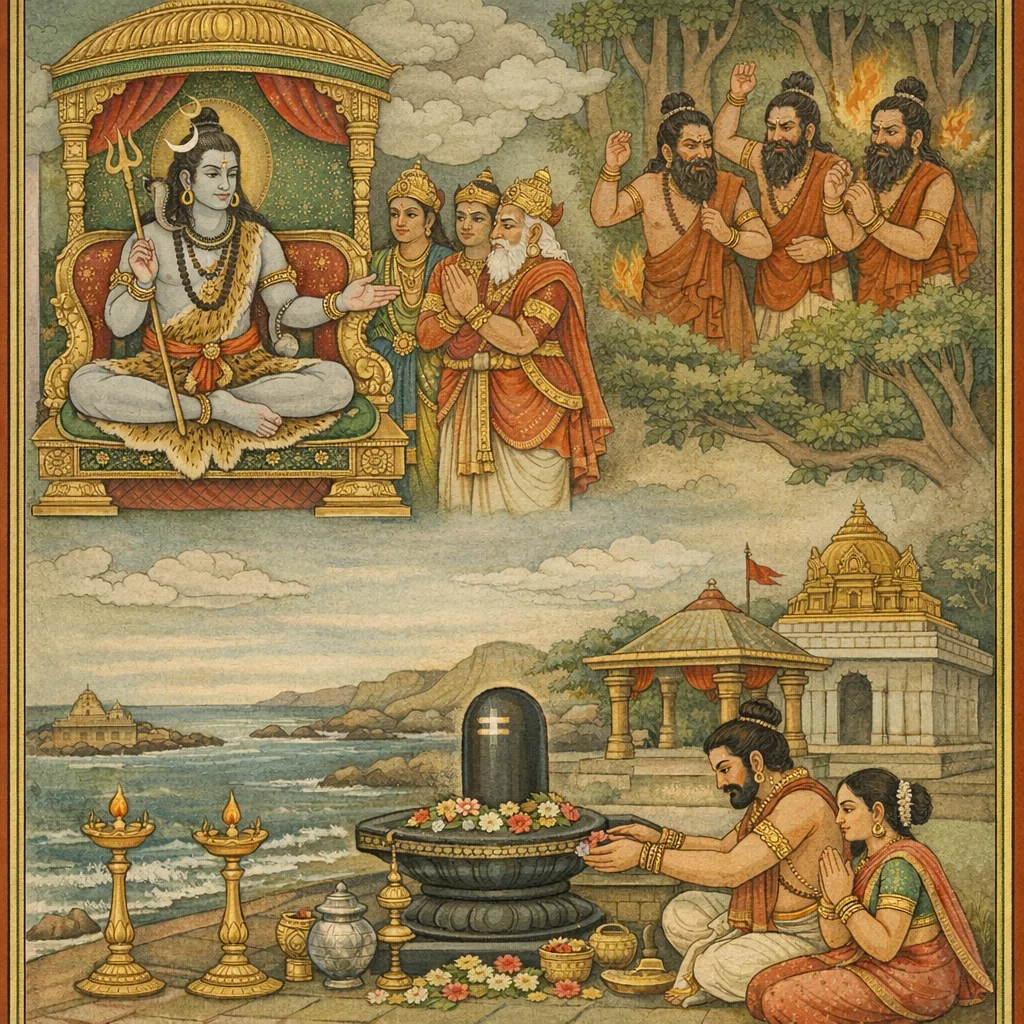
This adhyāya unfolds as a Śiva–Devī theological dialogue. Īśvara first sets out the Prabhāsa-pañcaka, a pilgrimage circuit of five related tīrthas—Prabhāsa (the chief), Vṛddha-Prabhāsa, Jala-Prabhāsa, and Kṛta-smara-Prabhāsa (connected with a cremation-ground and Bhairava)—declaring that faithful visitation of the whole route leads to a “non-returning” state beyond aging and death. A ritual discipline is then prescribed: bathing in the ocean at Prabhāsa, especially on amāvāsyā and the adjoining lunar days (caturdaśī/pañcadaśī), keeping overnight observance, feeding brāhmaṇas according to one’s means, and giving gifts—above all a cow and gold—as ethical supports for pilgrimage merit. Devī asks why there are said to be five Prabhāsas when one is commonly known, and an origin-myth is narrated. Śiva, wandering in divine form, enters the Daruka forest; sages, angered by the disturbance among their households, curse him so that his liṅga falls, triggering cosmic upheaval—earthquakes, swelling oceans, and cracking mountains. The gods consult Brahmā, then Viṣṇu, and finally approach Śiva, who instructs them not to oppose the sages’ curse but to worship the fallen liṅga itself. The gods transport and install it at Prabhāsa, worship it, and proclaim its saving power; the chapter closes by noting that humans’ ascent to heaven declined due to Indra’s covering/obstruction, and by affirming Prabhāsa’s mahodaya as a universal purifier of sin and fulfiller of wishes.
Shlokas
Verse 1
ईश्वर उवाच । ततो गच्छेन्महादेवि सर्वकामफलप्रदम् । प्रभासपंचकं पुण्यमाद्यं तत्र व्यवस्थितम्
Īśvara said: Then, O Great Goddess, one should go to the sacred Prabhāsa-Pañcaka, the foremost holy complex established there, which bestows the fruits of all desired aims.
Verse 2
तस्यैव पश्चिमे भागे प्रभास इति चोच्यते । वृद्धप्रभासश्च ततो दक्षिणे नातिदूरतः
On its western side lies the sacred place called “Prabhāsa”; and to its south, not far away, is “Vṛddha‑Prabhāsa.”
Verse 3
जल प्रभासश्च ततो दक्षिणेन वरानने । कृतस्मरप्रभासश्च श्मशानं यत्र भैरवम्
Further south, O fair‑faced one, is Jala‑Prabhāsa; and also Kṛtasmarā‑Prabhāsa—where stands the śmaśāna, the cremation‑ground sacred to Bhairava.
Verse 4
एवं पंचप्रभासान्यः पश्येद्भक्तया समन्वितः । स याति परमं स्थानं जरामरणवर्जितम्
Thus, whoever—endowed with devotion—beholds the five Prabhāsas attains the supreme abode, free from old age and death.
Verse 5
न निवर्तति यत्प्राप्य दुष्प्राप्यं त्रिदशैरपि । प्रभासं प्रथमं तीर्थं त्रिषु लोकेषु विश्रुतम्
Having reached it, one does not return to bondage; it is hard to attain even for the gods. Prabhāsa is the foremost tīrtha, renowned in the three worlds.
Verse 6
देवानामपि दुष्प्राप्यं महापातकनाशनम् । प्रभासे त्वेकरात्रेण अमावास्यां कृतोदकः
Even for the gods it is hard to obtain, yet it destroys great sins: at Prabhāsa, one who performs the water‑rite—the sacred bath (snāna)—on the Amāvāsyā (new‑moon day), even with a single night’s stay, gains that fruit.
Verse 7
मुच्यते पातकैः सर्वैः शिवलोकं स गच्छति । सप्तजन्मकृतं पापं गंगासागरसंगमे
He is freed from all sins and goes to Śiva’s world. Thus it is said of the confluence of the Gaṅgā and the Ocean: the sin amassed over seven births…
Verse 8
जन्मनां च सहस्रेण यत्पापं कुरुते नरः । स्नानादेवास्य नश्येत सागरे लवणांभसि
Whatever sin a man commits over a thousand births—by bathing alone it perishes for him in the ocean’s salty waters.
Verse 9
चतुर्दश्याममावास्यां पञ्चदश्यां विशेषतः । अहोरात्रोषितो भूत्वा ब्राह्मणान्भोज्य शक्तितः
On the fourteenth lunar day, on Amāvāsyā, and especially on the fifteenth—having stayed for a full day and night—one should feed brāhmaṇas according to one’s capacity.
Verse 10
दत्त्वा गां कांचनं तेभ्यः शिवः प्रीतो भवत्विति । एवं कृत्वा नरो देवि कुलानां तारयेच्छतम्
Having given them a cow and gold, (one should pray,) “May Śiva be pleased.” Having done so, O Devī, a man uplifts a hundred generations of his lineage.
Verse 11
देव्युवाच । प्रभासपंचकं ह्येतद्यत्त्वया परिकीर्तितम् । कथमत्र समुद्भूतमेतन्मे कौतुकं महत्
Devī said: “This ‘fivefold Prabhāsa’ that you have described—how did it arise here? This has become a great wonder to me.”
Verse 12
एक एव श्रुतोऽस्माभिः प्रभासस्तीर्थवासितः । प्रभासाः पंच देवेश यत्त्वया परिकीर्तिताः
We have heard of only one Prabhāsa, renowned as a tīrtha; yet you, O Lord of the gods, have proclaimed five “Prabhāsas”.
Verse 13
एतन्मे संशयं सर्वं यथावद्वक्तुमर्हसि
You should explain to me, properly and in full, this entire doubt of mine.
Verse 14
ईश्वर उवाच । शृणु देवि प्रवक्ष्यामि कथां पापप्रणाशनीम् । यां श्रुत्वा मानवो भक्त्या प्राप्नोति परमां गतिम्
Īśvara said: “Listen, O Goddess. I shall relate a sin-destroying sacred account; hearing it with devotion, a human being attains the supreme destination.”
Verse 15
पुरा महेश्वरो देवश्चचार वसुधामिमाम् । दिव्यरूपधरः कान्तो दिग्वासाः स यदृच्छया
In former times, the god Maheśvara wandered over this earth—radiant, assuming a divine form, digvāsā (clad in the directions, i.e., naked), moving about at his own free will.
Verse 16
एवं च रममाणस्तु ऋषीणामाश्रमं महत् । जगाम कौतुकाविष्टो भिक्षार्थं दारुके वने
Thus, while sporting about, he went—filled with curiosity—to the great hermitage of the sages, in the Dāruka forest, to seek alms.
Verse 17
भ्रममाणस्य तस्याथ दृष्ट्वा रूपमनुत्तमम् । ता नार्यः कामसंतप्ता बभूवुर्व्यथितेन्द्रियाः
Then, seeing his unsurpassed beauty as he wandered about, those women were inflamed by desire and became inwardly agitated in their senses.
Verse 18
सानुरागास्ततः सर्वा अनुगच्छंति तं सदा । समालिंगंति ताः काश्चित्काश्च वीक्षंति रागतः
Thereafter, all of them—filled with attachment—kept following him; some embraced him, while others gazed upon him with passion.
Verse 19
प्रार्थयंति तथा चान्याः परित्यज्य गृहान्स्वकान्
And others, abandoning their own homes, began to implore him as well.
Verse 20
एवं तासां स्वरूपं ते दृष्ट्वा सर्वे महर्षयः । कोपेन महता युक्ताः शेपुस्तं वृषभध्वजम्
Seeing their condition thus, all the great sages—overcome with intense anger—cursed that Bull-bannered Lord.
Verse 21
यस्मात्त्वं नग्नतामेत्य आश्रमेऽस्मिन्ममागतः । मोहयानः स्त्रियोऽस्माकं लज्जां नैवं करोषि च । तस्मात्ते पतताल्लिंगं सद्य एव वृषध्वज
“Since you have come to this hermitage in nakedness, deluding our women, and you do not observe propriety and modesty—therefore, O Bull-bannered one, let your liṅga fall this very moment!”
Verse 22
ततस्तत्पतितं लिंगं तत्क्षणाच्छंकरस्य च । तस्मिन्प्रपतिते भूमौ प्राकंपत वसुंधरा
Then, at that very instant, Śaṅkara’s liṅga fell; and when it struck the ground, the earth trembled violently.
Verse 23
क्षुभिताः सागराः सर्वे मर्यादा विजहुस्तदा । शीर्णानि गिरिशृंगाणि त्रस्ताः सर्वे दिवौकसः
All the oceans were thrown into turmoil and then abandoned their boundaries; mountain peaks crumbled, and all the celestial beings were struck with fear.
Verse 24
ततो देवाः सगन्धर्वाः समहोरगकिन्नराः । ऊचुः पितामहं गत्वा किमेतत्कारणं विभो
Then the gods—together with the Gandharvas, the great serpents, and the Kinnaras—approached Pitāmaha (Brahmā) and said: “O Lord, what is the cause of this?”
Verse 25
सागराः क्षुभिता येन प्लावयंति वसुंधराम् । शीर्यंते गिरिशृङ्गाणि कंपते च वसुंधरा
“By whatever cause this has happened, the oceans are churned into turmoil and flood the earth; mountain-peaks are breaking apart, and the very ground is trembling.”
Verse 26
चिह्नानि लोकनाशाय दृश्यन्ते दारुणानि च । तेषां तद्वचन श्रुत्वा ब्रह्मलोके पितामहः
“Terrifying signs foretelling the ruin of the world are appearing.” Hearing their words, Pitāmaha (Brahmā) in Brahmaloka…
Verse 27
ध्यात्वा तु सुचिरं कालं वाक्यमेतदुवाच ह । शिवलिंगं निपतितं पृथिव्यां सुरसत्तमाः
After meditating for a long time, he spoke these words: “O best among the gods, a Śiva-liṅga has fallen upon the earth.”
Verse 28
शापेन ऋषिमुख्यानां भार्गवाणां महात्मनाम् । तस्मिन्निपतिते भूमौ त्रैलोक्यं सचराचरम्
“Because of the curse of the foremost sages—the great Bhārgavas—when it fell upon the earth, the three worlds with all that moves and does not move were thrown into this state.”
Verse 29
एतदवस्थतां प्राप्तं तस्मात्तत्रैव गम्यताम् । विष्णुना सह गीर्वाणास्तथा नीतिर्विधीयताम्
“This is the condition that has arisen; therefore let us go there at once. O gods, together with Viṣṇu let the proper course of action be determined.”
Verse 30
ततः क्षीरोदधिं जग्मुर्ब्रह्माद्यास्त्रिदिवौकसः । यत्र शेते चतुर्बाहुर्योगनिद्रां च संगतः
Then Brahmā and the other dwellers of heaven went to the Ocean of Milk, where the four-armed Lord lies in yogic sleep (Yoga-nidrā).
Verse 31
तस्मै सर्वं समाचख्युस्तेनैव सहितास्ततः । जग्मुर्यत्र महादेवो लिंगेन रहितो विभुः
They reported everything to Viṣṇu. Then, accompanied by him, they went to where the mighty Mahādeva was without his liṅga.
Verse 32
ऊचुः समाहिताः सर्वे प्रणिपत्य दिवौकसः
Then all the dwellers of heaven, composed and focused, bowed down and spoke.
Verse 33
लिंगमुत्क्षिप्यतामेतद्यत्क्षितौ पतितं विभो । एते महार्णवाः सर्वे प्लावयंति वसुंधराम्
They said: “O Lord, let this liṅga that has fallen upon the earth be lifted up. For all these great oceans are flooding the world.”
Verse 34
भगवानुवाच । ऋषिभिः पातितं ह्येतन्मम लिंगं सुरेश्वराः । न तु शक्यो मया कर्तुं बाधस्तेषां महात्मनाम्
The Blessed Lord said: “O lords of the gods, this liṅga of Mine has indeed been brought down by the ṛṣis. Yet I am not able to obstruct the will and power of those great-souled sages.”
Verse 35
शापो हि भार्गवेन्द्राणामतो मे श्रूयतां वचः । पूजयध्वं सुराः सर्वे ब्रह्मविष्णुपुरस्सराः
“For the curse of the foremost Bhārgavas is effective; therefore, hear My word. All you gods—led by Brahmā and Viṣṇu—worship this liṅga.”
Verse 36
लिंगमेतत्ततः सर्वे सर्वं लिप्सथ सत्तमाः । प्रकृतिं सागराः सर्वे यास्यंति गिरयस्तथा
“Therefore, all of you excellent ones, seek every good by honoring this very liṅga. Then the oceans shall return to their natural bounds, and likewise the mountains shall return to their proper state.”
Verse 37
एतत्पुण्यतमे क्षेत्रे धृत्वा सर्वे समाहिताः । अथोद्धृत्य सुराः सर्वे प्रभासं क्षेत्रमागताः
Placing it in that most holy kṣetra, all of them, composed and intent, then lifted it up; and all the gods came to the sacred region of Prabhāsa.
Verse 38
तत्रैव निदधुः सर्वे ततः पूजां प्रचक्रिरे । ब्रह्मणा पूजितं लिंगं विष्णुना प्रभविष्णुना
There itself they all set it down, and then began the worship. The liṅga was worshiped by Brahmā, and by Viṣṇu—the mighty Lord Viṣṇu as well.
Verse 39
शक्रेणाथ कुबेरेण यमेन वरुणेन च । ऊचुश्चैव ततो देवा लिंगं संपूज्य भक्तितः
Then, with Śakra (Indra), Kubera, Yama, and Varuṇa, the gods—having devoutly worshiped the liṅga—spoke as follows.
Verse 40
अद्यप्रभृति रुद्रस्य लिंगं संपूज्य भक्तितः । भविष्यामो न संदेहस्तथा पितृगणाश्च ये
“From today onward, having worshiped Rudra’s liṅga with devotion, we shall prosper—there is no doubt; and so too shall the hosts of the ancestors (pitṛs).”
Verse 41
य एनं पूजयिष्यंति भक्तियुक्ताश्च मानवाः । यास्यंति ते सुरावासं सशरीरा नरोत्तमाः
“Those humans who will worship this (liṅga) with devotion shall go to the abode of the gods—those best of men, even with their bodies.”
Verse 42
अत्रैव प्रथमं लिगं यतोस्माऽभिः प्रतिष्ठितम् । प्रभासं नाम चास्यापि प्रभासेति भविष्यति
Here itself stands the first Liṅga, for it was established by us. Its name too shall be “Prabhāsa”, and at Prabhāsa it shall be famed as “Prabhāse”.
Verse 43
एवमुक्त्वा गताः सर्वे त्रिदिवं सुरसत्तमाः । तं दृष्ट्वा त्रिदिवं यान्ति भूयांसः प्राणिनो भुवि
Having spoken thus, all those best among the gods departed to Tridiva, the heavenly realm. Beholding that Liṅga, many living beings on earth likewise attain the world of heaven.
Verse 44
ततस्त्रिविष्टपं व्याप्तं बहुभिः प्राणिभिः प्रिये । तद्दृष्ट्वा त्रिदिवं व्याप्तं सहस्राक्षः सुदुःखितः
Then, O beloved, Triviṣṭapa—the heaven of the Thirty-three—became filled with many beings. Seeing the divine world thus crowded, Sahasrākṣa (Indra), the Thousand-eyed, was overwhelmed with sorrow.
Verse 45
ज्ञात्वा लिंगप्रभावं तु ततश्चागत्य भूतलम् । वज्रेणाच्छादयामास समंतात्स वरानने
Realizing the wondrous power of the Liṅga, he then descended to the earth and, O fair-faced one, covered it on all sides with the Vajra.
Verse 46
ततः प्रभृति नो देवि स्वर्गं गच्छंति मानवाः । इति संक्षेपतः प्रोक्तः प्रभासस्य महोदयः । सर्वपापोपशमनः सर्वकामफलं प्रदः
From that time onward, O Goddess, people no longer go to heaven in the former manner. Thus, in brief, has been declared the great exaltation of Prabhāsa—one that pacifies all sins and grants the fruits of all desired aims.
Verse 187
इति श्रीस्कांदे महापुराण एकाशीतिसाहस्र्यां संहितायां सप्तमे प्रभासखण्डे प्रथमेप्रभासक्षेत्रमाहात्म्ये प्रभासपञ्चकमाहात्म्यवर्णनंनाम सप्ताशीत्युत्तरशततमोऽध्यायः
Thus ends the one-hundred-and-eighty-seventh chapter, called “The Description of the Greatness of the Prabhāsa Fivefold (Prabhāsapañcaka),” in the Prabhāsa Khaṇḍa, within the Prabhāsa-kṣetra-māhātmya section of the venerable Skanda Mahāpurāṇa, the Saṃhitā of eighty-one thousand verses.