Adhyaya 25
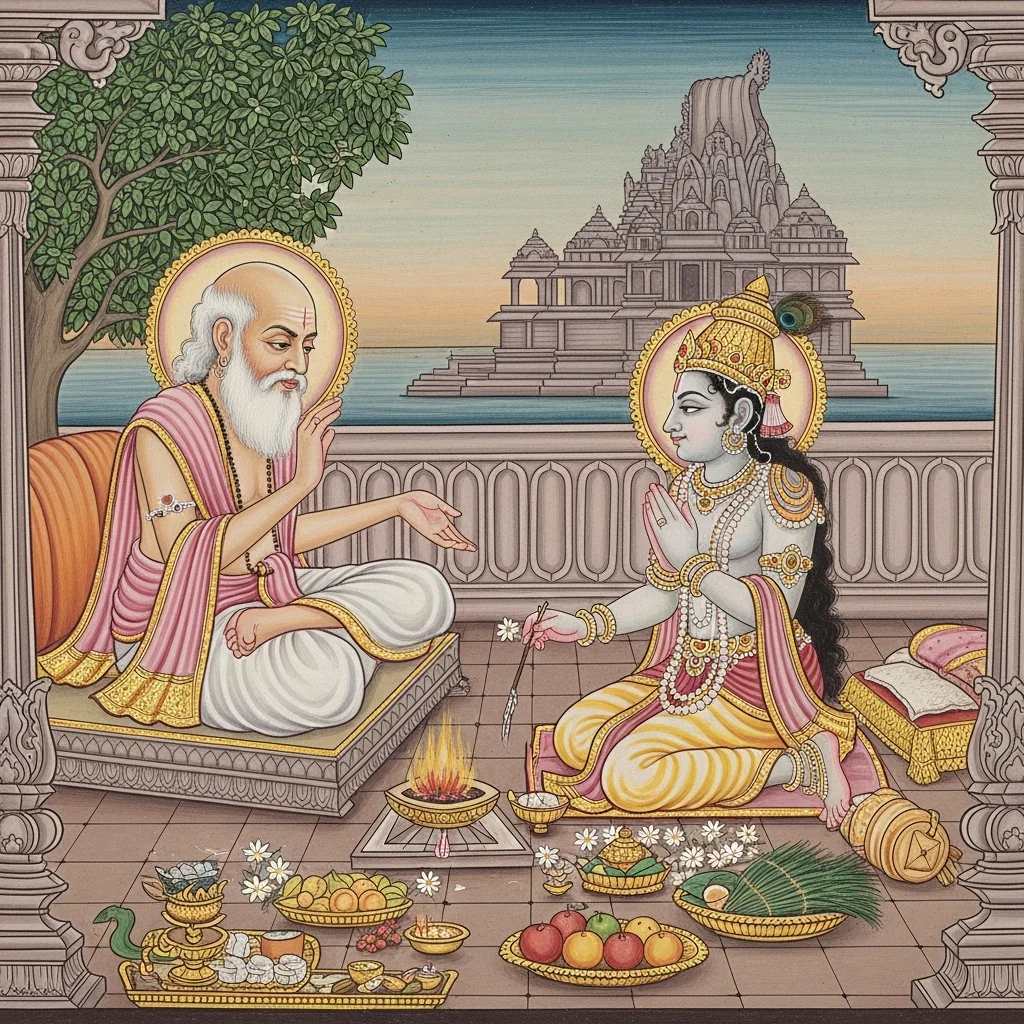
This chapter teaches ritual and theology through dialogue. Īśvara presents a Gandharva who longs to propitiate Bhava (Śiva) and asks about the Somavāra-vrata, the Monday vow. The sage Gośṛṅga extols it as universally beneficial and recounts its sacred precedent: Soma, stricken by Dakṣa’s curse and disease, worships Śiva in sustained meditation; Śiva, pleased, grants the establishment of a liṅga that will endure as long as the sun, moon, and mountains remain, and Soma is freed from illness and regains his radiance. The chapter then lays out a vrata-manual: choose a Monday in the bright fortnight, perform purification, set up a decorated kalaśa and ritual space, and worship Someśvara with Umā and the directional forms. Offer white flowers and prescribed foods and fruits, and recite the named mantra to Śiva—multi-faced and multi-armed—united with Umā. A sequence of Monday observances follows (varying dantakāṣṭha, offerings, and night disciplines such as sleeping on darbha and occasional vigil), culminating in a ninth-day udhyāpana with maṇḍapa, kuṇḍa, lotus-maṇḍala, eight directional kalaśas, a golden image, homa, guru-dāna, feeding brāhmaṇas, and gifts of cloth and a cow. The phalāśruti promises removal of disease, prosperity, benefits to one’s lineage, and attainment of Śiva-loka; the Gandharva performs the vow at Prabhāsa/Someśvara and receives boons.
Shlokas
Verse 1
ईश्वर उवाच । स गन्धर्वस्तदा देवि आरिराधयिषुर्भवम् । सोमवारव्रतंनाम पप्रच्छ मुनिसत्तमम्
Īśvara said: “Then, O Goddess, that Gandharva—wishing to propitiate Bhava (Śiva)—questioned the best of sages about the vow called the Somavāra-vrata.”
Verse 2
गन्धर्व उवाच । कथं सोमव्रतं कार्यं विधानं तस्य कीदृशम् । कस्मिन्काले च तत्कार्यं सर्वं विस्तरतो वद
The Gandharva said: “How is the Soma vow (of Monday) to be observed? What is its proper rite and procedure? And at what time should it be undertaken? Tell me all of it in full detail.”
Verse 3
गोशृंग उवाच । साधुसाधु महाप्राज्ञ सर्वसत्त्वोपकारकम् । यन्न कस्यचिदाख्यातं तदद्य कथयामि ते
Gośṛṅga said: “Well said, well said, O greatly wise one—this is for the welfare of all beings. What has not been disclosed to just anyone, that I shall tell you today.”
Verse 4
सर्वरोगहरं दिव्यं सर्वसिद्धिप्रदायकम् । सोमवारव्रतंनाम सर्वकामफलप्रदम्
The divine observance called Somavāra-vrata, the Monday fast, removes every disease, bestows every siddhi, and grants the fruits of all cherished desires.
Verse 5
सर्वकालिकमादेयं वर्णानां शुभकारकम् । नारी नरैः सदा कार्यं दृष्ट्वादृष्ट्वा फलोदयम्
This vow may be undertaken at any time and brings auspiciousness to all social orders; women and men should always observe it, for it yields fruits both seen in this life and unseen beyond.
Verse 6
ब्रह्मविष्ण्वादिभिर्देवैः कृतमेतन्महाव्रतम् । पुनस्तु सोमराजेन दक्षशापहतेन च
This great vow was practiced by the gods—Brahmā, Viṣṇu, and others. Later, King Soma too observed it, after being struck by Dakṣa’s curse.
Verse 7
आराधितोऽनेन शंभुः शंभुध्यानपरेण तु । ततस्तुष्टो महादेवः सोमराजस्य भक्तितः
By this observance, Soma worshipped Śambhu, devoted to meditation upon Śambhu. Pleased thereby, Mahādeva was satisfied with the Moon-king’s devotion.
Verse 8
तेनोक्तं यदि तुष्टोऽसि प्रतिष्ठास्थो निरंतरम्
Then he said: “If you are pleased, remain here, firmly established, without interruption.”
Verse 9
यावच्चंद्रश्च सूर्यश्च यावत्तिष्ठंति भूधराः । तावन्मे स्थापितं लिंगमुमया सह तिष्ठतु
“So long as the Moon and Sun endure, so long as the mountains stand—so long may the liṅga established by me remain here, abiding with Umā.”
Verse 10
स्थापितं तु तदा तेन प्रार्थयित्वा महेश्वरम् । आत्मनामांकितं कृत्वा ततो रोगैर्व्यमुच्यत
Then, after praying to Maheśvara, he installed it, inscribing it with his own name; and thereafter he was freed from diseases.
Verse 11
ततः शुद्धशरीरोऽसौ गगनस्थो विराजते
Thereupon, with his body made pure, he shines resplendent in the sky.
Verse 12
तदाप्रभृति ये केचित्कुर्वंति भुवि मानवाः । तेऽपि तत्पदमायांति विमलांगाश्च सोमवत्
From that time onward, whatever people on earth perform this observance, they too attain that same state—becoming pure-limbed, like Soma.
Verse 13
अथ किं बहुनोक्तेन विधानं तस्य कीर्त्तये । यस्मिन्कस्मिंश्च मासे वा शुक्ले सोमस्य वासरे
But what is the use of speaking at length? I shall proclaim its proper procedure: in any month whatsoever, on a Monday in the bright fortnight...
Verse 14
दंतकाष्ठं पुरा ब्राह्मे कृत्वा स्नानं समाचरेत् । स्वधर्मविहितं कर्म कृत्वा स्थाने मनोरमे
At the auspicious brāhma-muhūrta, having first used a tooth-stick, one should duly perform bathing. In that delightful sacred place, one should then carry out the duties enjoined by one’s own dharma.
Verse 15
सुसमे भूतले शुद्धे न्यस्य कुम्भं सुशोभितम् । चूतपल्लवविन्यस्ते चंदनेन सुचित्रिते
On a clean, level ground, one should place a well-adorned water-pot, arranging mango-leaves upon it and decorating it beautifully with sandal paste.
Verse 16
श्वेतवस्त्रपरीधाने सर्वाभरणभूषिते । आदौ पात्रे तु संन्यस्य आधारसहितं शिवम्
Wearing white garments and adorned with all ornaments, one should first place Śiva—together with His support (ādhāra)—in the ritual vessel/receptacle.
Verse 17
अष्टमूर्त्यष्टकं दिक्षु सोमनाथं सशक्तिकम् । उमया सहितं तत्र श्वेतपुष्पैश्च पूजयेत्
In the directions, one should worship the eightfold company of the Eight Forms (Aṣṭamūrti), and then worship Somnātha together with His Śakti, accompanied by Umā, offering white flowers there.
Verse 18
विविधं भक्ष्यभोज्यं च फलं वै बीजपूर कम् । अनेनैव तु मंत्रेण सर्वं तत्रैव कारयेत्
One should offer various eatables and dishes, and fruits—indeed including bījapūra (citron). Using this very mantra, one should have all offerings and rites performed there itself.
Verse 19
ॐ नमः पंचवक्त्राय दशबाहुत्रिनेत्रिणे । श्वेतं वृषभमारूढ श्वेताभरणभूषित
Om—homage to the Five-Faced One, to Him of ten arms and three eyes; O Rider upon the white bull, O You adorned with white ornaments.
Verse 20
उमादेहार्द्धसंयुक्त नमस्ते सर्वमूर्तये । अनेनैव तु मंत्रेण पूजां होमं च कारयेत्
O One united with half of Umā’s body, salutations to You who are the form of all. Using this very mantra, one should perform both worship and fire-offering (homa).
Verse 21
कृत्वैवं च दिने रात्रौ पश्यंश्चैवं स्वपेन्नरः । दर्भशय्या समारूढो ध्यायन्सोमेश्वरं हरम्
Having done thus, by day and by night a man should keep this observance—seeing thus and sleeping thus—lying upon a bed of darbha grass, meditating on Lord Someśvara, Hari (Śiva).
Verse 22
एवं कृतेऽष्टादशानां कुष्ठानां नाशनं भवेत् । द्वितीये सोमवारे तु करंजं दन्तधावनम्
When it is performed in this manner, the eighteen kinds of skin-disease (kuṣṭha) are destroyed. Then, on the second Monday, one should cleanse the teeth with karañja.
Verse 23
देवं संपूजयेत्सूक्ष्मं ज्येष्ठाशक्तिसमन्वितम् । शतपत्रैः पूजयित्वा मधु प्राश्य यथाविधि
One should thoroughly worship the subtle Deity, endowed with Jyeṣṭhā-Śakti. Having worshipped with hundred‑petalled flowers, one should then partake of honey according to rule.
Verse 24
नारंगं तत्र दत्त्वा तु शेषं पूर्ववदाचरेत् । एवं कृते द्वितीये तु गोलक्षफलमाप्नुयात्
Then one should offer an orange there, and perform the remaining observances exactly as before. When this is done in the second Monday observance, one attains merit equal to the gift of a hundred thousand cows.
Verse 25
सोमवारे तृतीये तु अपामार्गसमुद्भवम् । दंतकाष्ठादिकं कृत्वा त्रिनेत्रं च प्रपूजयेत्
On the third Monday, one should prepare the tooth-stick and related requisites from apāmārga, and then worship the Three‑eyed Lord with due reverence.
Verse 26
फलं च दाडिमं दद्याज्जातीपुष्पैश्च पूजयेत् । रजन्यामंगुरं प्राश्य सिद्धियुक्तं तु पूजयेत्
One should offer a pomegranate fruit and worship with jāti (jasmine) flowers. At night, having eaten aṅgura (grapes or raisins), one should worship the Lord endowed with siddhi, spiritual power.
Verse 27
चतुर्थे सोमवारे तु काष्ठमौदुम्बरं स्मृतम् । पूजयेत्तत्र गौरीशं सूक्ष्मया सहितं तथा
On the fourth Monday, the prescribed wood is that of the udumbara. There one should worship Gaurīśa (Śiva), together with Sūkṣmā, the subtle Devī, in the same manner.
Verse 28
नारिकेलफलं दद्याद्दमनेन प्रपूजयेत् । शर्करां प्राशयेद्रात्रौ जागरं चैव कारयेत्
One should offer a coconut and worship with damana (dūrvā/damana grass). At night one should partake of sugar, and also keep vigil (jāgaraṇa).
Verse 29
पञ्चमे सोमवारे तु पूजयेच्च गणाधिपम् । विभूत्या सहितं देवं कुन्दपुष्पैः प्रपूजयेत्
On the fifth Monday, one should worship Gaṇādhipa, the Lord of the Gaṇas. One should worship that deity together with sacred ash (vibhūti), using kunda flowers.
Verse 30
आश्वत्थं दन्तकाष्ठं च अर्घ्यं वै द्राक्षया तथा । मोचं च प्राशयेद्रात्रावश्वमेधफलं लभेत्
One should use an aśvattha tooth-stick, and offer arghya with grapes as well. At night one should eat moca (banana/plantain), and thereby obtain merit equal to that of the Aśvamedha sacrifice.
Verse 31
षष्ठे सोमस्य वारे तु सुरूपं नाम पूजयेत् । कर्पूरं प्राशयेत्तत्र भक्त्या परमया युतः
On the sixth Monday, one should worship the form named Surūpa. There, endowed with supreme devotion, one should partake of camphor.
Verse 32
सप्तमे सोमवारे तु दन्तकाष्ठं च मल्लिका । सर्वज्ञं पूजयेत्तत्र दीप्तया सहितं तथा
On the seventh Monday, with the tooth-stick and mallikā (jasmine), one should worship there Sarvajña, the All-knowing Lord, together with Dīptā Devī, the Radiant, in the same manner.
Verse 33
जम्बीरं च फलं दद्याज्जातीपुष्पैश्च पूजयेत् । लवङ्गं प्राशयेत्तत्र तस्यानन्तफलं भवेत्
One should offer the fruit jambīra (citron/lemon) and worship with jātī (jasmine) flowers. There one should partake of clove; for him, its reward becomes endless.
Verse 34
अष्टमे सोमवारे तु अमोघायुतमीश्वरम् । कदलीफलकेनार्घ्यं मरुबकेन पूजयेत् । रात्रौ तु प्राशयेद्दुग्धमग्निष्टोमफलं लभेत्
On the eighth Monday, one should worship the Lord Amoghāyuta-īśvara. One should offer arghya with a banana fruit and perform pūjā with marubaka. At night one should take milk as food; by doing so, one attains merit equal to the Agniṣṭoma sacrifice.
Verse 35
गंगास्नाने कृते सम्यक्कोटिधा यत्फलं स्मृतम् । दशहेमसहस्राणां कुरुक्षेत्रे रवेर्ग्रहे
Whatever merit is traditionally remembered as arising a crore-fold from properly bathing in the Gaṅgā—and whatever merit comes from giving ten thousand pieces of gold at Kurukṣetra during a solar eclipse—
Verse 36
ब्राह्मणे वेदविदुषे यद्दत्त्वा फल माप्नुयात् । तत्पुण्यं कोटिगुणितमस्मिन्नाचरिते व्रते
Whatever fruit one would obtain by giving charity to a Veda-knowing brāhmaṇa—when this vow is practiced, that very merit becomes multiplied a crore-fold.
Verse 37
गजानां तु शते दत्ते लक्षे च रथवाजिनाम् । तत्फलं कोटिगुणितं सोमवारव्रते कृते
Even the fruit gained by gifting a hundred elephants and a hundred thousand chariots and horses—when the Monday vow is observed—becomes multiplied a crore-fold (a koṭi times).
Verse 38
गुग्गुलोर्धूपनं कृत्वा कोटिशो यत्फलं लभेत् । तत्पुण्यं तु भवेत्तस्य सोमवारव्रते कृते
Whatever fruit one would gain by offering guggulu incense a koṭi times—when the Monday vow is performed—that very merit indeed becomes his.
Verse 39
सर्वैश्वर्यसमायुक्तः शिवतुल्यपराक्रमः । रुद्रलोके वसेत्तावद्ब्रह्मणः प्रलयावधि
Endowed with every prosperity and with valor equal to Śiva, he dwells in Rudra’s world until the time of Brahmā’s dissolution (pralaya).
Verse 40
संप्राप्ते नवमे वारे कुर्यादुद्यापनं शुभम् । यथा भवति गन्धर्व तथा वक्ष्यामि तेऽधुना
When the ninth Monday arrives, one should perform the auspicious concluding rite (udyāpana). How one becomes a Gandharva—I shall now explain to you in due order.
Verse 41
मंडलं मंडपं कुण्डं पताकाध्वजशोभितम् । तोरणानि च चत्वारि कुण्डं कृत्वा विधानतः
One should prepare a ritual maṇḍala, a maṇḍapa, and a kuṇḍa (fire-pit) adorned with banners and flags; and, according to rule, having made the kuṇḍa, one should set up four ceremonial gateways (toraṇas).
Verse 42
मध्ये वेदिः प्रकर्त्तव्या चतुरस्रा सुशोभना । निष्पाद्य मंडलं तत्र मध्ये पद्मं प्रकल्पयेत्
In the center one should fashion a beautiful square vedi, the altar. Having completed the maṇḍala there, one should arrange a lotus design in its midst.
Verse 43
कलशानष्टदिग्भागे सहिरण्यान्पृथक्पृथक् । स्थापयित्वा तु शक्तिस्ता वामाद्याः पूर्वतः क्रमात्
In the eight directional quarters one should place kalaśas, water-pots, each separately furnished with gold. Having set them up, those Śaktis—beginning with Vāmā—should be arranged in order, starting from the east.
Verse 44
कर्णिकायां तु पद्मस्य श्रीसोमेशं महाप्रभम् । प्रतिमारूपसंपन्नं हेमजं शक्तिसंयुतम्
In the lotus’s central pericarp one should install and contemplate Śrī Someśa, the greatly radiant Lord—endowed with a well-formed sacred icon, fashioned of gold, and invested with divine power.
Verse 45
रुक्मशय्यासमारूढं मनोन्मन्या समन्वितम् । हेमपात्रादिके पात्रे मधुना परिपूरिते
One should worship Him seated upon a golden couch, united with the supreme contemplative state (Manonmanī); and offer honey, filling a golden vessel and other fitting containers to the brim.
Verse 46
रुक्मशय्यासमाच्छन्ने तत्रस्थं पूजयेत्क्रमात् । अनंतादिशिखंड्यंतैर्नामभिः क्रमशोऽर्चयेत्
When the golden couch has been properly spread and arranged, one should worship the Lord placed there, step by step; and in due sequence offer arcana by reciting the names beginning with “Ananta” and ending with “Śikhaṇḍin”.
Verse 47
गन्धस्रग्धूपदीपैश्च नैवेद्यैश्च पृथग्विधैः । वस्त्रालंकारतांबूलच्छत्रचामरदर्प्पणम्
With perfumes, garlands, incense, and lamps, and with various kinds of food-offerings (naivedya); with garments, ornaments, betel, a parasol, chowries (chāmara), and a mirror—thus should one honor the Lord with distinct upacāras.
Verse 48
दीपघंटावितानं च पर्यंकं च सतू लिकम् । सोमेश्वरं समुद्दिश्य देयं पौराणिके गुरौ
A lamp-stand, bell, canopy (vitāna), and also a couch with a pillow—these should be given in charity, dedicating them to Someśvara, to the Purāṇic guru who expounds the tradition.
Verse 49
भूषयित्वा तथाऽचार्य्यं होमं तत्रैव कारयेत् । बलिकर्मावसाने च रात्रौ तत्रैव जागृयात्
Having duly honored and adorned the ācārya, one should have the homa, the fire-offering, performed there itself; and when the bali-rites are concluded, one should keep vigil there throughout the night.
Verse 50
पञ्चगव्यं ततः पीत्वा ध्यायेत्सोमेश्वरं हृदि । प्रभाते तु ततः स्नात्वा ध्यायेत्तं च विधानतः
Then, having drunk pañcagavya, one should meditate on Someśvara within the heart. At dawn, after bathing, one should again meditate upon Him according to proper rule.
Verse 51
ततो भक्त्या च गंधर्व क्षीरखण्डादिनिर्म्मितम् । भक्ष्यभोज्यैरनेकैश्च भोजयेद्ब्राह्मणानथ
Then, O Gandharva, with devotion, preparing sweets made from milk, sugar, and the like, and with many kinds of foods for eating and for a full meal, one should thereafter feed the brāhmaṇas.
Verse 52
वस्त्रयुग्मं ततो दत्त्वा गां च दत्त्वा विसर्जयेत्
Then, having offered a pair of garments and also given a cow, one should duly conclude the rite and formally take leave of the observance.
Verse 53
एवं चीर्णव्रतः सम्यग्लभते पुण्यमक्षयम् । धनधान्यसमृद्धात्मा पुत्रदारसमन्वितः
Thus, one who has properly observed the vow attains imperishable merit—prospering in wealth and grain, and endowed with children and spouse.
Verse 54
न कुले जायते तस्य दरिद्रो दुःखितोऽपिवा । अपुत्रो लभते पुत्रान्वन्ध्या पुत्रवती भवेत्
In that person’s lineage, neither poverty nor sorrow arises. The childless obtain sons, and even a barren woman becomes blessed with children.
Verse 55
काकवंध्या तु या नारी मृतवत्सा च दुर्भगा । कन्याप्रसूश्च या कार्यमाभिरेतद्विशेषतः
But a woman who is called ‘kākavandhyā’ (one who miscarries repeatedly), or one whose children die, or one who is unfortunate, or one who bears only daughters—such women should especially undertake this rite.
Verse 56
एवं कृते विधाने तु देहपाते शिवं व्रजेत् । कल्पकोटिसहस्राणि कल्पकोटिशतानि च । भुंक्तेऽसौ विपुलान्भो गान्यावदाभूतसंप्लवम्
When this procedure is performed in this manner, at the fall of the body one goes to Śiva. For thousands and hundreds of crores of kalpas, one enjoys vast heavenly delights—until the cosmic dissolution.
Verse 57
इति ते कथितं सर्वं सोमवारव्रतं क्रमात् । गच्छ शीघ्रं महाभाग यत्र सोमेश्वरः स्थितः
Thus, in proper order, the entire Monday observance has been told to you. Go swiftly, O fortunate one, to the place where Lord Someśvara abides.
Verse 58
ईश्वर उवाच । इत्युक्तः सच गन्धर्वः पुत्र्या सह वरानने । सर्वोपहारसंयुक्तः प्रभासक्षेत्रमाश्रितः
Īśvara said: Thus addressed, that Gandharva—together with his lovely-faced daughter—set out for Prabhāsa Kṣetra, bearing all offerings.
Verse 59
तत्र सोमेश्वरं दृष्ट्वा आनन्दाश्रुपरिप्लुतः । यात्राक्रमेण संपूज्य चक्रे सोमव्रतं क्रमात्
There, upon seeing Someśvara, he was flooded with tears of joy. Worshipping in the proper manner of pilgrimage, he then performed the Soma (Monday) vow step by step.
Verse 69
पुत्र्या सह महाभागस्तस्य तुष्टो महेश्वरः । सर्वरोगविनाशं च सर्वकामसमृद्धिदम् । ददौ गन्धर्वराज्यं च भक्तिं चैवात्मनस्तथा
Pleased with that noble one, together with his daughter, Maheśvara granted the destruction of all diseases and the fulfillment of all desires. He also bestowed the sovereignty of the Gandharvas, and devotion to Himself as well.