Adhyaya 152
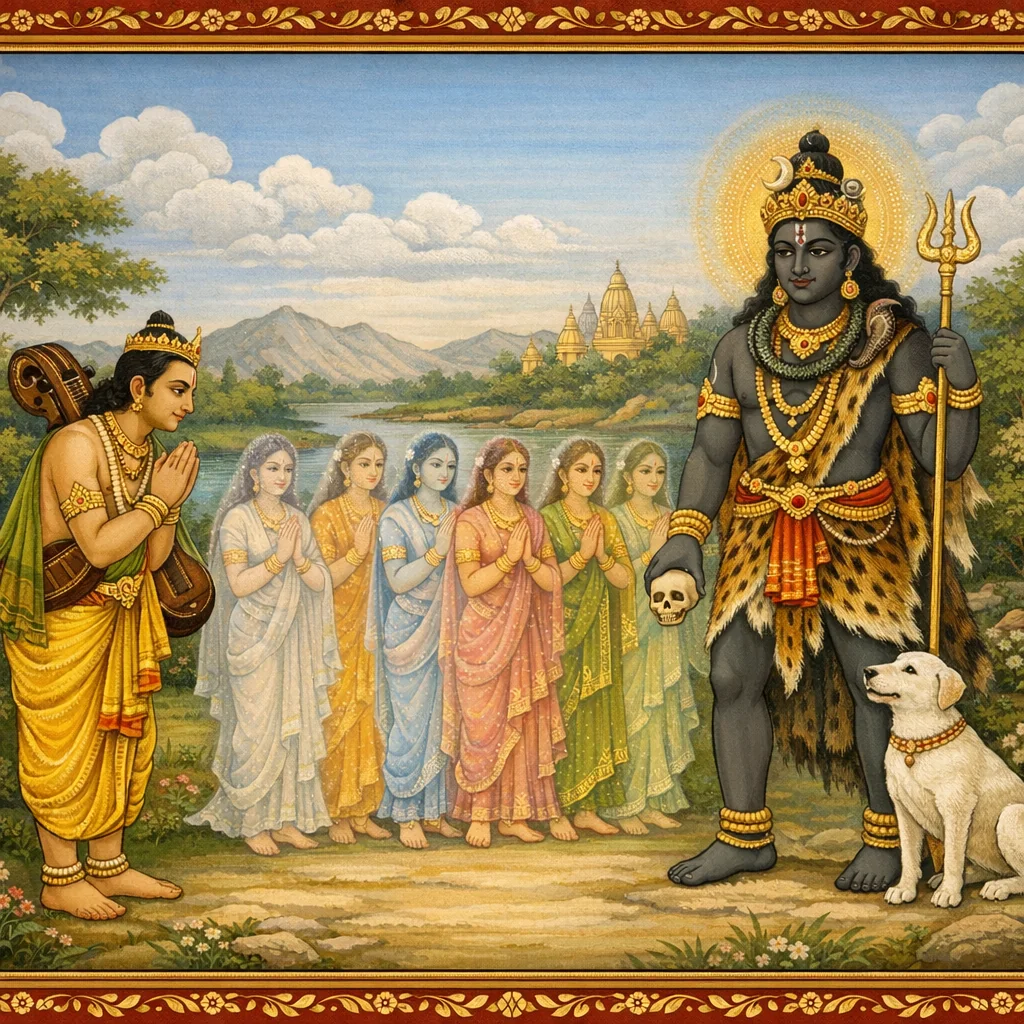
Īśvara describes a succession of Bhairava manifestations and points out a fourth Bhairava-site to the west of Brahmeśa, its location given with exact measurements in bow-lengths. There stands the liṅga called Naradeśvara, established by the sage Nārada, famed for removing all sins and granting desired aims. A framed legend tells how Nārada, once in Brahmaloka, encountered a radiant vīṇā associated with Sarasvatī. Out of curiosity he played it improperly; the resulting notes—understood as the seven svaras—are narrated as “fallen brāhmaṇas.” Brahmā declares this a grave fault born of ignorant performance, equal to harming seven brāhmaṇas, and commands Nārada to go at once on pilgrimage to Prabhāsa to propitiate Bhairava for purification. Nārada reaches Brahmakuṇḍa and worships Bhairava for a hundred divine years, becoming purified and attaining mastery in song. The chapter concludes by proclaiming Naradeśvara Bhairava as world-renowned for destroying major transgressions, prescribing that those who handle vīṇā and notes in ignorance should go there to be cleansed. An observance is added: in Māgha, with a controlled diet, worship three times daily; the devotee attains an auspicious and delightful heavenly state.
Shlokas
Verse 1
ईश्वर उवाच । तृतीयो भैरवः प्रोक्तश्चतुर्थं भैरवं शृणु । ब्रह्मेशात्पश्चिमे भागे धनुषां त्रितये स्थितम्
Īśvara said: “The third Bhairava has been spoken of; now hear of the fourth Bhairava. To the west of Brahmeśa, at a distance of three bow-lengths, he is situated.”
Verse 2
सर्वपापप्रशमनं सर्व कामप्रदं नृणाम् । नारदेश्वरनामानं स्थापितं नारदेन वै
It pacifies all sins and grants all desires to people. It is named Nāradeśvara, and was indeed established by Nārada.
Verse 3
ब्रह्मलोके स्थितः पूर्वं नारदो भगवानृषिः । तत्र दृष्ट्वा महावीणां दिव्यां तंत्र्ययुतै र्युताम्
Formerly, the blessed sage Nārada dwelt in Brahmaloka. There he beheld a great divine vīṇā, furnished with thousands of strings.
Verse 4
सरस्वत्या विनिर्मुक्तां ब्रह्मलोके महाप्रभाम् । तेनासौ कौतुकाविष्टो वादयामास तां तदा
That vīṇā, released by Sarasvatī, shone with great splendor in Brahmaloka. Then Nārada, seized by curiosity, played it at that very time.
Verse 5
तंत्रीभ्यो वाद्यमानाभ्यो ब्राह्मणाः पतिता भुवि । सप्त स्वरास्ते विख्याता मूर्च्छिताः षड्जकादयः
As those strings were sounded, the brāhmaṇas fell upon the earth. They became famed as the seven notes, arranged in order—beginning with Ṣaḍja.
Verse 6
तान्दृष्ट्वा विस्मयाविष्टो मुक्त्वा वीणां प्रयत्नतः । पप्रच्छ देवं ब्रह्माणं किमिदं कौतुकं विभो
Seeing them, Nārada—filled with astonishment—carefully set aside the vīṇā and asked the god Brahmā: “O Lord, what is this wondrous occurrence?”
Verse 7
वाद्यमानासु तन्त्रीषु पतिता ब्राह्मणा भुवि । क एते ब्राह्मणा देव किं मृता इव शेरते
When the strings were being played, the brāhmaṇas fell upon the ground. “O Deva, who are these brāhmaṇas? Why are they lying as though dead?”
Verse 8
ब्रह्मोवाच । एते स्वरा महाभाग मूर्च्छिताः पतिता भुवि । अज्ञानवादनेनैव पापं जातं तवाधुना
Brahmā said: “O fortunate one, these are the musical notes, embodied. They have fainted and fallen to the earth. By playing in ignorance, sin has now arisen for you.”
Verse 9
सप्तब्राह्मणविध्वंसपातकं ते समा गतम् । तस्माच्छीघ्रं व्रज मुने प्रभासं क्षेत्रमुत्तमम्
“The sin equal to the destruction of seven brāhmaṇas has come upon you. Therefore, O sage, go quickly to Prabhāsa—the supreme sacred field.”
Verse 10
समाराधय देवेशं सर्वपापविशुद्धये । इत्युक्तो नारदस्तत्र संतप्य च मुहुर्मुहुः
“Worship the Lord of the gods, Deveśa, for the cleansing of all sins.” Thus instructed, Nārada there grieved again and again.
Verse 11
कृत्वा विषादं बहुशः प्रभासं क्षेत्रमागतः । तत्रैव ब्रह्मकुण्डं तु समासाद्य प्रयत्नतः
After repeatedly falling into sorrow, he came to the sacred field of Prabhāsa. There itself, with earnest effort, he reached the Brahmakuṇḍa.
Verse 12
भैरवं पूजयामास दिव्याब्दानां शतं प्रिये । ततो निष्कल्मषो भूत्वा गीतज्ञश्चाभवत्तथा
“O beloved, he worshipped Bhairava for a hundred divine years. Thereupon he became free from impurity—and likewise became a true knower of song and music.”
Verse 13
ततः प्रभृति तल्लिंगं नारदेश्वरभैरवम् । ख्यातं लोके महादेवि सर्वपातकनाशनम्
“From that time onward, O Great Goddess, that liṅga—Nāradeśvara Bhairava—became famed in the world as the destroyer of all sins.”
Verse 14
अज्ञानाद्वादयेद्यस्तु वीणां चैव तथा स्वरान् । स तत्पातकशुद्ध्यर्थं तत्र गच्छेन्महेश्वरि
“But whoever, out of ignorance, plays the vīṇā and the notes (svara) improperly—O Maheśvarī—should go there for the purification of that sin.”
Verse 15
माघे मासि जिताहारस्त्रिकालं योऽर्चयेत्ततः । नारदेशं भैरवं स स्वर्गरामामनोहरः
In the month of Māgha, controlling his diet, whoever worships there three times a day—he who worships Nāradeśa Bhairava becomes delightful in heaven, charming to the celestial women.