Adhyaya 203
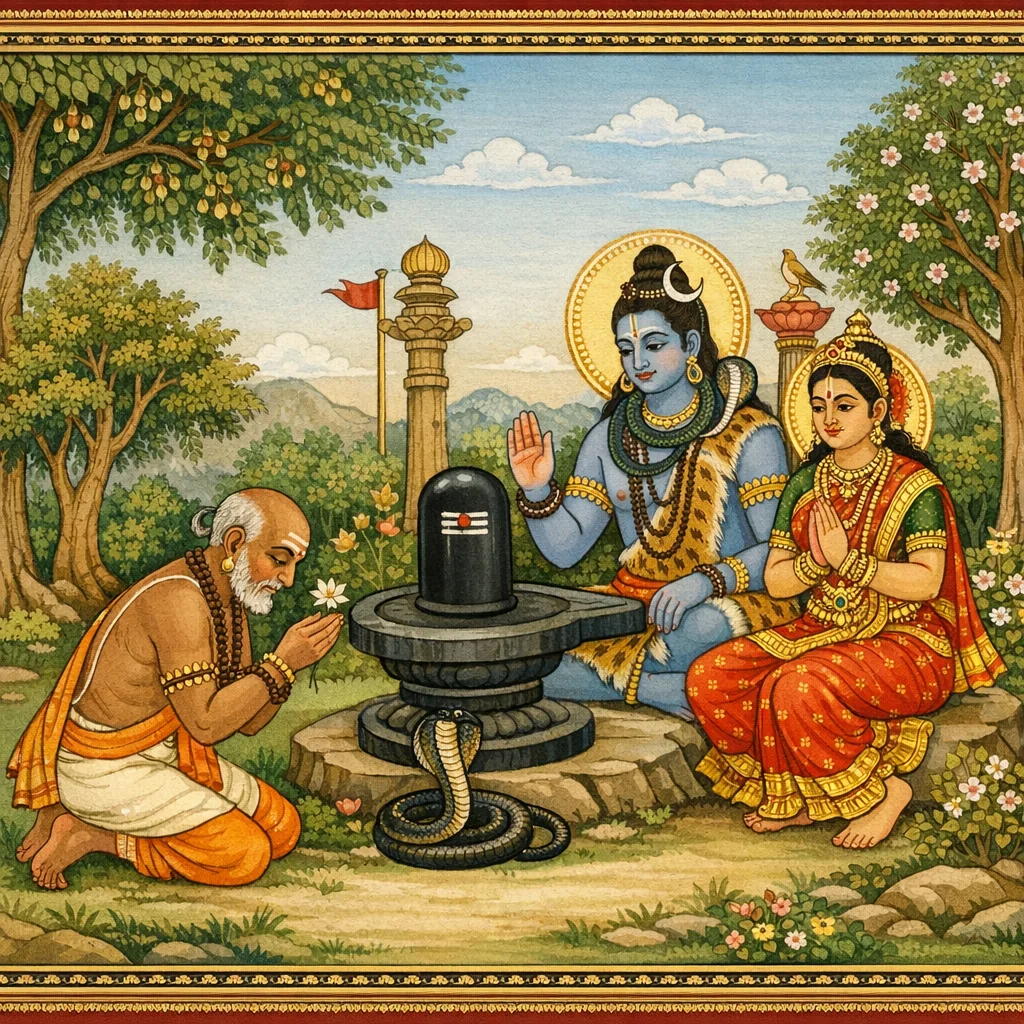
Īśvara tells Devī of a pilgrimage to the Mankīśvara shrine, north of Rāmeśa and near the Devamātṛ site, with further directions given from Arka-sthala and Kṛta-smara. The liṅga there is said to have been installed long ago by a brāhmaṇa named Maṅki—physically bent (kubja), yet steadfast in devotion to Śiva through sustained tapas and careful ritual worship. Though he worships for many years, Maṅki grieves that the Lord has not granted him satisfaction, and he intensifies his practice with japa and dhyāna into old age. Śiva finally appears and explains the practical difficulty: Maṅki cannot easily reach the tree-branches to gather many flowers like other ascetics, yet even a single flower offered with bhakti yields the full merit of sacrifice. The teaching expands into a ritual-theological vision: Brahmā stands to the right of the liṅga, Viṣṇu to the left, and Śiva in the center—thus liṅga-worship embraces the worship of the triad. Preferred offerings are listed—bilva, śamī, karavīra, mālatī, unmattaka, campaka, aśoka, kahlāra, and other fragrant flowers. Maṅki asks a boon that anyone who bathes and even offers only water to this liṅga should gain the fruit of all forms of worship, and that divine and earthly trees be present nearby; Śiva grants these, declares the place Nāga-sthāna for the presence of all nāgas, and disappears. Maṅki then relinquishes his body and attains Śiva’s realm. The chapter ends with a phalaśruti: hearing this account with faith removes sins.
Shlokas
Verse 1
ईश्वर उवाच । ततो गच्छेन्महादेवि मंकीश्वर महालयम् । रामेशादुत्तरे भागे देवमातुः समीपगम्
Īśvara said: Then, O great Goddess, one should go to the great shrine of Maṃkīśvara, situated to the north of Rāmeśa and close to Devamātṛ.
Verse 2
अर्कस्थलात्ततो याम्ये पूर्वतश्च कृतस्मरात् । लिंगं महाप्रभावं तु मंकिना स्थापितं पुरा
To the south of Arkasthala, and to the east of Kṛtasmara, there is a Liṅga of great power, which long ago was established by Maṃki.
Verse 3
तं दृष्ट्वा मानवः सम्यगश्वमेधफलं लभेत्
Having beheld it in the proper manner, a person attains the fruit of the Aśvamedha sacrifice.
Verse 4
देव्युवाच । कोऽसौ मंकिर्महादेव कथं लिंगं प्रतिष्ठितम् । किं प्रभावं च तल्लिंगमेतन्मे वद विस्तरात्
The Goddess said: “Who is this Maṃki, O Mahādeva? How was the Liṅga installed, and what is the power of that Liṅga? Tell me this in detail.”
Verse 5
ईश्वर उवाच । मंकिर्नामाभवत्पूर्वं कुब्जकायो द्विजोत्तमः । प्रभासं क्षेत्रमासाद्यतपस्तेपे महत्तमम्
Īśvara said: “Formerly there was an excellent brāhmaṇa named Maṃkir. Though his body was hunched, he came to the sacred kṣetra of Prabhāsa and undertook the most intense austerities.”
Verse 6
प्रतिष्ठाप्य महादेवं शिवभक्तिपरायणः । न तुतोष हरस्तस्य वहुवर्षगणार्चितः
Having installed Mahādeva and being wholly devoted to Śiva-bhakti, he worshipped for many years—yet Hara was still not satisfied with him.
Verse 7
तस्यैवं तप्यमानस्य सिद्धिं प्राप्ता ह्यनेकशः । तत्राराध्य महादेवं स्वर्गलोकमितो गताः
While he was thus engaged in austerity, many others attained success again and again; worshipping Mahādeva there, they departed from this world to heaven.
Verse 8
ततो दुःखं समभवन्मंकेस्तत्र वरानने । कस्मान्मे भगवांस्तुष्टिं न गच्छति महेश्वरः
Then sorrow arose in Maṃkir there, O fair-faced one: “Why does the Blessed Mahā-īśvara not become pleased with me?”
Verse 9
ततस्तीव्ररतिं चक्रे कृत्वा तीव्रनिवर्तनम् । एवं वृद्धत्वमापन्नो जपध्यानपरायणः
Thereafter he intensified his resolve, adopting even stricter restraint. Thus, as he grew old, he remained wholly devoted to japa and meditation.
Verse 10
तस्य तुष्टो महादेवो वयसोऽन्ते वरं ददौ । परितुष्टोऽस्मि ते मंके ब्रूहि किं करवाणि ते
Pleased with him, Mahādeva granted a boon at the end of his life: “Maṃke, I am fully satisfied with you. Tell me—what shall I do for you?”
Verse 11
मंकिरुवाच । किं वरेण सुरश्रेष्ठ मम वृद्धस्य सांप्रतम् । किञ्चिन्मे परमं दुःखं स्थितस्यात्र परं प्रभो
Maṃkir said: “O best of the gods, what use is a boon to me now, when I am old? Yet one great sorrow afflicts me as I remain here, O supreme Lord.”
Verse 12
शिव उवाच । शृणु यत्कारणं तत्र तेषां तव तपस्विनाम् । व्रतचर्याप्तये विप्राः पूजयन्त्यधिकं हि ते
Śiva said: “Listen to the reason for this, regarding those ascetics there. For the sake of completing their observances, the brāhmaṇas worship with offerings more abundantly than you.”
Verse 13
ते पुष्पाणि समानीय नानावर्णानि सर्वशः । वृक्षाणामतिगंधीनि न तेषां हर्षकारणम्
They gather flowers of every kind—many-colored and exceedingly fragrant, taken from the trees—yet even that is not the true cause of their joy.
Verse 14
त्वं पुनः कुब्जरूपश्च यज्ञपूजापरायणः । न च प्राप्नोषि वृक्षाणां शाखाग्राण्यतियत्नवान्
“But you, being of a hunched form—though devoted to sacrifice and worship—cannot reach the tips of the trees’ branches, even with great effort.”
Verse 15
एकेनापि प्रदत्तेन पुष्पेण द्विजसत्तम । भक्त्या शिरसि लिंगस्य लभ्यते याज्ञिकं फलम्
O best of the twice-born, even by offering just a single flower with devotion upon the head of the Liṅga, one attains the fruit that is won by sacrificial rites.
Verse 16
लिंगस्य दक्षिणे ब्रह्मा स्वयमेव व्यवस्थितः । वामे च भगवान्विष्णुर्मध्येहं वै प्रतिष्ठितः
On the right side of the Liṅga, Brahmā himself is stationed; on the left is the Lord Viṣṇu; and in the middle, I myself am established.
Verse 17
त्रयोऽपि पूजितास्तेन येन लिंगं प्रपूजितम्
By him who has duly worshipped the Liṅga, all three (deities) are worshipped.
Verse 18
बिल्वपत्रं शमीपत्रं करवीरं च मालतीम् । उन्मत्तकं चम्पकं च सद्यः प्रीतिकरं भवेत्
Bilva leaves, śamī leaves, karavīra, mālatī, unmattaka, and campaka—by offering these, one becomes instantly pleasing to the Lord.
Verse 19
चंपकाशोक कह्लारैः करवीरैस्तथा मम । पूजेष्टा द्विजशार्दूल ये चान्ये वहुगंधिनः । एतैर्हि पूजितो नित्यं शीघ्रं तुष्टिं प्रयाम्यहम्
With campaka, aśoka, kahlāra, and karavīra—these are dear to My worship, O tiger among the twice-born; and other flowers of rich fragrance as well. When I am worshipped daily with these, I quickly become pleased.
Verse 20
ब्राह्मण उवाच । यदि तुष्टोऽसि मे देव यदि देयो वरो मम । इहागत्य नरः स्नात्वा यो जलेनापि सिञ्चति
The brāhmaṇa said: “If You are pleased with me, O Lord, and if a boon is to be granted to me—then let a man who comes here, bathes, and even merely sprinkles (this Liṅga) with water…”
Verse 21
लिंगमेतद्धि सर्वासां पूजानां फलमाप्नुयात् । अद्यप्रभृति ये वृक्षा दैविकाः पार्थिवाश्च ये । तेषां सान्निध्यमत्रास्तु प्रसादात्तव शंकर
May this very Liṅga bestow the fruit of every form of worship. And from this day onward, by Your grace, O Śaṅkara, may all trees—divine and earthly—have their presence here.
Verse 22
भगवानुवाच । सलिलेनापि यः पूजामस्मिंल्लिंगे विधास्यति । तस्य पूजाफलं सर्वं भविष्यति द्विजोत्तम
The Blessed Lord said: “O best of the twice-born, whoever worships this Liṅga even with mere water—every fruit of worship shall indeed be his.”
Verse 23
वृक्षाणामत्रसान्निध्यं सर्वेषां च भविष्यति । अद्यप्रभृति नाम्नैतन्नागस्थानं भविष्यति
Here there shall be the presence of all trees; and from this day onward, this place shall be known by the name “Nāgasthāna”.
Verse 24
यतस्तु सर्वनागानां सांनिध्य मत्र संस्थितम् । त्वमपि द्विजशार्दूल प्रयास्यसि ममान्तिकम्
Since here the presence of all Nāgas has been established, you too, O tiger among the twice-born, shall come into my very presence.
Verse 25
एवमुक्त्वा तु भगवांस्तत्रैवान्तरधीयत । मंकिस्तु देहमुत्सज्य शिवलोकं ततो गतः
Having spoken thus, the Blessed Lord vanished from that very spot. Maṃki then cast off his body and thereafter attained Śiva’s world.
Verse 26
इत्येवं कथितं देवि मंकीशोद्भवमुत्तमम् । श्रुतं हरति पापानि सम्यक्छ्रद्धासमन्वितैः
Thus, O Goddess, has the excellent account of the manifestation of Maṃkīśvara been told. When heard with true and steady faith, it destroys sins.
Verse 203
इति श्रीस्कान्दे महापुराण एकाशीतिसाहस्र्यां संहितायां सप्तमे प्रभासखण्डे प्रथमे प्रभासक्षेत्रमाहात्म्ये मंकीश्वरमाहात्म्यवर्णनंनाम त्र्युत्तरद्विशततमोऽध्यायः
Thus ends the two-hundred-and-third chapter, called “The Description of the Greatness of Maṃkīśvara,” in the Prabhāsa Khaṇḍa—within the Prabhāsa-kṣetra Māhātmya—of the Śrī Skanda Mahāpurāṇa, in the eighty-one-thousand-verse Saṃhitā.