Adhyaya 252
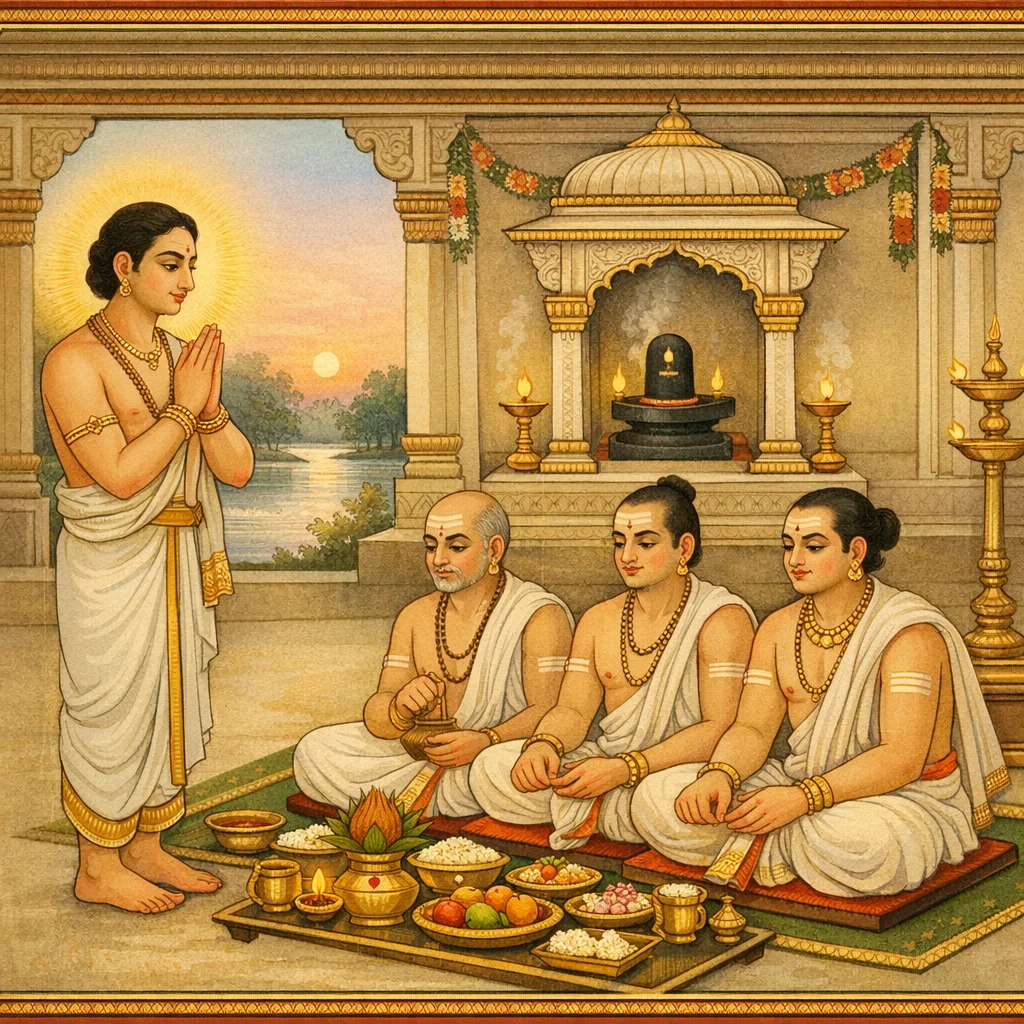
Īśvara speaks to Devī and directs the pilgrimage sequence toward the famed liṅga called Śaṅkaranātha, renowned in the three worlds and praised as a remover of sin. The chapter credits Bhānu (the Sun) with installing this liṅga: after performing great austerities, he established the shrine and set the sacred emblem in place. It then lays down a compact discipline of ethical-ritual acts—worship of Mahādeva with fasting, feeding Brahmins, performing śrāddha with control of the senses, and gifting gold and garments according to one’s means. The teaching ends with a clear phala: the practitioner attains the supreme abode, presented as a decisive outcome within the chapter’s theological frame.
Shlokas
Verse 1
ईश्वर उवाच । ततो गच्छेन्महादेवि लिंगं त्रैलोक्यविश्रुतम् । तत्र शंकरनाथेति प्रसिद्धं पापनाशनम्
Īśvara said: “Then, O Great Goddess, one should go to the Liṅga renowned throughout the three worlds. There it is famed as ‘Śaṅkaranātha’, the destroyer of sins.”
Verse 2
स्थापितं भानुना देवि कृत्वा तत्र महत्तपः । तमर्चयित्वा देवेशं सोपवासो महेश्वरम्
“O Goddess, it was established by Bhānu (the Sun), who performed great austerity there. Having worshipped the Lord of the gods—Maheśvara—while observing a fast…”
Verse 3
ब्राह्मणान्भोजयेत्तत्र श्राद्धं कुर्याज्जितेन्द्रियः । शक्त्या हिरण्यं वासांसि विप्रे दद्यात्समाहितः । स याति परमं स्थानं नात्र कार्या विचारणा
“There, with senses restrained, one should feed Brāhmaṇas and perform śrāddha. According to one’s capacity, with a composed mind, one should give gold and garments to a Brāhmaṇa. Such a person attains the supreme abode—of this there is no need for doubt.”
Verse 252
इति श्रीस्कांदे महापुराण एकाशीतिसाहस्र्यां संहितायां सप्तमे प्रभासखण्डे प्रथमे प्रभासक्षेत्रमाहात्म्ये शङ्करनाथमाहात्म्यवर्णनंनाम द्विपञ्चाशदुत्तरद्विशततमोऽध्यायः
Thus ends the two-hundred-and-fifty-second chapter, called “The Description of the Greatness of Śaṅkaranātha,” in the Prabhāsa Khaṇḍa (Book Seven) of the Śrī Skanda Mahāpurāṇa, in the Ekāśītisāhasrī Saṃhitā, within the Prabhāsakṣetra Māhātmya (First division).