Adhyaya 74
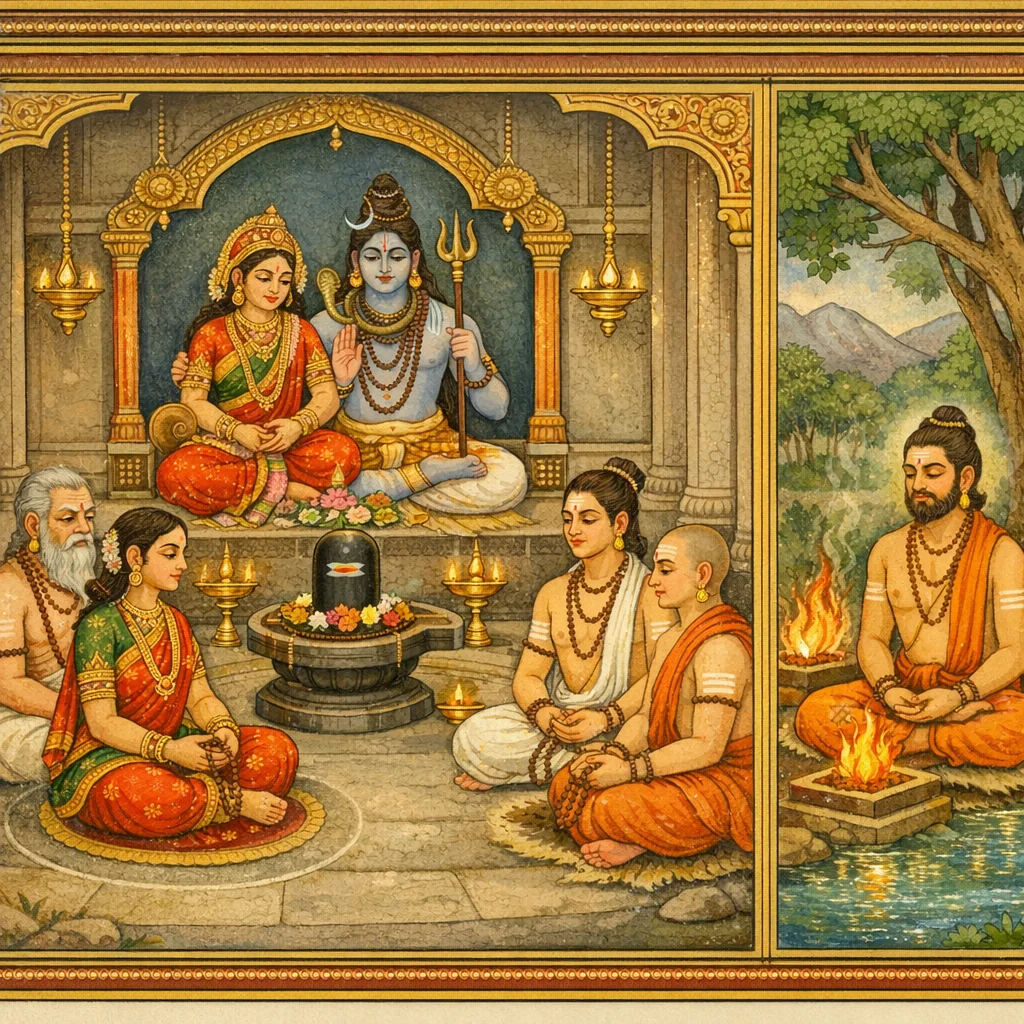
Īśvara instructs Mahādevī to go to the eminent shrine of the Śākalyeśvara liṅga, located by the stated direction and distance-marker. The liṅga is praised as “sarvakāmadam,” the granter of all desired aims, and its sanctity is grounded in a lineage of worship: the royal seer Śākalya performs great tapas, pleases Mahādeva, and the satisfied Lord manifests/is established in liṅga form. A phalaśruti declares that mere darśana of the deity dissolves sins amassed over seven births, as darkness vanishes at sunrise. The chapter then prescribes ritual times and procedures—especially bathing Śiva with milk on Aṣṭamī and Caturdaśī, worship with sequential offerings of fragrance, flowers, and the like, and the recommendation of gifting gold for those seeking the full fruit of pilgrimage. It also lists four yuga-specific names: in Kṛta, Bhairaveśvara; in Tretā, Sāvarṇikeśvara (connected with Sāvarṇi Manu); in Dvāpara, Gālavēśvara (connected with the sage Gālava); and in Kali, Śākalyeśvara (connected with the muni Śākalya attaining aṇimā and related siddhis). The kṣetra’s sanctified boundary is set at eighteen dhanu in radius; even small creatures within it are said to be eligible for liberation; local waters are revered as Sarasvatī-like; and darśana is equated with the fruits of great Vedic sacrifices. A month-long discipline near the liṅga on Soma-parvan is taught—Aghora-japa with ghee-homa—promising “uttamā siddhi” even to heavily burdened sinners. The liṅga is further described as “kāmika,” with Aghora as the deity’s face and a prominent Bhairava presence, explaining the earlier prevalence of the name Bhairaveśvara and its present Kali-age designation, Śākalyeśvara.
Shlokas
Verse 1
ईश्वर उवाच । ततो गच्छेन्महादेवि शाकल्येश्वरमुत्तमम् । दैत्यसूदनवायव्ये धनुषां त्रिंशता स्थितम्
Īśvara said: Then, O Great Goddess, one should go to the excellent Śākalyeśvara, situated thirty bow-lengths to the northwest of Daityasūdana.
Verse 2
शाकल्येन महादेवि पूजितं सर्वकामदम् । शाकल्योनाम राजर्षिर्यत्र तप्त्वा महत्तपः
O Great Goddess, it was worshipped by Śākalya and grants all desired aims. There, the royal sage named Śākalya performed great austerities.
Verse 3
समाराध्य महादेवं प्रत्यक्षीकृतवान्भवम् । लिंगेऽवतारयामास प्रसन्नं तं महेश्वरम्
Having thoroughly propitiated Mahādeva, he brought Bhava into direct manifestation; and he established that gracious Maheśvara in the liṅga.
Verse 4
तस्मिन्दृष्टे वरारोहे सप्तजन्मकृतं नृणाम् । पापं प्रणश्यते शीघ्रं तमः सूर्योदये यथा
O fair-hipped Lady, by merely beholding (Śākalyeśvara), the sins amassed by people over seven births swiftly perish—like darkness at sunrise.
Verse 5
तत्राष्टम्यां चतुर्द्दश्यां स्नापयेत्पयसा शिवम् । पूजयेच्च विधानेन गन्धपुष्पादिभिः क्रमात्
There, on the eighth lunar day and on the fourteenth, one should bathe Śiva with milk; and worship, according to the prescribed rite, in due order with perfumes, flowers, and the like.
Verse 6
हिरण्यं तत्र दातव्यं सम्यग्यात्राफलेप्सुभिः । चत्वारि तस्य नामानि कथ्यमानानि मे शृणु
Those who seek the full and proper fruit of pilgrimage there should give gold in charity. Now hear from me the four names by which that deity is proclaimed.
Verse 7
आदौ कृतयुगे देवि कीर्तितो भैरवेश्वरः । ततः सावर्णिमनुना सम्यगाराधितः प्रिये
In the beginning, in the Kṛta Yuga, O Goddess, he was celebrated as Bhairaveśvara. Thereafter, O beloved, he was duly worshipped by Sāvarṇi Manu.
Verse 8
सावर्णिकेश्वरं नाम त्रेतायां तस्य संज्ञितम् । ततस्तु द्वापरे देवि गालवेन महात्मना । सम्यगाराधितस्तत्र लिंगरूपीवृषध्वजः
In the Tretā Yuga he was known by the name Sāvarṇikeśvara. Then, in the Dvāpara Yuga, O Goddess, the great-souled Gālava duly worshipped there the Bull-bannered Lord (Vṛṣadhvaja), who abides in that place in the form of a liṅga.
Verse 9
तृतीयं तस्य देवस्य गालवेश्वरसंज्ञितम् । कलौ युगे तु संप्राप्ते शाकल्योनाम वै मुनिः
The third name of that God is proclaimed as Gālavēśvara. And when the Kali Yuga arrived, there was indeed a sage named Śākalya.
Verse 10
यत्र सिद्धिमनुप्राप्त ऐश्वर्यं चाणिमादिकम् । शाकल्येश्वरनामेति ततः ख्यातं तुरीयकम्
There, having attained siddhi and powers such as aṇimā and the rest, it became renowned by the fourth name: Śākalyeśvara.
Verse 11
एवं चातुर्युगं नाम तस्य लिंगस्य कीर्तितम् । पापघ्नं पुण्यदं नॄणां कीर्त्तितं सर्वकामदम्
Thus the liṅga’s “Cāturyuga” set of names has been declared. When praised and remembered, it destroys sin, grants merit to people, and is said to bestow all desired aims.
Verse 12
तस्यैव देवदेवस्य क्षेत्रोत्पत्तिं शृणु प्रिये
Now, O beloved, hear of the very origin of the sacred field (kṣetra) of that God of gods.
Verse 13
अष्टादशधनुर्देवि समंतात्परिमण्डलम् । महापापहरं देवि तत्र क्षेत्रनिवासिनाम्
O Goddess, it is a circular precinct extending eighteen dhanus in every direction. O Goddess, it removes great sins for those who dwell within that sacred field.
Verse 14
कृमिकीटपतंगानां तिरश्चामपि मोक्षदम् । यत्र कूपादितोयेषु जलं सारस्वतं स्मृतम्
In that place, liberation is granted even to worms, insects, and birds—and to other creatures as well. There, the water found in wells and other sources is remembered as “Sārasvata”, holy water akin to Sarasvatī.
Verse 15
यत्र तत्र नरः स्नात्वा स्वर्गलोके महीयते । अश्वमेधसहस्रस्य वाजपेयशतस्य च
Whoever bathes there is honoured in the world of heaven. The merit is said to be comparable to that of a thousand Aśvamedha sacrifices and a hundred Vājapeya rites.
Verse 16
तत्फलं समवाप्नोति तस्य लिंगस्य दर्शनात् । सोमपर्वणि संप्राप्ते यस्तत्र शुचिरात्मवान्
By merely beholding (darśana of) that sacred Liṅga, one attains the very fruit promised for the rite. When the Soma-parvan, the holy lunar observance, arrives, whoever remains there in purity and self-restraint gains that merit.
Verse 17
अघोरं च जपेत्सम्यगाज्यहोमसमन्वितम् । तल्लिंगस्य समीपस्थो यावन्मासावधिः प्रिये
And one should properly chant the Aghora mantra, together with oblations in a ghee-homa. Remaining near that Liṅga for as long as a month, O beloved, one becomes fit to receive its grace.
Verse 18
महापातकयुक्तोऽपि युक्तो वाऽप्युपपातकैः । स सर्वां लभते सिद्धिमुत्तमां वरवर्णिनि
Even one burdened with great sins—or tainted by secondary transgressions—attains all siddhis and the supreme spiritual accomplishment there, O fair-complexioned one.
Verse 19
कामिकं तत्स्मृतं लिंगं सर्वकामफलप्रदम् । अघोर वक्त्रं देवस्य तत्रस्थं भैरवं महत्
That Liṅga is remembered as Kāmika, bestowing the fruits of all desired aims. There abides the great Bhairava—the Lord’s Aghora face-aspect—present at that very spot.
Verse 20
भैरवेश्वरनामेति पूर्वं ख्यातमभूद्भुवि । अस्मिन्युगे तु संप्राप्ते शाकल्येश्वरनामकम्
Formerly on earth it was renowned by the name Bhairaveśvara. But in this present age it is known by the name Śākalyeśvara.