Adhyaya 302
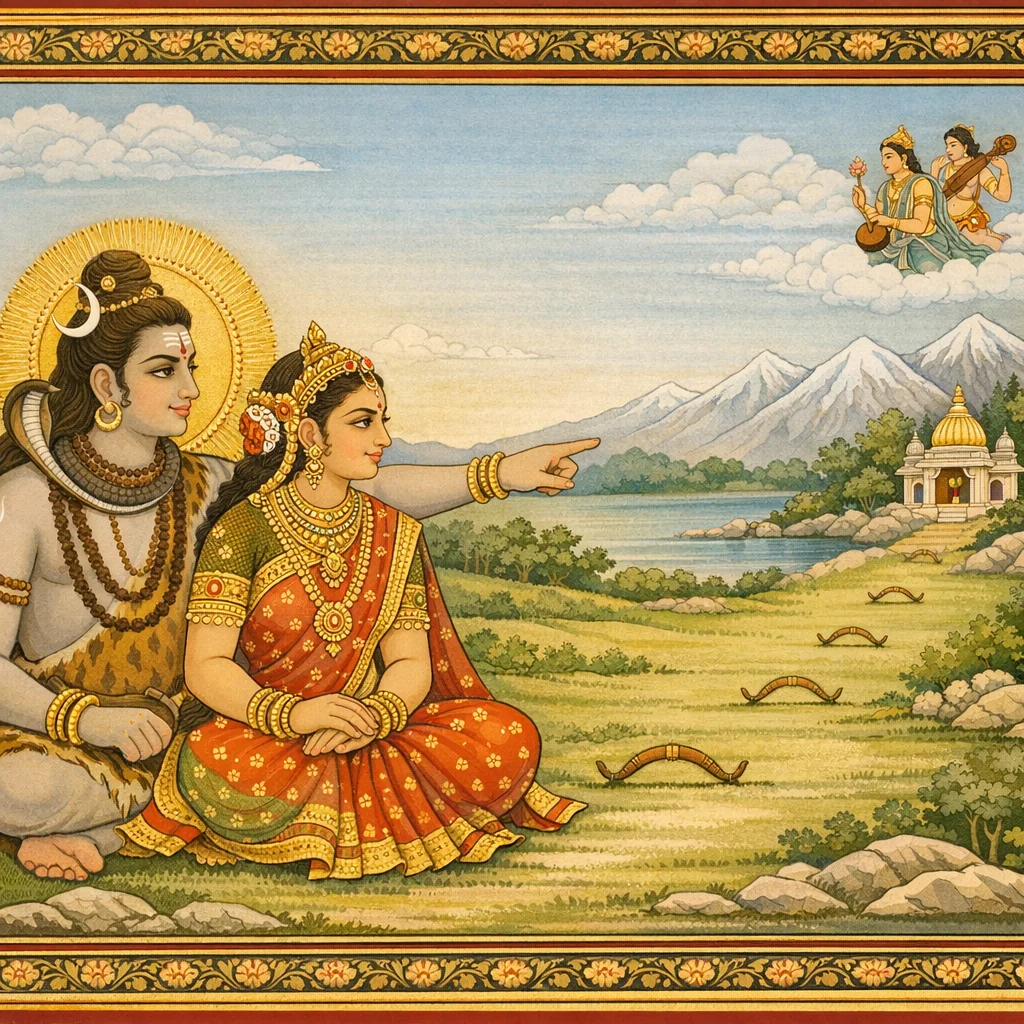
Īśvara speaks to Devī and instructs her—thereby guiding the pilgrim-reader as well—to proceed to the eminent shrine called Gandharveśvara within Prabhāsa-kṣetra. The chapter also gives a precise cue for finding it: the liṅga lies in the northern sector (uttara-dik-bhāga), at a distance of five dhanus, serving as a brief sacred itinerary. The teaching links darśana (beholding the shrine) with embodied transformation: the one who sees it becomes rūpavān, endowed with beauty and attractiveness. It is said that the liṅga was established by the Gandharvas, sanctifying its origin, and a minimal yet complete rite is prescribed—bathe (snātvā) and then perform one proper act of worship (sampūjayet sakṛt). The phalaśruti promises the attainment of all desires (sarvān kāmān avāpnoti) and the auspicious mark raktakaṇṭha (“red-throated”), gained through engagement with the site’s ritual merit.
Shlokas
Verse 1
ईश्वर उवाच । ततो गच्छेन्महादेवि गंधर्वेश्वरमुत्तमम् । तस्यैवोत्तरदिग्भागे धनुषां पंचके स्थितम्
Īśvara said: “Then, O Mahādevī, one should go to the excellent Gaṃdharveśvara. It is situated to the north of that place, at a distance of five bows.”
Verse 2
तं दृष्ट्वा च महादेवि रूपवाञ्जायते नरः । गंधर्वैः स्थापितं लिंगं स्नात्वा संपूजयेत्सकृत् । सर्वान्कामानवाप्नोति रक्तकण्ठश्च जायते
O Mahādevī, upon seeing it a person becomes endowed with beauty. Having bathed and worshiped even once that liṅga established by the Gandharvas, one attains all desired aims—and becomes “Red-throated” (raktakaṇṭha).
Verse 302
इति श्रीस्कांदे महापुराण एकाशीतिसाहस्र्यां संहितायां सप्तमे प्रभासखंडे प्रथमे प्रभासक्षेत्रमाहात्म्ये गंधर्वेश्वरमाहात्म्यवर्णनंनाम द्व्युत्तरत्रिशततमोऽध्यायः
Thus ends the three-hundred-and-second chapter, called “The Description of the Greatness of Gaṃdharveśvara,” in the Prabhāsa Khaṇḍa—within the Prabhāsa-kṣetra Māhātmya—of the Śrī Skanda Mahāpurāṇa, in the Saṃhitā of eighty-one thousand verses.