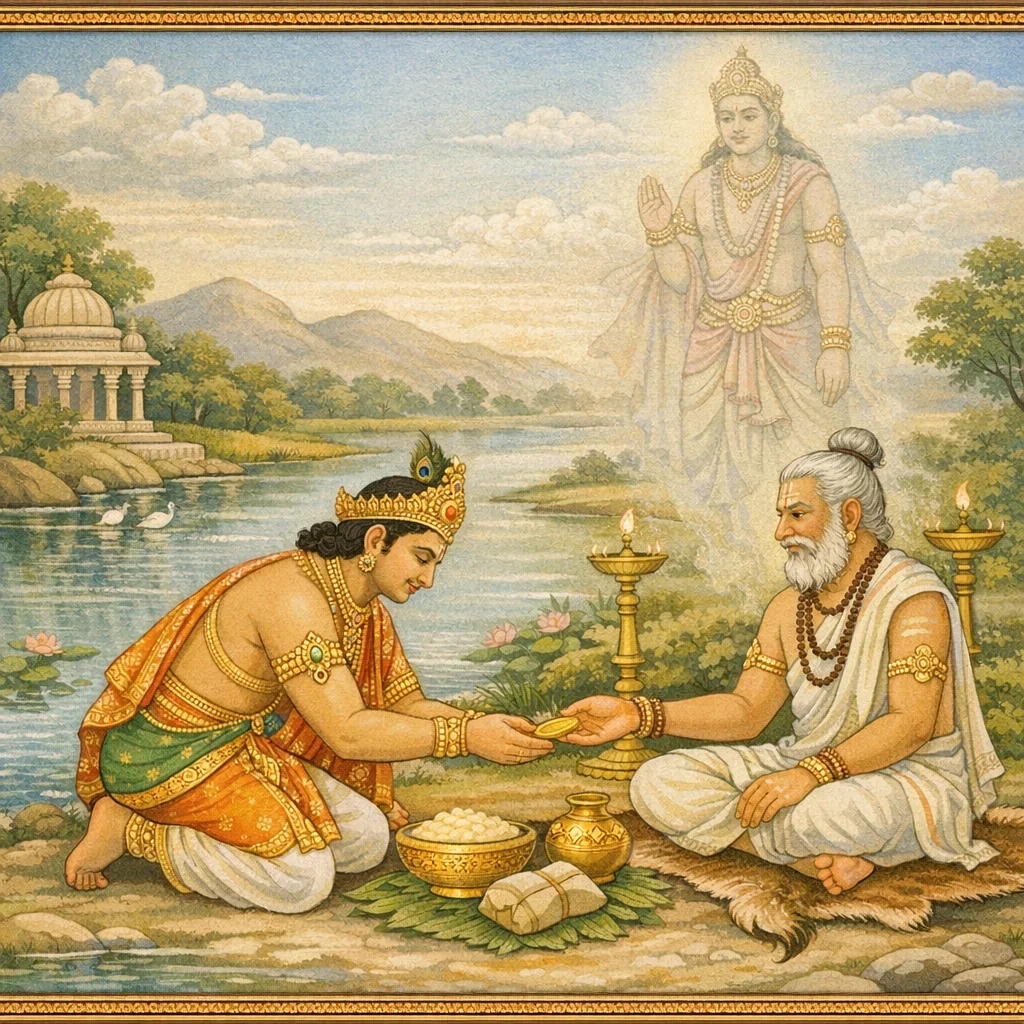
Adhyaya 336
Chapter 336 is a theological dialogue between Īśvara and Devī revealing a hidden yet supremely efficacious pilgrimage site in Prabhāsa: Goṣpada Tīrtha, near the Nyanku-matī river system and connected with a “preta-śilā” associated with ancestral release. The text proclaims that śrāddha performed here yields merit “sevenfold of Gayā,” and illustrates this through King Pṛthu’s śrāddha, by which the sinful King Vena is uplifted from an impure birth. Devī asks for the site’s origin, the rite’s procedure, mantras, and qualified officiants; Īśvara stresses that this is a secret teaching (rahasya) to be shared only with the faithful. A structured ritual itinerary follows: disciplines of purity (brahmacarya, śauca, āstikya), avoidance of nāstika company, preparation of śrāddha materials, bathing in Nyanku-matī, and tṛpaṇa to devas and pitṛs. Invocation-mantras summon pitṛ-deities such as Agniṣvātta, Barhiṣad, and Somapā, and expansive piṇḍa-offerings are prescribed for known and unknown ancestors, including those in difficult post-mortem states and even non-human births. Offerings include pāyasa, madhu, saktu, piṣṭaka, caru, grains, roots/fruits, along with dāna (notably go-dāna and dīpa-dāna), circumambulation, dakṣiṇā, and immersion of the piṇḍas. The itihāsa section recounts Vena’s adharmic rule, his death at the hands of ṛṣis, the emergence of Niṣāda and Pṛthu, Pṛthu’s kingship and the motif of “milking the earth,” and Pṛthu’s effort to redeem Vena. Ordinary tīrthas recoil from Vena’s sin, but celestial instruction directs Pṛthu to Prabhāsa and specifically Goṣpada, where the rite succeeds and Vena attains release. The chapter ends by reaffirming the site’s flexible timing with minimal calendrical restriction, listing auspicious occasions, and restricting transmission of this sacred secret to sincere practitioners.
Shlokas
Verse 1
ईश्वर उवाच । ततो गच्छेन्महादेवि गोष्पदं तीर्थमुत्तमम् । यत्र श्राद्धं नरः कृत्वा गयासप्तगुणं फलम् । लभते नात्र संदेहो यदि श्रद्धा दृढा भवेत्
Īśvara said: Then, O Great Goddess, one should go to the excellent tīrtha called Goṣpada. Having performed śrāddha there, a person gains merit sevenfold that of Gayā—of this there is no doubt—provided faith is firm.
Verse 2
यत्र श्राद्धं पृथुः कृत्वा पितरं पापयोनितः उद्दधार महादेवि वेनंनाम महाप्रभुम्
O Great Goddess, it was there that Pṛthu, having performed śrāddha, raised up his father—the mighty one named Vena—from an evil womb, a fallen state.
Verse 3
देव्युवाच । कस्मिन्स्थाने स्थितं तीर्थमुत्पत्तिस्तस्य कीदृशी । कथं स वेनराजो वा उद्धृतः पापयोनितः
The Goddess said: “In what place is that tīrtha situated, and what is its origin like? And how was King Vena delivered from an evil womb, from a fallen birth?”
Verse 4
गयासप्तगुणं पुण्यं कथं तत्र प्रजायते । श्राद्धस्य किं विधानं तु के मंत्रास्तत्र के द्विजाः । एतन्मे कौतुकं देव यथावद्वक्तुमर्हसि
How does merit arise there, sevenfold that of Gayā? What is the proper ordinance for śrāddha—what mantras are used there, and which brāhmaṇas (dvijas) should be engaged? This is my curiosity, O Lord; please explain it rightly, as it ought to be.
Verse 5
ईश्वर उवाच । इदं रहस्यं देवेशि यत्त्वया परिपृच्छितम् । अप्रकाश्यमिदं तीर्थमस्मिन्पापयुगे प्रिये
Īśvara said: “O Goddess, the secret you have asked about—this sacred tīrtha is not to be made public in this sinful age, O beloved.”
Verse 6
तथापि संप्रवक्ष्यामि तव स्नेहात्सुरेश्वरि । न पापिन इदं ब्रूयान्नैव तर्करताय वै
“Even so, O sovereign Goddess, out of affection for you I shall explain it. Yet one should not tell this to a sinner, nor to one addicted to disputation.”
Verse 7
न नास्तिकाय देवेशि न सुवर्णेतराय च । अस्ति देवि महासिद्धा पुण्या न्यंकुमती नदी
“Not for an unbeliever, O Goddess, nor for one lacking true worth. O Devī, there exists the supremely efficacious and holy river Nyanku-matī.”
Verse 8
मर्यादार्थं मयाऽनीता क्षेत्रस्यास्य महेश्वरि । संस्थिता पापशमनी पर्णादित्याच्च दक्षिणे
“To mark the sacred boundary of this holy region, O Maheśvarī, I brought her here. The sin-destroying river stands to the south of Parṇāditya.”
Verse 9
नारायणगृहात्सौम्ये नातिदूरे व्यवस्थिता । तस्या मध्ये महादेवि तीर्थं त्रैलोक्यविश्रुतम्
“O gentle one, she is situated not far from the abode of Nārāyaṇa. In her midst, O great goddess, is a tīrtha renowned throughout the three worlds.”
Verse 10
गोष्पदं नाम विख्यातं कोटिपापहरं नृणाम् । गोष्पदस्य समीपे तु नातिदूरे व्यवस्थितः
“It is famed by the name Goṣpada, removing the sins of men by the crore. And near Goṣpada, not far away, there is another presence situated.”
Verse 11
अनन्तो नाम नागेन्द्रः स्वयंभूतो धरातले । तस्य तीर्थस्य रक्षार्थं विष्णुना सन्नियोजितः
“There is the serpent-king named Ananta, self-manifest upon the earth. For the protection of that tīrtha, he was appointed by Viṣṇu.”
Verse 12
कांक्षंति पितरः पुत्रान्नरकादतिभीरवः । गंता यो गोष्पदे पुत्रः स नस्त्राता भविष्यति । गोष्पदे च सुतं दृष्ट्वा पितॄणामुत्सवो भवेत्
“The ancestors (Pitṛs), greatly afraid of hell, long for sons. The son who goes to Goṣpada will become our deliverer. And upon seeing a son at Goṣpada, the Pitṛs rejoice in celebration.”
Verse 13
पद्भ्यामपि जलं स्पृष्ट्वा अस्मभ्यं किं न दास्यति । अपि स्यात्स कुलेऽस्माकं यो नो दद्याज्जलांजलिम् । प्रभासक्षेत्रमासाद्य गोष्पदे तीर्थ उत्तमे
Even by merely touching the water with his feet, what would he not bestow upon us—the Pitṛs (ancestors)? May there arise in our lineage one who offers us a handful of water (jalāñjali), having reached Prabhāsa-kṣetra, at Goṣpada, the most excellent tīrtha.
Verse 14
अपि स्यात्स कुलेऽस्माकं खड्गमांसेन यः सकृत् । श्राद्धं कुर्यात्प्रयत्नेन कालशाकेन वा पुनः
May there be in our lineage one who, even once, earnestly performs the Śrāddha—whether with khaḍga-meat or again with kālaśāka greens.
Verse 15
अपि स्यात्स कुलेऽस्माकं गोष्पदे दत्तदीपकः । आकल्पकालिका दीप्तिस्तेनाऽस्माकं भविष्यति
If only there might be someone in our lineage who offers even a single lamp at Goṣpada—by that act an enduring radiance, lasting until the end of the age (kalpa), will arise for our family.
Verse 16
गोष्पदे चान्नशता यः पितरस्तेन पुत्रिणः । दिनमेकमपि स्थित्वा पुनात्यासप्तमं कुलम्
The Pitṛs who are satisfied at Goṣpada with a hundred offerings of food grant progeny; and by residing there even for a single day, one purifies the family line up to the seventh generation.
Verse 17
पिण्डं दद्याच्च पित्रादेरात्मनोऽपि स्वयं नरः । पिण्याकेंगुदकेनापि तेन मुच्येद्वरानने
A man should himself offer the piṇḍa for his forefathers—and even for himself. Even if it is done with mere oil-cake and water, by that he is liberated, O fair-faced one.
Verse 18
ब्रह्मज्ञानेन किं योगैर्गोग्रहे मरणेन किम् । किं कुरुक्षेत्रवासेन गोष्पदे यदि गच्छति
What need is there of Brahma-knowledge, of yogic disciplines, of dying at Go-graha, or of dwelling at Kurukṣetra—if one goes to Goṣpada?
Verse 19
सकृत्तीर्थाभिगमनं सकृत्पिण्डप्रपातनम् । दुर्ल्लभं किं पुनर्नित्यमस्मिंस्तीर्थे व्यवस्थितम्
To visit the tīrtha even once, and to offer piṇḍa even once—what could be difficult to attain, then, for one who dwells here constantly in this sacred place?
Verse 20
अर्द्धकोशं तु तत्तीर्थं तदर्द्धार्द्धं तु दुर्ल्लभम् । तन्मध्ये श्राद्धकृत्पुण्यं गयासप्तगुणं लभेत्
That tīrtha extends for half a krośa; but its innermost quarter is rare to reach. Performing śrāddha in its very midst yields merit sevenfold of that gained at Gayā.
Verse 21
श्राद्धकृद्गोष्पदे यस्तु पितॄणामनृणो हि सः । पदमध्ये विशेषेण कुलानां शतमुद्धरेत्
Whoever performs śrāddha at Goṣpada becomes truly free from debt to the ancestors; and especially in the very middle of that sacred ‘pada’, he uplifts a hundred families (lines).
Verse 22
गृहाच्चलितमात्रस्य गोष्पदे गमनं प्रति । स्वर्गारोहणसोपानं पितॄणां तु पदेपदे
For one who has merely set out from home to go to Goṣpada, each step becomes a stair for the ancestors’ ascent to heaven.
Verse 23
पायसेनैव मधुना सक्तुना पिष्टकेन च । चरुणा तंदुलाद्यैर्वा पिंडदानं विधीयते
Piṇḍa-offering is enjoined to be made with pāyasa (sweet rice-pudding), honey, parched flour, cakes, caru (the ritually cooked oblation), or with rice and other such grains.
Verse 24
गोप्रचारे तु यः पिण्डा ञ्छमीपत्रप्रमाणतः । कन्दमूलफलाद्यैर्वा दत्त्वा स्वर्गं नयेत्पितॄन्
But in the cow-grazing grounds, whoever offers piṇḍas of the measure of a śamī leaf—whether made from bulbs, roots, fruits, and the like—leads the ancestors to heaven.
Verse 25
गोष्पदे पिण्डदानेन यत्फलं लभते नरः । न तच्छक्यं मया वक्तुं कल्पकोटिशतैरपि
The fruit a man obtains by offering piṇḍas at Goṣpada is such that I am unable to describe it—even in hundreds of crores of aeons.
Verse 26
अथातः संप्रवक्ष्यामि सम्यग्यात्राविधिं शुभम् । यात्राविधानं च तथा सम्यक्छ्रद्धान्विता शृणु
Now, therefore, I shall explain the auspicious and proper method of pilgrimage. Listen with steady faith to the rules and procedure of the yātrā as well.
Verse 27
यदि तीर्थं नरो गच्छेद्गयाश्राद्धफलेप्सया । तथाविधविधानेन यात्रा कुर्याद्विचक्षणः
If a man goes to a sacred ford seeking the fruit of the Gayā-śrāddha, the discerning person should undertake the pilgrimage according to that very prescribed discipline.
Verse 28
ब्रह्मचारी शुचिर्भूत्वा हस्तपादेषु संयतः । श्रद्धावानास्तिको भावी गच्छेत्तीर्थं ततः सुधीः
Having become a brahmacārin and pure, restrained in the conduct of hands and feet, faithful, theistic, and well-intentioned—then the wise man should proceed to that tīrtha.
Verse 29
न नास्तिकस्य संसर्गं तस्मिंस्तीर्थे नरश्चरेत् । सर्वोपस्करसंयुक्तः श्राद्धार्ह द्रव्यसंयुतः । गच्छेत्तीर्थं साधुसंगी गयां मनसि मानयन्
At that tīrtha, a man should not keep company with the faithless. Equipped with all requisites and with offerings fit for śrāddha, he should go to the holy place in the company of the virtuous, reverently honoring Gayā in his heart.
Verse 30
एवं यस्तु द्विजो गच्छेत्प्रतिग्रहविवर्जितः । पदेपदेऽश्वमेधस्य फलं प्राप्नोत्य संशयम्
Thus, the twice-born who goes on pilgrimage without accepting gifts obtains at every step the fruit of the Aśvamedha sacrifice—without doubt.
Verse 31
तत्र स्नात्वा न्यंकुमत्यां सिद्धये पितृमुक्तये । स्नात्वाथ तर्प्पणं कुर्याद्देवादीनां यथाविधि
There, having bathed in the Nyaṅkumatī for spiritual accomplishment and for the liberation of the ancestors, and having bathed, he should then perform tarpaṇa for the gods and others according to rule.
Verse 32
ब्रह्मादिस्तंबपर्यंता देवर्षि मनुमानवाः । तृप्यन्तु पितरः सर्वे मातृमातामहादयः
From Brahmā down to the very grass and plants; the gods, seers, Manus, and humans—may all the Pitṛs be satisfied: the maternal ancestors, the maternal grandfathers, and the rest.
Verse 33
एवं संतर्प्य विधिना कृत्वा होमादिकं नरः । श्राद्धं सपिण्डकं कुर्यात्स्वतंत्रोक्तविधानतः
Thus, having satisfied (the recipients) in due manner and performed the homa and the rites allied to it, a man should then perform the śrāddha together with the sapiṇḍīkaraṇa, according to the procedure taught in the authoritative tradition.
Verse 34
आमन्त्र्य ब्राह्मणांस्तत्र शास्त्रजान्दोषवर्जितान् । एवं कृतोपचारस्तु इमं मन्त्रमुदीरयेत्
Having respectfully invited Brahmins there—learned in the scriptures and free from faults—and having duly offered them the proper honors, he should then recite this mantra.
Verse 35
कव्यवाडनलः सोमो यमश्चैवार्यमा तथा । अग्निष्वात्ता बर्हिषदः सोमपाः पितृदेवताः । आगच्छन्तु महाभागा युष्माभी रक्षिता स्त्विह
May Kavyavāḍānala, Soma, Yama, and Aryamā, and also the Agniṣvāttas, the Barhiṣads, and the Somapās—the divine Pitṛ-deities—come here, O greatly blessed ones. Here, may we be protected by you.
Verse 36
मदीयाः पितरो ये च कुले जाताः सनाभयः । तेषां पिण्डप्रदाताऽहमागतोऽस्मिन्पितामहाः
O grandfathers: for those ancestors of mine who were born in my lineage, kinsmen of the same family, I have come here as the giver of the piṇḍas, the funeral rice-balls.
Verse 37
एवमुक्त्वा महादेवि इमं मन्त्रमुदीरयेत्
Having spoken thus, O Great Goddess, one should then recite this mantra.
Verse 38
पिता पितामहश्चैव तथैव प्रपितामहः । माता पितामही चैव तथैव प्रपितामही
Father, grandfather, and great-grandfather; likewise mother, grandmother, and great-grandmother—
Verse 39
मातामहः प्रमाता च तथा वृद्धप्रमातृकः । तेषां पिंडो मया दत्तो ह्यक्षय्यमुपतिष्ठताम्
Maternal grandfather, maternal great-grandfather, and the elder ancestor beyond them—may the piṇḍa I have offered to them be imperishable, never diminished, and stand as lasting support.
Verse 40
ॐ नमो भानवे भर्त्रेऽब्जभौमसोमरू पिणे । एवं नत्वाऽर्चयित्वा तु इमां स्तुतिमथो पठेत्
Om—salutations to Bhānu, the Lord, whose form is also the Lotus-born, Bhūma, and Soma. Having thus bowed and worshipped, one should then recite this hymn.
Verse 41
तत्र गोष्पदसामीप्ये चरुणा सुशृतेन च । पितॄणामनाथानां च मंत्रैः पिंडांश्च निर्वपेत्
There, near the sacred spot called Goṣpada, with well-cooked caru, one should, with mantras, place piṇḍa-offerings also for those Pitṛs who are without support and unattended.
Verse 42
अस्मत्कुले मृता ये च गतिर्येषां न विद्यते । रौरवे चांधतामिस्रे कालसूत्रे च ये गताः । तेषामुद्धरणार्थाय इमं पिंडं ददाम्यहम्
For those who have died in our family and for whom no onward refuge is known—those who have gone to Raurava, Andhatāmisra, or Kālasūtra—for their deliverance I offer this piṇḍa.
Verse 43
अनेकयातनासंस्थाः प्रेतलोकेषु ये गताः । तेषामुद्धरणार्थाय इमं पिंडं ददाम्यहम्
For those who have gone to the preta-worlds and abide amid many torments—seeking their deliverance, I offer this piṇḍa.
Verse 44
पशुयोनिगता ये च ये च कीटसरी सृपाः । अथवा वृक्षयोनिस्थास्तेभ्यः पिंडं ददाम्यहम्
And for those who have entered animal wombs, and for those who have become insects, creeping beings, or reptiles—or even those abiding in the birth of trees—for them I offer this piṇḍa.
Verse 45
असंख्या यातनासंस्था ये नीता यमशासकैः । तेषामुद्धरणार्थाय इमं पिंडं ददाम्यहम्
For those whom Yama’s enforcers have led into countless abodes of torment—seeking their deliverance, I offer this piṇḍa.
Verse 46
येऽबांधवा बांधवा ये येऽन्यजन्मनि बांधवाः । ते सर्वे तृप्तिमायांतु पिंडेनानेन सर्वदा
May all—those not related to me, those related to me, and those who were kin in another birth—through this piṇḍa, attain enduring satisfaction always.
Verse 47
ये केचित्प्रेतरूपेण वर्त्तंते पितरो मम । ते सर्वे तृप्तिमायांतु पिंडेनानेन सर्वदा
Whatever ancestors of mine may exist in the state of a preta—may they all, through this piṇḍa offering, attain satisfaction always.
Verse 48
दिव्यांतरिक्षभूमिस्थपितरो बांधवादयः । मृताश्चासंस्कृता ये च तेषां पिंडोस्तु मुक्तये
May this sacred piṇḍa be for the liberation of my ancestors and kin who dwell in the heavenly realms, in mid-space, or upon the earth—and also of those who died without the due rites.
Verse 49
पितृवंशे मृता ये च मातृवंशे तथैव च । गुरुश्वशुरबंधूनां ये चान्ये बांधवा मृताः
Those who have died in my father’s lineage and likewise in my mother’s lineage; and those deceased among my teachers, fathers-in-law, and other relations—
Verse 50
ये मे कुले लुप्तपिंडाः पुत्रदारविवर्जिताः । क्रियालोपगता ये च जात्यंधाः पंगवस्तथा
Those in my family whose piṇḍa offerings have lapsed—those without sons and without wives; those for whom the rites were omitted; and those blind from birth or likewise lame—
Verse 51
विरूपा आमगर्भा येऽज्ञाता ज्ञाताः कुले मम । तेषां पिंडो मया दत्तो ह्यक्षय्यमुपतिष्ठताम्
Whether misshapen, or those who died as unformed embryos; whether unknown or known within my lineage—this piṇḍa has been offered by me for them; may it become an inexhaustible support.
Verse 52
प्रेतत्वात्पितरो मुक्ता भवंतु मम शाश्वतम् । यत्किंचिन्मधुसमिश्रं गोक्षीरं घृतपायसम्
May my ancestors be freed forever from the preta-state. Whatever offering is mixed with honey—cow’s milk and rice cooked with ghee—
Verse 53
अक्षय्यमुपतिष्ठेत्त्वत्त्वस्मिंस्तीर्थे तु गोष्पदे । स्वाध्यायं श्रावयेत्तत्र पुराणान्यखिलान्यपि
May the inexhaustible fruit abide here for you, in this tīrtha called Goṣpada. There one should have the svādhyāya recited, and indeed all the Purāṇas as well.
Verse 54
ब्रह्मविष्ण्वर्करुद्राणां स्तवानि विविधानि च । ऐंद्राणि सोमसूक्तानि पावमानीश्च शक्तितः
And one should recite various hymns to Brahmā, Viṣṇu, Arka (the Sun), and Rudra—together with Indra hymns, Soma-sūktas, and the purificatory Pāvamānī chants—according to one’s capacity.
Verse 55
बृहद्रथंतरं तद्वज्ज्येष्ठसाम सरौरवम् । तथैव शांतिकाध्यायं मधुब्राह्मणमेव च
Likewise one should recite the Bṛhadrathantara, the Jyeṣṭha-sāman, and the Saraurava; and also the Śānti chapter for pacification, and the Madhu Brāhmaṇa as well.
Verse 56
मंडलं ब्राह्मणं तत्र प्रीतकारि च यत्पुनः । विप्राणामात्मनश्चैव तत्सर्वं समुदीरयेत्
There one should also duly recite the Maṇḍalas and the Brāhmaṇa passages; and whatever else is pleasing—both for the brāhmaṇas and for oneself—one should pronounce all of that.
Verse 57
एवं न्यंकुमतीमध्ये गोष्पदे तीर्थ उत्तमे । दत्त्वा पिंडांश्च विधिवत्पुनर्मंत्रमिमं पठेत्
Thus, in the midst of the Nyaṅkumatī, at Goṣpada—the excellent sacred ford—having offered the piṇḍas according to rule, one should again recite this mantra.
Verse 58
साक्षिणः संतु मे देवा ब्रह्माद्या ऋषिपुंगवाः । मयेदं तीर्थमासाद्य पितॄणां निष्कृतिः कृता
Let the gods—Brahmā and the rest—and the foremost of sages be my witnesses: having reached this tīrtha, I have performed the expiation and release due to my ancestors.
Verse 59
आगतोऽस्मि इदं तीर्थं पितृकार्ये सुरोत्तमाः । भवंतु साक्षिणः सर्वे मुक्तश्चाहमृणत्रयात्
O best of gods, I have come to this tīrtha for the ancestral rite. Let all of you be witnesses, and may I be freed from the threefold debt.
Verse 60
एवं प्रदक्षिणीकृत्य गोष्पदं तीर्थमुत्तमम् । विप्रेभ्यो दक्षिणां दत्त्वा नद्यां पिंडान्विसर्जयेत्
Having thus circumambulated Goṣpada, the excellent tīrtha, and having given the honorarium (dakṣiṇā) to the Brāhmaṇas, one should consign the piṇḍas into the river.
Verse 61
गोदानं तत्र देयं तु तद्वत्कृष्णाजिनं प्रिये । अष्टकासु च वृद्धौ च गयायां मृतवासरे
There, a gift of a cow should indeed be given—and likewise a black antelope skin, O beloved—on the Aṣṭakā days, on occasions of prosperity (vṛddhi), and at Gayā on the day of death-anniversary.
Verse 62
अत्र मातुः पृथक्छ्राद्धमन्यत्र पतिना सह । वृद्धिश्राद्धे तु मात्रादि गयायां पितृपूर्वकम्
Here, the śrāddha for one’s mother is performed separately; elsewhere it is done together with the husband. But in the vṛddhi-śrāddha, beginning with the mother (and other maternal relations) is proper; while at Gayā, it is done with the father’s line first.
Verse 63
गयावदत्रैव पुनः श्राद्धं कार्यं नरोत्तमैः । तस्माद्गुप्तगया प्रोक्ता इयं सा विष्णुना स्वयम्
As at Gayā, so here too the best of men should again perform śrāddha. Therefore this place is called “Hidden Gayā” (Guptagayā) by Viṣṇu Himself.
Verse 64
गंधदानेन गंधाप्तिः सौभाग्यं पुष्पदानतः । धूपदानेन राज्याप्तिर्दीप्तिर्दीपप्रदानतः
By gifting fragrance one attains fragrance (refinement and pleasantness); by gifting flowers one gains good fortune. By gifting incense one attains sovereignty, and by gifting lamps one attains radiance.
Verse 65
ध्वजदानात्पापहानिर्यात्राकृद्ब्रह्मलोकभाक् । श्राद्धपिंडप्रदो लोके विष्णुर्नेष्यति वै पितॄन्
By gifting a banner (dhvaja), one’s sins are destroyed; the pilgrim attains Brahmā’s world. And whoever offers śrāddha piṇḍas in this sacred realm—Viṣṇu Himself indeed leads that person’s forefathers onward, upon their blessed course.
Verse 66
एकं यो भोजयेत्तत्र ब्राह्मणं शंसितव्रतम् । गोप्रचारे महातीर्थे कोटिर्भवतिभोजिता
Whoever feeds even a single Brāhmaṇa there—one established in praised vows—at the great tīrtha called Gopracāra, it is as though a koṭi (ten million) have been fed.
Verse 67
इति संक्षेपतः प्रोक्तस्तत्र श्राद्धविधिस्तव । अथ ते कथयिष्यामि इतिहासं पुरातनम्
Thus, in brief, the procedure for śrāddha there has been explained to you. Now I shall narrate to you an ancient sacred history (itihāsa).
Verse 68
वेनस्य राज्ञश्चरितं पृथोश्चैव महात्मनः । यथा तत्राभवन्मुक्तिस्तस्य चांडालयोनितः । तत्सर्वं शृणु देवेशि सम्यक्छ्रद्धासमान्विता
Hear in full, O Lady of the Lord, with steadfast faith: the deeds of King Vena and of the great-souled Pṛthu—how, in that place, liberation (mokṣa) came to him, even though he was born from a cāṇḍāla womb.
Verse 69
पिशुनाय न पापाय नाशिष्यायाहिताय च । कथनीयमिदं पुण्यं नाव्रताय कथंचन
This meritorious teaching should not be told to a slanderer, nor to a sinner, nor to one who is no disciple and acts with ill will; it should never be told to one who is without vows (undisciplined).
Verse 70
स्वर्ग्यं यशस्यमायुष्यं धन्यं वेदेन संमितम् । रहस्यमृषिभिः प्रोक्तं शृणुयाद्योऽनसूयकः
This teaching leads to heaven, grants renown, enhances lifespan, and is auspicious—measured in accord with the Veda. It is a secret declared by the sages; one who is free from envy should listen to it.
Verse 71
यश्चैनं श्रावयेन्मर्त्यः पृथो र्वैन्यस्य संभवम् । ब्राह्मणेभ्यो नमस्कृत्वा न स शोचेत्कृताऽकृते
And the mortal who causes this account of Pṛthu Vainya’s birth to be recited—having bowed to the Brāhmaṇas—does not grieve over what has been done or left undone.
Verse 72
गोप्ता धर्मस्य राजाऽसौ बभौ चात्रिसमप्रभः । अत्रिवंशसमुत्पन्नो ह्यंगो नाम प्रजापतिः
That king became a protector of dharma, radiant like Atri. From the lineage of Atri arose the Prajāpati named Aṅga.
Verse 73
तस्य पुत्रोऽभवेद्वेनो नात्यर्थं धार्मिकस्तथा । जातो मृत्युसुतायां वै सुनीथायां प्रजापतिः
His son was Vena, not at all especially righteous. That Prajāpati was born of Sunīthā, the daughter of Mṛtyu.
Verse 74
समातामह दोषेण तेन कालात्मकाननः । स धर्मं पृष्ठतः कृत्वा पापबुद्धिरजायत
Because of the fault inherited from his maternal grandfather, his very face took on the nature of Death-Time. Turning dharma behind him, he developed a sinful mind.
Verse 75
स्थितिमुत्थापयामास धर्मोपेतां सनातनीम् । वेदशास्त्राण्यतिक्रम्य ह्यधर्म निरतोऽभवत्
He overturned the ancient, dharma-endowed order; transgressing the Vedas and the śāstras, he became devoted to adharma.
Verse 76
निःस्वाध्यायवषट्काराः प्रजास्तस्मिन्प्रशासति । डिंडिमं घोषयामास स राजा विषये स्वके
While he ruled, the people were left without Vedic study and without the vaṣaṭ-cry of sacrifice; that king had a drum proclaimed throughout his own realm.
Verse 77
न दातव्यं न यष्टव्यं मयि राज्यं प्रशासति । आसीत्प्रतिज्ञा क्रूरेयं विनाशे प्रत्युपस्थिते
‘No gifts are to be given, no sacrifices are to be performed while I govern the kingdom’—such was this cruel vow, made when ruin had drawn near.
Verse 78
अहमीड्यश्च पूज्यश्च सर्वयज्ञैर्द्विजोत्तमैः । मयि यज्ञा विधातव्या मयि होतव्यमित्यपि
“I alone am to be praised and worshipped by the best of the twice-born through every sacrifice; sacrifices must be instituted for me, and oblations must be offered to me”—so he even proclaimed.
Verse 79
तमतिक्रांतमर्यादं प्रजापीडनतत्परम् । ऊचुर्महर्षयः क्रुद्धा मरीचिप्रमुखास्तदा
Then the great seers—angered—led by Marīci, addressed him, who had overstepped all bounds and was intent on tormenting the people.
Verse 80
माऽधर्मं वेन कार्षीस्त्वं नैष धर्मः सनातनः । अत्रेर्वंशे प्रसूतोऽसि प्रजापतिरसंशयम्
“Do not commit adharma, O Vena—this is not the eternal dharma (sanātana). You are born in Atri’s lineage; you are a Prajāpati, beyond doubt.”
Verse 81
पालयिष्ये प्रजाश्चेति पूर्वं ते समयः कृतः । तांस्तथावादिनः सर्वान्ब्रह्मर्षीनब्रवीत्तदा
“‘I will protect the subjects’—this was the former covenant you made.” Then he spoke to all those Brahmarṣis who had said so.
Verse 82
वेनः प्रहस्य दुर्बुद्धिरिदं वचनकोविदः । स्रष्टा धर्मस्य कश्चान्यः श्रोतव्यं कस्य वा मया
Vena—foolish though clever with words—laughed and said: “Who else is the maker of dharma? And whom should I listen to?”
Verse 83
वीर्यश्रुततपःसत्यैर्मयान्यः कः समो भुवि । मदात्मानो न नूनं मां यूयं जानीथ तत्त्वतः
By valor, learning, austerity, and truth—who on earth is equal to me? Surely you do not know me in essence, for your minds are not aligned with mine.
Verse 84
प्रभवं सर्वलोकानां धर्माणां च विशेषतः । इत्थं देहेन पृथिवीं भावेन यजनेन च
I am the source of all worlds, and especially of dharmas. Thus, by my very person, by my will, and by worship, I sustain the earth.
Verse 85
सृजेयं च ग्रसेयं च नात्र कार्या विचारणा । यदा न शक्यते स्तंभान्मत्तश्चैव विमोहितः
I can create and I can devour—there is no need for deliberation here. When I cannot be checked or restrained, I become intoxicated and utterly deluded.
Verse 86
अनुनेतुं नृपो वेनस्तत्र क्रुद्धा महर्षयः । आथर्वणेन मंत्रेण हत्वा तं ते महाबलम्
There the great sages, angered at him, sought to bring King Vena to reason; and by an Atharvanic mantra they struck down that mighty one.
Verse 87
ततोऽस्य वामबाहुं ते ममंथुर्भृशकोपिताः । तस्माच्च मथ्यमानाद्वै जज्ञे पूर्वमिति श्रुतिः
Then, in fierce anger, they churned his left arm; and from that churning, according to tradition, there arose first a being.
Verse 88
ह्रस्वोऽतिमात्रः पुरुषः कृष्णश्चापि तदा प्रिये । स भीतः प्राञ्जलिश्चैव तस्थिवान्संमुखे प्रिये
Then, dear one, a man arose—short of stature, exceedingly misshapen, and dark in complexion. Frightened, he stood before them with palms joined in reverence, facing them.
Verse 89
तमात्तं विह्वलं दृष्ट्वा निषीदेत्यब्रुवन्किल । निषादो वंशकर्ता वै तेनाभूत्पृथुविक्रमः
Seeing him terrified and trembling, they said, “Sit down,” as is told. Thus he was called Niṣāda, a founder of a lineage; and from that line arose the valiant Pṛthu.
Verse 90
धीवरानसृजच्चापि वेनपापसमुद्भवान् । ये चान्ये विन्ध्यनिलयास्तथा वै तुंबराः खसाः
He also brought forth the fisher-folk (Dhīvara), born of Vena’s sin; and other peoples too—those dwelling in the Vindhya regions, as well as the Tumbara-s and the Khasa-s.
Verse 91
अधर्मे रुचयश्चापि वर्द्धिता वेनपापजाः । पुनर्महर्षयस्तेथ पाणिं वेनस्य दक्षिणम्
And inclinations toward adharma also increased, born of Vena’s sin. Then again the great sages there turned to Vena’s right hand.
Verse 92
अरणीमिव संरब्धा ममंथुर्जात मन्यवः । पृथुस्तस्मात्समुत्पन्नः कराज्ज्वलनसंनिभः
Like men churning the arani fire-stick, they churned it with fervor, their wrath aroused. From that, Pṛthu arose—flame-like—out of the hand.
Verse 93
पृथोः करतलाच्चापि यस्माजातस्ततः पृथुः । दीप्यमानश्च वपुषा साक्षादग्निरिव ज्वलन्
Because he was born from the palm (karatala), he was therefore called Pṛthu; and his body shone, blazing like Agni himself.
Verse 94
धनुराजगवं गृह्य शरांश्चाशीविषोपमान् । खङ्गं च रक्षन्रक्षार्थं कवचं च महाप्रभम्
Taking up the Ājagava bow and arrows like venomous serpents, and also a sword for protection, he bore a splendid armor, greatly radiant.
Verse 95
तस्मिञ्जातेऽथ भूतानि संप्रहृष्टानि सर्वशः । संबभूवुर्महादेवि वेनश्च त्रिदिवं गतः
When he was born, O Mahādevī, all beings everywhere became filled with joy; and Vena too departed to the heavenly world.
Verse 96
ततो नद्यः समुद्राश्च रत्नान्यादाय सर्वशः । अभिषेकाय ते सर्वे राजानमुपतस्थिरे
Then the rivers and the oceans, bringing jewels from every quarter, all came forward to attend the king’s consecration (abhiṣeka).
Verse 97
पितामहश्च भगवानृषिभिश्च सहामरैः । स्थावराणि च भूतानि जंगमानि च सर्वशः
The Blessed Pitāmaha (Brahmā) too arrived, together with sages and gods; and all beings—both the immovable and the moving—gathered from every side.
Verse 98
समागम्य तदा वैन्यमभ्यषिंचन्नराधि पम् । सोऽभिषिक्तो महातेजा देवैरंगिरसादिभिः
Then they assembled and anointed Vainya as the overlord of men. Thus consecrated, that mighty, radiant one was installed by the gods—led by Aṅgiras and others.
Verse 99
अधिराज्ये महाभागः पृथुर्वैन्यः प्रतापवान् । पित्रा न रंजिताश्चास्य प्रजा वैन्येन रंजिताः
In sovereignty, the fortunate and valorous Pṛthu Vainya shone with power. The subjects whom his father had not pleased were, under Vainya, truly delighted and satisfied.
Verse 100
ततो राजेति नामास्य अनुरागादजायत । आपः स्तस्तंभिरे चास्य समुद्रमभियास्यतः
Then, out of affection, the name ‘Rājā’ (King) arose for him. And as he advanced toward the ocean, the waters themselves stood still before him.
Verse 101
पर्वताश्चापि शीर्यंते ध्वजसंगोऽपि नाऽभवत् । अकृष्टपच्या पृथिवी सिध्यंत्यन्नानि चिंतया । सर्वकामदुघा गावः पुटकेपुटके मधु
Even the mountains yielded and crumbled; there was no obstruction even for his banner. The earth became ‘unploughed-yet-fruitful’: foods were obtained merely by thought. Cows became givers of every desired good, and honey was found in every little vessel.
Verse 102
तस्मिन्नेव तदा काले पुन र्जज्ञेऽथ मागधः । सामगेषु च गायत्सु स्रुग्भांडाद्वैश्वदेविकात्
At that very time, the Māgadha was born again—when the Sāma-chanters were singing—arising from the ladle-vessel used for the Vaiśvadeva offering.
Verse 103
सामगेषु समुत्पन्नस्तस्मान्मगध उच्यते । ऐंद्रेण हविषा चापि हविः पृक्तं बृहस्पतिः
Since he arose among the Sāma-chanters, he is therefore called “Magadha”. And Bṛhaspati, too, mixed the oblation (havis) with Indra’s offering.
Verse 104
यदा जुहाव चेंद्राय ततस्ततो व्यजायत । प्रमादस्तत्र संजज्ञे प्रायश्चित्तं च कर्मसु
When he offered into the fire for Indra, from that very act a lapse arose; thus, within ritual actions, the need for prāyaścitta—expiatory rites—came into being.
Verse 105
शेषहव्येन यत्पृक्तमभिभूतं गुरोर्हविः । अधरोत्तरस्वारेण जज्ञे तद्वर्णवैकृतम्
When the preceptor’s oblation, mixed with the remaining sacrificial portion, was overpowered, a distortion of sound arose—through low and high intonations—bringing about an alteration of syllables and phonetic form.
Verse 106
यज्ञस्तस्यां समभवद्ब्राह्मण्यां क्षत्रयोनितः । ततः पूर्वेण साधर्म्यात्तुल्यधर्माः प्रकीर्त्तिताः
In that Brāhmaṇa line there arose Yajña, born of Kṣatriya stock; and because of their kinship in former times and their shared nature, they are proclaimed as bearing comparable duties.
Verse 107
मध्यमो ह्येष तत्त्वस्य धर्मः क्षत्रोपजीवनम् । रथनागाश्वचरितं जघन्यं च चिकित्सितम्
This is said to be the middling duty in principle: livelihood by the Kṣatriya mode—engagement with chariots, elephants, and horses; while the lowest occupation is reckoned to be medical practice.
Verse 108
पृथोः कथार्थं तौ तत्र समा हूतौ महर्षिभिः । तावूचुर्मुनयः सर्वे स्तूयतामिति पार्थिवः
To recount Pṛthu’s deeds, those two were summoned there together by the great seers; and all the sages said to them, “Let the king be praised.”
Verse 109
कर्मभिश्चानुरूपो हि यतोयं पृथिवीपतिः । तानूचतुस्तदा सर्वानृषींश्च सूतमागधौ
“For this lord of the earth is truly in accord with his deeds.” Thus, at that time, the Sūta and the Māgadha addressed all those sages.
Verse 110
आवां देवानृषींश्चैव प्रीणयाव स्वकर्मभिः । न चास्य विद्वो वै कर्म न तथा लक्षणं यश
“By our own duties we satisfy both the gods and the seers. Yet we do not fully know his deeds, nor in that measure his marks and fame.”
Verse 111
स्तोत्रं येनास्य संकुर्वो राज्ञस्तेजस्विनो द्विजाः । ऋषिभिस्तौ नियुक्तौ तु भविष्यैः स्तूयतामिति
“By what hymn shall we compose praise for this radiant king, O twice-born ones?” Thus those two were appointed by the seers with the instruction, “He should be praised for future ages.”
Verse 112
यानि कर्माणि कृतवान्पृथुः पश्चान्महाबलः । तानि गीतानि बद्धानि स्तुवद्भिः सूतमागधैः
Whatever deeds the mighty Pṛthu performed thereafter—those deeds were sung and set into composed verses by the praising Sūtas and Māgadhas.
Verse 113
ततः श्रुतार्थः सुप्रीतः पृथुः प्रादात्प्रजेश्वरः । अनूपदेशं सूताय मागधान्मागधाय च
Then Pṛthu, lord of the people, having heard their words and being greatly pleased, granted to the Sūta a fitting region, and to the Māgadha also the land of Māgadha, the country of the Māgadhas.
Verse 114
तदादि पृथिवीपालाः स्तूयन्ते सूतमागधैः । आशीर्वादैः प्रशंस्यंते सूतमागधबंदिभिः
From that time onward, the protectors of the earth (kings) are praised by the Sūtas and Māgadhas, and they are extolled with blessings by the Sūtas, Māgadhas, and the court-bards.
Verse 115
तं दृष्ट्वा परमं प्रीताः प्रजा ऊचुर्महर्षयः । एष वो वृत्तिदो वैन्यो विहितोऽथ नराधिपः
Seeing him, the people—filled with supreme joy—spoke to the great sages: “This ruler, Vainya, descendant of Vena, has now been appointed as the giver of your livelihood and sustenance.”
Verse 116
ततो वैन्यं महाभागं प्रजाः समभिदुद्रुवुः । त्वं नो वृत्तिविधातेति महर्षिवचनात्तथा
Then the subjects rushed toward the fortunate Vainya and, in accordance with the sages’ words, appealed: “You are the one who must now arrange our livelihood and welfare.”
Verse 117
सोऽभीहितः प्रजाभिस्तु प्रजाहितचिकीर्षया । धनुर्गृहीत्वा बाणांश्च वसुधामार्दयद्बली
Thus addressed by the people, and wishing to accomplish their welfare, the mighty one took up his bow and arrows and began to press and subdue the Earth (Vasudhā).
Verse 118
ततो वैन्यभयत्रस्ता गौर्भूत्वा प्राद्रवन्मही । तां धेनुं पृथुरादाय द्रवन्तीमन्वधावत
Then the Earth, terrified of Vainya, assumed the form of a cow and fled. Pṛthu seized that cow and pursued her as she ran.
Verse 119
सा लोकान्ब्रह्मलोकादीन्गत्वा वैन्यभयात्तदा । ददर्श चाग्रतो वैन्यं कार्मुकोद्यतपाणिनम्
Out of fear of Vainya, she passed through the worlds, beginning with Brahmaloka. Yet right before her she beheld Vainya, his hand raised and his bow poised.
Verse 120
ज्वलद्भिर्विशिखैस्तीक्ष्णैर्दीप्ततेजःसमन्वितैः । महायोगं महात्मानं दुर्द्धर्षममरैरपि
He was formidable—his sharp, blazing arrows shone with fiery splendor; a great-souled master of mighty yoga, hard to withstand even for the gods.
Verse 121
अलभंती तु सा त्राणं वैन्यमेवाभ्यपद्यत । कृतांजलिपुटा देवी पूज्या लोकैस्त्रिभिस्सदा
Unable to find refuge, she sought protection from Vainya himself. The goddess Earth, with palms joined in reverence, is ever worthy of worship by the three worlds.
Verse 122
उवाच चैनं नाधर्म्यं स्त्रीवधं परिपश्यसि । कथं धारयिता चासि प्रजा राजन्मया विना
And she said to him: “Do you not see that killing a woman is adharma, unrighteous? O King, without me how will you sustain and support the people?”
Verse 123
मयि लोकाः स्थिता राजन्मयेदं धार्यते जगत् । मदृते तु विनश्येयुः प्रजाः पार्थिव विद्धि तत्
O King, the worlds rest upon me; by me this universe is upheld. Without me, O sovereign, the creatures would perish—know this as truth.
Verse 124
स मां नार्हसि हंतुं वै श्रेयश्चेत्त्वं चिकीर्षसि । प्रजानां पृथिवीपाल शृणुष्वेदं वचो मम
Therefore you should not kill me, if you truly desire what is best. O protector of the earth and guardian of the people, listen to these words of mine.
Verse 125
उपायतः समारब्धाः सर्वे सिध्यंत्युपक्रमाः । हत्वा मां त्वं न शक्तो वै प्रजाः पालयितुं नृप
Enterprises begun with proper means succeed in every way. But if you slay me, O king, you will not truly be able to protect your subjects.
Verse 126
अनुकूला भविष्यामि त्यज कोपं महाद्युते । अवध्याश्च स्त्रियः प्राहुस्तिर्यग्योनिगता अपि
I shall become favorable—abandon your anger, O great-splendored one. For they say that women are not to be slain, even when they are born in animal wombs.
Verse 127
एकस्मिन्निधनं प्राप्ते पापिष्ठे क्रूरकर्मणि । बहूनां भवति क्षेमस्तत्र पुण्यप्रदो वधः । सत्येवं पृथिवीपाल धर्म्मं मा त्यक्तुमर्हसि
When death comes to a single most sinful one of cruel deeds, many find safety; in such a case, that slaying becomes a giver of merit. Therefore, O protector of the earth, since this is true, you should not abandon dharma.
Verse 128
एवंविधं तु तद्वाक्यं श्रुत्वा राजा महाबलः । क्रोधं निगृह्य धर्मात्मा वसुधामिदमब्रवीत्
Hearing those words, the mighty king—self-possessed and righteous—checked his anger and spoke thus to Vasudhā.
Verse 129
एकस्यार्थे च यो हन्यादात्मनो वा परस्य वा । एकं वापि बहून्वापि कामतश्चास्ति पातकम्
Whoever kills for the sake of one—whether for himself or for another—whether one person or many, commits sin when it is done out of desire.
Verse 130
यस्मिंस्तु निधनं प्राप्ता एधन्ते बहवः सुखम् । तस्मिन्हते च भूयो हि पातकं नास्ति तस्य वै
But when, upon one meeting death, many thrive in happiness—if that one is slain, then indeed for him there is no further sin.
Verse 131
सोऽहं प्रजानिमित्तं त्वां हनिष्यामि वसुन्धरे । यदि मे वचनं नाद्य करिष्यसि जगद्धितम्
Therefore I, for the sake of the people, will slay you, O Vasundharā—if today you will not carry out my word that is for the good of the world.
Verse 132
त्वां निहत्याद्य बाणेन मच्छासनपराङ्मुखीम् । आत्मानं पृथुकृत्वेह प्रजा धारयितास्म्यहम्
Having struck you down today with my arrow—since you have turned away from my rule—I will here expand myself and uphold the people.
Verse 133
सा त्वं वचनमास्थाय मम धर्मभृतांवरे । सञ्जीवय प्रजा नित्यं शक्ता ह्यसि न संशयः
Therefore, O best among the upholders of dharma, accept my word and continually revive and sustain the people; you are able to do so—of this there is no doubt.
Verse 134
दुहितृत्वं हि मे गच्छ एवमेतन्महच्छरम् । नियच्छे त्वद्वधार्थं च प्रयुक्तं घोरदर्शनम् । प्रत्युवाच ततो वैन्यमेवमुक्ता महासती
“Become as a daughter to me—so be it.” Then that great arrow, terrible to behold and released for your killing, I shall restrain. Thus addressed, the great virtuous lady replied to Vainya (the king).
Verse 135
सर्वमेतदहं राजन्विधास्यामि न संशयः । वत्सं तु मम संयुक्ष्व क्षरेयं येन वत्सला
“O King, I shall indeed arrange all this—there is no doubt. But first, yoke for me a calf; then I shall yield my flow of milk, becoming affectionate as a cow to her calf.”
Verse 136
समां च कुरु सर्वत्र मां त्वं सर्वभृतां वर । यथा विस्यन्दमानाहं क्षीरं सर्वत्र भावये
“O best of all sustainers, make me level everywhere, so that, as I flow forth, I may cause my milk to be present in all places.”
Verse 137
ईश्वर उवाच । तत उत्सारयामास शिलाजालानि सर्वशः । धनुष्कोट्या ततो वैन्यस्तेन शैला विवर्द्धिताः
Īśvara said: “Then Vainya drove away the masses of rocks on every side; and with the tip of his bow he worked upon them—so the mountains were shaped and made to rise.”
Verse 138
मन्वतरेष्वतीतेषु चैवमासीद्वसुन्धरा । स्वभावेनाभवत्तस्याः समानि विषमाणि च
In the Manvantaras that have passed, the Earth was indeed thus: by her own nature she bore both level tracts and uneven regions.
Verse 139
न हि पूर्वनिसर्गे वै विषमं पृथिवीतलम् । प्रविभागः पुराणां च ग्रामाणां चाथ विद्यते
For in the earliest creation the earth’s surface was not uneven, and there was then no demarcation whatsoever of cities and villages.
Verse 140
न सस्यानि न गोरक्षं न कृषिर्न वणिक्पथः
There were no crops, no tending and protection of cattle, no agriculture, and no trade-routes.
Verse 141
चाक्षुषस्यांतरे पूर्वमासीदेतत्पुरा किल । वैवस्वतेऽन्तरे चास्मिन्सर्वस्यैतस्य संभवः । समत्वं यत्रयत्रासीद्भूमेः कस्मिंश्चिदेव हि
In the earlier age, in the Manvantara of Cākṣuṣa, it was so, as remembered from of old. But in this Vaivasvata Manvantara arose all these institutions; wherever the earth was level, there indeed people settled.
Verse 142
तत्रतत्र प्रजास्ता वै निवसन्ति स्म सर्वदा । आहारः फलमूलं तु प्रजानामभवत्किल
In such places people indeed dwelt continually; and the food of those beings, it is said, was fruits and roots.
Verse 143
कृच्छ्रेणैव तदा तासामित्येवमनुशुश्रुम । वैन्यात्प्रभृतिलोकेऽस्मिन्सर्वस्यैतस्य संभवः
Thus we have heard: even then their livelihood was won only with hardship. From Vainya (King Pṛthu) onward in this world arose the origin of all these ordered means of sustenance.
Verse 144
संकल्पयित्वा वत्सं तु चाक्षुषं मनुमीश्वरम् । पृथुर्दुदोह सस्यानि स्वहस्ते पृथिवीं ततः
Having appointed Cākṣuṣa Manu, the lordly one, as the calf, Pṛthu then milked forth crops from the Earth, using his own hand as the vessel.
Verse 145
सस्यानि तेन दुग्धा वै वेन्येनेयं वसुन्धरा । मनुं वै चाक्षुषं कृत्वा वत्सं पात्रे च भूमये
By him—Vainya (King Pṛthu)—this Earth, the Sustainer, was truly ‘milked’ of crops. Taking Cākṣuṣa Manu as the calf and making the earth itself the vessel, he drew forth grains for the world’s support.
Verse 146
तेनान्नेन तदा ता वै वर्त्तयन्ते सदा प्रजाः । ऋषिभिः श्रूयते चापि पुनर्दुग्धा वसुन्धरा
By that very food the creatures then—and ever after—were sustained. And it is heard from the Ṛṣis as well that again and again the Earth was ‘milked’ for the benefit of different orders of beings.
Verse 147
वत्सः सोमस्ततस्तेषां दोग्धा चापि बृहस्पतिः । पात्रमासन्हि च्छन्दांसि गायत्र्यादीनि सर्वशः
Then, for them, Soma became the calf, and Bṛhaspati indeed the milker. And the vessels were the Vedic metres—Gāyatrī and the rest in every form—through which the essence was drawn.
Verse 148
क्षीरमासीत्तदा तेषां तपो ब्रह्म च शाश्वतम् । पुनस्ततो देवगणैः पुरंदरपुरोगमैः
For them, at that time, the yield was milk—eternal tapas and brahman, spiritual power and sacred knowledge. Then again thereafter, by the hosts of devas led by Purandara (Indra)…
Verse 149
सौवर्णं पात्रमादाय दुग्धेयं श्रूयते मही । वत्सस्तु मघवा चासीद्दोग्धा च सविताऽभवत्
Taking a golden vessel, the Earth (Mahī) is said to have been milked again. Maghavān (Indra) became the calf, and Savitṛ—the Sun as the Impeller—became the milker.
Verse 150
क्षीरमूर्जामधु प्रोक्तं वर्तंते तेन देवताः । पितृभिः श्रूयते चापि पुनर्दुग्धा वसुन्धरा
That milk is declared to be ‘ūrjā’ and ‘madhu’—vital strength and sweetness—by which the deities are sustained. And it is also heard from the Pitṛs (ancestors) that once more the Earth was milked again.
Verse 151
राजतं पात्रमादाय स्वधा त्वक्षय्यतृप्तये । वैवस्वतो यमस्त्वासीत्तेषां वत्सः प्रतापवान्
Taking a silver vessel, for inexhaustible satisfaction through svadhā, Vaivasvata Yama (Yamarāja) became their powerful calf.
Verse 152
अंतकश्चाभवद्दोग्धा पितृणां भगवा न्प्रभुः । असुरैः श्रूयते चापि पुनर्दुग्धा वसुन्धरा
And Antaka became the milker for the Pitṛs—the blessed, lordly one. And it is also heard among the Asuras that, once again, the Earth was milked anew.
Verse 153
आयसं पात्रमादाय बलमाधाय सर्वशः । विरोचनस्तु प्राह्लादिस्तेषां वत्सः प्रतापवान्
Taking an iron vessel and gathering strength from every side, Virocana—the son of Prahlāda—became their mighty calf.
Verse 154
ऋत्विग्द्विमूर्द्धा दैत्यानां दोग्धा तु दितिनन्दनः । मायाक्षीरं दुदोहासौ दैत्यानां तृप्तिकारकम्
For the Daityas, the ṛtvik was Dvimūrdhā, and the milker was the son of Diti. He drew forth “illusory milk”—māyā-kṣīra—bringing satisfaction to the Daityas.
Verse 155
तेनैते माययाऽद्यापि सर्वे मायाविदोऽसुराः । वर्त्तयंति महावीर्यास्तदेतेषां परं बलम्
By that power, even today all those Asuras skilled in māyā continue to sustain themselves; mighty in valor, they live by it—this indeed is their supreme strength.
Verse 156
नागैश्च श्रूयते दुग्धा वत्सं कृत्वा तु तक्षकम् । अलाबुपात्रमादाय विषं क्षीरं तदा महत्
It is heard that the Nāgas too milked the Earth—making Takṣaka the calf; taking a gourd-vessel, they then drew forth great “milk” in the form of poison.
Verse 157
तेषां वै वासुकिर्दोग्धा काद्रवेयो महायशाः । नागानां वै महादेवि सर्पाणां चैव सर्वशः
For them, the illustrious Vāsuki—son of Kadrū—was the milker, O Great Goddess; for the Nāgas and, indeed, for all serpents.
Verse 158
तेन वै वर्त्तयन्त्युग्रा महाकाया विषोल्बणाः । तदाहारास्तदाचारास्तद्वीर्यास्तदपाश्रयाः
By that alone those fierce, huge-bodied, poison-laden beings sustain themselves—feeding on it, living by it, drawing vigor from it, and relying upon it as their support.
Verse 159
आमपात्रे पुनर्दुग्धा त्वंतर्द्धानमियं मही । वत्सं वैश्रवणं कृत्वा यक्षपुण्यजनैस्तथा
Again, this Earth was milked into an unbaked earthen vessel; and her ‘milk’ was the power of vanishing—of becoming unseen. With Vaiśravaṇa (Kubera) made the calf, the Yakṣas and the Puṇyajanas likewise performed the milking.
Verse 160
दोग्धा रजतनागस्तु चिन्तामणिचरस्तु यः । यक्षाधिपो महातेजा वशी ज्ञानी महातपाः
The milker was the Silver Serpent—he who moves amid wish-fulfilling cintāmaṇi jewels: the lord of Yakṣas, great in splendor, self-controlled, wise, and of mighty austerity.
Verse 161
तेन ते वर्त्तयं तीति यक्षा वसुभिरूर्जितैः । राक्षसैश्च पिशाचैश्च पुनर्दुग्धा वसुन्धरा
By that they maintain their existence—those Yakṣas, strengthened by riches; and again the Earth was milked by the Rākṣasas and by the Piśācas as well.
Verse 162
ब्रह्मोपेन्द्रस्तु दोग्धा वै तेषामासीत्कुबेरतः । वत्सः सुमाली बलवान्क्षीरं रुधिरमेव च
For them, Brahmā and Upendra (Viṣṇu) were indeed the milkers—in the line beginning from Kubera; the calf was the mighty Sumālī, and the ‘milk’ was blood itself.
Verse 163
कपालपात्रे निर्दुग्धा त्वंतर्द्धानं तु राक्षसैः । तेन क्षीरेण रक्षांसि वर्त्तयन्तीह सर्वशः
Milked into a skull-bowl, the power of “vanishing/invisibility” was drawn forth by the Rākṣasas; and by that “milk” the Rākṣasas sustain themselves here in every way.
Verse 164
पद्मपत्रेषु वै दुग्धा गंधर्वाप्सरसां गणैः । वत्सं चैत्ररथं कृत्वा शुचिगन्धान्मही तदा
Then the Earth was milked into lotus-leaves by the hosts of Gandharvas and Apsarases, making Caitraratha the calf; and she yielded pure fragrances.
Verse 165
तेषां वत्सो रुचिस्त्वासीद्दोग्धा पुत्रो मुनेः शुभः । शैलैस्तु श्रूयते देवि पुनर्दुग्धा वसुंधरा
For them, Ruci was the calf, and the auspicious son of the sage served as the milker. And, O Devī, it is heard that Vasundharā (the Earth) was again milked—this time for the sake of the mountains.
Verse 166
तदौषधीर्मूर्तिमती रत्नानि विविधानि च । वत्सस्तु हिमवांस्तेषां दोग्धा मेरुर्महागिरिः
Then the herbs became embodied, and various kinds of jewels too arose. For them, Himavān was the calf, and Meru—the great mountain—was the milker.
Verse 167
पात्रं शिलामयं ह्यासीत्तेन शैलाः प्रतिष्ठिताः । श्रूयते वृक्षवीरुद्भिः पुनर्दुग्धा वसुन्धरा
The vessel indeed was made of stone; by that, the mountains were set firm. It is also heard that Vasundharā (the Earth) was again milked—this time through trees and creeping plants.
Verse 168
पालाशं पात्रमादाय च्छिन्नदग्धप्ररोहणम् । दोग्धा तु पुष्पितः शालः प्लक्षो वत्सो यशस्विनि । सर्वकामदुघा दोग्धा पृथिवी भूतभाविनी
Taking a vessel of palāśa-wood—able to sprout again even when cut or burnt—the flowering śāla tree became the milker, and the plakṣa the calf, O illustrious one. Thus was the Earth, the mother who brings forth beings, milked as the giver of every desired good.
Verse 169
सैषा धात्री विधात्री च धरणी च वसुन्धरा । दुग्धा हितार्थं लोकानां पृथुना इति नः श्रुतम्
She indeed is Dhātrī and Vidhātrī, Dharaṇī and Vasundharā. We have heard that she was milked by Pṛthu for the welfare of the worlds.
Verse 170
चराचरस्य लोकस्य प्रतिष्ठा योनिरेव च । आसीदियं समुद्रांता मेदिनीति परिश्रुता
She is the foundation of the moving and unmoving world, and its very womb. This Earth, bounded by the oceans, is renowned in tradition as Medinī.
Verse 171
मधुकैटभयोः पूर्वं मेदोमांसपरिप्लुता । वसुन्धारयते यस्माद्वसुधा तेन कीर्तिता
Before (the slaying of) Madhu and Kaiṭabha, she was flooded with fat and flesh. Since she bears ‘vasu’ (treasures and beings), therefore she is celebrated as Vasudhā.
Verse 172
ततोऽभ्युपगमाद्राज्ञः पृथोर्वैन्यस्य धीमतः । दुहितृत्वमनुप्राप्ता पृथिवीत्युच्यते ततः
Then, through the acceptance (and protection) of the wise king Pṛthu Vainya, she attained the status of a daughter; therefore she is called Pṛthivī.
Verse 173
प्रथिता प्रविभक्ता च शोभिता च वसुन्धरा । दुग्धा हि यत्नतो राज्ञा पत्तनाकरमालिनी
Thus the Earth (Vasundharā) became renowned, rightly apportioned, and beautified. For the king, with deliberate effort, milked her—she who is garlanded with cities and mines.
Verse 174
एवं प्रभावो राजासीद्वैन्यः स नृपसत्तमः । ततः स रंजयामास धर्मेण पृथिवीं तदा
Such was the power and greatness of King Vainya, the best of rulers. Then, at that time, he delighted the Earth and governed her through dharma.
Verse 175
ततो राजेति शब्दोऽथ पृथिव्यां रंजनादभूत् । स राज्यं प्राप्य वैन्यस्तु चिंतयामास पार्थिवः
Thereafter, on earth the very word “rājā” (king) arose from the act of pleasing and gladdening the people. And Vainya, having attained sovereignty, began to reflect deeply as a ruler.
Verse 176
पिता मम ह्यधर्मिष्ठो यज्ञाद्युच्छित्तिकारकः । कस्मिन्स्थाने गतश्चासौ ज्ञेयं स्थानं कथं मया
“My father was exceedingly unrighteous, a destroyer of sacrifices (yajñas) and other sacred duties. To what realm has he gone? How am I to know the place where he is?”
Verse 177
कथं तस्य क्रिया कार्या हतस्य ब्राह्मणैः किल । कथं गतिर्भवेत्तस्य यज्ञदानक्रियाबलात्
“How are the funerary rites (kriyā) to be performed for him, since he was, it is said, slain by brāhmaṇas? And by the power of sacrifice, charity, and prescribed rites, how can his onward course be improved?”
Verse 178
इत्येव चिंतया तस्य नारदोभ्याजगाम ह । तस्यैवमासनं दत्त्वा प्रणिपत्य च पृष्टवान्
As he was thus absorbed in contemplation, the sage Nārada came to him. The king offered him a seat, bowed in reverence, and then put his question.
Verse 179
भगवन्सर्वलोकस्य जानासि त्वं शुभाशुभम् । पिता मम दुराचारो देवब्राह्मणनिंदकः
“O Blessed One, you know what is auspicious and inauspicious in all the worlds. My father was of wicked conduct, a reviler of the gods and the brāhmaṇas.”
Verse 180
स्वकर्मणा हतो विप्रैः परलोकमवाप्तवान् । कस्मिंस्थाने गतस्तातः श्वभ्रं वा स्वर्गमेव च
“Slain by brāhmaṇas through the force of his own deeds, he has reached the next world. To what state has my father gone—into a dreadful pit (hell), or indeed to heaven?”
Verse 181
ततोऽब्रवीन्नारदस्तु ज्ञात्वा दिव्येन चक्षुषा । शृणु राजन्महाबाहो यत्र तिष्ठति ते पिता
Then Nārada spoke, having perceived it with divine vision: “Listen, O king, mighty-armed—where your father now abides.”
Verse 182
अत्र देशो मरुर्नाम जलवृक्षविवर्जितः । तत्र देशे महारौद्रे जनकस्ते नरोत्तम
“There is a region here called Maru, devoid of water and trees. In that exceedingly dreadful land, O best of men, your father is now found.”
Verse 183
म्लेच्छमध्ये समुत्पन्नो यक्ष्मी कुष्ठसमन्वितः । उच्छिष्टभोजी म्लेच्छानां कृमिभिः संयुतो व्रणैः
Born among the mlecchas, he was wasted by consumption and stricken with leprosy; feeding on their leftovers, his wounds were filled with worms.
Verse 184
तच्छ्रुत्वा वचनं तस्य नारदस्य महात्मनः । हाहाकारं ततः कृत्वा मूर्छितो निपपात ह
Hearing those words of the great-souled Nārada, he cried out in anguish and then, overcome, fell down in a faint.
Verse 185
चिंतयामास दुःखार्तः कथं कार्यं मया भवेत् । इत्येवं चिंतयानस्य मतिर्जाता महात्मनः । पुत्रः स कथ्यते लोके पितरं त्रायते तु यः
Afflicted with sorrow, he reflected: “What should be done by me?” As he pondered thus, a noble resolve arose within that great-souled one: in the world, he alone is called a “son” who truly delivers his father.
Verse 186
स कथं तु मया तातः पापान्मुक्तो भविष्यति । एवं संचिंत्य स ततो नारदं पर्यपृच्छत
“But how, through me, will my father be freed from sins?” Thinking in this way, he then questioned Nārada.
Verse 188
नारद उवाच । गच्छ राजन्प्रधानानि तीर्थानि मनुजेश्वर । पितरं तेषु चानीय तस्माद्राजन्मरुस्थलात्
Nārada said: “Go, O King, to the foremost tīrthas, O lord of men. Bring your father to those sacred fords, leading him out from that desert land, O King.”
Verse 189
यत्र देवाः सप्रभावास्तीर्थानि विमलानि च । तत्र गच्छ महाराज तीर्थयात्रां कुरु प्रभो
Go there, O great King—where the gods are manifest in their power and where the tīrthas are pure and stainless. O lord, undertake the pilgrimage to those holy places.
Verse 190
एवं ह्यवितथं विद्धि मोक्षस्ते भविता पितुः । तच्छ्रुत्वा वचनं राजा नारदस्य महात्मनः । सचिवे भारमाधाय स्वराजस्य जगाम ह
Know this as truly unfailing: liberation (mokṣa) will come to your father. Hearing the words of the great-souled Nārada, the king entrusted the burden of his realm to his minister and set out.
Verse 191
स गत्वा मरुभूमिं तु म्लेच्छमध्ये ददर्श ह । कुष्ठरोगेण महता क्षयेण च समावृतम्
Going to the desert, he saw (his father) among the Mlecchas—overwhelmed by severe leprosy and by a wasting, consuming disease.
Verse 192
गव्यूतिमात्रं तत्रैव शून्यं मानुषवर्जितम् । एवं दृष्ट्वा स राजा तु संतप्तो वाक्यमब्रवीत्
That place was empty, deserted of people, for about a gavyūti in extent. Seeing this, the king, burning with grief, spoke these words.
Verse 193
हे म्लेच्छ रोगिपुरुषं स्वगृहं च नयाम्यहम् । तत्राहमेनं निरुजं करोमि यदि मन्यथ
“O Mlecchas, I will take this sick man to my own home. There I shall restore him to health—if you consent.”
Verse 194
ज्ञात्वेति सर्वे ते म्लेच्छाः पुरुषं तं दयापरम् । ऊचुः प्रणतसर्वांगाः शीघ्र नय जगत्पते । अस्मद्भाग्यवशान्नाथ त्वमेवात्र समागतः
Recognizing him as a man devoted to compassion, all those Mlecchas spoke, bowing with their whole bodies: “Lead him quickly, O Lord of the world. By the power of our good fortune, O Protector, you yourself have come here.”
Verse 195
दुर्गंधोपहता लोकास्त्वया नाथ सुखीकृताः । तत आनाय्य पुरुषाञ्छिबिकावाहनोचितान्
“People afflicted by foul stench have been made comfortable by you, O Lord.” Then they brought men fit to carry a palanquin, preparing to convey him.
Verse 196
ततः श्रुत्वा तु वचनं तस्य राज्ञो दयावहम् । प्रापुस्तीर्थान्यनेकानि केदारादीनि कोटिशः
Then, hearing the king’s compassion-stirring words, countless sacred fords (tīrthas)—beginning with Kedāra—gathered there in great multitudes.
Verse 197
यत्रयत्र स गच्छेत वैन्यो वेनेन संयुतः । तत्र तत्रैव तीर्थानामाक्रंदः श्रूयते महान्
Wherever Vainya went—accompanied by his bow—there and then a great wailing cry of the tīrthas was heard.
Verse 198
हा दैव रिपुरायाति अस्माकं नाशहेतवे । अधुना क्व गमिष्याम इति चिंता पुनःपुनः
‘Alas! By fate the enemy is coming, as a cause of our ruin. Now where shall we go?’—such anxious thought arose again and again.
Verse 199
दर्शनेनापि तस्यैव हाहाकारं विधाय वै । पलायंते च तीर्थानि देवा नश्यंति तत्क्षणात्
At the mere sight of him, cries of “alas, alas!” arose; the tīrthas fled away, and the deities vanished that very instant.
Verse 200
एवं वर्षत्रयं राजा तीर्थयात्रां चकार वै । न तस्य मुक्तिर्ददृशे ततः शोकमगात्परम्
Thus for three years the king made pilgrimage to the tīrthas; yet he beheld no deliverance for himself, and so he fell into profound sorrow.
Verse 201
ततस्तु प्रेरिता भृत्याः कुरुक्षेत्रे महाप्रभे । यदि वापि पुनस्तत्र पापमुक्तिर्भवेत्ततः
Then, urged on by his attendants, O great lord, they said: “Perhaps there, at Kurukṣetra, there may yet be release from sin.”