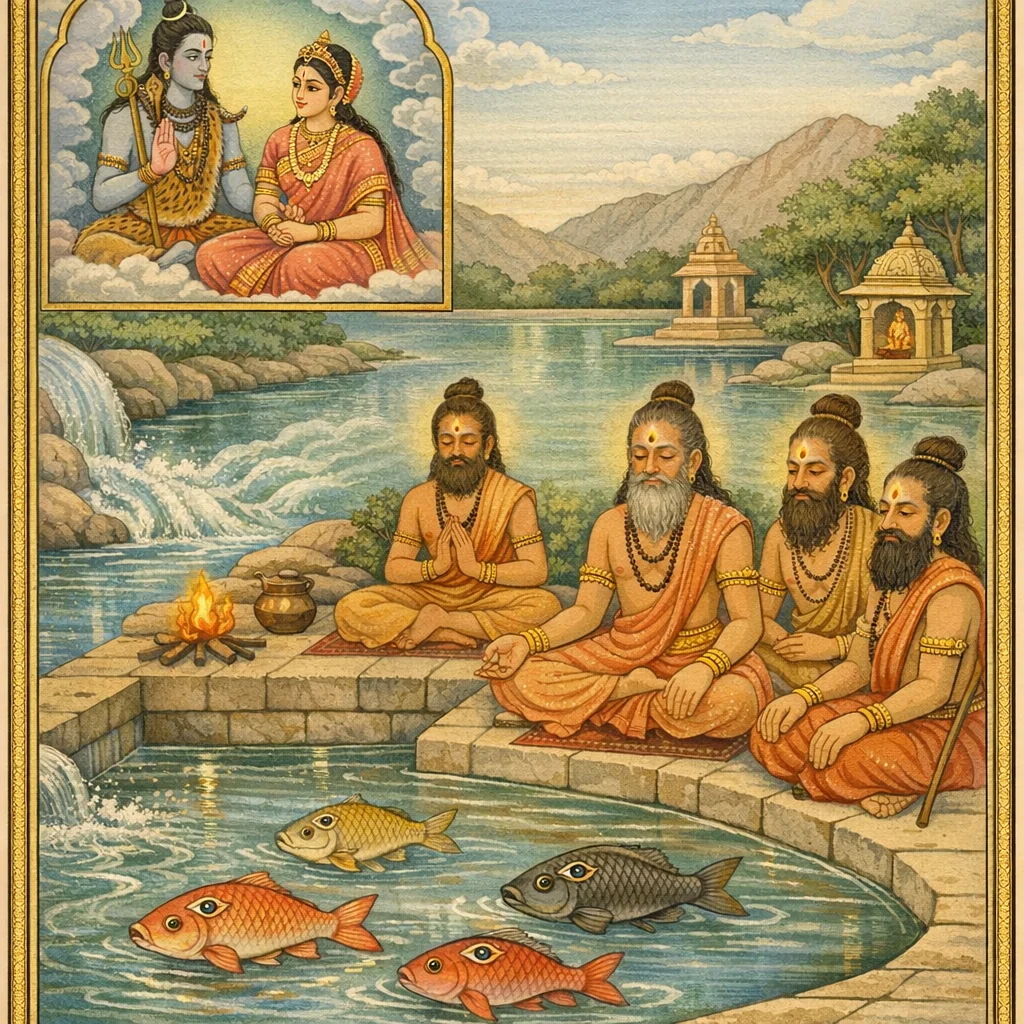
Adhyaya 304
The chapter unfolds as a framed dialogue: Sūta introduces the account, and Īśvara explains to Pārvatī how Gaṅgā, the Tripathagāminī, manifests near Saṅgāleśvara in Prabhāsa. Pārvatī asks about two wonders—how Gaṅgā comes to that place, and why three-eyed fish (trinetra-matsya) are found there. Īśvara relates the origin story: sages once involved in a curse episode connected with Mahādeva repent and perform intense tapas and worship at Saṅgāleśvara. Through sustained devotion they receive a “three-eyed” mark as a nidarśana for the world, and Śiva, pleased, grants their request to bring Gaṅgā for abhiṣeka. Gaṅgā appears at once, accompanied by fish; when the sages behold them, the fish too become “three-eyed” by divine favor. The text then states the practice and its fruits: bathing in the kuṇḍa frees one from the five great sins (pañca-pātaka). Further, on amāvāsyā, one who bathes and gives gold, cows, cloth, and sesame to a brāhmaṇa is said to become “three-eyed,” a symbolic sign of Śiva’s grace. The narration concludes by praising even the hearing of this account as meritorious and as granting desired outcomes.
Shlokas
Verse 1
ईश्वर उवाच । ततो गच्छेन्महादेवि गंगां त्रिपथगामिनीम् । संगालेशादथैशान्यां धनुषां सप्तके स्थिताम्
Īśvara said: “Then, O great goddess, one should go to the Gaṅgā who flows in the three paths. She is situated to the northeast of Saṅgāleśa, at a distance of seven bow-lengths.”}]}}
Verse 2
तस्यां त्रिनेत्रा मत्स्याः स्युर्नित्यमांभसिकाः प्रिये । कलौयुगेऽपि दृश्यंते सत्यंसत्यं मयोदितम्
In that river are fish with three eyes, ever dwelling in the waters, O beloved. Even in the age of Kali they are seen—this is truth, truth, as I have declared.
Verse 3
तस्यां स्नात्वा महादेवि मुच्यते पञ्चपातकैः
Bathing there, O great goddess, one is freed from the five grave sins.
Verse 4
सूत उवाच । तस्य तद्वचनं श्रुत्वा विस्मिता गिरिजा सती । उवाच तं द्विजश्रेष्ठाः प्रचलच्चंद्रशेखरम्
Sūta said: Hearing those words, Satī—Girijā—was filled with wonder. Then she spoke to the Moon-crested Lord, foremost among the twice-born in spiritual excellence, whose matted locks were in motion.
Verse 5
पार्वत्युवाच । कथं तत्र समायाता गंगा त्रिपथगामिनी । कथं त्रिनेत्राः संजाता मत्स्या आंभसिकाः शिव
Pārvatī said: How did Gaṅgā, who flows along the three paths, come there? And how did the three-eyed fishes—creatures of the waters—come into being, O Śiva?
Verse 6
एतद्विस्तरतो ब्रूहि यद्यहं ते प्रिया विभो
Tell me this in full detail, O mighty Lord—if indeed I am dear to you.
Verse 7
ईश्वर उवाच । शृणु देवि प्रवक्ष्यामि यदि पृच्छसि मां शुभे । आस्तिकाः श्रद्दधानाश्च भवंतीति मतिर्मम
Īśvara said: Listen, O Goddess; since you ask Me, O auspicious one, I shall explain. In My understanding, you are faithful and full of trust.
Verse 8
यदा शप्तो महादेवो ह्यज्ञानतिमिरावृतैः । ऋषिभिः कोपयुक्तैश्च कस्मिंश्चित्कारणांतरे
At one time, for some particular reason, Mahādeva was cursed by sages who, veiled by the darkness of ignorance, were also seized by anger.
Verse 9
तदा ते मुनयः सर्वे शप्तं ज्ञात्वा महेश्वरम् । निरानंदं जगत्सर्वं दृष्ट्वा चात्मानमेव च
Then all those sages, realizing that Maheśvara had been cursed, and seeing the whole world become devoid of joy—along with recognizing their own fault—
Verse 10
आराध्य परमेशानं दधतं गजरूपकम् । उन्नतं स्थानमानीय सानंदं चक्रिरे द्विजाः
Having propitiated Parameśāna—who had assumed the form of an elephant—the twice-born brought Him to an exalted place and made the world joyful again.
Verse 11
ततः प्रभृति सर्वे ते शिवद्रोहकरं परम् । आत्मानं मेनिरे नित्यं प्रसन्नेऽपि महेश्वरे
From that time onward, all of them continually regarded themselves as having committed a grave offense against Śiva—even though Maheśvara had become gracious.
Verse 12
महोदयान्महातीर्थं सर्व आगत्य सत्वरम् । तपस्तेपुर्महाघोरं संगालेश्वरसन्निधौ
Therefore, all of them swiftly came to the great tīrtha called Mahodayā and performed exceedingly severe austerities in the presence of Saṅgāleśvara.
Verse 13
संगालेश्वरनामानं सर्वे पूज्य यथाविधि । भृगुरत्रिस्तथा मंकिः कश्यपः कण्व एव च
All of them duly worshipped the Lord known as Saṅgāleśvara—Bhṛgu, Atri, Maṅki, Kaśyapa, and Kaṇva as well.
Verse 14
गौतमः कौशिकश्चैव कुशिकश्च महातपाः । शूकरोऽथ भरद्वाजो भार्गविश्च महातपाः
Gautama, Kauśika, and Kuśika—great ascetics—together with Śūkara, Bharadvāja, and Bhārgavi, all mighty in austerity, (came there).
Verse 15
जातूकर्ण्यो वसिष्ठश्च सावर्णिश्च पराशरः । शांडिल्यश्च पुलस्त्यश्च वत्सश्चैव महातपाः
Jātūkarṇya, Vasiṣṭha, Sāvarṇi, and Parāśara—along with Śāṇḍilya, Pulastya, and Vatsa—(all) great ascetics (were there).
Verse 16
एते चान्ये च बहवो ह्यसंख्याता महर्षयः
These—and many others besides—were innumerable great seers.
Verse 17
संगालेश्वरमासाद्य प्रभासे पापनाशने । तपः कुर्वंति सततं प्रतिष्ठाप्य महेश्वरम्
Having reached Saṅgāleśvara at Prabhāsa, the destroyer of sins, they established Maheśvara (Śiva) there and continually performed austerities.
Verse 18
ततः कालेन महता ते सर्वे मुनिपुंगवाः । ध्यानात्त्रिलोचनस्यैव अदृष्टे तु महेश्वरे
Then, after a long time, all those foremost sages—though Maheśvara had not yet appeared to them—through meditation upon the Three-eyed Lord alone attained a wondrous state.
Verse 19
त्रिनेत्रत्वमनुप्राप्तास्तपोनिष्ठास्तपोधनाः । परस्परं वीक्षमाणास्त्रिनेत्रस्याभिशंकया
Established in austerity and rich in tapas, they attained three-eyedness; and, looking at one another, they wondered whether each had become like the Three-eyed Lord.
Verse 20
स्तुवंति विविधैः स्तोत्रैर्मन्यमाना महेश्वरम् । ज्ञात्वा ध्यानेन देवस्य त्रिनेत्रत्वमुपागताः
Taking that state to be Maheśvara’s grace, they praised Him with many hymns; and, understanding through meditation upon the Deva, they knew they had attained three-eyedness.
Verse 21
चकुरुग्रं तपस्ते तु पूजां देवस्य शूलिनः । तेषु वै तप्यमानेषु कृपाविष्टो महेश्वरः
They undertook fierce austerities and worship of the God, the trident-bearer (Śiva); and as they thus practiced tapas, Maheśvara became filled with compassion toward them.
Verse 22
उवाच तान्मुनीन्सर्वाञ्छृणुध्वं वरमुत्तमम् । प्रसन्नोऽहं मुनिश्रेष्ठास्तपसा पूजयापि च
Maheśvara spoke to all those sages: “Hear an excellent boon. O best of sages, I am pleased—by your austerities (tapas) and also by your worship.”
Verse 23
ऋषय ऊचुः । यदि प्रसन्नो देवेश वरं नो दातुमर्हसि । गंगामानय वेगेन ह्यभिषेकाय नो हर
The sages said: “If you are pleased, O Lord of gods, and deem it fit to grant us a boon—O Hara, bring the Gaṅgā swiftly for our consecratory bathing (abhiṣeka).”
Verse 24
तस्यां कृताभिषेकास्तु तव द्रोहकरा वयम् । अज्ञानभावात्पूतत्वं यास्यामः पृथिवीतले
Having been consecrated in that sacred place, we—who acted treacherously toward you—shall, due to our state of ignorance, come to purity upon the earth.
Verse 25
ईश्वर उवाच । यूयं पवित्रकरणाः पावनानां च पावनाः । गंगां चैवानयिष्यामि युष्माकं चित्ततुष्टये
Īśvara said: “You are makers of purity—purifiers even among the purifiers. And to gladden your hearts, I shall bring Gaṅgā herself.”
Verse 26
पावित्र्याद्भवतां जातं त्रैनेत्र्यं मुनिसत्तमाः । एवमुक्त्वा ततः शंभुर्ध्यानस्तिमितलोचनः । सस्मार क्षणमात्रेण गंगां मीनकुलावृताम्
“O best of sages, from your purity has arisen the state of ‘three-eyedness.’” Having spoken thus, Śambhu—his eyes stilled in meditation—remembered, in but a moment, Gaṅgā, surrounded by shoals of fish.
Verse 27
स्मृतमात्रा तदा देवी गंगा त्रिपथगामिनी । भित्वा भूमितलं प्राप्ता तत्र मीनकुलावृता
At that very remembrance, the Goddess Gaṅgā—she who flows along the three paths—pierced the earth’s surface and arrived there, encircled by multitudes of fish.
Verse 28
ऋषिभिश्च यदा दृष्टा गंगा मीनयुता शुभा । दृष्टमात्रास्तु ते मत्स्यास्त्रिनेत्रत्वमुपागताः
And when the sages beheld the auspicious Gaṅgā, accompanied by fish, those fish—by that mere sight—attained the state of being three-eyed.
Verse 29
ईश्वर उवाच । युष्माकं दर्शनाद्विप्रास्त्रिनेत्रत्वमुपागताः । एतन्निदर्शनं सर्वं लोकानां च प्रदर्शनम्
Īśvara said: “O brāhmaṇas, by the mere sight of you they have attained three-eyedness. This is a complete demonstration—set forth for the instruction of the worlds.”
Verse 30
ऋषय ऊचुः । अस्मिन्कुंडे महादेव मत्स्यानां संततिः सदा । त्रिनेत्रा त्वत्प्रसादेन भूयात्सर्वा युगेयुगे
The sages said: “O Mahādeva, in this pond may the lineage of fish ever continue; and by your grace, may all of them be three-eyed in every age.”
Verse 31
अस्मिन्कुंडे समागत्य नरः स्नानं करोति यः । ददाति हेम विप्राय गाश्च वस्त्रं तथा तिलान्
Whoever comes to this sacred pond and bathes here, and gives gold to a brāhmaṇa—along with cows, garments, and sesame—
Verse 32
अमावास्यां विशेषेण त्रिनेत्रः स प्रजायताम् । एवं भविष्यतीत्युक्त्वा ह्यन्तर्धानं गतो हरः
Especially on the day of Amāvāsyā, may that person be born three‑eyed. Having declared, “So shall it be,” Hara then vanished from sight.
Verse 33
ब्राह्मणास्तुष्टिसंयुक्ता गताः सर्वे महोदयम्
And all those brāhmaṇas, filled with contentment, went on to great prosperity and upliftment.
Verse 34
एतत्ते कथितं देवि गंगामाहात्म्यमुत्तमम् । श्रुतं पापप्रशमनं सर्वकामफलप्रदम्
O Goddess, thus have I told you the supreme greatness of the Gaṅgā. When it is heard, it removes sins and bestows the fruits of all rightful desires.
Verse 304
इति श्रीस्कांदे महापुराण एकाशीतिसाहस्र्यां संहितायां सप्तमे प्रभासखण्डे प्रथमे प्रभासक्षेत्रमाहात्म्ये संगालेश्वरसमीपवर्ति गंगामाहात्म्यवर्णनंनाम चतुरुत्तरत्रिशततमोऽध्यायः
Thus, in the holy Skanda Mahāpurāṇa—within the compilation of eighty‑one thousand verses—here ends chapter 304 in the seventh, the Prabhāsa Khaṇḍa, in the first section, the Prabhāsa-kṣetra Māhātmya, entitled “The Description of the Greatness of the Gaṅgā situated near Saṅgāleśvara.”