Adhyaya 75
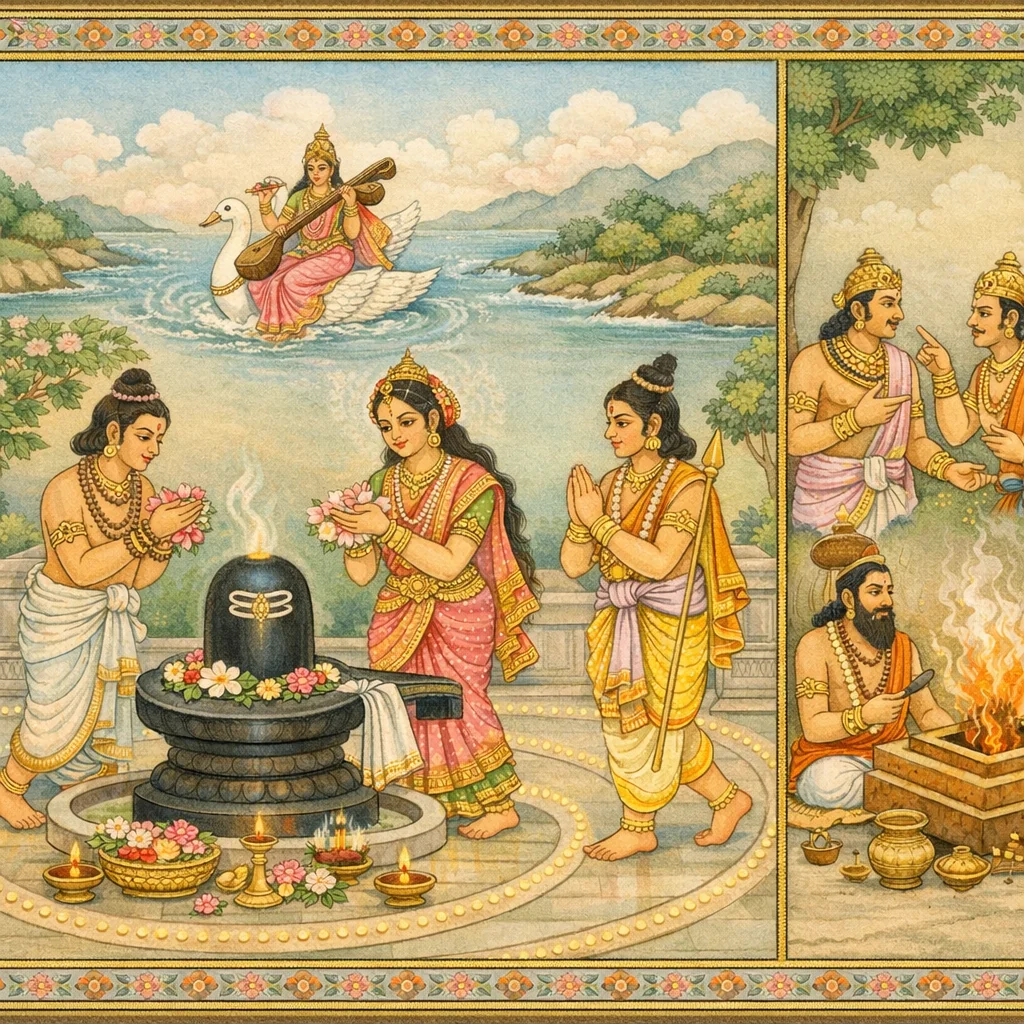
Chapter 75 records a place-centered teaching in which Īśvara instructs Devī about the liṅga known as Śākalakaleśvara/Kalakaleśvara in Prabhāsa-kṣetra—its relative location and its renown as a remover of pāpa (sin). It also sets out a yuga-wise nāma-catuṣṭaya: the same liṅga is remembered as Kāmeśvara in Kṛta, Pulahēśvara in Tretā, Siddhinātha in Dvāpara, and Nāradeśa in Kali, while the name Kalakaleśa/Kalakaleśvara is explained through sound-based etymology. One account traces the title to the tumultuous “kalakala” sound that arose when Sarasvatī reached the sea and the celestial beings rejoiced. Another, more social-ethical narrative tells how Nārada performed severe tapas and a Pauṇḍarīka-yajña near the liṅga, summoned many ṛṣis, and then—when local brāhmaṇas came seeking dakṣiṇā—threw valuables to provoke conflict; a brawl ensued, and learned yet impoverished brāhmaṇas rebuked the conduct, becoming the causal explanation for the shrine’s name Kalakaleśvara, associated with noise and quarrel. The chapter ends with phalaśruti: bathing the liṅga and performing three pradakṣiṇās leads to Rudraloka, while worship with perfumes and flowers and gifting gold to worthy recipients grants the “supreme state.”
Shlokas
Verse 1
ईश्वर उवाच । ततो गच्छेन्महादेवि लिंगं शाकलकलेश्वरम् । शाकल्येश्वरनैरृत्ये धनुषां षष्टिभिः स्थितम्
Īśvara said: Then, O great Goddess, one should go to the Liṅga called Śākalakaleśvara. It is situated to the southwest of Śākalyeśvara, at a distance of sixty dhanuṣ (bows).
Verse 2
तच्चतुर्युगनामाढ्यं स्मृतं पातकनाशनम् । पूर्वं कामेश्वरंनाम त्रेतायां पुलहेश्वरम्
That (Liṅga) is remembered as bearing names across the four yugas and as a destroyer of sins. Formerly it was called Kāmeśvara; in the Tretā age it was known as Pulaheśvara.
Verse 3
द्वापरे सिद्धिनाथं तु नारदेशं कलौ स्मृतम् । तथा कलकलेशं च नाम तस्यैव कीर्त्तितम्
In the Dvāpara age it is called Siddhinātha; in the Kali age it is remembered as Nāradeśa. Likewise, the name Kalakaleśa is also proclaimed for that very (Liṅga).
Verse 4
समुद्रे च महापुण्ये यस्मिन्काले सरस्वती । आगता सा महाभागा हृष्टा तुष्टा सरिद्वरा । तस्य तोयस्य शब्देन सागरस्य महात्मनः
At the supremely holy ocean, when Sarasvatī arrived—she, the fortunate one, best of rivers, delighted and satisfied—there arose, by the sound of the waters of that great-souled sea…
Verse 5
ततो देवाः सगन्धर्वा ऋषयः सिद्धचारणाः । नेदुः कलकलं तत्र तुमुलं लोमहर्षणम्
Then the gods with the Gandharvas—and the seers, Siddhas, and Cāraṇas—raised there a mighty, hair-raising uproar, a resounding “kalakala.”
Verse 6
तेन शब्देन महता मम मूर्त्तिः समुत्थिता । कल्कलेश्वरनामेति ततो लिंगं प्रकीर्तितम्
By that mighty sound, My manifested form arose; therefore that liṅga became renowned by the name “Kalkaleśvara.”
Verse 7
इति ते पूर्ववृत्तांतं कथितं नामकार णम् । सांप्रतं तु यथा जातं पुनः कलकलेश्वरम् । तत्तेऽहं संप्रवक्ष्यामि शृणुष्वैकमनाः प्रिये
Thus I have told you the former account—the reason for the naming. Now, how Kalkaleśvara came to be again in later times, that I shall explain to you; listen with single-minded attention, O beloved.
Verse 9
पुरा द्वापरसंधौ च प्रविष्टे तु कलौ युगे । नारदस्तु समागत्य क्षेत्रं प्राभासिकं शुभम् । संचकार तपश्चोग्रं तत्र लिंगसमीपतः
Formerly, at the juncture of the Dvāpara age when the Kali age had begun, Nārada came to the auspicious Prābhāsika sacred field and performed intense austerity there, near the liṅga.
Verse 10
ततो हृष्टमना भूत्वा तल्लिंगस्य समीपतः । स चकार महायज्ञं पौंडरीकमिति श्रुतम्
Then, his heart filled with joy, he performed a great sacrifice near that liṅga—known in tradition as the Pauṇḍarīka (Mahāyajña).
Verse 11
देवदेवस्य तुष्ट्यर्थं स सदा भावितात्मवान् । समाहूय ऋषींस्तत्र ब्रह्मलोकात्सहस्रशः
For the satisfaction of the God of gods, he—ever disciplined in spirit—summoned there thousands of ṛṣis from Brahmaloka.
Verse 12
ततः संभृतसंभारो यज्ञोपकरणान्वितः । कृत्वा कुण्डादिकं सर्वं समारेभे ततः क्रतुम्
Then, having gathered all requisites and furnished with the implements of sacrifice, and having prepared everything beginning with the fire-pits, he commenced the rite.
Verse 13
ततः संपूर्णतां प्राप्ते तस्मिन्क्रतौ वरानने
Then, when that sacrifice had reached completion, O fair-faced one,
Verse 14
अथागमंस्ततो विप्रास्तत्र क्षेत्रनिवासिनः । दक्षिणार्थं महदेवि शतशोऽथ सहस्रशः
Then the brāhmaṇas dwelling in that sacred region came—O Great Goddess—by hundreds and even by thousands, seeking sacrificial fees (dakṣiṇā).
Verse 15
ततः स कौतुकाविष्टस्तेषां युद्धार्थमेव हि । प्राक्षिपत्तत्र रत्नानि सुवर्णं च महीतले
Then, seized by a playful impulse, he cast jewels and gold upon the ground there, truly intending to provoke them into quarrel.
Verse 16
ततस्ते ब्राह्मणाः सर्वे युध्यमानाः परस्परम् । कोलाहलं परं चक्रुर्बहुद्रव्यपरीप्सया
Thereupon all those brāhmaṇas, fighting one another, raised a great uproar, driven by the desire to obtain abundant wealth.
Verse 17
एके दिगंबरा देवि त्यक्तयज्ञोपवीतिनः । विकचाः केऽपि दृश्यंते त्वन्ये रुधिरविप्लवाः
O Goddess, some were seen naked, having cast off the sacred thread; some appeared with dishevelled hair, while others were smeared and splashed with blood—such was the tumult there.
Verse 18
अन्ये परस्परं जघ्नुर्मुष्टिभिश्चरणैस्तथा । एवं तत्र तदा क्षिप्तं यद्द्रव्यं नारदेन तु
Others struck one another with fists and feet. Thus, the wealth that Nārada had cast there at that time led to such a scene.
Verse 19
अथाभावे तु वित्तस्य ये च विप्रा ह्यकिंचनाः । विद्याविनयसंपन्ना ब्राह्मणैर्जर्जरीकृताः
Then, when wealth was lacking, those brāhmaṇas who were truly destitute—yet endowed with learning and humility—were battered and injured by other brāhmaṇas.
Verse 20
ते तमूचुर्भृशं शांताः स्मयमानं मुहुर्मुहुः । कलहार्थं यतो दानं त्वया दत्तमिदं मुने
Those very calm and restrained ones spoke to that sage, who kept smiling again and again: “Since this gift given by you, O Muni, has become a cause of quarrel…”
Verse 21
विद्यायुक्तान्परित्यज्य विधिं त्यक्त्वा तु याज्ञिकम् । तस्मादस्य मुने नाम ख्यातं कलकलेश्वरम्
“Having neglected those endowed with learning and having abandoned the proper sacrificial rule, therefore, O sage, this name became famous: Kalakaleśvara—the Lord of Tumult.”
Verse 22
तेन नाम्ना द्विजश्रेष्ठ लिंगमेतद्भविष्यति । एतस्मात्कारणाद्देवि जातं कलकलेश्वरम्
“By that very name, O best of the twice-born, this liṅga shall be known. For this reason, O Goddess, it came to be called Kalakaleśvara.”
Verse 23
यस्तं स्नाप्य नरो भक्त्या कुरुते त्रिः प्रदक्षिणम् । स गच्छेद्रुद्रलोकं तु त्वत्प्रसादादसंशयम्
Whoever, with devotion, bathes that liṅga and performs three circumambulations, surely attains Rudra’s world—by your grace, without doubt.
Verse 24
यस्तं पूजयते भक्त्या गंधपुष्पानुलेपनैः । हेमं दत्त्वा द्विजातिभ्यः स गच्छेत्परमं पदम्
Whoever worships that liṅga with devotion using fragrance, flowers, and unguents, and gives gold to the twice-born, attains the supreme state.
Verse 75
इति श्रीस्कांदे महापुराण एकाशीतिसाहस्र्यां संहितायां सप्तमे प्रभासखण्डे प्रथमे प्रभासक्षेत्रमाहात्म्ये कलकलेश्वरमाहात्म्यवर्णनंनाम पञ्चसप्ततितमोऽध्यायः
Thus ends the seventy-fifth chapter, entitled “The Description of the Greatness of Kalakaleśvara,” in the first part, the Prabhāsa-kṣetra-māhātmya, within the seventh book, the Prabhāsa-khaṇḍa, of the Śrī Skanda Mahāpurāṇa, in the Ekāśītisāhasrī Saṃhitā.