Adhyaya 34
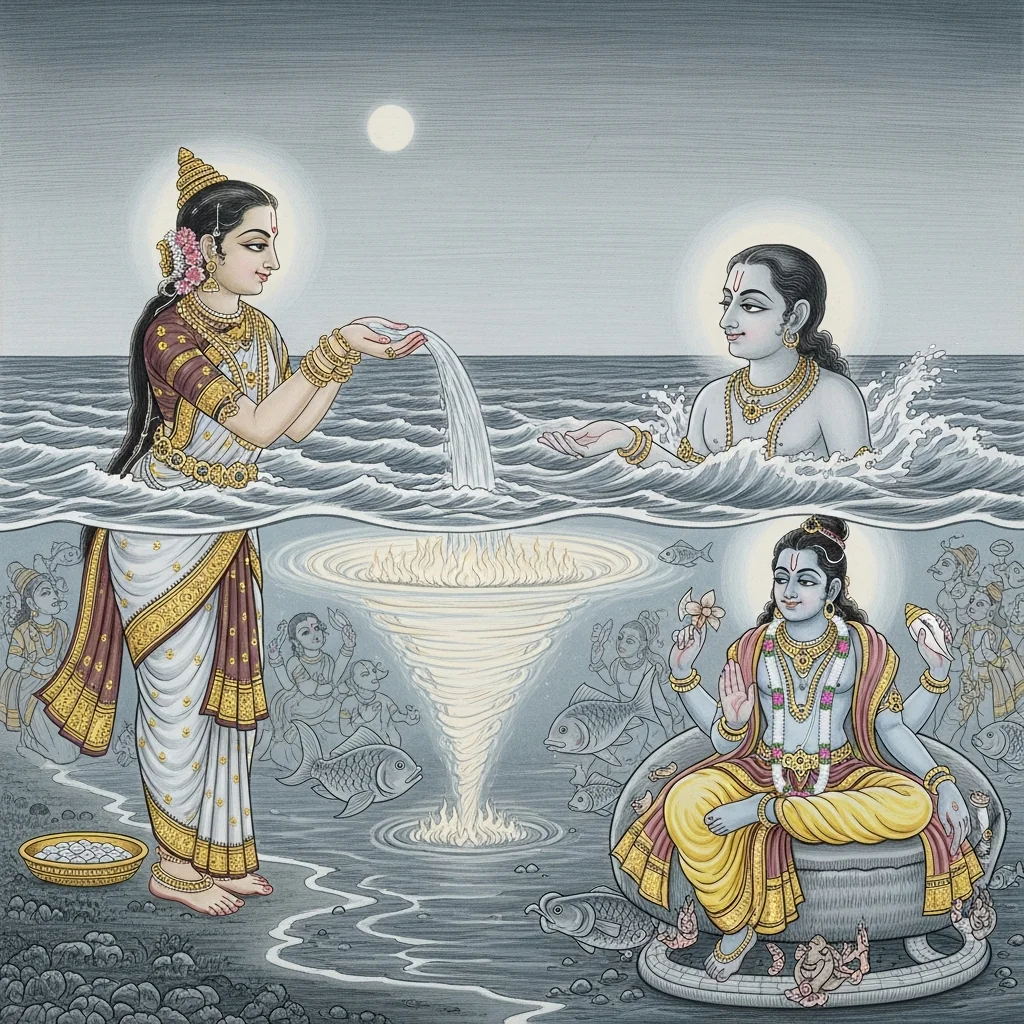
Īśvara tells Devī a sacred episode rooted in Prabhāsa. Sarasvatī, having gained a boon connected with the Vaḍavānala (the destructive “submarine fire”), goes to Prabhāsa by divine instruction and summons the Ocean. The Ocean appears in divine splendor with attendants; Sarasvatī praises him as the primordial support of beings and asks him to receive the Vaḍava fire for the gods’ purpose. The Ocean reflects and agrees, taking in the fire; the water-creatures tremble as the blaze intensifies. Viṣṇu (Acyuta/Daitiyasūdana) arrives, reassures the aquatic beings, and commands Varuṇa/the Ocean to cast the Vaḍavānala into the deepest waters, where it remains, as though “drinking” the sea, yet held in controlled containment. When the Ocean fears depletion, Viṣṇu makes the waters inexhaustible, restoring cosmic balance. The narrative then establishes local observance: Sarasvatī enters the sea by a named route, offers arghya, and installs Arghyeśvara; she is said to stand near Somēśa in the south-east, bearing the Vaḍavānala association. It concludes with pilgrimage rites at Agnitīrtha—bathing, worship, gifting clothing and food to couples, and worship of Mahādeva—along with a note on the Cākṣuṣa and Vaivasvata manvantaras and the phala that hearing this account removes sin and increases merit and renown.
Shlokas
Verse 1
ईश्वर उवाच । सरस्वती वरं प्राप्य वरिष्ठं वडवानलात् । पुनस्तं सागरे क्षेप्तुमुद्यता सा मनस्विनी
Īśvara said: Having obtained an excellent boon from the Vāḍavānala, the resolute Sarasvatī again prepared to cast him into the ocean.
Verse 2
देवादेशात्प्रभासस्य पुरतः संस्थिता तदा । समुद्रमाहूय तदा वाडवार्पणकांक्षिणी
By the gods’ command, she then stood before Prabhāsa; summoning the Ocean, she longed to consign the Vāḍava fire to him as an offering.
Verse 3
त्वमादिः सर्वदेवानां त्वं प्राणः प्राणिनां सदा । देवादेशाद्गृहाण त्वमागत्यार्णव वाडवम्
“You are the origin of all the gods; you are ever the life-breath of living beings. Therefore, by the gods’ command, come forth, O Ocean, and receive the Vāḍava.”
Verse 4
एवं संचिंतितो देव्या यदासावंभसांपतिः । तथा जलात्समुत्तीर्य समायातो महाद्युतिः
When the Goddess had thus reflected, the Lord of the waters rose up from the sea and approached, radiant with great splendor.
Verse 5
तं दृष्ट्वा विस्मिता देवी दिव्यं विष्णुमिवापरम् । श्यामं कमलपत्राक्षं सागरं सुमनोरमम्
Seeing him, the Goddess was astonished—he appeared like another divine Viṣṇu: dark-hued, lotus-petaled in eyes, the Ocean himself, exceedingly beautiful to behold.
Verse 6
विचित्रमाल्याभरणं चित्रवस्त्रानुलेपनम् । आपगाभिः सरूपाभिः स्त्रीरूपाभिः समावृतम्
He was adorned with wondrous garlands and ornaments, with splendid garments and unguents, and was surrounded by rivers of like form, appearing in the shapes of women.
Verse 7
एवंविधं समालोक्य सा देवी ब्रह्मणः सुता । सरस्वती जलनिधिमुवाचेदं शुचिस्मिता
Beholding him in that form, the Goddess Sarasvatī—daughter of Brahmā—smiled with serene purity and spoke these words to the Ocean, the treasure-house of waters.
Verse 8
त्वमग्रजः सर्वभवोद्भवानां त्वं जीवितं जन्मवतां नराणाम् । तस्मात्सुराणां कुरु कार्यमिष्टं वह्निं गृहाण त्वमिहोपनीतम्
You are the elder of all beings that arise into existence; you are the very life of mortals who are born. Therefore fulfill what the gods desire—receive here this fire that has been brought.
Verse 9
अत्रांतरे सोऽपि विमृश्य सर्वं कार्यं स्वबुद्ध्या किमिहोपपन्नम् । कृत्वाऽनलस्य ग्रहणं मयेदं कार्यं सुराणां विहितं भवेच्च
Meanwhile, he too considered everything with his own understanding—what course here would be fitting. “If I accept this fire, then the gods’ appointed purpose will indeed be fulfilled by me.”
Verse 10
एवं चिंतयतस्तस्य ग्रहणं रुचितं ततः । वाडवाग्नेः समुद्रस्य सुरपीडाकृते यदा
As he reflected thus, accepting it became agreeable to him—when the Ocean was to take up the Vāḍava fire in order to relieve the gods’ affliction.
Verse 11
तदा तेन पुरःस्थेन देवी साभिहिता भृशम् । वाडवं संप्रयच्छैनं सुरशत्रुं सरस्वति
Then, standing before her, he spoke earnestly to the Goddess: “Sarasvatī, hand over to me this Vāḍava—this enemy of the gods.”
Verse 12
ततस्तया प्रणम्याशु पितामहपुरःसरान् । चारणांश्चारुचित्रांग्या सरस्वत्या दिवि स्थितान्
Then Sarasvatī, of lovely and wondrous form, swiftly bowed in reverence to those led by the Grandfather (Brahmā) and to the Cāraṇas abiding in heaven.
Verse 13
पुनश्च करसंस्थोऽसौ वाडवोऽभिहितस्तया । त्वमपो भक्षयस्वेति सुरैरुक्त इमा इति
And again, while that Vāḍava was held in her hand, she addressed him: “Drink up these waters,”—as the gods had instructed him.
Verse 14
एवमुक्त्वा समुद्रस्य तदा देव्या समर्प्पितः । वाडवोऽग्निः सरस्वत्या सुरादेशान्महाबलः
Having spoken thus, the mighty Vāḍava Fire—by the goddess Sarasvatī, in obedience to the command of the gods—was then entrusted to the Ocean.
Verse 15
तं समर्प्य ततस्तस्मि न्नदी भूत्वा सरस्वती । प्रविष्टा सागरं देवी नारदेश्वरमार्गतः
After entrusting it, Sarasvatī—becoming a river—entered the Ocean; the goddess proceeded by the route of Nāradeśvara.
Verse 16
दैत्यसूदनसांनिध्ये दत्त्वार्घ्यं लवणांभसि । अर्घ्येश्वरं प्रतिष्ठाप्य दैत्यसूदन पश्चिमे
In the presence of Daityasūdana, she offered arghya into the salty waters; and installing Arghyeśvara, she placed it to the west of Daityasūdana.
Verse 17
ततोऽब्धिं संप्रविष्टा सा पंचस्रोता महानदी । स्वरूपेणैव सा पुण्या पुनः पुण्यतमाऽभवत्
Thereupon that great river, flowing in five streams, entered the Ocean; and though holy by her very nature, there she became holiest once again.
Verse 18
प्रभासक्षेत्रसंपर्कात्समुद्रस्य च संगमात् । सागरोऽपि समासाद्य सरस्वत्यास्तु वाडवम् । निर्धनो वै धनं प्राप्याचिन्तयत्क्व क्षिपाम्यहम्
By contact with Prabhāsa Kṣetra and by the sacred confluence with the Ocean, even the Sea—having received Sarasvatī’s Vāḍava fire—pondered like a poor man who has gained wealth: “Where shall I place it?”
Verse 19
स तेनैव करस्थेन दीप्य मानेन सागरः । वह्निना शिखरस्थेन भाति मेरुरिवापरः
With that blazing fire, as though held in his very hand, the Ocean shone—like another Meru with fire upon its peak.
Verse 20
तं तथाविधमालोक्य तत्र ये जलचारिणः । यादोगणास्ते मुमुचुर्दाहभीता महास्वनम्
Seeing the Ocean in that dreadful state, the aquatic beings there—the hosts of sea-creatures—cried out with a great roar, terrified of being scorched.
Verse 21
तं श्रुत्वा भैरवं शब्दमायातो दैत्यसूदनः । आह यादोगणान्सर्वान्मा भैष्ट सुमहाबलाः
Hearing that terrifying sound, Daityasūdana came there and said to all the hosts of sea-creatures: “Do not fear, O greatly strong ones.”
Verse 22
यस्मादनेन प्रथमा आपो भक्ष्या न तत्रगाः । प्राणिनस्तन्न भेतव्यं भवद्भिस्तु ममाज्ञया
For by this fire, the waters there are no longer to be consumed as at first. Therefore let living beings not fear—by my command, remain unafraid.
Verse 23
एवमुक्तस्तु कृष्णेन तूष्णींभूता जलेचराः
Thus addressed by Kṛṣṇa, the water-dwellers fell silent.
Verse 24
तूष्णींभूतेषु सर्वेषु जलजेषु जलेश्वरम् । प्राहाच्युतः प्रक्षिप त्वमपां मध्ये तु वाडवम्
When all aquatic beings had fallen silent, Acyuta addressed the Lord of Waters: “Cast the Vaḍava-fire into the midst of the waters.”
Verse 25
अगाधेम्भसि तेनासौ निक्षिप्तो वाडवोऽनलः । वरुणेन पिबन्नास्ते तज्जलं सुमहाबलः
Thus the Vaḍava-fire was cast into the unfathomable waters; and there, mighty yet restrained, it remains—ever drinking that water through Varuṇa.
Verse 26
तस्योच्छ्वासानिलोद्धूतं तत्तोयं सागराद्बहिः । निर्मर्यादेव युवतिरितश्चेतश्चधावति
Driven outward by the wind of its exhalations, that water is hurled beyond the ocean—rushing in all directions like a young woman who knows no bounds.
Verse 27
अथ काले गते देवि शुष्यत्यंबु शनैःशनैः । विदित्वा क्षीयमाणास्ता अपो जलनिधिस्ततः
Then, as time passed, O Goddess, the waters slowly began to dry up. Realizing that those waters were diminishing, the ocean grew greatly alarmed.
Verse 28
आहैवं पुंडरीकाक्षमपः कुरु त्वमक्षयाः । अन्यथा सर्वनाशेन जलानां मामिहाग्रतः । भक्षयिष्यत्यसौ वह्निर्वाडवो हि जनार्द्दन
He spoke thus to the Lotus-eyed Lord: “Make these waters inexhaustible. Otherwise, before my very eyes, that Vaḍava-fire will consume me utterly, bringing total ruin upon the waters, O Janārdana.”
Verse 29
एतच्छ्रुत्वा वचस्तस्य समुद्रस्य तु भीषणम् । कृतं तदक्षयं तोयमा त्मनो भयनाशनम्
Hearing the ocean’s dreadful words, He made the water inexhaustible, thereby dispelling the fear that threatened its very existence.
Verse 30
ज्ञात्वा सुराः सर्वमिदं विचेष्टितं कृत्यानलस्यास्य निबंधनं तथा । प्रलोभनं तोयपुरःसरा द्विषः पुपूजिरे केशवमत्र चारिणम्
When the gods understood the whole course of these events—how that baleful fire was bound and how the foe was lured onward with water as its forerunner—they worshipped Keśava, who moved and acted there.
Verse 31
एवं सरस्वती प्राप्ता प्रभासं क्षेत्रमुत्तमम् । ब्रह्मलोकान्महादेवि सर्वपापप्रणाशिनी
Thus Sarasvatī came from Brahmaloka to Prabhāsa, the most excellent sacred field, O Great Goddess—she who destroys all sins.
Verse 32
सोमेशाद्दक्षिणाग्नेये सागरस्य समी पतः । संस्थिता तु महादेवी वडवानलधारिणी
To the south-east of Someśa, near the ocean, the Great Goddess took her station—she who bears the Vaḍavānala, the submarine fire.
Verse 33
स्नात्वाऽग्नितीर्थे पूर्वं तां पूजयेद्विधिना नरः । दंपत्योर्भोजनं तत्र परिधानं सकञ्चु कम्
After first bathing at Agni-tīrtha, a man should worship her according to proper rite. There he should also provide a meal for a married couple, along with garments and bodices (kāñcuka) as gifts.
Verse 34
दत्त्वा ततो महादेवं पूजयेच्च कपर्द्दिनम् । इति वृत्तं पुरा देवि चाक्षुषस्यांतरेऽभवत्
Having made the offering, one should then worship Mahādeva—Kaparddin, the Lord of matted locks. Thus, O Goddess, this event occurred in ancient times during the Cākṣuṣa Manvantara.
Verse 35
दधीच्यन्वयजातस्य वाडवस्य महा त्मनः । अस्मिन्पुनर्महादेवि प्राप्ते वैवस्वतेंऽतरे । और्वस्तु भार्गवे वंशे समुत्पन्नो महाद्विजः
From the lineage of Dadhīci was born the great-souled Vāḍava. Then again, O Great Goddess, when the Vaivasvata Manvantara arrived, Aaurva—the great Brahmin—was born in the Bhārgava line.
Verse 36
संक्षिप्तोऽसौ सरस्वत्या देवमात्रा महाप्रभः । तावत्स्थास्यत्यपां गर्भे यावन्मन्वतरावधिः
That mighty being was contained by Sarasvatī, the divine Mother. He will remain within the womb of the waters until the end of the Manvantara.
Verse 37
इति ते कथितं देवि सरस्वत्याः समुद्भवम् । श्रुतं पापहरं नृणां कीर्त्तिदं पुण्यवर्द्धनम्
Thus, O Goddess, I have told you of Sarasvatī’s manifestation. When heard, it removes the sins of people, grants fame, and increases merit.