Adhyaya 1
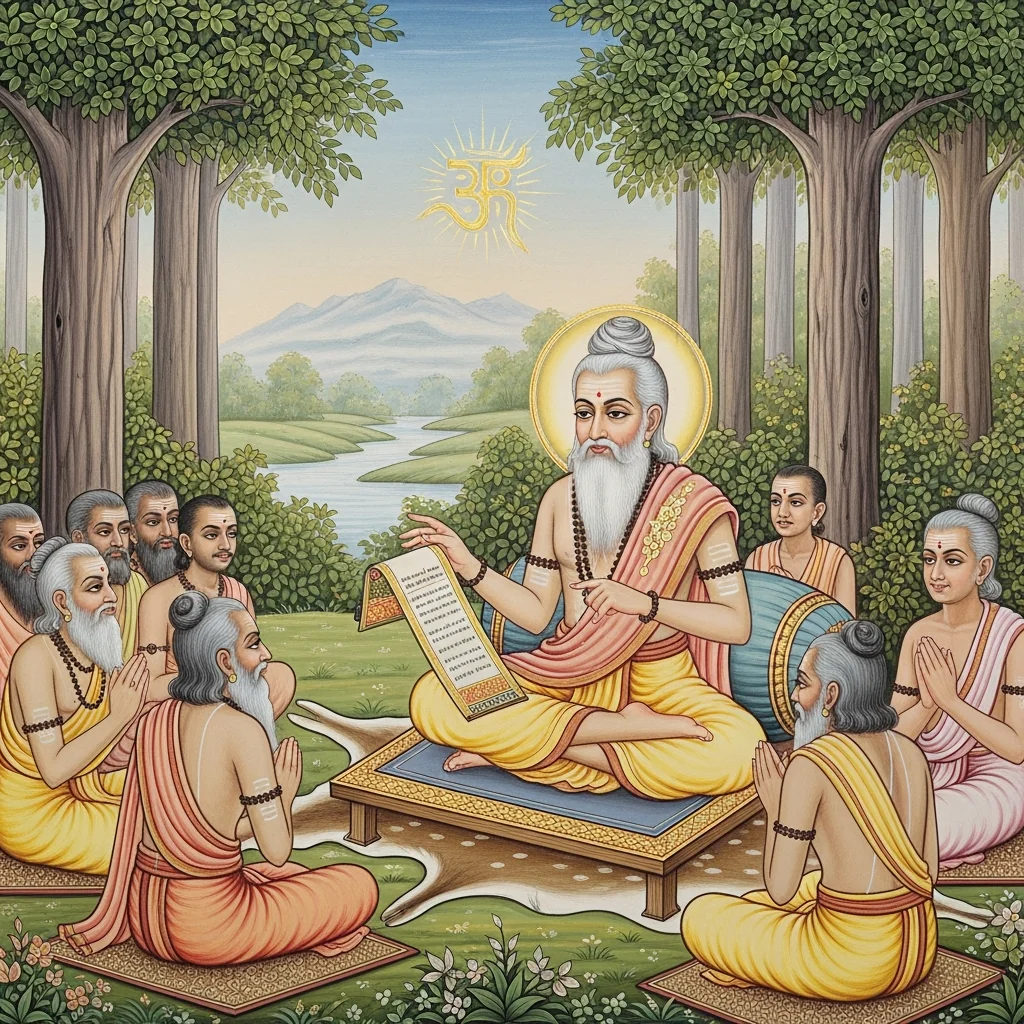
Chapter 1 sets the scene of the discourse and establishes the authority-chain for the Prabhāsa portion of the Skanda Purāṇa. Vyāsa is recalled as the foundational knower and teacher of purāṇic meaning, and the sages of Naimiṣa request Sūta (Romaharṣaṇa) to narrate the Prabhāsa-kṣetra māhātmya—asking especially about the Vaiṣṇavī and Raudrī yātrās, after noting an earlier Brahmī yātrā tradition. It opens with invocatory verses praising Someśvara and a metaphysical salutation to pure consciousness (cinmātra), followed by a protective motif contrasting amṛta and viṣa. Sūta then offers a theological eulogy of Hari as the form of Omkāra, transcendent yet immanent, and describes the ideal qualities of the coming kathā as orderly, ornamented, and purifying. Ethical guidelines are stated: the teaching is not to be given to nāstikas; it should be recited for the faithful, peaceful, and qualified (adhikārin), with emphasis on brāhmaṇa eligibility defined through life-cycle ritual competence and conduct. The chapter concludes by recounting the transmission lineage from Śiva on Kailāsa down to Sūta, legitimizing this section as a tradition-bearing record.
Shlokas
Verse 1
व्यास उवाच । यश्चाद्यः पुरुषः पुराण इति यः संस्तूयते सर्वतः सोमेशः सुरसंयुतः क्षितितले यैर्वीक्षितो हीक्षणैः । ते तीर्त्वा विततांतरं भवभयं भूत्याऽभिसंभूषिताः स्वर्गं यानवरैःप्रयान्ति सुकृतैर्यज्ञै यथा यज्विनः
Vyāsa said: He who is praised everywhere as the Primordial Person, the Ancient One—Someśa, accompanied by the gods—whom people behold upon the earth with reverent eyes: those who cross over the wide expanse of fear in saṃsāric existence, adorned with divine prosperity, depart to heaven in excellent celestial vehicles, through meritorious deeds and sacrifices (yajña), like accomplished sacrificers.
Verse 2
प्रसरद्बिन्दुनादाय शुद्धामृतमयात्मने । षड्त्रिंशत्तत्त्वदेहाय नमश्चिन्मात्रमूर्तये
Salutations to Him whose sound is the ever-spreading bindu and nāda; whose very being is pure amṛta; whose body is constituted of the thirty-six tattva; who is the embodiment of consciousness alone.
Verse 3
अमृतेनोदरस्थेन म्रियन्ते सर्वदेवताः । कंठस्थित विषेणापि यो जीवति स पातुः वः
Even all the gods would perish if the nectar remained confined within the belly; yet He who lives even with poison lodged in His throat—may that One protect you.
Verse 4
सत्रान्ते सूतमनघं नैमिषेया महर्षयः । पुराणसंहितां पुण्यां पप्रच्छू रोमहर्षणम्
At the close of the sacrificial session in Naimiṣa, the great sages questioned the sinless Sūta, Romaharṣaṇa, concerning the holy compendium of Purāṇic lore.
Verse 5
त्वया सूत महा बुद्धे भगवान्ब्रह्मवित्तमः । इतिहासपुराणार्थे व्यासः सम्यगुपासितः
O Sūta of great understanding, the Blessed Vyāsa—supreme knower of Brahman—has been duly served by you in the true meaning of the Itihāsas and the Purāṇas.
Verse 6
तस्य ते सर्वरोमाणि वचसा हर्षितानि यत् । द्वैपायनस्यानुभावात्ततोऽभू रोमहर्षणः
For by his words all the hairs upon your body thrilled with joy; therefore, by the power of Dvaipāyana (Vyāsa), you came to be known as Romaharṣaṇa.
Verse 7
भवन्तमेव प्रथमं व्याजहार स्वयं प्रभुः । मुनीनां संहितां वक्तुं व्यासः पौराणिकीं कथाम्
Vyāsa himself, the lordly sage, first addressed you alone, that you might proclaim to the sages the compendium and the sacred Purāṇic narrative.
Verse 8
त्वं हि स्वायंभुवे यज्ञे सुत्याहे वितते हरिः । संभूतः संहितां वक्तुं स्वांशेन पुरुषोत्तमः
For indeed, on the expansive Soma-pressing day of the Svāyambhuva sacrifice, you were born as Hari—Puruṣottama himself—through a portion of his own essence, in order to expound the compendium.
Verse 9
तस्माद्भवन्तं पृच्छामः पुराणे स्कन्दकीर्तिते । प्रभासक्षेत्रमाहात्म्ये ब्राह्मी यात्रा श्रुता पुरा
Therefore we ask you, in this Purāṇa proclaimed by Skanda: in the Māhātmya of Prabhāsa Kṣetra we once heard of the “Brāhmī pilgrimage”—tell us of it.
Verse 10
अधुना वैष्णवीं रौद्रीं यात्रां सर्वार्थसंयुताम् । वक्तुमर्हसि चास्माकं पुराणार्थविशारद
Now, O knower of the Purāṇas’ meaning, you should also tell us of the Vaiṣṇavī and the Raudrī pilgrimages, complete in every sacred purpose.
Verse 11
मुनीना वचनं श्रुत्वा सूतः पौराणिकोत्तमः । प्रणम्य शिरसा प्राह व्यासं सत्यवतीसुतम्
Hearing the sages’ words, Sūta—the foremost narrator of Purāṇic lore—bowed his head in reverence and addressed Vyāsa, the son of Satyavatī.
Verse 12
रोमहर्षण उवाच । श्रीवत्सांकं जगद्योनिं हरिमोंकाररूपिणम् । अप्रमेयं गुरुं देवं निर्मलं निर्मलाश्रयम्
Romaharṣaṇa said: “I bow to Hari—marked with Śrīvatsa, the womb-source of the world, whose form is the syllable Oṃ; immeasurable, the divine Guru, stainless, and the refuge of the stainless.”
Verse 13
हंसं शुचिषदं व्योम व्यापकं सर्वदं शिवम् । उदासीनं निरायासं निष्प्रपञ्चं निरञ्जनम्
“(I bow to Him who is) the Haṃsa, the indweller of purity; the all-pervading vastness of space; the giver of all; auspicious; detached and effortless; beyond the web of phenomena, and stainless.”
Verse 14
शून्यं बिंदुस्वरूपं तु ध्येयं ध्यानविवर्जितम् । अस्ति नास्तीति यं प्राहुः सुदूरे चान्तिके च यत्
I bow to That which is “void” and yet of the nature of the point (bindu); to be realized, yet beyond ordinary meditation; spoken of as “is” and “is not”; and which is at once very far and very near.
Verse 15
मनोग्राह्यं परं धाम पुरुषाख्यं जगन्मयम् । हृत्पंकजसमासीनं तेजोरूपं निरिन्द्रियम्
I bow to Him, graspable by the purified mind—the supreme abode, called the Puruṣa, pervading the universe; seated in the lotus of the heart, of the form of light, beyond the senses.
Verse 16
एवंविधं नमस्कृत्य परमात्मानमीश्वरम् । कथां वदिष्ये द्विविधां द्विशरीरां तथैव तु
Having thus bowed to the Supreme Self, the Lord, I shall now relate the sacred account—twofold in its method, and likewise presented in a double-bodied form, with two aspects.
Verse 17
दिव्यभाषासमोपेतां वेदाधिष्ठानसंयुताम् । पञ्चसंधिसमायुक्तां षडलंकारभूषिताम्
This account is endowed with divine language, grounded in Vedic authority; joined with the five junctions of structure, and adorned with six ornaments of expression.
Verse 18
सप्तसाधनसंयुक्तां रसाष्टगुणरंजिताम् । गुणैर्नवभिराकीर्णां दशदोषविवर्जिताम्
Furnished with seven means (sādhana) of effective exposition, enriched with the eight aesthetic flavors (rasa); filled with nine virtues (guṇa), and free from ten faults (doṣa).
Verse 19
विभाषाभूषितां तद्वदेकायत्तां मनोहराम् । पञ्चकारणसंयुक्तां चतुष्करणसम्मताम्
Adorned with varied modes of expression, yet ever unified and delightful; joined to five causal factors, and approved by four instruments (of proper composition and communication).
Verse 20
पुनश्च द्विविधां तद्वज्ज्ञानसंदोहदायिनीम् । व्यासेन कथितां पुण्यां शृणुध्वं पापनाशिनीम्
And again, hear that same sacred account, twofold in form, bestowing a treasury of knowledge—told by Vyāsa—meritorious and a destroyer of sin.
Verse 21
यां श्रुत्वा पापकर्मापि गच्छेद्धि परमां गतिम् । दुःखत्रयविनिर्मुक्तः सर्वातङ्कविवर्जितः
On hearing this sacred account, even one engaged in sinful deeds indeed attains the supreme state—freed from the threefold suffering and devoid of every affliction.
Verse 22
न नास्तिके कथां पुण्यामिमां ब्रूयात्कदाचन । श्रद्दधानाय शान्ताय कीर्तनीया द्विजातये
This meritorious sacred narrative should never be told to an unbeliever. It should be recited to one who has faith, whose conduct is peaceful, and to a worthy twice-born (dvija) listener.
Verse 23
निषेकादिः श्मशानान्तो मन्त्रैर्यस्योदितो विधिः । तस्य शास्त्रेऽधिकारोऽस्ति ज्ञेयो नान्यस्य कस्यचित्
He alone has authority in this śāstra whose life-rites—from conception onward up to the final rites at the cremation ground—are prescribed and performed with mantras; none other should be regarded as qualified.
Verse 24
चतुःपक्षावदातस्य विशुद्धिर्ब्राह्मणस्य च । सद्वृत्तस्याधिकारोऽस्ति शास्त्रेऽस्मिन्वेदसम्मते
Purity belongs to the brāhmaṇa who is “bright with four wings,” that is, firmly grounded in the four Vedas; and eligibility belongs to one of righteous conduct in this śāstra, which accords with the Vedas.
Verse 25
यथा सुराणां प्रवरो देवदेवो महेश्वरः । नदीनां च यथा गंगा वर्णानां ब्राह्मणो यथा
Just as Maheśvara, the God of gods, is foremost among the deities; just as Gaṅgā is foremost among rivers; and just as the brāhmaṇa is foremost among the social orders—
Verse 26
अक्षराणां तु सर्वेषामोंकारः प्रथमो यथा । पूज्यानां तु यथा माता गुरूणां च यथा पिता । तथैव सर्वशास्त्राणां प्रधानं स्कन्दकीर्तितम्
Just as Oṃkāra is foremost among all syllables; just as the mother is foremost among those worthy of worship, and the father among gurus—so too, among all śāstras, the Skanda (Purāṇa) is proclaimed as chief.
Verse 27
पुरा कैलासशिखरे ब्रह्मादीनां च सन्निधौ । स्कान्दं पुराणं कथितं पार्वत्यग्रे पिनाकिना
Formerly, on the summit of Kailāsa, in the presence of Brahmā and the other gods, the Skanda Purāṇa was narrated by the Bearer of the Pināka (Śiva) before Pārvatī.
Verse 28
पार्वत्या षण्मुखस्याग्रे तेन नन्दिगणाय वै । नन्दिना तु कुमाराय तेन व्यासाय धीमते
Pārvatī then (conveyed it) before Ṣaṇmukha, the Six-Faced One; he in turn taught it to Nandigaṇa. Nandin taught it to Kumāra, and Kumāra to the wise Vyāsa.
Verse 29
व्यासेन मे समाख्यातं भवद्भ्योऽहं प्रकीर्तये
What Vyāsa explained to me, that I now proclaim to you.
Verse 30
यूयं सद्भावसंयुक्ता यतः सर्वे महर्षयः । तेन मे भाषितुं श्रद्धा भवतां स्कन्दसंहिताम्
Since you all are great sages endowed with noble disposition, therefore I have the faith and resolve to speak to you this Skanda-saṃhitā.