Adhyaya 155
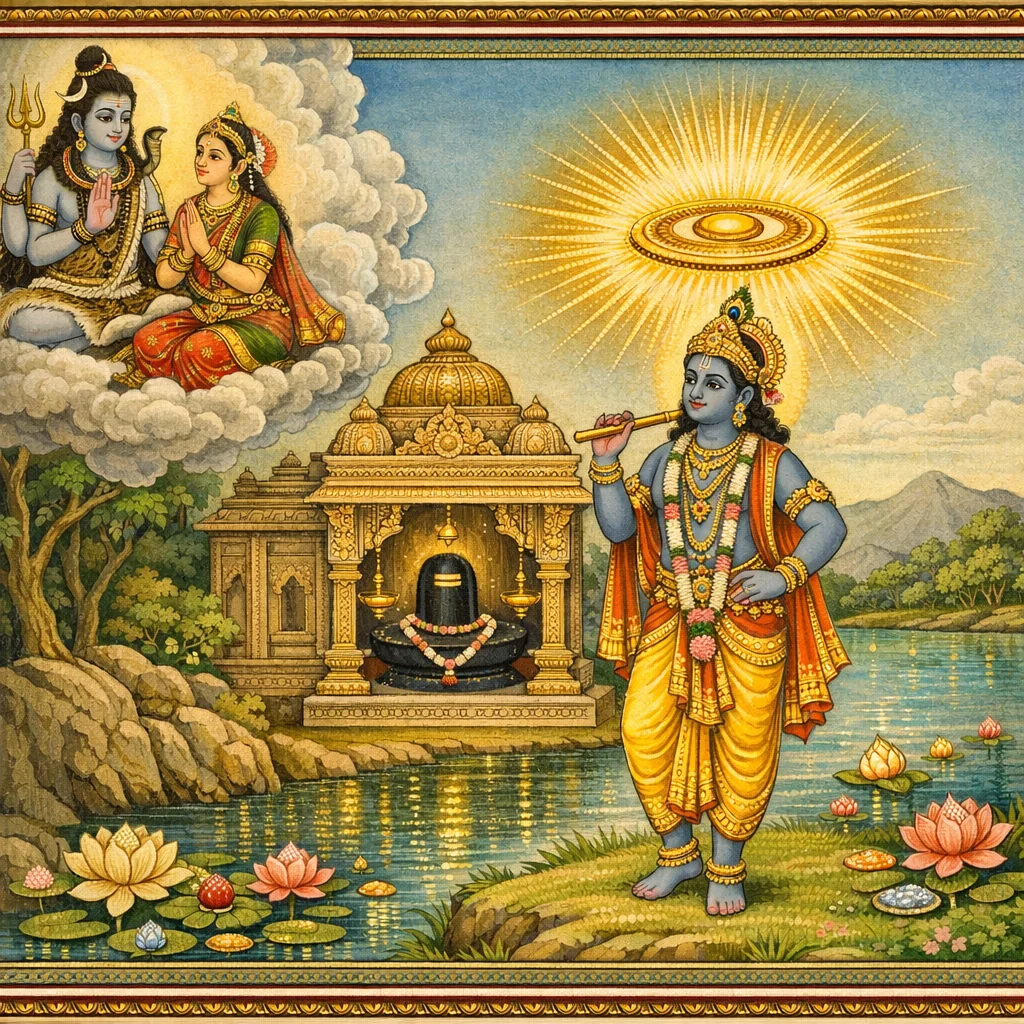
This chapter is cast as a theological dialogue in which Īśvara speaks to Devī, guiding her—and thereby the pilgrim—toward Ratneśvara, praised as an unsurpassed shrine. It declares that Viṣṇu, mighty and pre-eminent, performed tapas there and established a liṅga that grants every desired aim. A practical ritual path is then given: bathing in Ratnakuṇḍa and continually worshiping the deity with complete offerings and heartfelt devotion yields the sought fruit. The site’s mythic glory is further affirmed by stating that Kṛṣṇa, of immeasurable radiance, undertook severe austerities there and obtained the Sudarśana-cakra, the destroyer of all daityas. Īśvara proclaims the place eternally dear to him and confirms his abiding presence there even at cosmic dissolution. The kṣetra is named “Sudarśana,” its boundary measured as thirty-six dhanvantaras. The text extends its promise of liberation: even those deemed ‘low’ who die within that limit attain the supreme state; and a dāna rite—offering Viṣṇu a golden Garuḍa and yellow garments—is said to bestow the merit of pilgrimage.
Shlokas
Verse 1
ईश्वर उवाच । ततो गच्छेन्महादेवि रत्नेश्वरमनुत्तमम् । तत्र तप्त्वा तपो देवि विष्णुना प्रभविष्णुना । स्थापितं तत्र तल्लिंगं सर्वकामप्रदं प्रिये
Īśvara said: Then, O Mahādevī, one should go to the unsurpassed Ratneśvara. There, O Devī, after performing austerities, Viṣṇu—Prabhaviṣṇu—installed that liṅga; O beloved, it bestows all desired aims.
Verse 2
रत्नकुंडे नरः स्नात्वा यस्तं पूजयते सदा । सर्वोपचारैर्भक्त्या स प्राप्नुयादीप्सितं फलम्
After bathing in Ratnakuṇḍa, the person who always worships Him with devotion and with all customary offerings attains the desired fruit.
Verse 3
अत्र कृत्वा तपो घोरं कृष्णेनामिततेजसा । प्राप्तं सुदर्शनं चक्रं सर्वदैत्यान्तकारकम्
Here, after performing fierce austerities, Kṛṣṇa of immeasurable splendor obtained the Sudarśana discus, the destroyer of all demons.
Verse 4
एतत्स्थानं महादेवि सदा प्रियतरं मम । वसामि तत्र देवेशि प्रलयेऽपि न संत्यजे
O Mahādevī, this place is always especially dear to Me. O Lady of the gods, I dwell there and do not abandon it even at the time of cosmic dissolution.
Verse 5
स्मृतं तद्वैष्णवं क्षेत्रं नाम्ना देवि सुदर्शनम् । धन्वंतराणि षट्त्रिंशत्समंतात्परिमण्डलम्
O Goddess, that sacred region is remembered as a Vaiṣṇava kṣetra, renowned by the name Sudarśana. It forms a circular expanse extending thirty-six dhanvantaras in every direction.
Verse 6
एतदन्तरमासाद्य ये केचित्प्राणिनोऽधमाः । मृताः कालवशाद्देवि ते यास्यंति परं पदम्
O Goddess, even those living beings who are fallen, if they merely come within this sacred boundary and then die by the force of time, will attain the supreme state.
Verse 7
कांचनं तत्र गरुडं पीतानि वसनानि च । विष्णुमुद्दिश्य यो दद्यात्स तु यात्राफलं लभेत्
Whoever, in that place, donates a golden Garuḍa and yellow garments, dedicating the gift to Viṣṇu, truly obtains the full fruit of pilgrimage.
Verse 155
इति श्रीस्कान्दे महापुराण एकाशीतिसाहस्र्यां संहितायां सप्तमे प्रभासखण्डे प्रथमे प्रभासक्षेत्रमाहात्म्ये रत्नेश्वरमाहात्म्यवर्णनंनाम पंचपंचाशदु त्तरशततमोऽध्यायः
Thus, in the Śrī Skanda Mahāpurāṇa, in the Saṃhitā of eighty-one thousand verses, within the seventh—Prabhāsa Khaṇḍa, in the first part, the Prabhāsakṣetra Māhātmya—concludes the chapter entitled “Description of the Greatness of Ratneśvara,” being Chapter 155.