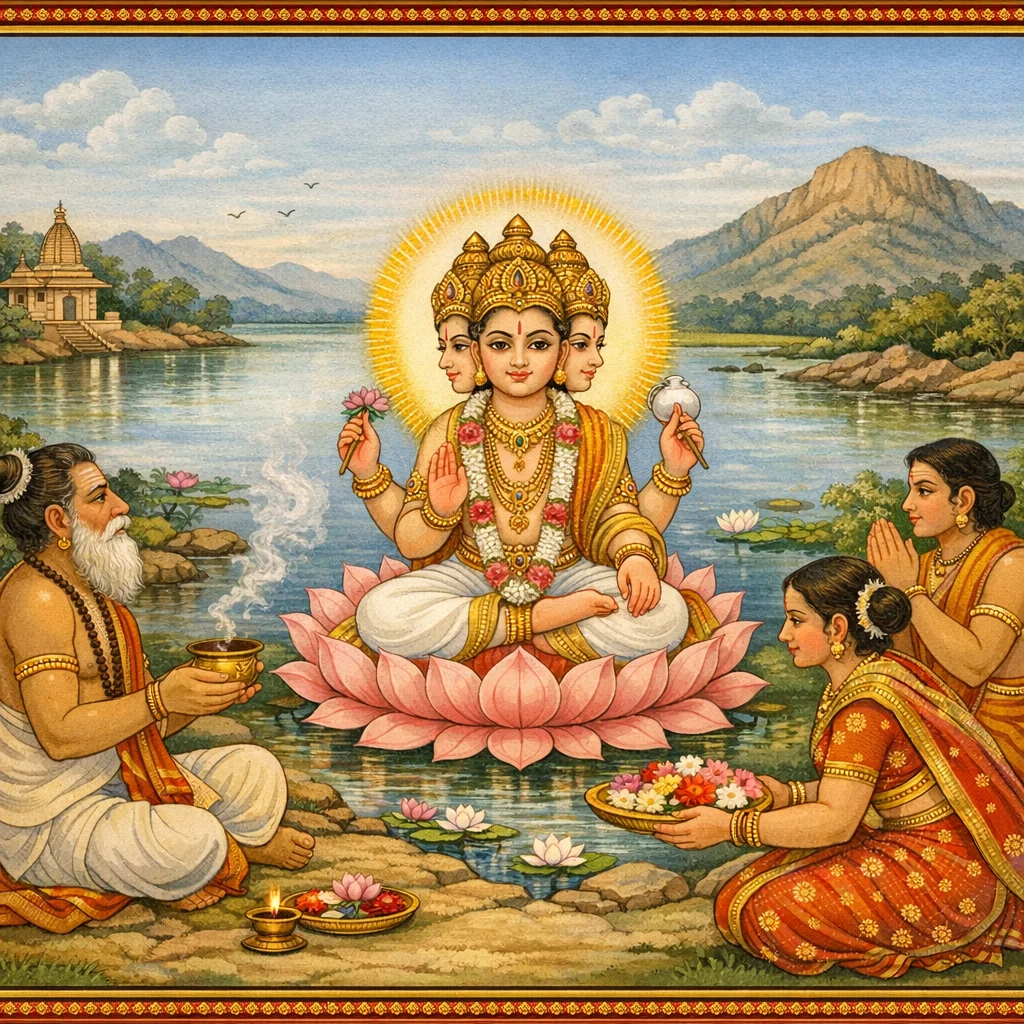
Adhyaya 321
This chapter unfolds as a dialogue between Śiva and Devī. Īśvara proclaims a secret, superior sacred place that destroys human sin and then sets forth the māhātmya of Brahmā connected with the elevated site called Unnata-sthāna. Devī questions how Brahmā can be “child-formed” here when elsewhere he is depicted as aged, and she asks the site’s location, the reason for Brahmā’s presence, and the proper manner and time of worship. Īśvara replies that Brahmā’s principal seat lies near the Ṛṣitoya river and describes a triad of worship-sites within Prabhāsa: Brahmā on the auspicious riverbank, Rudra at Agnitīrtha, and Hari (Dāmodara) on the pleasing Raivataka hill. The narrative adds that Soma petitioned Brahmā, who arrived at Unnata-sthāna in the form of an eight-year-old; mere darśana is said to free devotees from sins. A doctrinal encomium follows: no deity, teacher, knowledge, or austerity equals Brahmā, and release from worldly suffering depends on devotion to Pitāmaha. The chapter concludes by prescribing a preliminary bath at Brahma-kuṇḍa and then worship of child-form Brahmā with flowers, incense, and related offerings.
Shlokas
Verse 1
ईश्वर उवाच । अथ ते कीर्तयिष्यामि रहस्यं स्थानमुत्तमम् । सर्वपापहरं नॄणामुन्नतस्थानवासिनाम्
Īśvara said: Now I shall proclaim to you a supreme and secret holy place—one that removes all sins for those who dwell at Unnata-sthāna.
Verse 2
श्रेष्ठदेवस्य माहात्म्यं ब्रह्मणोऽव्यक्तजन्मनः । उन्नतस्थानसंस्थस्य देवस्य बालरूपिणः । यस्य दर्शनमात्रेण सर्वपापैः प्रमुच्यते
I shall describe the greatness of the most excellent deity—Brahmā, whose birth is unmanifest—who abides at Unnata-sthāna in the form of a child; by merely beholding him one is freed from all sins.
Verse 3
देव्युवाच । बालरूपीति यत्प्रोक्तमुन्नतं तत्कथं वद । स्थानेष्वन्येषु सर्वत्र वृद्धरूपी पितामहः
The Goddess said: You have said that (Brahmā) is in a child-form at Unnata-sthāna—tell me how that is so. In other places everywhere, the Grandfather (Brahmā) is depicted in an aged form.
Verse 4
कस्मिन्स्थाने स्थितस्तत्र किमर्थं तत्र वा गतः । कथं स पूज्यो विप्रेन्द्रैस्तिथौ कस्यां क्रमाद्वद
In what exact spot is he established there, and for what reason did he go there? How should he be worshiped by the best of brāhmaṇas, and on which tithi (lunar day)—tell me in proper order.
Verse 5
ईश्वर उवाच । ऋषितोयापश्चिमे तु ऐशान्यां स्थलकेश्वरात् । ब्रह्मणः परमं स्थानं ब्रह्मलोक इवापरः
Īśvara said: To the west of Ṛṣitoyā, and to the northeast of Sthalakeśvara, lies Brahmā’s supreme abode—like another Brahmaloka itself.
Verse 6
ब्रह्मा विष्णुश्च रुद्रश्च पूज्याः प्राभासिके सदा । ब्रह्मभागे स्थितो ब्रह्मा ऋषितोयातटे शुभे
In Prabhāsa, Brahmā, Viṣṇu, and Rudra are always worthy of worship. Brahmā is stationed in the ‘Brahmā-portion’ on the auspicious bank of Ṛṣitoyā.
Verse 7
रुद्रभागेऽग्नितीर्थे च पूज्यो रुद्रः सनातनः । गिरौ रैवतके रम्ये पूज्यो दामोदरो हरिः
At Rudrabhāga, at the Agnitīrtha, the eternal Rudra should be worshipped. And on the delightful Mount Raivataka, Dāmodara—Hari—should be worshipped.
Verse 8
सोमेन प्रार्थितो देवो बालरूपी पितामहः । आगतश्चाष्टवर्षस्तु ह्युन्नते स्थान उत्तमे
When Soma entreated him, the divine Pitāmaha (Brahmā) came there in the form of a child—indeed as an eight-year-old—at that excellent, elevated holy place.
Verse 9
दृष्ट्वा ब्रह्मा द्विजाञ्छ्रेष्ठांस्तत्र स्थाने स्थितो विभुः
Seeing the foremost of the twice-born (brāhmaṇas), Brahmā—the all-pervading Lord—remained there at that sacred spot.
Verse 10
नास्ति ब्रह्मसमो देवो नास्ति ब्रह्मसमो गुरुः । नास्ति ब्रह्मसमं ज्ञानं नास्ति ब्रह्मसमं तपः
There is no god equal to Brahmā; there is no guru equal to Brahmā. There is no knowledge equal to Brahmā, and no austerity (tapas) equal to Brahmā.
Verse 11
तावद्भ्रमंति संसारे दुःखशोकभयाप्लुताः । न भवंति सुरज्येष्ठे यावद्भक्ताः पितामहे
So long do beings wander in saṃsāra, overwhelmed by suffering, grief, and fear—so long as they do not become devotees of Pitāmaha (Brahmā), the eldest among the gods.
Verse 12
समासक्तं यथा चित्तं जंतोर्विषयगोचरे । यद्येवं ब्रह्मणि न्यस्तं को न मुच्येत बंधनात्
Just as a creature’s mind clings intensely to the range of sense-objects—if in that very way it were placed upon Brahman (the Supreme), who would not be freed from bondage?
Verse 13
परमायुः स्मृतो ब्रह्मा परार्धं तस्य वै गतम् । उन्नतस्थानसंस्थस्य द्वितीयं भविताऽधुना
Brahmā is remembered as possessing the utmost lifespan; of that, indeed, one parārdha has already passed. Now, for him who abides at the Elevated Place (Unnata-sthāna), the second parārdha will commence.
Verse 14
यदासावुन्नते स्थाने ब्रह्मलोकात्पितामहः । आगतश्चाष्टवर्षस्तु बालरूपी तदोच्यते
When Pitāmaha (Brahmā) comes from Brahmaloka to that Elevated Place, he is then spoken of as ‘child-formed’—indeed, as an eight-year-old.
Verse 15
स्थानेष्वन्येषु विप्राणां वृद्धरूपी पितामहः । युक्तं तदुन्नतस्थानं सदा च ब्रह्मणः प्रियम्
In other places, O brāhmaṇas, Pitāmaha (Brahmā) appears in an aged form. Therefore that “Exalted Place” (Unnata-sthāna) is rightly so named and is ever dear to Brahmā.
Verse 16
स्नात्वा च विधिवत्पूर्वं ब्रह्मकुंडे नरोत्तम । पूजयेत्पुष्पधूपाद्यैर्ब्रह्माणं बालरूपिणम्
Having first bathed duly in Brahmakuṇḍa, O best of men, one should worship Brahmā in his child-form with flowers, incense, and other offerings.
Verse 321
इति श्रीस्कांदे महापुराण एकाशीतिसाहस्र्यां संहितायां सप्तमे प्रभासखण्डे प्रथमे प्रभासक्षेत्रमाहात्म्य उन्नतस्थाने ब्रह्ममाहात्म्यवर्णनंनामैकविंशत्युत्तर त्रिशततमोध्यायः
Thus, in the Śrī Skanda Mahāpurāṇa—within the saṃhitā of eighty-one thousand verses—ends the three-hundred-and-twenty-first chapter, in the seventh book, the Prabhāsa Khaṇḍa, in the first division called the Prabhāsa-kṣetra Māhātmya, titled “The Description of the Greatness of Brahmā at the Exalted Place.”