Adhyaya 204
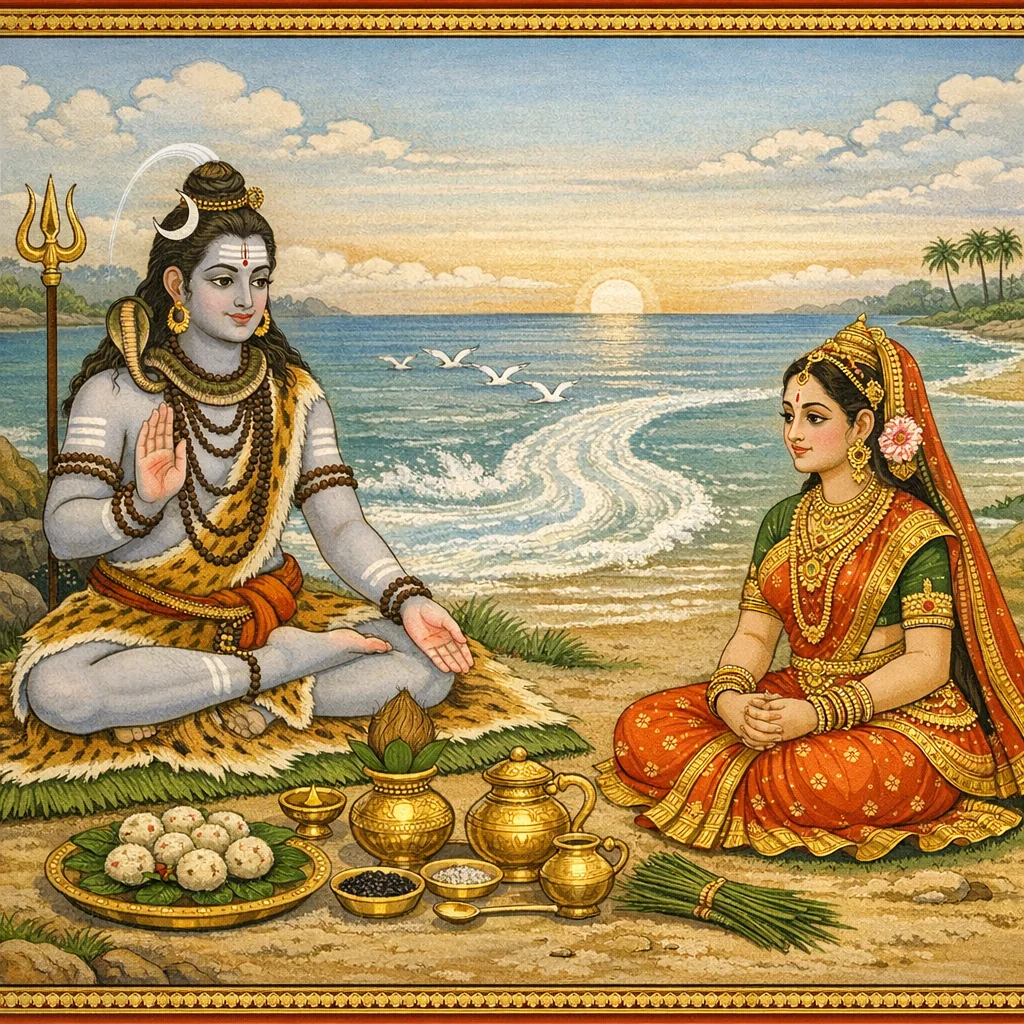
This chapter unfolds as a sacred question–answer discourse. Devī asks Īśvara for an expanded account of Sarasvatī’s māhātmya and raises precise questions on pilgrimage conduct at Prabhāsa: the merit of entering through the “mouth-gate” (mukha-dvāra), the fruits of bathing and giving (dāna), the results of immersion elsewhere, and the proper procedure of śrāddha—its rules, mantras, qualified officiants, suitable foods, and recommended gifts. Īśvara promises an orderly exposition of dāna and śrāddha and then magnifies Sarasvatī’s sanctity through layered praise. Sarasvatī-water is proclaimed supremely meritorious and, when mingled with the sea, rare even among the gods; the river is portrayed as granting worldly ease and freedom from sorrow. The text highlights the rarity of auspicious times, especially observances in Vaiśākha and vows connected with Soma. Access to Sarasvatī at Prabhāsa is said to surpass other austerities and expiations. Strong phala statements declare long residence in Viṣṇu-loka for those who remain in Sarasvatī’s waters, while those unable to perceive Sarasvatī at Prabhāsa are rhetorically likened to the spiritually impaired. Sarasvatī is also praised for beauty and for embodying expansive knowledge and pure discernment. The saṅgama of Sarasvatī with famed rivers and the ocean is presented as the pinnacle tīrtha. Bathing and gifting there yield results comparable to vast sacrificial merit, and those bathed by Sarasvatī’s waters are described as fortunate and worthy of honor.
Shlokas
Verse 1
देव्युवाच । भगवन्देवदेवेश संसारार्णवतारक । सरस्वत्याश्च माहात्म्यं विस्तरात्कथयस्व मे
The Goddess said: O Blessed Lord, Lord of the gods, savior who bears beings across the ocean of saṃsāra—tell me in detail the greatness of Sarasvatī.
Verse 2
यात्रागतानां देवेशि पुरुषाणां जितात्मनाम् । मुखद्वारे तु किं पुण्यं स्नानदाने च शंकर
O Lord of the gods, for disciplined men who have come on pilgrimage—what is the merit at Mukhadvāra, and what is the merit in bathing and giving, O Śaṅkara?
Verse 3
अवगाहनेन चान्यत्र फलं किंस्वित्प्रजायते । श्राद्धस्य किं विधानं तु के मंत्रास्तत्र के द्विजाः
And by bathing elsewhere, what fruit arises? What is the proper procedure for śrāddha there—what mantras are to be used, and which twice-born are to be engaged?
Verse 4
किं ग्राह्यं किञ्च भोक्तव्यं ब्राह्मणैः श्राद्धकर्मणि । कानि दानानि देयानि नृभिर्यात्रा फलेप्सुभिः
In the śrāddha rite, what may brāhmaṇas accept and what should they eat? And what gifts should be given by people who seek the fruits of pilgrimage?
Verse 5
ईश्वर उवाच । शृणु देविप्रवक्ष्यामि दानश्राद्धविधिक्रमम् । सरस्वत्याश्च माहात्म्यं कीर्त्यमानं निबोध मे
Īśvara said: Listen, O Goddess—I shall explain the ordered procedure of charity and śrāddha. And understand from me the greatness of Sarasvatī as it is being proclaimed.
Verse 6
पुण्यं सारस्वतं तोयं यत्र तत्रावगाह्यते । सागरेण तु संमिश्रं देवानामपि दुर्लभम्
The holy waters of Sarasvatī bestow merit wherever one bathes in them. When they mingle with the ocean, that confluence is rare even for the gods.
Verse 7
सरस्वती सर्वनदीषु पुण्या सरस्वती लोकसुखावगाहा । सरस्वतीं प्राप्य न दुःखिता नराः सदा न शोचंति परत्र चेह वा
Sarasvatī is holy among all rivers; Sarasvatī is an immersion into the happiness of the worlds. Having reached Sarasvatī, people are not afflicted with sorrow; they do not grieve—neither here nor in the world beyond.
Verse 8
पुण्यं सारस्वतं तीर्थं पुण्यकृल्लभते नरः । दुर्लभं त्रिषु लोकेषु वैशाख्या सोमपर्वणि
The holy Sārasvata Tīrtha is full of merit, and a person who has earned merit attains it. In the three worlds it is rare to obtain its complete auspiciousness, especially when the Soma-festival day falls in the month of Vaiśākha.
Verse 9
अमा सोमेन संयुक्ता यदि तत्रैव लभ्यते । तत्र किं क्रियते देवि पर्वकोटिशतैरपि
O Goddess, if the new-moon day joined with Soma is obtained right there at that tīrtha, then what could be accomplished elsewhere even by hundreds of millions of festival-days?
Verse 10
चान्द्रायणानि कृच्छ्राणि महासां तपनानि च । प्रायश्चित्तानि दीयन्ते यत्र नास्ति सरस्वती
Where Sarasvatī is not present, people resort to expiations—Cāndrāyaṇa vows, Kṛcchra austerities, and other severe penances. (But here, Sarasvatī herself grants purification.)
Verse 11
यावदस्थि शरीरस्य तिष्ठेत्सारस्वते जले । तावद्वर्षसहस्राणि विष्णुलोके वसे न्नरः । जात्यन्धैस्ते समा ज्ञेया मृतैः पंगुभिरेव च
So long as even a person’s bones remain in the waters of the Sārasvata tīrtha, for that many thousands of years he dwells in Viṣṇu’s world. Those who are able yet do not take this refuge are to be known as equal to the congenitally blind—indeed, as the dead and the lame.
Verse 12
समर्था ये न पश्यन्ति प्रभासस्थां सरस्वतीम् । ते देशास्तानि तीर्थानि आश्रमास्ते च पर्वताः
Those who are able yet do not behold Sarasvatī abiding at Prabhāsa—those lands, those tīrthas, those hermitages, and those mountains they frequent are of no account by comparison.
Verse 13
येषां सरस्वती देवी मध्ये याति सरिद्वरा । त्रैलोक्यपावनीं पुण्यां संश्रिता ये सरस्वतीम् । संसारकर्दमामोदमाजिघ्रन्ति न ते पुनः
Those through whose very midst the Goddess Sarasvatī—the best of rivers—flows, and those who take refuge in that holy Sarasvatī who purifies the three worlds: they never again inhale the foul stench of the mire of worldly existence.
Verse 14
शब्दविद्येव विस्तीर्णा मतैव जगतः प्रिया । सतां मतिरिव स्वच्छा रमणीया सरस्वती
Sarasvatī is expansive like the science of sound; beloved to the world like right understanding; clear like the discerning mind of the virtuous—truly delightful is Sarasvatī.
Verse 15
त्रैलोक्यशोभितां देवीं दिव्य तोयां सुनिर्मलाम् । स नीचो यः पुमानेतां न वन्देत सरस्वतीम्
Sarasvatī is the Goddess who adorns the three worlds—her waters are divine and utterly pure. Low indeed is that man who does not bow to this Sarasvatī.
Verse 16
स्वर्गनिश्रेणिसंभूता प्रभासे तु सरस्वती । नापुण्यवद्भिः संप्राप्तुं पुंभिः शक्या महानदी
At Prabhāsa, Sarasvatī arises like a stairway to heaven. This great river cannot be reached by men who are without merit.
Verse 17
चन्द्रभागा च गंगा च तथा यत्र सरस्वती । देवास्ते न मनुष्यास्ते तिस्रो नद्यः पिबन्ति ये
Where Candrabhāgā and Gaṅgā are present, and likewise Sarasvatī—those who drink of these three rivers are gods, not men.
Verse 18
सत्यमेव मया देवि जाह्नवी शिरसा धृता । याः काश्चित्सरितो लोके तासां पुण्या सरस्वती
Truly, O Goddess, I bore the river Jāhnavī (Gaṅgā) upon my head. Yet among all the rivers in the world, the Sarasvatī is the most sacred and merit-bestowing.
Verse 19
दर्शनेन सरस्वत्या राजसूयो न राजते । गंडूषश्चाश्वमेधाद्वै सर्व क्रतुवरं पयः
By merely beholding the Sarasvatī, even the Rājasūya sacrifice pales. And a single mouthful of her waters is indeed superior to the Aśvamedha—her water is the best among all sacrificial rewards.
Verse 21
वहन्ति येषां कालेन ते न काल वशा नराः । देवि किं बहुनोक्तेन वर्णितेन पुनःपुनः । सरस्वत्याः परं तीर्थं न भूतं न भविष्यति
Those for whom time itself flows are not men who fall under the dominion of Time. O Goddess, what is the use of saying more, of praising again and again? There has never been, nor will there ever be, any tīrtha higher than the Sarasvatī.
Verse 22
तत्रैव दुर्लभं स्नानं यत्र सागरसंगमः । तत्र स्नानेन दानेन कोटियज्ञफलं लभेत्
Right there, bathing is rare and precious—where the river meets the ocean. By bathing there and giving dāna (charity), one gains the fruit of crores of yajñas (sacrifices).
Verse 23
यत्र सारस्वतं तोयं सागरोर्मिसमाकुलम् । तत्र स्नास्यंति ये मर्त्या भाग्यवन्तो युगेयुगे
Where the Sarasvatī’s waters are churned and stirred by the ocean’s waves—those mortals who bathe there, age after age, are truly the fortunate ones.
Verse 24
ते धन्यास्ते नमस्कार्यास्तेषां स्फीततरं यशः । येषां कलेवरं नॄणां सिक्तं सारस्वतैर्जलैः
Blessed are they—worthy of salutation—and their fame grows ever more abundant: those whose bodies are bathed and sanctified by the waters of the Sarasvatī.