Adhyaya 270
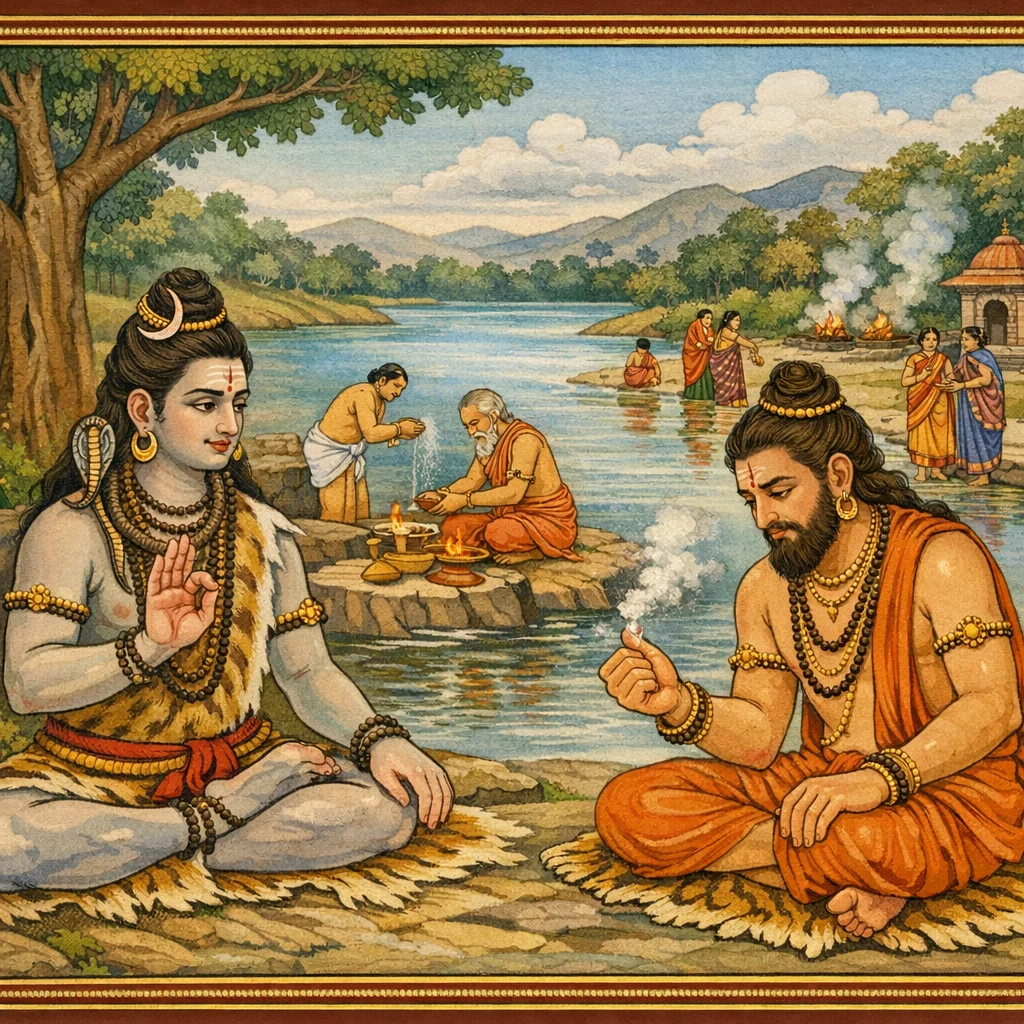
This chapter is framed as a Śaiva theological teaching in which Īśvara (Śiva) instructs Devī about the liṅga at the flow of the Prācī Sarasvatī, famed as Maṅkīśvara. It first recounts the origin legend: the ascetic ṛṣi Maṅkaṇaka performs long tapas with disciplined diet and study; when a plant-sap-like fluid accidentally oozes from his hand, he mistakes it for extraordinary siddhi and dances in rapture. His dance shakes the cosmos—mountains shift, oceans churn, rivers turn aside, and the heavenly bodies lose their alignment—so the devas led by Indra, with Brahmā and Viṣṇu, appeal to Tripurāntaka (Śiva) to restrain the upheaval. Śiva arrives disguised as a brāhmaṇa, questions the cause, and displays a greater marvel by producing ash from his thumb, correcting the ascetic’s delusion and restoring order. Maṅkaṇaka acknowledges Śiva’s supremacy and asks that his tapas not be diminished; Śiva grants its continued increase and establishes enduring presence at that sacred spot. The latter half turns to tīrtha-vidhi and phalaśruti, praising the Prācī Sarasvatī as exceptionally meritorious, especially at Prabhāsa. Death on the northern bank is said to prevent return to rebirth and to yield abundant merit likened to an aśvamedha. The text lists observances and fruits: disciplined bathing brings supreme siddhi and Brahman’s highest station; even a small gift of gold to a worthy brāhmaṇa gives Meru-like results; śrāddha benefits extend through many generations; a single piṇḍa offering and tarpaṇa uplift ancestors from adverse states; anna-dāna is linked to the path of mokṣa; gifts such as curd and woolen coverings lead to specific loka attainments; and bathing to remove impurity is equated with the fruit of go-dāna. It highlights bathing on kṛṣṇa-pakṣa caturdaśī and declares the river rare and hard to reach for the unmeritorious, with mentions of Kurukṣetra, Prabhāsa, and Puṣkara. The chapter closes with Śiva’s withdrawal after establishing his presence, and a verse attributed to Viṣṇu advising Dharma’s son to prefer the Prācī Sarasvatī over other renowned tīrthas.
Shlokas
Verse 1
ईश्वर उवाच । ततो गच्छेन्महादेवि यत्र प्राची सरस्वती । तत्र स्थाने स्थितं लिंगं मंकीश्वरमिति श्रुतम्
Īśvara said: “Then, O great Goddess, one should go where the Sarasvatī flows eastward. In that place stands a liṅga renowned by the name Maṃkīśvara.”
Verse 2
तस्योत्पत्तिं प्रवक्ष्यामि सर्वपातकनाशिनीम् । शृणु देवि महाभागे ह्याश्चर्यं यदभूत्पुरा
I shall declare the origin of that sacred account, which destroys all sins. Listen, O auspicious Goddess, to the wondrous marvel that occurred in ancient times.
Verse 3
ऋषिर्मंकणको नाम स तेपे परमं तपः । प्राचीमेत्य यताहारो नित्यं स्वाध्यायतत्परः
There was a sage named Maṅkaṇaka; he performed supreme austerity. Having gone to the eastern quarter, restrained in diet, he was ever devoted to svādhyāya—sacred study and recitation.
Verse 4
बहुवर्षसहस्राणि तस्यातीतानि भामिनि । कस्यचित्त्वथ कालस्य विद्धादस्य वरानने
Many thousands of years passed for him, O radiant one. Then, at a certain time, O fair-faced Lady, his finger was pierced by the tip of kuśa grass.
Verse 5
कराच्छाकरसो जातः कुशाग्रेणेति नः श्रुतम् । स तं दृष्ट्वा महाश्चर्यं विस्मयं परमं गतः
We have heard that, when pierced by the tip of kuśa grass, a sweet juice flowed from his hand. Beholding that great marvel, he was seized by the highest astonishment.
Verse 6
मेने सिद्धिं परां प्राप्तो हर्षान्नृत्यमथाकरोत् । तस्मिन्संनृत्यमाने च जगत्स्थावरजंगमम्
He thought he had attained the supreme siddhi, and in his joy he began to dance. As he danced, the whole world—both the unmoving and the moving—was affected.
Verse 7
अनर्त्तत वरारोहे प्रभावात्तस्य वै मुनेः । ततो देवा महेंद्राद्या ब्रह्मविष्णुपुरस्सराः । ऊचुस्त्रिपुरहंतारं नायं नृत्येत्तथा कुरु
O fair-hipped Lady, by the power of that sage all beings began to dance. Then the gods—beginning with great Indra, with Brahmā and Viṣṇu at their head—said to Śiva, the Slayer of Tripura: “Let this one not dance so; do something to stop it.”
Verse 8
चलिताः पर्वताः स्थानात्क्षुभितो मकरालयः । धरणी खण्डशो देव वृक्षाश्च निधनं गताः
Mountains were shaken from their places; the ocean, home of the makaras, churned in turmoil. The earth split into fragments, O Lord, and the trees met destruction.
Verse 9
उत्पथाश्च महानद्यो ग्रहा उन्मार्गसंस्थिताः । त्रैलोक्यं व्याकुलीभूतं यावत्प्राप्नोति संक्षयम्
Great rivers flowed off their proper courses, and the planets moved from their ordained paths. The three worlds were thrown into distress, as though approaching ruin.
Verse 10
तावन्निवारयस्वैनं नान्यः शक्तो निवारणे
Therefore restrain him at once—no one else has the power to stop him.
Verse 11
स तथेति प्रतिज्ञाय गत्वा तस्य समीपतः । द्विजरूपं समास्थाय तमृषिं वाक्यमब्रवीत्
He assented, saying “So be it,” and having pledged thus, he went near the sage. Assuming the form of a brāhmaṇa, he spoke words to that ṛṣi.
Verse 12
को हर्षविषयः कस्मात्त्वयैतन्नृत्यते द्विज । तस्मात्कार्यं वदाशु त्वं परं कौतूहलं द्विजः
“What is the cause of your joy, and why are you dancing, O twice-born? Therefore tell me quickly what the matter is—for I am greatly curious, O brāhmaṇa.”
Verse 13
ऋषिरुवाच । किं न पश्यसि मे ब्रह्मन्कराच्छाकर सं च्युतम् । अत एव हि मे नृत्यं सिद्धोऽहं नात्र संशयः
The sage said: “Do you not see, O brāhmaṇa, the lump of sugar that has fallen from my hand? For this very reason I dance—without doubt I have attained success (siddhi).”
Verse 14
ईश्वर उवाच । तस्य तद्वचनं श्रुत्वा भगवांस्त्रिपुरांतकः । अंगुष्ठं ताडयामास अंगुल्यग्रेण भामिनि
Īśvara said: “Hearing his words, the Blessed Lord—Tripurāntaka—struck his own thumb with the tip of his finger, O fair one.”
Verse 15
ततो विनिर्गतं भस्म तत्क्षणाद्धिमपांडुरम् । अथाब्रवीत्प्रहस्यैनं भगवान्भूतभावनः
Then ash came forth, at that very moment white as frost. And the Lord, the Nourisher of all beings, smiling, spoke to him.
Verse 16
पश्य मेंऽगुष्ठतो ब्रह्मन्भूरि भस्म विनिर्गतम् । न नृत्येऽहं न मे हर्षस्तथापि मुनिसत्तम
“Behold, O brāhmaṇa—abundant ash has emerged from my thumb. Yet I do not dance, nor do I feel exultation, O best of sages.”
Verse 17
तद्दृष्ट्वा सुमहाश्चर्यं विस्मयं परमं गतः । अब्रवीत्प्रांजलिर्भूत्वा हर्षगद्गदया गिरा
Seeing that exceedingly great wonder, he was overcome with the highest amazement; and with folded hands he spoke, his voice trembling with joy.
Verse 18
नान्यं देवमहं मन्ये त्वां मुक्त्वा वृषभध्वजम् । नान्यस्य विद्यते शक्तिरीदृशी धरणीतले
“I consider no other god besides you, O Bull-bannered Lord. No one else possesses such power upon the face of the earth.”
Verse 19
भगवानुवाच । ज्ञातोऽस्मि मुनिशार्दूल त्वया वेदविदां वर । वरं वरय भद्रं ते नित्यं यन्मनसेप्सितम्
The Lord said: “You have recognized me, O tiger among sages, O best of Veda-knowers. Choose a boon—blessings to you—whatever your heart continually desires.”
Verse 20
ऋषिरुवाच । प्रसादाद्देवदेवस्य नृत्येन महता विभो । यथा न स्यात्तपोहानिस्तथा नीतिर्विधीयताम्
The sage said: “O mighty one, by the grace of the God of gods I have danced in great measure. Ordain a fitting means, so that my austerity (tapas) may suffer no loss.”
Verse 21
शंभुरुवाच । तपस्ते वर्द्धतां विप्र मत्प्रसादात्सहस्रधा । प्राचीमन्विह वत्स्यामि त्वया सार्द्धमहं सदा
Śambhu said: “O brāhmaṇa, by my grace may your austerity increase a thousandfold. I shall ever dwell here, facing east, always together with you.”
Verse 22
सरस्वती महापुण्या क्षेत्रे चास्मिन्विशेषतः । सरस्वत्युत्तरे तीरे यस्त्यजेदात्मनस्तनुम्
Sarasvatī is supremely meritorious—most especially in this sacred kṣetra. Whoever relinquishes the body on the northern bank of the Sarasvatī attains exceptional sanctity through the greatness of this place.
Verse 23
प्राचीने ह्यृषिशार्दूल न चेहागच्छते पुनः । आप्लुतो वाजिमेधस्य फलं प्राप्नोति पुष्कलम्
O tiger among sages, one who bathes here returns no more to the eastern quarter—that is, to worldly wandering. Having immersed himself, he gains abundant fruit equal to that of the Aśvamedha sacrifice.
Verse 24
नियमैश्चोप वासैश्च शोषयन्देहमात्मनः । जलाहारा वायुभक्षाः पर्णाहाराश्च तापसाः । तथा च स्थंडिलशया ये चान्ये नियताः पृथक्
By observances and fasts, ascetics dry up their bodies—some living on water, some as though ‘feeding on air,’ some on leaves; likewise those who sleep upon bare ground, and others who keep distinct disciplines in various ways.
Verse 25
ये स्नानमाचरिष्यंति तीर्थेऽस्मिन्नियमान्विताः । ते यांति परमां सिद्धिं ब्रह्मणः परमं पदम्
Those who bathe at this tīrtha, endowed with sacred observances, attain the highest siddhi—the supreme abode of Brahman.
Verse 26
अस्मिंस्तीर्थे तु यो दानं त्रुटिमात्रं च कांचनम् । ददाति द्विजमुख्याय मेरुतुल्यं भवेत्फलम्
But at this tīrtha, whoever gives in charity even the tiniest amount of gold to an eminent brāhmaṇa gains a reward as vast as Mount Meru.
Verse 27
अस्मिंस्तीर्थे तु ये श्राद्धं करिष्यंतीह मानवाः । एकविंशत्कुलोपेताः स्वर्गं यास्यंति ते ध्रुवम्
And those who perform śrāddha here at this tīrtha—together with twenty-one generations of their lineage—will surely go to heaven.
Verse 28
पितॄणां वल्लभं तीर्थं पिंडेनैकेन तर्पिताः । ब्रह्मलोकं गमिष्यंति सुपुत्रेणेह तारिताः
This tīrtha is beloved of the ancestors. Satisfied with even a single piṇḍa offering, they will go to Brahmaloka—being delivered here through a virtuous son.
Verse 29
भूयश्चान्नं प्रयच्छंति मोक्षमार्गं व्रजंति ते
Moreover, those who give food in charity proceed upon the path to liberation (mokṣa).
Verse 30
अत्र ये शुभ कर्माणः प्रभासस्थां सरस्वतीम् । पश्यंति तेपि यास्यंति स्वर्गलोकं द्विजोत्तमाः
Here, those of auspicious deeds who behold Sarasvatī abiding at Prabhāsa—even they, O best of the twice-born, shall go to the heavenly world.
Verse 31
ये पुनस्तत्र भावेन नराः स्नानपरायणाः । ब्रह्मलोकं समासाद्य ते रमिष्यंति सर्वदा
But those men who, with heartfelt devotion, are devoted to bathing there—reaching Brahmaloka, they will rejoice forever.
Verse 32
दधि प्रदद्याद्योऽपीह ब्राह्मणाय मनोरमम् । सोऽप्यग्निलोकमासाद्य भुंक्ते भोगान्सुशोभनान्
Whoever here (in Prabhāsa) offers delightful curd to a brāhmaṇa—he too attains the world of Agni and enjoys splendid, auspicious pleasures.
Verse 33
ऊर्णाप्रावरणं योऽपि भक्त्या दद्याद्द्विजोत्तमे । सोऽपि याति परां सिद्धिं मर्त्यैरन्यैः सुदुर्लभाम्
Whoever, with devotion, gives a woollen covering to an excellent brāhmaṇa—he too attains the supreme accomplishment, exceedingly hard for other mortals to obtain.
Verse 34
ये चात्र मलनाशाय विशेयुर्मानवा जलम् । गोप्रदानफलं तेषां सुखेन फलमादिशेत्
And those people who enter the water here for the removal of impurity—one should declare that they easily obtain the fruit of gifting a cow.
Verse 35
भावेन हि नरः कश्चित्तत्र स्नानं समाचरेत् । सर्वपापविनिर्मुक्तो विष्णुलोके महीयते
Indeed, whoever bathes there with true inward devotion is freed from all sins and is honoured in the world of Viṣṇu.
Verse 36
तर्पणात्पिंडदानाच्च नरकेष्वपि संस्थिताः । स्वर्गं प्रयांति पितरः सुपुत्रेणेह तारिताः
By offerings of water (tarpaṇa) and by the giving of piṇḍas, even ancestors abiding in hell attain heaven—rescued here by a worthy son.
Verse 37
ते लभंतेऽक्षयांल्लोका न्ब्रह्मविष्ण्वीशशब्दितान् । भूयस्त्वन्नं प्रयच्छन्ति मोक्षमार्गं लभंति ते
They obtain imperishable realms known as those of Brahmā, Viṣṇu, and Īśa; and again they bestow food in abundance—thus they attain the path to liberation.
Verse 38
स्वर्गनिश्रेणिसंभूता प्रभासे तु सरस्वती । नापुण्यवद्भिः संप्राप्तुं पुंभिः शक्या महानदी
In Prabhāsa, the great river Sarasvatī has arisen as though from a stairway to heaven; that mighty river cannot be reached by men who are without merit.
Verse 39
प्राची सरस्वती चैव अन्यत्रैव तु दुर्लभा । विशेषेण कुरुक्षेत्रे प्रभासे पुष्करे तथा
The east-flowing (Prācī) Sarasvatī is indeed rare elsewhere; she is found especially at Kurukṣetra, at Prabhāsa, and likewise at Puṣkara.
Verse 40
प्राचीं सरस्वतीं प्राप्य योन्यत्तीर्थं हि मार्गते । स करस्थं समुत्सृज्य कूर्परेण समाचरेत्
Having reached the eastern Sarasvatī (Prācī Sarasvatī), one should seek the Yonyat-tīrtha; and there, setting aside what is held in the hand, one should perform the rite by the elbow (kūrpra) method.
Verse 41
कृष्णपक्षे चतुर्दश्यां स्नानं च विहितं सदा । पिण्याकेंगुदकेनापि पिंडं तत्र ददाति यः । पितॄणामक्षयं भूयात्पितृलोकं स गच्छति
On the fourteenth day of the dark fortnight (kṛṣṇa-pakṣa), bathing is ever enjoined. Whoever there offers a piṇḍa—even with water mixed with oil-cake (piṇyāka)—bestows imperishable benefit upon the ancestors, and he goes to the world of the Pitṛs (Pitṛloka).
Verse 42
सरस्वतीवाससमा कुतो रतिः सरस्वतीवाससमाः कुतो गुणाः । सरस्वतीं प्राप्य गता दिवं नराः पुनः स्मरिष्यंति नदीं सरस्वतीम्
Where could there be delight equal to dwelling by Sarasvatī? Where could there be virtues comparable to living in Sarasvatī’s abode? Having attained Sarasvatī, men go to heaven—yet again and again they remember the river Sarasvatī.
Verse 43
ईश्वर उवाच । उक्त्वैवं भगवान्देवस्तत्रैवांतरधीयत । सांनिध्यमकरोत्तत्र ततःप्रभृति शंकरः
Īśvara said: Having spoken thus, the Blessed Lord disappeared right there. From that time onward, Śaṅkara established his abiding presence in that place.
Verse 44
अत्र गाथा पुरा गीता विष्णुना प्रभविष्णुना । स्नेहार्द्रेण च चित्तेन धर्मपुत्रं प्रति प्रिये
Here is a gāthā once sung of old by Viṣṇu—the mighty Viṣṇu, the source of all beginnings—spoken with a heart softened by affection, addressed to Dharma’s son (Dharmaputra), O beloved.
Verse 45
मा गंगां व्रज कौंतेय मा प्रयागं च पुष्करम् । तत्र गच्छ कुरुश्रेष्ठ यत्र प्राची सरस्वती
O son of Kuntī, go not to the Gaṅgā; go not to Prayāga or to Puṣkara. Go there, O best of the Kurus—where the Prācī Sarasvatī is.
Verse 46
एतत्ते सर्वमाख्यातं यन्मां त्वं परिपृच्छसि । माहात्म्यं च सरस्वत्या भूयः किं श्रोतुमिच्छसि
All this I have explained to you, in answer to what you asked of me. And the greatness of Sarasvatī as well—what more do you wish to hear?
Verse 270
इति श्रीस्कांदे महापुराण एकाशीतिसाहस्र्यां संहितायां सप्तमे प्रभासखंडे प्रथमे प्रभासक्षेत्रमाहात्म्ये प्राचीसरस्वतीमंकीश्वरमाहात्म्यवर्णनंनाम सप्तत्युत्तरद्विशततमोऽध्यायः
Thus ends, in the holy Skanda Mahāpurāṇa—within the eighty-one-thousand-verse compendium—within the seventh, the Prabhāsa Khaṇḍa, and in the first subdivision, the Prabhāsakṣetra Māhātmya, the chapter called “The Description of the Greatness of Prācī Sarasvatī and Maṅkīśvara,” being Chapter 270.