Adhyaya 107
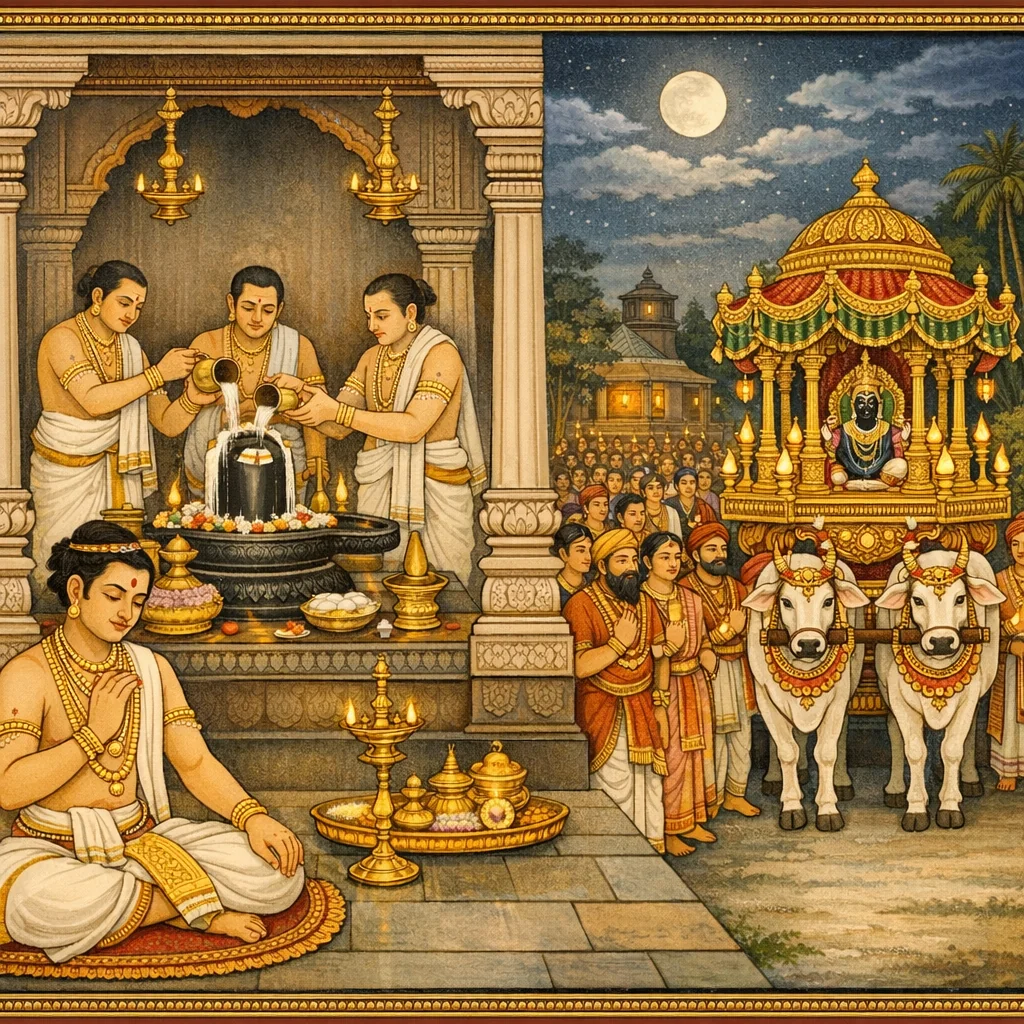
This adhyāya is a ritual and doctrinal manual framed as Īśvara’s instruction. It first classifies bhakti as mental (mānasī), verbal (vācikī), and bodily (kāyikī), and further distinguishes worldly (laukikī), Vedic (vaidikī), and inward/contemplative (ādhyātmikī) orientations. It then lays out a Prabhāsa-specific procedure for worshiping Brahmā in child-form (Bālarūpī): bathing at the tīrtha; pañcagavya and pañcāmṛta ablutions with mantra recitation; a mapped nyāsa across the body; sanctifying offerings; rites of flowers, incense, lamp, and naivedya; and honoring Vedic corpora and abstract virtues as objects of reverence. The chapter also introduces a Kārttika ratha-yātrā (especially around Pūrṇimā), describing civic roles, ritual cautions, and promised outcomes for participants and onlookers. A long catalog of place-linked names and manifestations of Brahmā functions as a theological geography index, followed by phalāśruti asserting that stotra-recitation and correct observance remove wrongdoing and yield great merit, with rare calendrical yogas such as Padmaka-yoga at Prabhāsa highlighted. It concludes by recommending dāna (including land-gift and specified items) and recitation practices for resident brāhmaṇas during major festivals.
Shlokas
Verse 1
ईश्वर उवाच । अथ पूजाविधानं ते कथयामि समासतः । भक्तिभेदान्पृथक्तस्य ब्रह्मणो बालरूपिणः
Īśvara said: Now I shall briefly explain to you the procedure of worship—together with the distinct modes of devotion—of that Brahman who is set apart (from all) and who is worshipped in the form of a divine Child.
Verse 2
रथयात्राविधानं तु स्तोत्रमंत्रविधिक्रमम् । विविधा भक्तिरुद्दिष्टा मनोवाक्कायसंभवा
The ordinance for the chariot-festival (ratha-yātrā), and the proper sequence for hymns and mantras—thus, devotion is taught as manifold, arising through mind, speech, and body.
Verse 3
लौकिकी वैदिकी चापि भवेदाध्यात्मिकी तथा । ध्यानधारणया या तु वेदानां स्मरणेन च । ब्रह्मप्रीतिकरी चैषा मानसी भक्तिरुच्यते
Devotion may be worldly, Vedic, and also spiritual. That devotion which is practised through meditation and steady concentration, and through remembrance of the Vedas—bringing delight to Brahman—is called mental devotion (mānasī bhakti).
Verse 4
मंत्रवेदनमस्कारैरग्निश्राद्धविधानकैः । जाप्यैश्चारण्यकैश्चैव वाचिकी भक्तिरुच्यते
By mantras, recitation of the Veda, acts of salutation (namaskāra), the prescribed rites of fire and śrāddha, and also by japa and forest-dwelling disciplines—this is called verbal devotion (vācikī bhakti).
Verse 5
व्रतोपवासनियमैश्चितेंद्रियनिरोधिभिः । कृच्छ्र सांतपनैश्चान्यैस्तथा चांद्रायणादिभिः
Through vows (vrata), fasts, and disciplines that restrain the senses; through austerities such as kṛcchra and sāṃtāpana; and also through observances like cāndrāyaṇa and others—(devotion is expressed through bodily practice).
Verse 6
ब्रह्मोक्तैश्चोपवासैश्च तथान्यैश्च शुभव्रतैः । कायिकी भक्तिराख्याता त्रिविधा तु द्विजन्मनाम्
By fasts enjoined in sacred teaching (brahma-ordained) and by other auspicious vows as well—this is declared to be bodily devotion (kāyikī bhakti), which is threefold for the twice-born (dvija).
Verse 7
गोघृतक्षीरदधिभिर्मध्विक्षुसुकुशोदकैः । गंधमाल्यैश्च विविधैर्वस्तुभिश्चोपपादिभिः
With cow’s ghee, milk, and curd; with honey, sugarcane, and pure kuśa-water; with various perfumes and garlands, and with suitable offerings of many kinds—(worship is performed).
Verse 8
घृतगुग्गुलधूपैश्च कृष्णागुरुसुगंधिभिः । भूषणै हैमरत्नाद्यैश्चित्राभिः स्रग्भिरेव च
With incense of ghee and guggulu, fragrant with black aloe-wood (kṛṣṇāguru); with ornaments of gold, gems, and the like; and indeed with splendid garlands—(worship is offered).
Verse 9
न्यासैः परिसरैः स्तोत्रैः पताकाभिस्तथोत्सवैः । नृत्यवादित्रगीतैश्च सर्ववस्तूपहारकैः
With nyāsa (ritual placements), with circumambulations, with hymns, with banners and festivals; with dance, instrumental music, and song; and with offerings of every kind of article—worship is duly celebrated.
Verse 10
भक्ष्यभोज्यान्न पानैश्च या पूजा क्रियते नरैः । पितामहं समुद्दिश्य सा भक्तिर्लौकिकी मता
That worship which people perform with sweets, cooked foods, grains, and drinks—directed toward Pitāmaha (the Grandfather, Brahmā)—is regarded as worldly devotion (laukikī bhakti).
Verse 11
वेदमंत्रहविर्भागैः क्रिया या वैदिकी स्मृता
That rite which is remembered as ‘Vedic’ is the performance carried out with Vedic mantras and with the proper portions of oblations (havis).
Verse 12
दर्शे च पौर्णमास्यां च कर्त्तव्यं चाग्निहोत्रजम् । प्राशनं दक्षिणादानं पुरोडाश इति क्रिया
On the new-moon day and on the full-moon day, the Agnihotra-related rite should be performed—namely the ritual tasting (prāśana), the giving of the priestly fee (dakṣiṇā), and the offering of the puroḍāśa cake: this is the prescribed procedure.
Verse 13
इष्टिर्धृतिः सोमपानं याज्ञियं कर्म सर्वशः । ऋग्यजुः सामजाप्यानि संहिताध्ययनानि च । क्रियते ब्रह्माणमुद्दिश्य सा भक्तिर्वेदिकोच्यते
Sacrificial worship (iṣṭi), steadfastness (dhṛti), Soma-drinking, and all sacrificial acts; the japa of Ṛk, Yajus, and Sāman, and the study of the Saṃhitās—when these are performed with Brahmā in view, that devotion is called ‘Vedic devotion.’
Verse 14
प्राणायामपरो नित्यं ध्यानवान्विजितेंद्रियः । भैक्ष्यभक्षी व्रती चापि सर्वप्रत्याहृतेंद्रियः
Ever devoted to prāṇāyāma, meditative and master of the senses; living on alms, observing vows, with all the senses withdrawn—such is the disciplined practitioner.
Verse 15
धारणं हृदये कृत्वा ध्यायमानः प्रजेश्वरम् । हृत्पद्मकर्णिकासीनं रक्तवर्णं सुलोचनम्
Fixing concentration within the heart, he meditates on the Lord of creatures (Prajāpati/Brahmā), seated upon the pericarp of the heart-lotus, red-hued and fair-eyed.
Verse 16
पश्यन्नुद्द्योतितमुखं ब्रह्माणं सुकटीतटम् । रक्तवर्णं चतुर्बाहुं वरदाभयहस्तकम् । एवं यश्चिंतयेद्देवं ब्रह्मभक्तः स उच्यते
Beholding Brahmā with a radiant face, of comely waist and hips, red-hued, four-armed, with hands granting boons and fearlessness—whoever thus contemplates the deity is called a devotee of Brahmā.
Verse 17
विधिं च शृणु मे देवि यः स्मृतः क्षेत्रवासिनाम्
And hear from me, O Goddess, the rule of conduct that is prescribed for those who dwell in the sacred field (kṣetra).
Verse 18
निर्ममा निरहंकारा निःसंगा निष्परिग्रहाः । चतुर्वर्गेपि निःस्नेहाः समलोष्टाश्मकांचनाः
Free from possessiveness and ego, unattached and without hoarding; even toward the four aims of life they are without clinging, regarding a clod of earth, a stone, and gold as equal.
Verse 19
भूतानां कर्मभिर्नित्यं त्रिविधैरभयप्रदाः । प्राणायामपरा नित्यं परध्यानपरायणाः
Through threefold acts of karma they ever bestow fearlessness upon beings; ever devoted to prāṇāyāma, wholly given to meditation upon the Supreme Deity.
Verse 20
जापिनः शुचयो नित्यं यतिधर्मक्रियापराः । सांख्ययोगविधिज्ञा ये धर्मविच्छिन्नसंशयाः
They are practitioners of japa, ever pure, devoted to the duties and disciplines of renunciants; knowers of the methods of Sāṃkhya and Yoga, their doubts concerning dharma having been cut asunder.
Verse 21
ब्रह्मपूजारता नित्यं ते विप्राः क्षेत्रवासिनः । तैर्यथा पूजनीयो वै बालरूपी पितामहः
Those brāhmaṇas who dwell in the sacred kṣetra are ever devoted to the worship of Brahmā; and by them the Grandsire—Brahmā appearing in the form of a child—is indeed to be worshipped in the proper manner.
Verse 22
तथाहं कीर्त्तयिष्यामि शृणुष्वैकमनाः प्रिये । स्नात्वा तु विमले तीर्थे शुक्लांबरधरः शुचिः । पूजोपहारसंयुक्तस्ततो ब्रह्माणमर्चयेत्
Thus shall I describe it—listen with one-pointed mind, beloved. Having bathed at the pure tīrtha, wearing white garments and being clean, and furnished with offerings for worship, one should then adore Brahmā.
Verse 23
पूर्वं संस्नाप्य विधिना पंचामृतरसोदकैः । गोमूत्रं गोमयं क्षीरं दधि सर्पिः कुशोदकम्
First, according to the proper rule, one should bathe the deity with the liquids of pañcāmṛta: cow-urine, cow-dung, milk, curd, ghee, and water sanctified with kuśa.
Verse 24
गायत्र्या गृह्य गोमूत्रं गंधद्वारेति गोमयम् । आप्यायस्वेति च क्षीरं दधिक्राव्णेति वै दधि
With the Gāyatrī mantra one takes cow-urine; with “Gandhadvāra,” cow-dung; with “Āpyāyasva,” milk; and with “Dadhikrāva,” curd—thus indeed the rite proceeds.
Verse 25
तेजोऽसि शुक्रमित्याज्यं देवस्य त्वा कुशोदकम् । आपोहिष्ठेति मंत्रेण पंचगव्येन स्नापयेत्
Ghee is used with “Tejo’si śukram”; kuśa-water with “Devasya tvā”; and with the mantra “Āpohiṣṭha” one should bathe the deity using pañcagavya.
Verse 26
कपिलापंचगव्येन कुशवारियुतेन च । स्नापयेन्मंत्रपूतेन ब्रह्मस्नानं हि तत्स्मृतम्
One should bathe (the deity) with the pañcagavya of a tawny (kapilā) cow, together with kuśa-water, sanctified by mantra; this is indeed remembered as “Brahmā-snāna.”
Verse 27
वर्षकोटिसहस्रैस्तु यत्पापं समुपार्जितम् । सुरज्येष्ठं तु संस्नाप्य दहेत्सर्वं न संशयः
Whatever sin has been amassed through thousands of crores of years—by bathing Sura-jyeṣṭha, the foremost among the gods, it is all burned away; of this there is no doubt.
Verse 28
एवं संस्नाप्य विधिना ब्रह्माणं बालरूपिणम् । कर्पूरागरुतोयेन ततः संस्नापयेद्द्विजः
Having thus bathed Brahmā in child-form according to the rite, the twice-born should thereafter bathe him again with water scented with camphor and agaru.
Verse 29
एवं कृत्वार्च्चयेद्देवं गायत्रीन्यासयोगतः । मूर्ध्नः पादतलं यावत्प्रणवं विन्यसेद्बुधः
Having thus done, one should worship the Deity according to the discipline of Gāyatrī-nyāsa; the wise should install the Praṇava (Om) from the crown of the head down to the soles of the feet.
Verse 30
तकारं विन्यसेन्मूर्ध्नि सकारं मुखमण्डले । विकारं कंठदेशे तु तुकारं चांगसंधिषु
One should place the syllable “ta” upon the crown of the head, “sa” upon the region of the face; “vi” upon the throat; and “tu” upon the joints of the limbs.
Verse 31
वकारं हृदि मध्ये तु रेकारं पार्श्वयोर्द्वयोः । णिकारं दक्षिणे कुक्षौ यकारं वामसंज्ञिते
Place the syllable “va” in the middle of the heart; “ra” upon both flanks; “ṇa” on the right side of the abdomen; and “ya” upon what is known as the left side.
Verse 32
भकारं कटिनाभिस्थं गोकारं पार्श्वयोर्द्वयोः । देकारं जानुनोर्न्यस्य वकारं पादपद्मयोः
Place the syllable “bha” at the waist and navel-region; “go” upon both flanks; placing “de” upon the knees, set “va” upon the lotus-feet.
Verse 33
स्यकारमंगुष्ठयोर्न्यस्य धीकारमुरसि न्यसेत् । मकारं जानुमूले तु हि कारं गुह्यमाश्रितम्
Placing the syllable “sya” upon the thumbs, one should set “dhī” upon the chest. Then place “ma” at the base of the knees; and “hi” is assigned to the secret (genital) region.
Verse 34
धिकारं हृदये न्यस्य योकारं चाधरोष्ठके । योकारं च तथैवान्यमुत्तरोष्ठे न्यसेत्सुधीः
Placing the syllable “dhi” in the heart, one should set “yo” upon the lower lip; and likewise the other “yo” should be placed upon the upper lip by the wise.
Verse 35
नकारं नासिकाग्रे तु प्रकारं नेत्रमाश्रितम् । चोकारं च भ्रुवोर्मध्ये दकारं प्राणमाश्रितम्
Place the syllable “na” at the tip of the nose; “pra” in the eye; “co” in the space between the eyebrows; and “da” in the vital breath.
Verse 36
यात्कारं च ललाटांते विन्यसेद्वै सुरेश्वरि । न्यासं कृत्वाऽत्मनो देहे देवे कुर्यात्तथा प्रिये
And place the syllable “yāt” at the end of the forehead, O Lady of the gods. Having performed nyāsa upon one’s own body, one should perform it likewise upon the deity, O beloved.
Verse 37
सर्वोपहारसंपन्नं कृत्वा सम्यङ्निरीक्षयेत् । कुंकुमागरुकर्पूरचंदनेन विमिश्रितम्
Having arranged all offerings in full, one should carefully inspect them, mixed with saffron, aloe-wood, camphor, and sandalwood.
Verse 38
गंधतोयैरुपस्कृत्य गायत्र्या प्रणवेन च । प्रोक्षयेत्सर्वद्रव्याणि पश्चादर्चनमारभेत्
Having purified the articles with scented water, and with the Gāyatrī and the Praṇava (Oṃ), one should sprinkle all the ritual substances; thereafter one should begin the worship.
Verse 39
दिव्यै पुष्पैः सुगंधैश्च मालतीकमलादिभिः । अशोकैः शतपत्रैश्च बकुलैः पूजयेत्क्रमात्
One should worship in due order with divine, fragrant flowers—such as jasmine and lotus—also with aśoka blossoms, hundred-petalled flowers, and bakula blooms.
Verse 40
कृष्णागरुसुधूपेन घृतदीपैस्तथोत्तमैः । ततः प्रदापयेत्तत्र नैवेद्यं विविधं क्रमात्
With excellent incense of dark agaru and with fine ghee-lamps, then, in due order, one should present there a variety of food-offerings (naivedya).
Verse 41
खण्डलड्डुकश्रीवेष्टकांसाराशोकपल्लवैः । स्वस्तिकोल्लिपिकादुग्धा तिलवेष्टकिलाटिकाम्
He should offer ritual edibles and sacred items—pieces of sweetmeats (laddus), auspicious wrappings, vessels, and aśoka shoots—together with milk prepared for auspicious markings and sesame-wrapped cakes (kilāṭikā), as part of the worship-rite.
Verse 42
फलानि चैव पक्वानि मूलमंत्रेण दापयेत् । ऋग्वेदं च यजुर्वेदं सामवेदं च पूजयेत्
He should present ripe fruits with the root-mantra; and he should worship the Ṛgveda, the Yajurveda, and the Sāmaveda as well.
Verse 43
ज्ञानं वैराग्यमैश्वर्यं धर्मं संपूजयेद्बुधः । ईशानादिक्रमाद्देवि दिशासु विदिशासु च
The wise worshipper should duly honour knowledge, dispassion, sovereignty, and dharma; and, O Goddess, he should do so in the directions and intermediate directions, beginning in order from Īśāna (the northeast).
Verse 44
चतुर्द्दशविद्यास्थानानि ब्रह्मणोऽग्रे प्रपूजयेत् । हृदयानि ततो न्यस्य देवस्य पुरतः क्रमात्
He should first worship the fourteen seats of knowledge before Brahmā; then, placing the Heart-formulas (hṛdaya) in proper sequence, he should set them before the deity.
Verse 45
आपोहिष्ठेति ऋगियं हृदयं परिकीर्त्तितम् । ऋतं सत्यं शिखा प्रोक्ता उदुत्यं नेत्रमादिशेत्
“Āpo hi ṣṭhā…”—this Ṛgvedic verse is declared to be the Heart (hṛdaya). “Ṛtaṃ satyaṃ…” is taught as the Topknot (śikhā), and “Ud u tyaṃ…” is to be assigned as the Eye (netra).
Verse 46
चित्रं देवानामित्येवं सर्वलोकेषु विश्रुतम् । ब्रह्मंस्ते छादयामीति कवचं समुदाहृतम्
“Citraṃ devānām…”—thus famed in all the worlds—is declared to be the Armour (kavaca); and “Brahmaṃs te chādayāmi” is recited as the protective covering.
Verse 47
भूर्भुवः स्वरितीरेश पूजनं परिकीर्तितम् । गायत्र्या पूजयेद्देवमोंकारेणाभिमंत्रितम्
Worship with “bhūr bhuvaḥ svaḥ” is taught, O Lord of the bank (tīra). He should worship the deity with the Gāyatrī, after consecrating the rite with the syllable Oṃ.
Verse 48
प्रणवेनापरान्सर्वानृग्वेदादीन्प्रपूजयेत् । गायत्री परमो मंत्रो वेदमाता विभावरी
With the Praṇava (Oṃ) he should duly worship all the others—the Ṛgveda and the rest. The Gāyatrī is the supreme mantra, the Mother of the Vedas, the radiant one.
Verse 49
गायत्र्यक्षरतत्त्वैस्तु ब्रह्माणं यस्तु पूजयेत् । उपोष्य पंचदश्यां तु स याति परमं पदम्
Whoever worships Brahmā through the essential syllabic truths of the Gāyatrī, and fasts on the fifteenth lunar day, attains the supreme state.
Verse 50
संसारसागरं घोरमुत्तितीर्षुर्द्विजो यदि । प्रभासे कार्त्तिके मासि ब्रह्माणं पूजयेत्सदा
If a twice-born seeks to cross the dreadful ocean of worldly existence, then in Prabhāsa, in the month of Kārttika, he should ever worship Brahmā.
Verse 51
यस्य दर्शनमात्रेण अश्वमेध फलं लभेत् । कस्तं न पूजयेद्विद्वान्प्रभासे बालरूपिणम्
Whose mere sight bestows the fruit of the Aśvamedha sacrifice—what wise person would not worship that child-formed Lord at Prabhāsa?
Verse 52
यस्यैकदिवसप्रांते सदेवासुरमानवाः । विलयं यांति देवेशि कस्तं न प्रतिपूजयेत्
At the end of His single day, gods, demons, and humans alike dissolve—O Goddess of the gods, who would not worship Him with great reverence?
Verse 53
पिता यः सर्वदेवानां भूतानां च पितामहः । यस्मादेष स तैः पूज्यो ब्राह्मणैः क्षेत्रवासिभिः
He is the father of all the gods and the grandsire of all beings; therefore He should be worshipped by them, and by the brāhmaṇas who dwell in this sacred region.
Verse 54
रुद्ररूपी विश्वरूपी स एव भुवनेश्वरः । पौर्णमास्यामुपोषित्वा ब्रह्माणं जगतां पतिम् । अर्चयेद्यो विधानेन सोऽश्वमेधफलं लभेत्
He is Rudra in form, universal in form—truly the Lord of the worlds. Whoever fasts on the full-moon day and, according to proper rite, worships Brahmā, the Lord of the universe, attains the fruit of an Aśvamedha.
Verse 55
कार्त्तिके मासि देवस्य रथयात्रा प्रकीर्त्तिता । यां कृत्वा मानवो भक्त्या याति ब्रह्मसलोकताम्
In the month of Kārttika, the Lord’s chariot procession is proclaimed. Performing it with devotion, a person attains the world of Brahmā.
Verse 56
कार्त्तिके मासि देवेशि पौर्णमास्यां चतुर्मुखम् । मार्गेण चर्मणा सार्द्धं सावित्र्या च परंतपः
O Lady of the gods, on the full-moon day in Kārttika, the four-faced Lord (Brahmā)—together with the sacred route, the hide-covering, and also with Sāvitrī, O subduer of foes—is to be honored (in the procession).
Verse 57
भ्रामयेन्नगरं सर्वं नानावाद्यैः समन्वितम् । स्थापयेद्भ्रामयित्वा तु सकलं नगरं नृपः
The king should have the entire city circumambulated in procession, accompanied by many kinds of musical instruments; and after leading it around, he should have the whole city properly set in order again.
Verse 58
ब्राह्मणान्भोजयित्वाग्रे शांडिलेयं प्रपूज्य च । आरोपयेद्रथे देवं पुण्यवादित्रनिःस्वनैः
First, having fed the brāhmaṇas and duly honored Śāṇḍileya, one should then place the Lord upon the chariot, amid the auspicious sounds of sacred instruments.
Verse 59
रथाग्रे शांडिलीपुत्रं पूजयित्वा विधानतः । ब्राह्मणान्वाचयित्वा च कृत्वा पुण्याहमंगलम्
At the front of the chariot, having duly worshipped Śāṇḍilī’s son and having the brāhmaṇas recite benedictions, one should perform the auspicious puṇyāha rite.
Verse 60
देवमारोपयित्वा तु रथे कुर्यात्प्रजागरम् । नानाविधैः प्रेक्षणकैर्ब्रह्मशेषैश्च पुष्कलैः
Then, having mounted the deity upon the chariot, one should keep a night-long vigil, with many kinds of sacred performances and abundant offerings of brahma-śeṣa, food sanctified through brāhmaṇic rites.
Verse 61
नारोढव्यं रथे देवि शूद्रेण शुभमिच्छता । नाधर्मेण विशेषेण मुक्त्वैकं भोजकं प्रिये
O Goddess, a Śūdra who seeks auspiciousness should not mount the chariot. Nor should one proceed by adharma—except, beloved, for the single exception of the Bhojaka attendant appointed for this rite.
Verse 62
ब्रह्मणो दक्षिणे पार्श्वे सावित्रीं स्थापयेत्प्रिये । भोजकं वामपार्श्वे तु पुरतः पंकजं न्यसेत्
Beloved, one should place Sāvitrī on Brahmā’s right side; on the left, the Bhojaka attendant; and in front, one should set a lotus.
Verse 63
एवं तूर्यनिनादैश्च शंखशब्दैश्च पुष्कलैः । भ्रामयित्वा रथं देवि पुरं सर्वं च दक्षिणम् । स्वस्थाने स्थापयेद्भूयः कृत्वा नीराजनं बुधः
Thus, amid abundant sounds of instruments and conch-blasts, O Goddess, having driven the chariot around the whole city in the auspicious rightward course, the wise man should perform nīrājana (ārati) and then set it again in its proper place.
Verse 64
य एवं कुरुते यात्रां भक्त्या यश्चापि पश्यति । रथं वाऽकर्षयेद्यस्तु स गच्छेद्ब्रह्मणः पदम्
Whoever performs this procession in this manner with devotion—and whoever even beholds it—or whoever draws the chariot, that person attains the abode of Brahmā.
Verse 65
यो दीपं धारयेत्तत्र ब्रह्मणो रथपृष्ठगः । पदेपदेऽश्वमेधस्य स फलं विंदते महत्
Whoever there holds a lamp while standing upon (or riding with) Brahmā’s chariot obtains, at every step, the great fruit of an Aśvamedha sacrifice.
Verse 66
यो न कारयते राजा रथयात्रां तु ब्रह्मणः । स पच्यते महादेवि रौरवे कालमक्षयम्
O Great Goddess, the king who does not cause Brahmā’s chariot-festival to be performed is tormented in the Raurava hell for an imperishable, very long time.
Verse 67
तस्मात्सर्वप्रयत्नेन राष्ट्रस्य क्षेममिच्छता । रथयात्रां विशेषेण स्वयं राजा प्रवर्त्तयेत्
Therefore, desiring the welfare of the kingdom, the king should, with every effort, personally set in motion this chariot-festival in a special manner.
Verse 68
प्रतिपद्ब्राह्मणांश्चापि भोजयेद्वि धिवत्सुधीः । वासोभिरहतैश्चापि गन्धमाल्यानुलेपनैः
On the Pratipad day, the wise person should also feed Brāhmaṇas according to proper rule, and honor them with unworn garments, as well as with fragrances, garlands, and unguents.
Verse 69
कार्त्तिके मास्यमावास्यां यस्तु दीपप्रदीपनम् । शालायां ब्रह्मणः कुर्यात्स गच्छेत्परमं पदम्
Whoever, on the new-moon day in the month of Kārttika, lights lamps in Brahmā’s hall, attains the supreme state.
Verse 70
उत्सवेषु च सर्वेषु सर्वकाले विशेषतः । पूजयेयुरिमं विप्रा ब्रह्माणं जगतां गुरुम्
In all festivals—and indeed at all times, especially—the Brāhmaṇas should worship this Brahmā, the guru of the worlds.
Verse 71
यथाकृत्यप्रयोगेण सम्यक्छ्रद्धा समन्विताः । पूज्यो दिव्योपचारेण यथावित्तानुसारतः
Endowed with proper faith and following the prescribed method, one should worship Him with divine offerings, according to one’s means.
Verse 72
एवं ते कथितं देवि पूजामाहात्म्यमुत्तमम् । प्रभासक्षेत्रमाहात्म्यं ब्रह्मणः बालरूपिणः
Thus, O Devī, I have described to you the supreme greatness of worship—namely, the greatness of Prabhāsa-kṣetra, where Brahmā abides in the form of a child.
Verse 73
तस्याहं कथयिष्यामि नाम्नामष्टोत्तरं शतम् । प्रदत्त्वा च पठित्वा च यज्ञायुतफलं लभेत्
I shall now proclaim His one-hundred-and-eight names. By bestowing it (to a worthy person) and by reciting it, one attains the merit equal to ten thousand sacrifices.
Verse 74
गायत्र्या लक्षजाप्येन सम्यग्जप्तेन यत्फलम् । तत्फलं समवाप्नोति स्तोत्रस्यास्य उदीरणात्
Whatever fruit is gained by a hundred thousand proper repetitions of the Gāyatrī, that very fruit is attained by the recitation of this hymn.
Verse 75
इदं स्तोत्रवरं दिव्यं रहस्यं पापनाशनम् । न देयं दुष्टबुद्धीनां निन्दकानां तथैव च
This excellent hymn is divine, secret, and a destroyer of sin. It should not be given to those of wicked intent, nor to slanderers.
Verse 76
ब्राह्मणाय प्रदातव्यं श्रोत्रियाय महात्मने । विष्णुना हि पुरा पृष्टं ब्रह्मणः स्तोत्रमुत्त्मम्
It should be given to a Brāhmaṇa—one learned in the Veda, a great-souled person. For long ago this excellent hymn of Brahmā was asked about by Viṣṇu.
Verse 77
केषुकेषु च स्थानेषु देवदेव पितामह । संचिन्त्यस्तन्ममाचक्ष्व त्वं हि सर्वविदुत्तम
O God of gods, O Pitāmaha, in which places and sacred stations are You to be contemplated? Consider this and tell me—for You are the best among all knowers.
Verse 78
ब्रह्मोवाच । पुष्करेऽहं सुरश्रेष्ठो गयायां प्रपितामहः । कान्यकुब्जे वेदगर्भो भृगुक्षेत्रे चतुर्मुखः
Brahmā said: In Puṣkara I am known as Suraśreṣṭha; in Gayā as Prapitāmaha. In Kānyakubja I am Vedagarbha, and in Bhṛgu-kṣetra I am Caturmukha.
Verse 79
कौबेर्यां सृष्टिकर्ता च नन्दिपुर्यां बृहस्पतिः । प्रभासे बालरूपी च वाराणस्यां सुरप्रियः
In Kauberī I am the Creator; in Nandīpurī I am Bṛhaspati. In Prabhāsa I appear in the form of a child, and in Vārāṇasī I am Surapriya, beloved of the gods.
Verse 80
द्वारावत्यां चक्रदेवो वैदिशे भुवनाधिपः । पौंड्रके पुण्डरीकाक्षः पीताक्षो हस्तिनापुरे
In Dvārāvatī I am Cakradeva; in Vaidiśa I am Bhuvanādhipa, Lord of the worlds. In Pauṇḍraka I am Puṇḍarīkākṣa, and in Hastināpura I am Pītākṣa.
Verse 81
जयंत्यां विजयश्चासौ जयन्तः पुरुषोत्तमे । वाडेषु पद्महस्तोऽहं तमोलिप्ते तमोनुदः
In Jayantī I am known as Vijaya, and in Puruṣottama as Jayanta. In Vāḍa I am the Lotus-handed One; and in Tamolipta I am the Dispeller of darkness.
Verse 82
आहिच्छत्र्यां जनानंदः काञ्चीपुर्यां जनप्रियः । कर्णाटस्य पुरे ब्रह्मा ऋषिकुण्डे मुनिस्तथा
In Āhicchatrā I am Janānanda, the Delighter of the people; in Kāñcīpurī I am Janapriya, the Beloved of the people. In the city of Karṇāṭa I am Brahmā; and at Ṛṣikuṇḍa I am revered as the Sage.
Verse 83
श्रीकण्ठे श्रीनिवासश्च कामरूपे शुभंकरः । उच्छ्रियाणे देवकर्त्ता स्रष्टा जालंधरे तथा
In Śrīkaṇṭha I am Śrīnivāsa; in Kāmarūpa I am Śubhaṅkara, the Bestower of auspiciousness. In Ucchriyāṇa I am Devakartṛ, the Maker of the gods; and in Jālandhara I am the Creator.
Verse 84
मल्लिकाख्ये तथा विष्णुर्महेन्द्रे भार्गवस्तथा । गोनर्दः स्थविराकारे ह्युज्जयिन्यां पितामहः
Likewise, in Mallikākhya I am Viṣṇu; in Mahendra I am Bhārgava. In Gonarda I manifest in the form of an elder; and in Ujjayinī I am Pitāmaha, the Grandsire.
Verse 85
कौशांब्यां तु महादेवो ह्ययोध्यायां तु राघवः । विरंचिश्चित्रकूटे तु वाराहो विन्ध्यपर्वते
In Kauśāmbī I am Mahādeva; in Ayodhyā I am Rāghava (Rāma). In Citrakūṭa I am Virañci (Brahmā); and on the Vindhya mountain I am Varāha.
Verse 86
गंगाद्वारे सुरश्रेष्ठो हिमवन्ते तु शंकरः । देहिकायां स्रुचाहस्तः पद्महस्तस्तथाऽर्बुदे
At Gaṅgādvāra I am the Best of the gods; in Himavant I am Śaṅkara. In Dehikā I am the Ladle-handed One; and likewise at Arbuda I am the Lotus-handed One.
Verse 87
वृन्दावने पद्मनेत्रः कुश हस्तश्च नैमिषे । गोपक्षेत्रे च गोविन्दः सुरेन्द्रो यमुनातटे
In Vṛndāvana I am the Lotus-eyed One; in Naimiṣa I am the One holding kuśa-grass. In Gopakṣetra I am Govinda; and on the bank of the Yamunā I am Surendra, the Lord of the gods.
Verse 88
भागीरथ्यां पद्मतनुर्जनानन्दो जनस्थले । कौंकणे च स मध्वक्षः काम्पिल्ये कनकप्रभः
On the Bhāgīrathī I am Padmatanu, of lotus-like form; in Janasthala I am Janānanda. In the Koṅkaṇa I am Madhvakṣa; and in Kāmpilya I shine as Kanakaprabha, the Golden-radiant One.
Verse 89
खेटके चान्नदाता च शंभुश्चैव क्रतुस्थले । लंकायां चैव पौलस्त्यः काश्मीरे हंसवाहनः
In Kheṭaka I am Annadātā, the Giver of food; and in Kratusthala I am Śambhu. In Laṅkā I am Paulastya; and in Kāśmīra I am Haṃsavāhana, the Swan-borne One.
Verse 90
वसिष्ठश्चार्बुदे चैव नारदश्चोत्पलावने । मेधके श्रुतिदाता च प्रयागे यजुषां पतिः
At Arbuda I am Vasiṣṭha; and in Utpalāvana I am Nārada. In Medhaka I am Śrutidātā, the Giver of sacred learning; and at Prayāga I am the Lord of the Yajus (Yajurveda).
Verse 91
शिवलिंगे सामवेदो मर्कटे च मधुप्रियः । नारायणश्च गोमन्ते विदर्भायां द्विज प्रियः
At Śivaliṅga He is praised as Sāmaveda; at Markaṭa He is known as Madhupriya (the beloved of sweetness). At Gomanta He is Nārāyaṇa; and in Vidarbhā He is renowned as Dvijapriya (beloved of the twice-born)—thus the One Lord is celebrated through many holy abodes.
Verse 92
अंकुलके ब्रह्मगर्भो ब्रह्मवाहे सुतप्रियः । इन्द्रप्रस्थे दुराधर्षश्चंपायां सुरमर्दनः
At Aṃkulaka He is called Brahmagarbha; at Brahmavāha He is Sutapriya (fond of virtuous offspring). In Indraprastha He is famed as Durādharṣa (the unassailable), and in Campā as Suramardana (crusher of hostile powers)—so do the tīrthas proclaim His might and grace.
Verse 93
विरजायां महारूपः सुरूपो राष्ट्रवर्धने । कदंबके जनाध्यक्षो देवाध्यक्षः समस्थले
In Virajā He is Mahārūpa (of the vast form); in Rāṣṭravardhana He is Surūpa (of auspicious beauty). At Kadaṃbaka He is Janādhyakṣa (overseer of beings), and at Samasthala He is Devādhyakṣa (overseer of the gods)—the tīrthas thus declare His universal sovereignty.
Verse 94
गंगाधरो रुद्रपीठे सुपीठे जलदः स्मृतः । त्र्यंबके त्रिपुरारिश्च श्रीशैले च त्रिलोचनः
At Rudrapīṭha He is Gaṅgādhara, bearer of the Gaṅgā; at Supīṭha He is remembered as Jalada. At Tryaṃbaka He is Tripurāri, foe of Tripura, and at Śrīśaila He is Trilocana, the Three-eyed Lord—each shrine proclaiming a distinct glory of Śiva.
Verse 95
महादेवः प्लक्षपुरे कपाले वेधनाशनः । शृङ्गवेरपुरे शौरिर्निमिषे चक्रधारकः
In Plakṣapura He is revered as Mahādeva; at Kapāla He is Vedhanāśana, destroyer of piercing afflictions. In Śṛṅgaverapura He is Śauri, and at Nimiṣa He is Cakradhāraka, bearer of the discus—the pilgrimage-map of dharma shining through divine names.
Verse 96
नन्दिपुर्यां विरूपाक्षो गौतमः प्लक्षपादपे । माल्यवान्हस्तिनाथे तु द्विजेन्द्रो वाचिके तथा
In Nandipurī He is Virūpākṣa; at the Plakṣa tree He is Gautama. At Hastinātha He is Mālyavān, and likewise at Vācika He is Dvijendra, lord of the twice-born—thus do varied sanctuaries preserve His revered manifestations.
Verse 97
इन्द्रपुर्यां दिवानाथो भूतिकायां पुरंदरः । हंसबाहुश्च चन्द्रायां चंपायां गरुडप्रियः
In Indrapurī He is Divānātha, lord of the day; in Bhūtikā He is Purandara. In Candrā He is Haṃsabāhu, and in Campā He is Garuḍapriya, beloved of Garuḍa—the tīrthas thus proclaim His celestial splendor.
Verse 98
महोदये महायक्षः सुयज्ञः पूतके वने । सिद्धेश्वरे शुक्लवर्णो विभायां पद्मबोधकः
At Mahodaya He is Mahāyakṣa; in the Pūtake forest He is Suyajña. At Siddheśvara He is Śuklavarṇa, of radiant whiteness, and in Vibhā He is Padmabodhaka, awakener through the lotus of wisdom—so the holy geography teaches purity and realization.
Verse 99
देवदारुवने लिंगी उदकेथ उमापतिः । विनायको मातृस्थाने अलकायां धनाधिपः
In the Devadāru forest He is Liṅgī (present as the Liṅga); at Udaketha He is Umāpati (consort of Umā). At the Mātṛsthāna He is Vināyaka, and in Alakā He is Dhanādhipa (lord of wealth)—thus the tīrthas honor Śiva and the deities who uphold worldly and spiritual order.
Verse 100
त्रिकूटे चैव गोविंदः पाताले वासुकिस्तथा । कोविदारे युगाध्यक्षः स्त्रीराज्ये च सुरप्रियः
At Trikūṭa He is Govinda; in Pātāla He is Vāsuki. At Kovidāra He is Yugādhyakṣa (overseer of the ages), and in Strīrājya He is Surapriya (beloved of the gods)—so the Purāṇa maps the Lord’s presence from mountains to nether realms and across wondrous lands.
Verse 101
पूर्णगिर्यां सुभोगश्च शाल्मल्यां तक्षकस्तथा । अमरे पापहा चैव अंबिकायां सुदर्शनः
At Pūrṇagiri I am known as Subhoga; at Śālmalī as Takṣaka. At Amara I am Pāpahā, the Destroyer of sin; and at Ambikā I am Sudarśana.
Verse 102
नरवाप्यां महावीरः कान्तारे दुर्गनाशनः । पद्मवत्यां पद्मगृहो गगने मृगलाञ्छनः
At Naravāpī I am Mahāvīra; in Kāntāra I am Durganāśana, the Destroyer of hardships; at Padmavatī I am Padmagṛha; and at Gagana I am Mṛgalāñchana.
Verse 103
अष्टोत्तरं नामशतं यत्रैतत्परिपठ्यते । तत्रैव मम सांनिध्यं त्रिसंध्यं मधुसूदन
Wherever this set of one hundred and eight names is recited in full, there—O Madhusūdana—my presence abides, at the three junctions of the day: morning, noon, and evening.
Verse 104
तेषामपि यस्त्वेकं पश्येद्वै बालरूपिणम् । सर्वेषां लभते पुण्यं पूर्वोक्तानां च वेधसाम्
Even among those forms, whoever beholds even one—appearing in a childlike form—gains the merit of all the sacred manifestations spoken of before.
Verse 105
एतैर्यो नामभिः कृष्ण प्रभासे स्तौति मां सदा । स्थानं मे विजयं लब्ध्वा मोदते शाश्वतीः समाः
O Kṛṣṇa, whoever in Prabhāsa continually praises me with these names—having attained my victorious abode—rejoices for everlasting years.
Verse 106
मानसं वाचिकं चैव कायिकं चैव दुष्कृतम् । तत्सर्वं नाशमायाति मम स्तोत्राऽनु कीर्तनात्
All wrongdoing—mental, verbal, and physical—goes to destruction through the devoted recitation of my hymn.
Verse 107
पुष्पोपहौरर्धूपैश्च ब्राह्मणानां च तर्पणैः । ध्यानेन च स्थिरेणाशु प्राप्यते यत्फलं नरैः । तत्फलं समवाप्नोति मम स्तोत्रानु कीर्तनात्
Whatever fruit people swiftly obtain by offerings of flowers, gifts and incense, by satisfying brāhmaṇas, and by steady meditation—that very fruit one attains through the recitation of my hymn.
Verse 108
ब्रह्महत्यादिपापानि इह लोके कृतान्यपि । अकामतः कामतो वा तानि नश्यंति तत्क्षणात्
Sins beginning with brahmahatyā (the gravest offenses)—even if committed in this world—whether done unintentionally or intentionally, perish instantly.
Verse 109
इदं स्तोत्रं ममाभीष्टं शृणुयाद्वा पठेच्च वा । स मुक्तः पातकैः सर्वैः प्राप्नुयान्महदीप्सितम्
This hymn is dear to me. Whoever listens to it or recites it is freed from all sins and attains the great desired goal.
Verse 110
अन्यद्रहस्यं ते वच्मि शृणु कृष्ण यथार्थतः
I shall tell you another secret teaching; listen, O Kṛṣṇa, in truth, just as it really is.
Verse 111
आग्नेयं तु यदा ऋक्षं कार्तिक्यां भवति क्वचित् । महती सा तिथिर्ज्ञेया प्रभासे मम वल्लभा
Whenever the Agneya asterism occurs during the Kārtikī observance, that day should be known as a great and exalted tithi—especially at Prabhāsa, for it is dear to me.
Verse 112
प्राजापत्यं यदा ऋक्षं तिथौ तस्यां भवेद्यदि । सा महाकार्तिकी पुण्या देवानामपि दुर्लभा
If, on that very tithi, the Prājāpatya asterism occurs, then that Kārtikī becomes the supremely great and holy Mahākārtikī—rare even for the gods.
Verse 113
मंदे वार्के गुरौ वाऽपि कार्तिकी कृत्तिकायुता । तत्राश्वमेधिकं पुण्यं दृष्ट्वा वै बालरूपिणम्
When Kārtikī is joined with Kṛttikā—whether under Saturn, the Sun, or Jupiter—then, by beholding the Lord in child-form, one gains merit equal to that of the Aśvamedha sacrifice.
Verse 114
विशाखासु यदा सूर्यः कृत्तिकासु च चन्द्रमाः । स योगः पद्मको नाम प्रभासे दुर्लभो हरे
When the Sun is in Viśākhā and the Moon in Kṛttikā, that conjunction is called the Padmaka-yoga—rare to obtain at Prabhāsa, O Hari.
Verse 115
तस्मिन्योगे नरो दृष्ट्वा प्रभासे बालरूपिणम् । पापकोटियुतो वाऽपि यमलोकं न पश्यति
In that very yoga, a man who beholds the child-formed Lord at Prabhāsa—even if burdened with crores of sins—does not behold the realm of Yama.
Verse 116
ईश्वर उवाच । इत्येवं कथितं स्तोत्रं ब्रह्मणा हरये पुनः । मया तव समाख्यातं माहात्म्यं ब्रह्मदैवतम्
Īśvara said: Thus was this hymn spoken again by Brahmā to Hari; and I have now related to you this greatness that is divine and Brahma-sanctioned.
Verse 117
सर्वपापहरं नृणां श्रुतं सर्वार्थसाधकम् । भूमिदानं च दातव्यं तत्र यात्राफलेप्सुभिः
For people, hearing this removes all sins and accomplishes every worthy aim. And those who desire the fruit of pilgrimage there should also give the gift of land.
Verse 118
कमंडलुः श्वेतवस्त्रं महादानानि षोडश । तत्रैव देवि देयानि ब्रह्मणे बालरूपिणे
A water-pot (kamaṇḍalu), white cloth, and the sixteen great gifts—these, O Goddess, should be given right there to a Brahmin, for the sake of the child-formed Lord.
Verse 119
महापर्वणि संप्राप्ते कुर्युः पारायणं द्विजाः । सर्वे ते ब्राह्मणा देवि क्षेत्रमध्यनिवासिनः
When the great festival arrives, the twice-born should perform the pārāyaṇa, the complete sacred recitation. O Goddess, all those Brahmins dwell within the very heart of the holy field.