Adhyaya 314
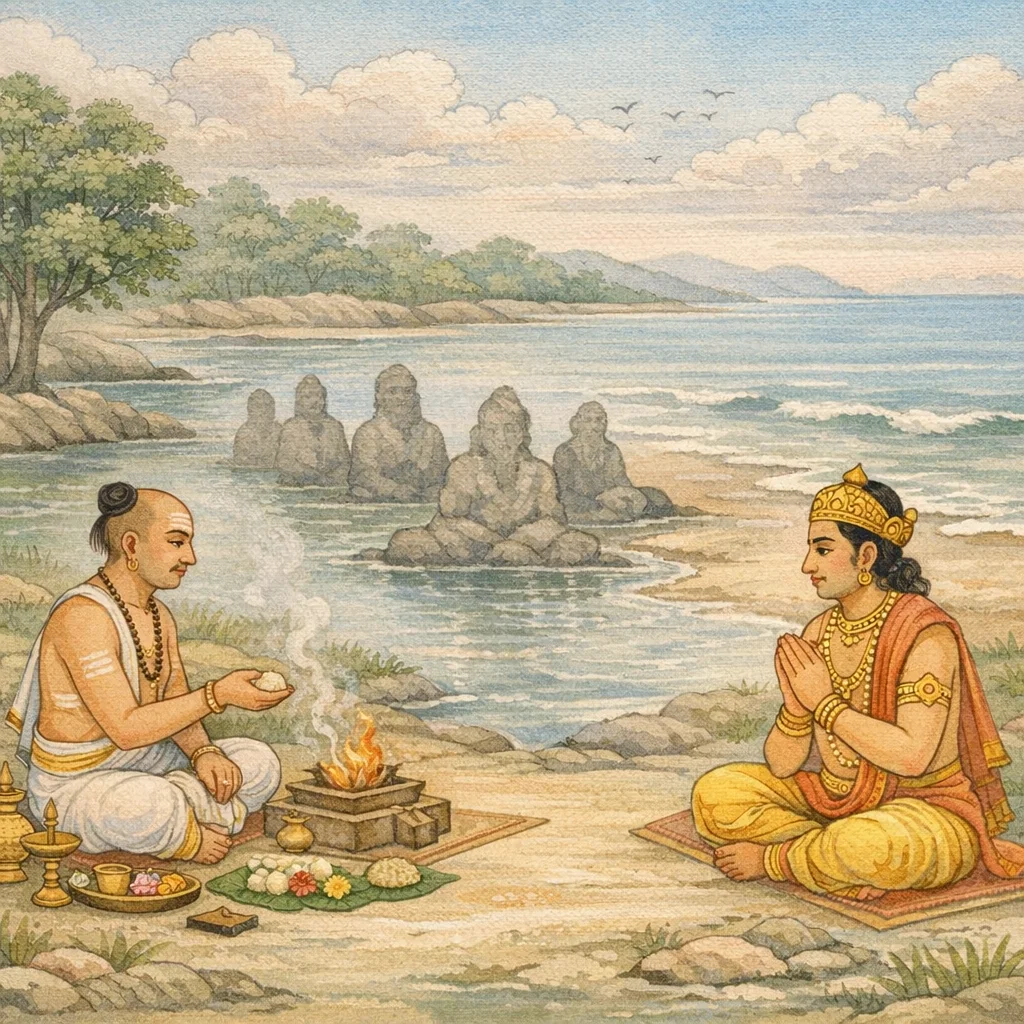
In a dialogue where Īśvara speaks to Devī, this chapter points to an eminent pilgrimage site called Ṛṣi-tīrtha, located on the seashore in a region connected with Devakula (devakulāgneiyyāṃ gavyūtyāṃ). It is praised as supremely beautiful and spiritually powerful. A striking feature is that sages (ṛṣi) abide there in stone-like forms (pāṣāṇākṛtayaḥ), still “seen” by human beings, and the text explicitly declares that this place destroys all sins. The chapter then lays down a calendrical and ritual observance: on the new-moon day (amāvāsyā) of the month Jyeṣṭha, devotees endowed with śraddhā should bathe and, above all, perform piṇḍa-dāna, offerings for the ancestors. At the confluence of the waters called Ṛṣitoya, bathing and the performance of śrāddha are described as rare and highly efficacious. The text further commends go-pradāna (the gift of a cow) and instructs that brāhmaṇas be fed according to one’s capacity, joining pilgrimage with charity and ritual hospitality.
Shlokas
Verse 1
ईश्वर उवाच । अथ देवकुलाग्नेय्यां गव्यूत्या तत्र संस्थितम् । समुद्रस्य तटे रम्यमृषितीर्थमनुत्तमम्
Īśvara said: “Next, in the south-eastern quarter of Devakula, at a distance of one gavyūti, lies the unsurpassed Ṛṣi-tīrtha—beautiful upon the ocean’s shore.”
Verse 2
पाषाणाकृतयस्तत्र ऋषयोऽद्यापि संस्थिताः । दृश्यंते मानुषे देवि सर्वपातकनाशनाः
There, O Goddess, the sages—formed as stone-images—still remain. They are seen in the human realm, and they destroy all great sins.
Verse 3
तत्र ज्येष्ठे त्वमावास्यां प्राप्यते नाधमैर्न्नरैः । पिंडदानं विशेषेण स्नानं श्रद्धासमन्वितैः
There, on the new-moon day of the month of Jyeṣṭha, the full fruit is not attained by base-minded men; it is attained by those endowed with faith—especially through the offering of piṇḍas and by sacred bathing.
Verse 4
ऋषितोयासंगमे तु स्नानं श्राद्धं सुदुर्लभम् । गोप्रदानं प्रशंसंति तत्र ते मुनिपुगवाः । भोजनं ब्राह्मणानां तु यथाशक्त्या प्रदापयेत्
At the confluence known as Ṛṣitoya-saṅgama, bathing and the performance of śrāddha are exceedingly rare in merit and opportunity. There, the foremost sages praise the gift of a cow; and one should also provide food to Brāhmaṇas according to one’s capacity.
Verse 314
इति श्रीस्कांदे महापुराण एकाशीतिसाहस्र्यां संहितायां सप्तमे प्रभासखण्डे प्रथमे प्रभासक्षेत्रमाहात्म्ये मूलचंडीशमाहात्म्य ऋषितीर्थसंगममाहात्म्यवर्णनंनाम चतुर्दशोत्तरत्रिशततमोऽध्यायः
Thus ends the three-hundred-and-fourteenth chapter, entitled “The Account of the Greatness of Mūlacaṇḍīśa and the Greatness of the Confluence at Ṛṣitīrtha,” in the first Prabhāsa-kṣetra-māhātmya of the Prabhāsa Khaṇḍa of the Śrī Skanda Mahāpurāṇa (in the eighty-one-thousand-verse Saṃhitā).