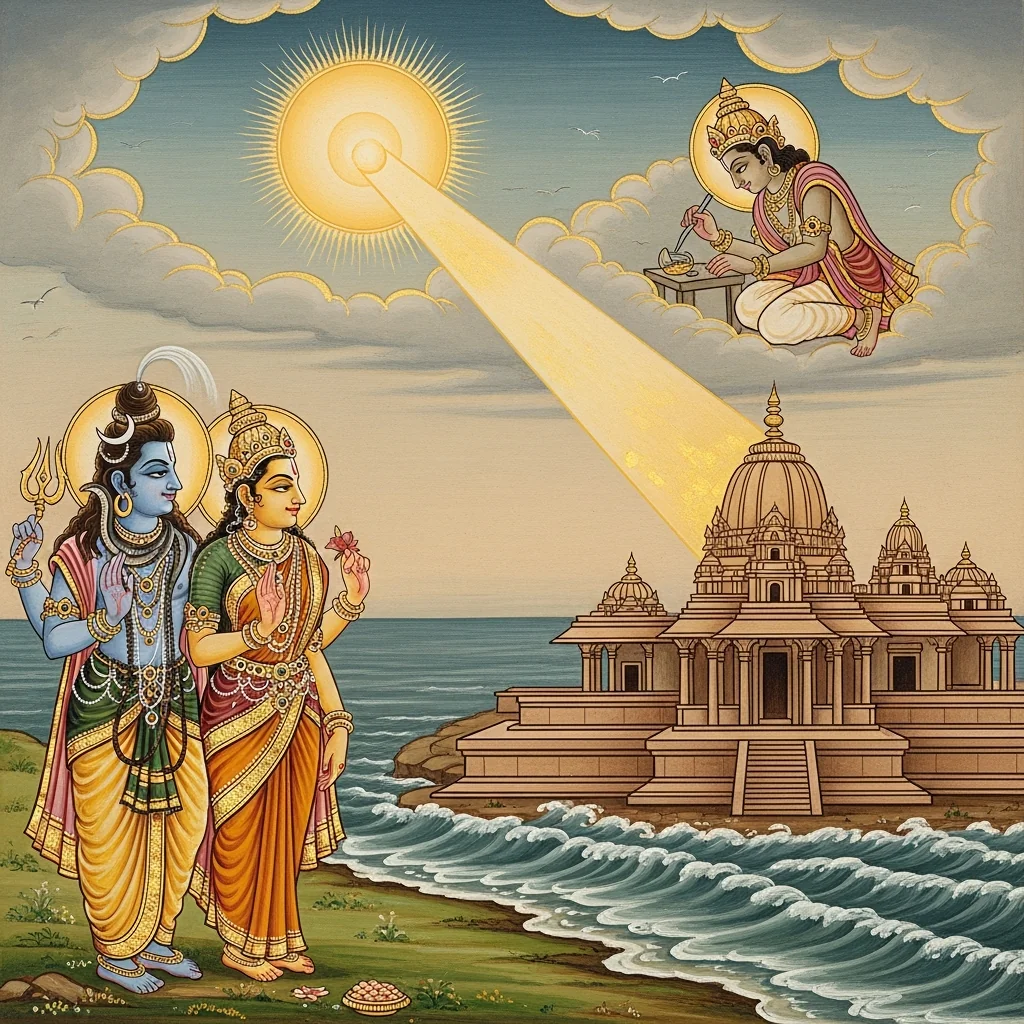
Adhyaya 11
Chapter 11 proceeds as a theological dialogue. Devī, pleased yet still inquisitive, asks for a fuller account of Prabhāsa-kṣetra. Īśvara first sets a cosmographic frame, describing Jambūdvīpa and Bhārata-varṣa with their measures and boundaries, and declaring Bhārata the chief karmabhūmi where puṇya and pāpa become concretely effective. He then overlays astral order upon the land through the kūrma (tortoise) model: nakṣatra groupings, rāśi placements, and graha lordships are mapped onto the “body” of Bhārata, yielding a diagnostic rule—when a graha or nakṣatra is afflicted, the corresponding region is afflicted, and tīrtha-observances are prescribed as remedy. Within this sacred mapping Saurāṣṭra is located, and Prabhāsa is singled out as an eminent ocean-near tract with a central pīṭhikā where Īśvara abides in liṅga-form, dearer than Kailāsa and guarded as a secret. The name “Prabhāsa” is explained in several ways—radiance, primacy among lights and tīrthas, solar presence, and regained brilliance. Devī then asks for the origin story in the present kalpa, and Īśvara begins the mythic causation: Sūrya’s marriages (Dyauḥ/Prabhā and Pṛthivī/Nikṣubhā), Saṃjñā’s distress at Sūrya’s unbearable tejas, the substitution by Chāyā, births including Yama and Yamunā, the disclosure to Sūrya, and Viśvakarmā’s “shaving/attenuation” of solar radiance. The account culminates in a decisive localization: a portion of solar, ṛk-maya radiance is said to fall at Prabhāsa, grounding the kṣetra’s exceptional sanctity and the logic of its name.
Shlokas
Verse 1
सूत उवाच । इति प्रोक्ता तदा देवि विस्मयोत्फुल्ललोचना । रोमांचकञ्चुका सुभ्रूः पुनः पप्रच्छ भूसुराः
Sūta said: When this had been spoken, the Goddess—her eyes wide with wonder, her body thrilled with horripilation, her brows beautiful—again questioned the divine sage.
Verse 2
देव्युवाच । धन्याऽहं कृतपुण्याऽहं तपः सुचरितं मया । यदेष क्षेत्र महिमा महादेवान्मया श्रुतः
The Goddess said: Blessed am I; meritorious am I—well-performed has been my austerity—since I have heard from Mahādeva the greatness of this sacred kṣetra.
Verse 3
भगवन्देवदेवेश संसारार्णवतारक । पृष्टं तु यन्मया पूर्वं तत्सर्वं कथितं हर
O Blessed Lord, God of gods, ferryman across the ocean of saṃsāra—whatever I asked earlier, all of that has been explained, O Hara.
Verse 4
पुनश्च देवदेवेश त्वद्वाक्यामृतरंजिता । न तृप्तिमधिगच्छामि देवदेव महेश्वर
And yet, O Lord of gods—delighted by the nectar of your words—I do not attain satiety, O God of gods, O Maheśvara.
Verse 5
किंचित्प्रष्टुमनाश्चास्मि प्रभासक्षेत्रविस्तरम् । तन्मे कथय कामेश दयां कृत्वा जगत्प्रभो
I wish to ask a little more about the full expanse of Prabhāsa-kṣetra. Tell me that, O Kāmeśa—showing compassion, O Lord of the world.
Verse 6
ईश्वर उवाच । पृथिव्या मध्यगर्भस्थं जंबूद्वीपमिति स्मृतम् । तच्च वै नवधा भिन्नं वर्षभेदेन सुन्दरि
Īśvara said: “Within the very middle of the earth lies what is known as Jambūdvīpa. O fair one, it is indeed divided into nine parts, distinguished as separate regions (varṣas).”
Verse 7
तस्याद्यं भारतं वर्षं तच्चापि नवधा स्मृतम् । नवयोजनसाहस्रं दक्षिणोत्तरमानतः
“Among those, the foremost is Bhārata-varṣa; that too is remembered as ninefold. Measured from south to north, it extends for nine thousand yojanas.”
Verse 8
अशीतिश्च सहस्राणि पूर्वपश्चायतं स्मृतम् । उत्तरे हिमवानस्ति क्षीरोदो दक्षिणे स्मृतः
“Its east–west extent is said to be eighty thousand yojanas. To its north stands Himavān, and to its south is remembered the Kṣīroda (ocean of milk).”
Verse 9
एतस्मिन्नंतरे देवि भारतं क्षेत्रमुत्तमम् । कृतं त्रेता द्वापरं च तिष्यं युगचतुष्टयम्
Within this expanse, O Goddess, Bhārata is the most excellent sacred field (kṣetra). Here are reckoned the four yugas—Kṛta, Tretā, Dvāpara, and Tiṣya (Kali).
Verse 10
अत्रैवैषा युगावस्था चतुर्वर्णश्च वै जनः । चत्वारि त्रीणि च द्वे च तथैवैक शरच्छतम्
Here indeed is this order of the yugas, and here too is mankind arranged in the four varṇas. The yugas endure by the measures of four, three, two, and likewise one hundred “autumn-centuries,” in due order.
Verse 11
जीवन्त्यत्र नरा देवि कृतत्रेतादिषु क्रमात् । यदेतत्पार्थिवं पद्मं चतुष्पत्रं मयोदितम्
Here, O Goddess, men live in due order through Kṛta, Tretā, and the other yugas. This earthly lotus that I have described is four-petalled.
Verse 12
वर्षाणि भारताद्यानि पत्राण्यस्य चतुर्द्दिशम् । भारतं केतुमालं च कुरु भद्राश्वमेव च
The regions beginning with Bhārata are its petals, extending in the four directions: Bhārata, Ketumāla, Kuru, and Bhadrāśva.
Verse 13
भारतं नाम यद्वर्षं दाक्षिणात्यं मयोदितम् । दक्षिणापरतो यस्य पूर्वेण च महोदधिः । हिमवानुत्तरेणास्य कार्मुकस्य यथा गुणः
That region called Bhārata, which I have described as southern, has the great ocean to its east and also to its south and west; and to its north is Himavān. Thus its form is like a bow.
Verse 14
तदेतद्भारतं वर्षं सर्वबीजं वरानने । तत्कर्मभूमिर्नान्यत्र संप्राप्तिः पुण्यपापयोः
Thus, O lovely-faced one, this Bhārata-varṣa is the seed-source of all spiritual fruits. It is the land of karma; nowhere else is there such attainment of merit and sin through action.
Verse 15
देवानामपि देवेशि सदैवैष मनोरथः । अपि मानुष्यमाप्स्यामो भारते प्रत्युत क्षितौ
Even for the gods, O Goddess, this is ever a cherished wish: “May we obtain human birth—indeed, upon the earth in Bhārata!”
Verse 16
भद्राश्वेऽश्वशिरा विष्णुर्भारते कूर्मसंस्थितः । वराहः केतुमाले च मत्स्यरूपस्तथोत्तरे
In Bhadrāśva Viṣṇu abides as Hayagrīva, the Horse-headed One; in Bhārata He is established as Kūrma, the Tortoise; in Ketumāla He is present as Varāha, the Boar; and in the northern region He appears as Matsya, the Fish.
Verse 17
तेषु नक्षत्रविन्यासाद्विषयाः समवस्थिताः । चतुर्ष्वपि महादेवि विग्रहो नव पादकः
Within those regions, the domains are arranged according to the disposition of the nakṣatras, the lunar mansions. O Great Goddess, in all four directions the manifested form is nine-footed, divided into nine parts or steps.
Verse 18
भारतो यो महादेवि कूर्मरूपेण संस्थितः । नक्षत्रग्रहविन्यासं तस्य ते कथयाम्यहम्
O Great Goddess, regarding Bhārata—established in the form of Kūrma, the Tortoise—I shall now describe to you its arrangement of nakṣatras and planets (grahas).
Verse 19
प्राङ्मुखो भगवान्देवो कूर्मरूपी व्यवस्थितः । आक्रम्य भारतं वर्षं नवभेदमिदं प्रिये
Facing east, the Blessed Lord stands established in the form of Kūrma, the Tortoise, encompassing Bhārata-varṣa—this beloved land divided into nine parts, O dear one.
Verse 20
नवधा संस्थितस्यास्य नक्षत्राणि निबोध मे । कृत्तिका रोहिणी सौम्यं तृतीयं कूर्मपृष्ठिगम्
Learn from me the nakṣatras of this (Bhārata) set in nine divisions. Kṛttikā, Rohiṇī, and Saumya (Mṛgaśīrṣa)—these three are said to rest upon the Tortoise’s back.
Verse 21
रौद्रं पुनर्वसुः पुष्यं नक्षत्रत्रितयं मुखे । आश्लेषाख्यं तथा पैत्रं फाल्गुनी प्रथमा प्रिये
Raudra (Ārdrā), Punarvasu, and Puṣya—this triad of nakṣatras is at the Tortoise’s face. Then come Āśleṣā, Paitra (Maghā), and the first Phālgunī (Pūrva-Phālgunī), O dear one.
Verse 22
नक्षत्रत्रितयं पादमाश्रितं पूर्वदक्षिणम् । फाल्गुनी चोत्तरा हस्तं चित्रा चर्क्षत्रयं स्मृतम्
A triad of nakṣatras rests upon the foot in the south-east. There, Phālgunī (Uttara-Phālgunī), Hasta, and Citrā are remembered as a set of three.
Verse 23
कूर्मस्य दक्षिणे कुक्षौ चर्क्षपादं तथाऽपरम् । स्वाती विशाखा मैत्रं च नैरृते त्रितयं स्मृतम्
On the Tortoise’s southern side—at the belly—there is another portion of the nakṣatra arrangement. In the south-west, the triad Svātī, Viśākhā, and Maitra (Anurādhā) is remembered.
Verse 24
ऐंद्रं मूलं तथाषाढा पृष्ठे तु त्रितयं स्मृतम् । आषाढा श्रवणं चैव धनिष्ठा चात्र शब्दिता
On the back, the triad is remembered as Aiṃdra (Jyeṣṭhā), Mūla, and Āṣāḍhā. Here, Āṣāḍhā, Śravaṇa, and Dhaniṣṭhā are also spoken of as the relevant grouping.
Verse 25
नक्षत्रितयं पादे वायव्ये तु यशस्विनि । वारुणं चैव नक्षत्रं तथा प्रोष्ठपदाद्वयम्
On the foot in the north-west, O illustrious one, there is a triad of nakṣatras: the Vāruṇa nakṣatra (Śatabhiṣaj) and the pair of Proṣṭhapadā (Pūrva- and Uttara-Proṣṭhapadā).
Verse 26
कूर्मस्य वामकुक्षौ तु त्रितयं संस्थितं प्रिये । रेवती चाश्विदैवत्यं याम्यं चर्क्षमिति त्रयम् । ईशपादे समाख्यातं शुभाशुभफलं शृणु
Beloved, on the tortoise’s left flank a triad is set—Revatī, the asterism whose deity is the Aśvins, and the southern asterism: these three. They are declared to belong to the Lord’s quarter; now listen to the auspicious and inauspicious results connected with them.
Verse 27
यस्यर्क्षस्य पतिर्यो वै ग्रहस्तद्धैन्यतो भयम् । तद्देशस्य महादेवि तथोत्कर्षे शुभागमः
O Great Goddess, whichever planet is the lord of a given asterism—if that planet is afflicted, fear born of misfortune arises for that region; but when it grows strong, auspicious outcomes come to that land.
Verse 28
एष कूर्मो मयाख्यातो भारते भगवानिह । नारायणो ह्यचिंत्यात्मा यत्र सर्वं प्रतिष्ठितम्
Thus have I described this divine Tortoise here in Bhārata. He is Nārāyaṇa, of inconceivable nature, upon whom all this is established.
Verse 29
मेषवृषौ हृदो मध्ये मुखे च मिथुनादिकौ । प्राग्दक्षिणे तथा पादे कर्कसिंहौ व्यवस्थितौ
Aries and Taurus are set in the heart’s very midst; Gemini and the sign that follows are placed at the mouth. Likewise, upon the foot toward the southeast, Cancer and Leo are stationed.
Verse 30
सिंहकन्यातुलाश्चैव कुक्षौ राशित्रयं स्मृतम् । धटोऽध वृश्चिकाश्चोभौ पादे दक्षिणपश्चिमे
Leo, Virgo, and Libra—this triad of zodiacal signs is declared to abide upon the flank. Below, upon the foot toward the southwest, Aquarius and Scorpio are both set.
Verse 31
पुच्छे तु वृश्चिकश्चैव सधनुश्च व्यवस्थितः । वायव्ये वामपादे च धनुर्ग्राहादिकं त्रयम्
At the tail, Scorpio is established, and Sagittarius as well. In the northwest, upon the left foot, the triad beginning with Sagittarius and Capricorn is arrayed.
Verse 32
कुम्भ मीनौ तथा चास्य उत्तरां कुक्षिमाश्रितौ । मीनमेषौ महादेवि पादे पूर्वोत्तरे स्थितौ
Aquarius and Pisces likewise abide upon its northern flank. O Great Goddess, Pisces and Aries are stationed upon the foot toward the northeast.
Verse 33
कूर्म्मदेशांस्तथर्क्षाणि देशेष्वेतेषु वै प्रिये । राशयश्च तथर्क्षेषु ग्रहा राशिव्यवस्थिताः
Beloved, thus the regions of Kūrma (the Tortoise) and the asterisms are assigned to these lands. Likewise, the zodiacal signs are set within the asterisms, and the planets are arranged in accordance with the signs.
Verse 34
तस्माद्ग्रहर्क्षपीडासु देशपीडां विनिर्दिशेत् । तत्र स्नानं प्रकुर्वंति दानं होमादिकं तथा
Therefore, when the planets and asterisms are afflicted, one should infer affliction for the corresponding region. There people perform sacred bathing, give dāna (charity), and offer homa (oblations into fire) and the like.
Verse 35
स एष वैष्णवः पादो देवि मध्ये ग्रहोऽस्य यः । नारायणाख्योऽचिंत्यात्मा कारणं जगतः प्रभुः
O Goddess, this is the Vaiṣṇava quarter; the planet set at its center is He who is called Nārāyaṇa—of inconceivable essence—the Lord, the cause of the whole world.
Verse 36
भौमशुक्रबुधेंद्वर्कबुधशुक्रमहीसुताः । गुरुमंदासुराचार्या मेषादीनामधीश्वराः
Mars, Venus, Mercury, the Moon, the Sun, Mercury, Venus, and Mars; and also Jupiter, Saturn, and the preceptor of the Asuras—these are declared the presiding lords of Aries and the other zodiacal signs.
Verse 37
एवंविधो महादेवि कूर्मरूपी जनार्द्दनः । तस्य नैऋतपादे तु सौराष्ट्र इति विश्रुतः
Thus, O Great Goddess, Janārdana is described in the form of a tortoise. On his south‑western foot lies the region renowned as Saurāṣṭra.
Verse 38
स चैवं नवधा भिन्नः पुरभेदेन सुंदरि । तस्य यो नवमो भागः सागरस्य च सन्निधौ
And, O fair one, that sacred expanse is thus divided ninefold according to the distinctions of its cities and settlements. Of these, the ninth portion lies in the very proximity of the ocean.
Verse 39
प्रभास इति विख्यातो मम देवि प्रियः सदा । योजनानां दशद्वे च विस्तीर्णः परिमण्डलम्
O Goddess, it is famed as “Prabhāsa” and is ever dear to me. Its circular expanse extends for twelve yojanas.
Verse 40
मध्येस्य पीठिका प्रोक्ता पंचयोजनविस्तृता । तन्मध्ये मद्ग्रहं देवि तिष्ठत्युदधिसंनिधौ
In its center, a pīṭhikā (central seat, altar‑zone) is spoken of, extending five yojanas. Within that, O Goddess, my own sacred abode stands near the sea.
Verse 41
तस्य मध्ये महादेवि लिंगरूपो वसाम्यहम्
In its very center, O Great Goddess, I dwell in the form of a Liṅga.
Verse 42
कृतस्मरात्पश्चिमतो धनुषां च शतत्रये । वसामि तत्र देवेशि त्वया सह वरानने
To the west of Kṛtasmarā, at a distance of three hundred bows, I dwell there, O Lady of the gods, together with you, O fair‑faced one.
Verse 43
तन्मे स्थानं महादेवि कैलासादपि वल्लभम् । गोचर्ममात्रं तत्रापि महागोप्यं वरानने
That place of mine, O Great Goddess, is dearer to me even than Kailāsa. Though it is only the measure of a cowhide, it is exceedingly secret, O fair‑faced one.
Verse 44
अकथ्यं देवदेवेशि तव स्नेहात्प्रकाशितम् । एतत्प्राभासिकं क्षेत्रं प्रभया दीपितं मम
O Goddess, Lady of the Lord of gods, this is beyond utterance; yet out of love for you it has been revealed. This Prābhāsika sacred field is illumined by my radiance.
Verse 45
तेन प्रभासमित्युक्तमादिकल्पे वरानने । द्वितीये तु प्रभा लब्धा सर्वैर्देवैः सवासवैः
Therefore, in the primordial age, O fair-faced one, it was called “Prabhāsa.” In the second age, all the gods, together with Indra (the Vāsavas), obtained radiance.
Verse 46
मम प्रभाभा देवेशि तेन प्राभासिकं स्मृतम् । प्रभाववन्तो देवेशि यत्र संति महासुराः
“O Goddess, because this is the radiance of my own splendor, it is remembered as Prābhāsika. And, O Lady of the gods, it is a place where mighty, power-filled great asuras are found.”
Verse 47
अथवा तेन लोकेषु प्रभासमिति कीर्त्यते । प्रथमं भासते देवि सर्वेषां भुवि तेजसाम् । तीर्थानामादितीर्थं यत्प्रभासं तेन कीर्त्तितम्
“Or else, for that very reason it is celebrated in the worlds as ‘Prabhāsa’. O Devī, it shines first among all luminaries upon the earth. Since it is the primordial tīrtha among tīrthas, it is therefore proclaimed as Prabhāsa.”
Verse 48
प्रकृष्टं भानुरथवा भासितो विश्वकर्मणा । यत्र साक्षात्प्रभापातो जातः प्राभासिकं ततः
“Or, because the Sun there shines with surpassing excellence—as though illumined by Viśvakarman—and because there occurred a direct ‘descent of radiance’ (prabhāpāta), it is therefore called Prābhāsika.”
Verse 49
अथवा दक्षसंशप्तेनेन्दुना निष्प्रभेणच । तत्र देवि प्रभा लब्धा तेन प्राभासिकं स्मृतम् । प्रोद्दधे भारती देवी ह्यौर्वाग्निं वडवानलम्
Or again: when the Moon, cursed by Dakṣa, was bereft of radiance, O Devī, it regained its splendor there; therefore it is remembered as Prābhāsika. There too Bhāratī Devī brought forth the Aurva-fire, the submarine blaze (Vaḍavānala).
Verse 50
अथवा तेन देवेशि प्रभासमिति कीर्त्यते । प्रकृष्टा भारती ब्राह्मी विप्रोक्ता श्रूयतेऽध्वनि । सदा यत्र महादेवि प्रभासं तेन कीर्तितम्
Or for that reason as well, O Goddess, it is praised as “Prabhāsa”: there the exalted Bhāratī—Brahmā’s power, the sacred speech (Brahmī Vāc)—spoken by sages is heard along the path. Since that radiance is ever-present there, O Great Goddess, it is therefore proclaimed as Prabhāsa.
Verse 51
प्रोल्लसद्वीचिभिर्भाति सर्वदा सागरः प्रिये । तेन प्रभास नामेति त्रिषु लोकेषु विश्रुतम्
Beloved, the ocean there ever shines with its surging waves; therefore the name “Prabhāsa” is renowned throughout the three worlds.
Verse 52
प्रत्यक्षं भास्करो यत्र सदा तिष्ठति भामिनि । तेन प्रभास नामेति प्रसिद्धिमगमत्क्षितौ
O radiant one, where the Sun is as it were directly present and ever abides—therefore the name “Prabhāsa” attained fame upon the earth.
Verse 53
प्रकृष्टं भाविनां सर्वं कामं तत्र ददाम्यहम् । तेन प्रभासनामेति तीर्थं त्रैलोक्यविश्रुतम्
There I grant all excellent desires to those who approach with faith; therefore that tīrtha, known as Prabhāsa, is renowned throughout the three worlds.
Verse 54
कल्पभेदेन नामानि तथैव सुरसुन्दरि । निरुक्तभेदैर्बहुधा भिद्यंते कारणैः प्रिये । प्रभासमिति यन्नाम दातव्यं निश्चलं स्मृतम्
O celestial beauty, by differences of kalpas the names too vary; and, beloved, through differing derivations (niruktas) they are divided in many ways for various reasons. Yet the name that should steadfastly be given is “Prabhāsa”—this is held to be unchanging.
Verse 55
अप्तत्त्वे संस्थितं देवि विष्णोराद्यकलेवरे । इति ते कथितं देवि संक्षेपात्क्षेत्रकारणम्
O Devī, it is established in the principle of the Waters (ap-tattva), in Viṣṇu’s primordial form. Thus, O Devī, I have briefly told you the cause of this sacred kṣetra.
Verse 56
पुनस्ते कथयाम्यद्य यत्पृच्छसि वरानने । तद्ब्रूहि शीघ्रं कल्याणि यत्ते मनसि वर्तते
Again, today I shall relate to you what you ask, O fair-faced one. Speak quickly, auspicious lady—tell me what is upon your mind.
Verse 57
देव्युवाच । अस्मिन्कल्पे यथा जातं क्षेत्रं प्राभासिकं हर । तन्मे विस्तरतो ब्रूहि उत्पत्तिं कारणं तथा
The Goddess said: In this present aeon, O Hara, how did the sacred Prābhāsika Kṣetra come into being? Tell me in detail its origin and its cause as well.
Verse 58
ईश्वर उवाच । शृणु देवि प्रवक्ष्यामि यथावत्क्षेत्रकारणम् । यच्छ्रुत्वा मानवो भक्त्या मुच्यते सर्वपातकैः
Īśvara said: Listen, O Goddess; I shall explain properly the cause of this sacred region—hearing which, a person, through devotion, is freed from all sins.
Verse 59
आदिक्षेत्रस्य माहात्म्यं रहस्यं पापनाशनम् । कथयिष्ये वरारोहे तव स्नेहेन भामिनि
O noble lady, moved by affection for you, I shall tell the greatness of the primordial sacred region—its secret that destroys sins.
Verse 60
अस्मिन्कल्पे तु यद्देवि आदावेव वरानने । स्वायंभुवे मनौ तत्र ब्रह्मणः सृजतः पुरा
In this very aeon, O Goddess, O fair-faced one, at the very beginning—during the time of Svāyambhuva Manu—when Brahmā was creating of old…
Verse 61
दक्षिणाल्लोचनाज्जातः पूर्वं सूर्य इति प्रिये । ततः कालान्तरे तस्य भार्ये द्वे च बभूवतुः
O beloved, from the right eye (of Brahmā) the Sun first arose. In the course of time, he came to have two wives as well.
Verse 62
तयोस्तु राज्ञी द्यौर्ज्ञेया निक्षुभा पृथिवी स्मृता । सौम्यमासस्य सप्तम्यां द्यौः सूर्येण च युज्यते
Of those two, know Dyauḥ to be the queen; Nikṣubhā is remembered as the Earth. On the seventh day of the lunar month, Dyauḥ is joined with the Sun.
Verse 63
माघमासे तु सप्तम्यां मह्या सह भवेद्रविः । भूश्चादित्यश्च भगवान्गच्छते संगमं तदा
But on the seventh day in the month of Māgha, Ravi (the Sun) is united with the Earth. Then the Lord Āditya, together with Bhū, goes to the place of confluence.
Verse 64
ऋतुस्नाता मही तत्र गर्भं गृह्णाति भास्करात् । द्यौर्जलं सूयते गर्भं वर्षास्वास्विह भूतले
There, the Earth—bathed and purified by the seasons—receives from Bhāskara (the Sun) the seed of the womb. And Dyauḥ gives birth to that watery embryo as rains, again and again, upon this earth.
Verse 65
ततस्त्रैलोक्यवृत्त्यर्थं मही सस्यानि सूयते । सस्योपयोगात्संहृष्टा जुह्वत्याहुतिभिर्द्विजाः
Then, for the sustenance of the three worlds, the Earth brings forth grains and crops. Delighted by the use of that produce, the twice-born (dvija) offer oblations in sacrifice.
Verse 66
स्वाहाकारस्वधाकारैर्यजंति पितृदेवताः । निःक्षुधः कुरुते यस्माद्गर्भौषधिसुधाऽमृतैः
The Pitṛ-deities are worshipped with the sacred utterances ‘svāhā’ and ‘svadhā’. And because she frees beings from hunger by the herbs of her womb, by nectar, and by amṛta-like sustenance, she is revered as the remover of famine and want.
Verse 67
मर्त्यान्पितॄंश्च देवांश्च तेन भूर्निक्षुभा स्मृता । यथा राज्ञी च संजाता यस्य चेयं सुता मता
Since she sustains mortals, the Pitṛs, and even the gods, the Earth is remembered as ‘Nikṣubhā’—the one who wards off hunger. And she is regarded as the daughter of that source from which she arose, as a queen is born into royal lineage.
Verse 68
अपत्यानि च यान्यस्यास्तानि वक्ष्याम्यशेषतः । मरीचिर्ब्रह्मणः पुत्रो मारीचः कश्यपः स्मृतः
Now I shall declare, without omission, the progeny that belong to her. Marīci is the son of Brahmā, and Kaśyapa—born in Marīci’s line—is remembered as ‘Mārīca’.
Verse 69
तस्माद्धिरण्यकशिपुः प्रह्रादस्तस्य चात्मजः । प्रह्रादस्य सुतो नाम्ना विरोचन इति स्मृतः
From him arose Hiraṇyakaśipu, and his son was Prahrāda. Prahrāda’s son is remembered by name as Virocana.
Verse 70
विरोचनस्य भगिनी संज्ञा या जननी तु सा । हिरण्यकशिपोः पौत्री दितेः पुत्रस्य सा स्मृता
She who is known as Saṃjñā became (his) mother; and she is remembered as the sister of Virocana, the granddaughter of Hiraṇyakaśipu, born in the line of Diti’s son.
Verse 71
सा विश्वकर्मणः पत्नी प्राह्लादी प्रोच्यते बुधैः
She is the wife of Viśvakarman, and the wise declare her to be Prāhlādī.
Verse 72
अथ नाम्नातिरूपेति मरीचिदुहिता शुभा । पत्नी ह्यंगिरसः सा तु जननी च बृहस्पतेः
Next, the auspicious daughter of Marīci, named Atirūpā, became the wife of Aṅgiras; and she is also the mother of Bṛhaspati.
Verse 73
बृहस्पतेस्तु भगिनी विश्रुता ब्रह्मवादिनी । प्रभासस्य तु सा पत्नी वसूनामष्टमस्य वै
Bṛhaspati’s sister—renowned as a knower and speaker of brahman—became the wife of Prabhāsa, the eighth of the Vasus.
Verse 74
प्रसूता विश्वकर्माणं सर्वशिल्पवतां वरम् । स चैव नाम्ना त्वष्टा तु पुनस्त्रिदशवार्द्धकिः
She gave birth to Viśvakarman, the foremost among all masters of craft. He is also called Tvaṣṭṛ, and again revered as the divine architect of the gods.
Verse 75
देवाचार्यस्य तस्येयं दुहिता विश्वकर्मणः । सुरेणुरिति विख्याता त्रिषु लोकेषु भामिनी
This radiant lady is the daughter of that divine preceptor, Viśvakarman. She is famed as Sureṇu, shining and renowned throughout the three worlds.
Verse 76
प्रह्रादपुत्री या प्रोक्ता भार्या वष्टुस्तु सा स्मृता । तस्यां स जनयामास पुत्रीस्ता लोकमातरः
She who is spoken of as Prahlāda’s daughter is remembered as the wife of Tvaṣṭṛ. Through her he begot daughters, revered as the Mothers of the worlds.
Verse 77
राज्ञी संज्ञा च द्यौस्त्वष्ट्री प्रभा सैव विभाव्यते । तस्यास्तु वलया छाया निक्षुभा सा महीयसी
That queen is Saṃjñā, also known as Dyauḥ, Tvaṣṭrī, and Prabhā. From her, as manifestations, arose Valayā and Chāyā, and the great Nikṣubhā as well.
Verse 78
सा तु भार्या भगवती मार्तंडस्य महात्मनः । साध्वी पतिव्रता देवी रूपयौवनशालिनी
She is indeed the blessed wife of the great-souled Mārtaṇḍa (Sūrya): a virtuous goddess, steadfast in wifely fidelity, radiant with beauty and youth.
Verse 79
न तु तां नररूपेण भार्यां भजति वै पुरा । आदित्यस्येह तप्तत्वं महता स्वेन तेजसा
But formerly he did not consort with his wife in a human form; for here the Āditya, the Sun, was scorching by the greatness of his own radiance.
Verse 80
गात्रेष्वप्रतिरूपेषु मासिकांतमिवाभवत् । संज्ञा च रविणा दृष्टा निमीलयति लोचने । यतस्ततः सरोषोऽर्कः संज्ञां वचनमब्रवीत्
Her limbs became as though deformed, like one afflicted at the end of the month. And when Ravi saw Saṃjñā, she would close her eyes. Seeing this again and again, the Sun, angered, spoke words to Saṃjñā.
Verse 81
रविरुवाच । मयि दृष्टे सदा यस्मात्कुरुषे नेत्रसंक्षयम् । तस्माज्जनिष्यसे मूढे प्रजासंयमनं यमम्
Ravi said: “Because, whenever you look upon me, you continually injure your eyes—therefore, O deluded one, you shall give birth to Yama, the restrainer of creatures.”
Verse 82
ईश्वर उवाच । ततः सा चपला दृष्टिं देवी चक्रे भयाकुला । विलोलितदृशं दृष्ट्वा पुनराह च तां रविः
Īśvara said: Then the goddess, frightened, made her gaze unsteady. Seeing her eyes wavering, Ravi addressed her once again.
Verse 83
रविरुवाच । यस्माद्विलोलिता दृष्टिर्मयि दृष्टे त्वया पुनः । तस्माद्विलोलां तनयां नदीं त्वं प्रसविष्यसि
Ravi said: “Because your gaze wavered again when looking at me, therefore you shall give birth to a wavering daughter—a river named Vilolā.”
Verse 84
ईश्वर उवाच । ततस्तस्यास्तु संजज्ञे भर्तृशापेन तेन वै । यमश्च यमुना चेयं प्रख्याता सुमहानदी । तृतीयं च सुतं जज्ञे श्राद्धदेवं मनुं शुभम्
Īśvara said: Then indeed, by that curse of her husband, she gave birth to Yama and to this Yamunā, famed as a mighty river. And as the third son she bore the auspicious Manu, the deity presiding over the śrāddha rites.
Verse 85
सापि संज्ञा रवेस्तेजो गोलाकारं महाप्रभम् । असहन्ती च सा चित्ते चिन्तयामास वै तदा
And Saṃjñā too—unable to endure the Sun’s mighty, globe-like radiance—then pondered within her heart what could be done.
Verse 86
किं करोमि क्व यास्यामि क्व गतायाश्च निर्वृतिः । भवेन्मम कथं भर्ता कोपमर्क्कश्च नेष्यति
“What shall I do? Where shall I go? And if I depart, where will there be peace for me? How will my husband be reconciled—and how will Arka (the Sun), in anger, not pursue me?”
Verse 87
इति संचिन्त्य बहुधा प्रजापतिसुता तदा । बहु मेने महाभागा पितृसंश्रयमेव च
Thus thinking in many ways, the blessed daughter of Prajāpati considered deeply and resolved to take refuge with her father.
Verse 88
ततः पितृगृहं गन्तुं कृतबुद्धिर्यशस्विनी । छायामयीमात्मतनुं प्रत्यंगमिव निर्मिताम्
Then the illustrious lady, having resolved to go to her father’s house, fashioned from herself a shadow-formed body—like a counterpart, limb by limb.
Verse 89
सम्मुखं प्रेक्ष्य तां देवीं स्वां छायां वाक्यमब्रवीत्
Gazing at her face to face, the Goddess addressed her own shadow with these words.
Verse 90
संज्ञोवाच । अहं यास्यामि भद्रं ते स्वकं च भवनं पितुः । निर्विकारं त्वया त्वत्र स्थेयं मच्छासनाच्छुभे
Saṃjñā said: “I shall go—may good befall you—to my father’s own house. You, auspicious one, must remain here without alteration, abiding by my command.”
Verse 91
इमौ च बालकौ मह्यं कन्या च वरवर्णिनी । संभाव्या नैव चाख्येयमिदं भगवते त्वया
“These two boys, and this maiden of excellent complexion, must be cared for as my own. And you must not reveal this matter to the Blessed Lord (Sūrya).”
Verse 92
पृष्टयापि न वाच्यं ते तथैतद्गमनं मम । तेनास्मि नामसंज्ञेति वाच्यसे तत्प्रतिष्ठया
“Even if questioned, you must not speak of this—nor of my departure. Therefore, by the establishment of that arrangement, you shall be called ‘Saṃjñā’ by name.”
Verse 93
छायोवाच । आ केशग्रहणाद्देवि आ शापान्नैव कर्हिचित् । आख्यास्यामि मतं तुभ्यं गम्यतां यत्र वांछितम्
Chāyā said: “O goddess, from the moment of hair-seizing, even up to the point of a curse, I will never disclose it. I shall follow your intention—go where you desire.”
Verse 94
ईश्वर उवाच । इत्युक्ता सा तदा देवी जगाम भवनं पितुः । ददर्श तत्र त्वष्टारं तपसा धूतकल्मषम्
Īśvara said: Thus addressed, the Goddess then went to her father’s dwelling. There she beheld Tvaṣṭṛ, whose impurities had been washed away by austerity.
Verse 95
बहुमानाच्च तेनापि पूजिता विश्वकर्मणा । वर्षाणां च सहस्रं तु वसमाना पितुर्गृहे । तस्थौ पितृगृहे सा तु किंचित्कालमनिंदिता
Honored with great regard, she was reverently received by him—Viśvakarman. Dwelling in her father’s house for a thousand years, the blameless Goddess remained there for some time.
Verse 96
ततस्तां प्राह चार्वंगीं पिता नातिचिरोषिताम् । स्तुत्वा तु तनयां प्रेम्णा बहुमानपुरःसरम्
Then her father addressed his fair-limbed daughter, who had not stayed long. After praising his child with affection—preceded by honor and esteem—he spoke to her.
Verse 97
विश्वकर्मोवाच । त्वामेव पश्यतो वत्से दिनानि सुबहून्यपि । मुहूर्तार्द्धसमानि स्युः किं तु धर्मो विलुप्यते
Viśvakarmā said: “O dear child, even many days pass while I merely look upon you, and they feel like only half a muhūrta. Yet dharma is being eroded.”
Verse 98
बांधवेषु चिरं वासो नारीणां न यशस्करः । मनोरथा बांधवानां नार्या भर्तृगृहे स्थितिः
A woman’s prolonged stay among her natal kin is not considered fame-bringing. The cherished wish of her relatives is that she remain firmly established in her husband’s home.
Verse 99
सा त्वं त्रैलोक्यनाथेन भर्त्रा सूर्येण संयुता । पितुर्गृहे चिरं कालं वस्तुं नार्हसि पुत्रिके
You are united with Sūrya, the lord of the three worlds, as your husband. Therefore, dear daughter, you should not dwell long in your father’s house.
Verse 100
तत्त्वं भर्तृगृहं गच्छ दृष्टोऽहं पूजितासि मे । पुनरागमनं कार्यं दर्शनाय शुचिस्मिते
Therefore go to your husband’s home. I have seen you, and you have honored me. Yet, O pure-smiling one, return again, so that I may receive your darśana.
Verse 101
ईश्वर उवाच । इत्युक्ता सा तदा पित्रा गच्छगच्छेति सा पुनः । संपूजयित्वा पितरं वडवारूपधारिणी
Īśvara said: Thus addressed by her father—“Go, go!”—she, who had assumed the form of a mare, again duly honored him.
Verse 102
मेरोरुत्तरतस्तत्र वर्षं यद्धनुषाकृति । उत्तराः कुरवो लोके प्रख्याता ये यशस्विनि
To the north of Meru lies that varṣa, shaped like a bow; there dwell the Uttara Kurus, famed in the world, O illustrious goddess.
Verse 103
तत्र तेपे तपः साध्वी निराहाराऽश्वरूपिणी । एतस्मिन्नंतरे देवि तस्याश्छाया विवस्वतः
There the virtuous lady, taking the form of a mare, practiced austerity without food. Meanwhile, O goddess, her shadow (Chāyā) remained with Vivasvān (Sūrya).
Verse 104
समीपस्था तदा देवी संज्ञाया वाक्यतत्परा । तस्यां च भगवान्सूर्यो द्वितीयायां दिवस्पतिः
Then the goddess Chāyā remained close by, intent upon Saṃjñā’s words. And in her—the second one—the blessed Sūrya, lord of the day, continued his life as husband.
Verse 105
संज्ञेयमिति मन्वानो रूपौदार्येण मोहितः । तस्यां च जनयामास द्वौ पुत्रौ कन्यकां तथा
Thinking, “She is Saṃjñā,” and deluded by the splendor of her beauty, Sūrya begot in her two sons and also a daughter.
Verse 106
पूर्वं यस्तु मनोस्तुल्यः सावर्णिस्तेन सोऽभवत् । यः सूर्यात्प्रथमं जातः पुत्रयोः सुरसुन्दरि
O celestial maiden, the one who was formerly equal to Manu became known as Sāvarṇi. And of the two sons, he who was first born from the Sun was thus spoken of.
Verse 107
द्वितीयो योऽभवच्चान्यः स ग्रहोऽभूच्छनैश्चरः । कन्या ऽभूत्तपती या तां वव्रे संवरणो नृपः
The other, born as the second, became the planetary deity Śanaiścara (Saturn). And the daughter who was born—Tapati—was chosen in marriage by King Saṃvaraṇa.
Verse 108
तापीनाम नदी चेयं विंध्यमूलाद्विनिःसृता । नित्यं पुण्यजला स्नाने पश्चिमोदधिगामिनी
This river is named Tāpī. She springs forth from the root of the Vindhya mountains; her waters are ever holy for bathing, and she flows to the western ocean.
Verse 109
अन्या चैव तथा भद्रा जाता पुत्री महाप्रभा । संज्ञा तु पार्थिवी छाया आत्मजानां यथाकरोत्
And another daughter, Bhadrā, was born, radiant with great splendor. Yet Saṃjñā’s earthly shadow, Chāyā, treated the children as she deemed fit.
Verse 110
स्नेहं न पूर्वजातानां तथा कृतवती सती । लालनाद्युपभोगेषु विशेषमनुवासरम्
That noble lady showed no such affection to the earlier-born children; day after day she drew distinctions in care and comforts—fondling, indulgence, and the like.
Verse 111
यथा स्वेष्वनुवर्तेत न तथान्येषु भामिनी । मनुस्तु क्षांतवांस्तस्या भविष्यो यो हि पार्वति
O passionate lady, she tended to her own children as she wished, but not so to the others. Yet Manu—who was to become the Manu of the future—endured her conduct, O Pārvatī.
Verse 112
मेरौ तिष्ठति सोऽद्यापि तपः कुर्वन्वरानने । सर्वं तत्क्षांतवान्मातुर्यमस्तस्या न चक्षमे
O fair-faced one, even today he remains on Mount Meru, performing austerities. He endured all that from his mother; but Yama could not bear it.
Verse 113
बहुशो याचमानस्तु छाययाऽतीव कोपितः । स वै कोपाच्च बाल्याच्च भाविनोऽर्थस्य वै बलात्
Though he pleaded many times, he was greatly enraged at Chāyā. Indeed, through anger and youthful impulse—and by the force of what was destined to occur—he was driven onward.
Verse 114
ताडनाय ततः कोपात्पादस्तेन समुद्यतः । तथा पुनः क्षांतिमता न तु देहे निपातितः
Then, in anger, he raised his foot to strike; yet again, restrained by patience, he did not bring it down upon her body.
Verse 115
पदा संतर्जयामास छायां संज्ञासुतो यमः
Yama, the son of Saṃjñā, threatened Chāyā with his foot.
Verse 116
तं शशाप ततश्छाया क्रुद्धा सा पार्थिवी भृशम् । किंचित्प्रस्फुरमाणोष्ठी विचलत्पाणिपल्लवा
Then Chāyā, that queen upon the earth, fiercely enraged, cursed him—her lips quivering slightly and her tender hands trembling.
Verse 117
छायोवाच । पितुः पत्नीममर्याद यन्मां तर्जयसे पदा । भुवि तस्मादयं पादस्तवाद्यैव पतिष्यति
Chāyā said: “O one without propriety! Since you threaten me—your father’s wife—with your foot, therefore that very foot of yours shall fall to the ground this very day.”
Verse 118
ईश्वर उवाच । यमस्तु तेन शापेन भृशं पीडितमानसः । मनुना सह धर्मात्मा पित्रे सर्वं न्यवेदयत्
Īśvara said: Yama, his mind deeply afflicted by that curse, the righteous-souled one, together with Manu, reported the entire matter to his father.
Verse 119
यम उवाच । तातैतन्महदाश्चर्यं न दृष्टमिह केनचित् । माता वात्सल्यमुत्सृज्य शापं पुत्रे प्रयच्छति
Yama said: “Father, this is a great wonder, never seen here by anyone—that a mother, casting aside affection, would bestow a curse upon her own son.”
Verse 120
स्नेहेन तुल्यमस्मासु माताद्य नैव वर्त्तते । विसृज्य ज्यायसो यस्मात्कनीयःसु बुभूषति
“Today our mother no longer behaves toward us with equal affection—for she has set aside the elder and wishes to favor the younger.”
Verse 121
तस्या मयोद्यतः पादो न तु देहे निपातितः । बाल्याद्वा यदि वा मोहात्तद्भवान्क्षंतुमर्हति
“My foot was raised against her, but it did not strike her body. If it was from childishness or from delusion, may you be pleased to forgive it.”
Verse 122
शप्तोऽहं तात कोपेन तया सुत इति स्फुटम् । अतो न मह्यं जननी सा भवेद्वदतां वर
“Father, I have plainly been cursed by her in anger—‘you are my son.’ Therefore she cannot be my mother, O best of speakers.”
Verse 123
निगुर्णेष्वपि पुत्रेषु न माता निर्गुणा भवेत् । पादस्ते पततां पुत्र कथमेतत्तयोदितम्
“Even if sons are without merit, a mother should not become devoid of virtue. ‘Let your foot fall,’ my son—how could such a thing be spoken by her?”
Verse 124
तव प्रसादाच्चरणो न पतेद्भगवन्यथा । मातृशापादयं मेऽद्य तथा चिंतय गोपते
O Lord, by Your grace may my foot not stumble and fall. Since this has arisen today from my mother’s curse, consider it and set it right as is fitting, O Protector (Gopati).
Verse 126
रविरुवाच । असंशयं महत्पुत्र भविष्यत्यत्र कारणम् । येन ते ह्याविशत्क्रोधो धर्मज्ञस्य महात्मनः
Ravi (the Sun) said: “Undoubtedly, my son, there is some great cause behind this; by it, anger came to possess you, though you are a great soul and a knower of dharma.”
Verse 127
न युक्तमेतन्मिथ्या तु कर्तुं मातुर्वचस्तव । किंचित्ते संविधास्यामि पुत्रस्नेहादनुग्रहम्
“It is not proper for you to make your mother’s words untrue. Out of affection for my son, I shall arrange a means for your welfare and bestow grace upon you.”
Verse 128
कृमयो मांसमादाय प्रयास्यंति महीतलम् । कृतं तस्या वचः सत्यं त्वं च त्रातो भविष्यसि
“Worms will carry away the flesh and depart into the earth. Thus her word shall be made true—and you too shall be saved.”
Verse 129
ईश्वर उवाच । आदित्यस्त्वब्रवीच्छायां किमर्थं तनयेषु वै । तुल्येष्वप्यधिकः स्नेह एकत्र क्रियते त्वया
Īśvara said: “Sūrya spoke to Chāyā: ‘Why indeed, among your sons—though they are alike—do you show greater affection to only one?’”
Verse 130
नूनं न चैषां जननी त्वं संज्ञा क्वापि सा गता । विकलेष्वप्यपत्येषु न माता शापदा भवेत्
Surely you are not their true mother; Saṃjñā must have gone elsewhere. Even if children are flawed or go astray, a mother should not become one who bestows curses.
Verse 131
अपि दोषसहस्राणि यदि पुत्रः समाचरेत् । प्राणद्रोहेऽपि निरतो न माता पापमाचरेत् । तस्मात्सत्यं मम ब्रूहि मा शापवशगा भव
Even if a son commits thousands of faults—even if he is bent on harming life—a mother should not commit sin. Therefore, tell me the truth; do not fall under the power of cursing.
Verse 132
ईश्वर उवाच । तं शप्तुमुद्यतं दृष्ट्वा छायासंज्ञा दिनाधिपम् । भयेन कंपती देवी यथावृत्तं महासती
Īśvara said: Seeing the Lord of Day ready to curse her, the goddess Chāyā‑Saṃjñā trembled with fear—the great virtuous one—and prepared to relate what had occurred.
Verse 133
सा चाह तनया त्वष्टुरहं संज्ञा विभावसो । पत्नी तव त्वया पत्या पतियुक्ता दिवाकर
She said: “I am Saṃjñā, daughter of Tvaṣṭṛ, O Vibhāvasu. I am your wife—joined to you as my husband, O Divākara.”
Verse 134
इत्थं विवस्वतः सा तु बहुशः पृच्छतोऽन्यथा । न वाचा भाषते क्रुद्धः शापं दातुं समुद्यतः
Though Vivasvān questioned her repeatedly in many ways, she did not answer in words; he, angered, rose to pronounce a curse.
Verse 135
शापोद्यतकरं दृष्ट्वा सूर्यं छाया विवस्वतः । कथयामास तत्सर्वं संज्ञायाः सुविचेष्टितम्
Seeing Sūrya—Vivasvān—with his hand raised to utter a curse, Chāyā told him everything: the entire well-planned course of Saṃjñā’s actions.
Verse 136
तच्छ्रुत्वा भगवान्सूर्यो जगाम त्वष्टुरालयम् । ततः संपूजयामास तदा त्रैलोक्यपूजितम्
Hearing this, the blessed Sūrya went to the dwelling of Tvaṣṭṛ; and there he duly honored him—Tvaṣṭṛ, revered throughout the three worlds.
Verse 137
निर्दग्धुकामं रोषेण सान्त्वयामास पार्वति । भास्वंतं निजया दीप्त्या निजगेहमुपागतम् । क्व संज्ञेति च पृच्छन्तं कथयामास विश्वकृत्
Pārvatī soothed Kāma, who had been scorched by wrath. Then Bhāsvān (the Sun), blazing with his own radiance, came to his own abode. When he asked, “Where is Saṃjñā?”, Viśvakṛt, the divine artisan, explained it to him.
Verse 138
विश्वकर्म्मोवाच । आगतैव हि मे वेश्म भवता श्रूयतां वचः । विख्यातं तेजसाऽढ्यं त इदं रूपं सुदुःसहम्
Viśvakarman said: “Indeed you have come to my dwelling; please hear my words. This form of yours—renowned and filled with blazing power—is exceedingly difficult to endure.”
Verse 139
असहन्ती ततः संज्ञा वने चरति वै तपः । द्रक्ष्यसे तां भवानद्य स्वभार्यां शुभचारिणीम्
Unable to bear it, Saṃjñā has gone into the forest and truly practices austerities. Today you will see your own wife, the virtuous one of auspicious conduct.
Verse 140
रूपार्थं चरतेऽरण्यं चरंती सुमहत्तपः । मतं मे ब्रह्मणो वाक्याद्यदि ते देव रोचते । रूपं निर्वर्त्तयाम्यद्य तव कांतं दिवस्पते
“Seeking a fitting form, she dwells in the forest, performing very great austerities. By Brahmā’s instruction this is my considered resolve: if it pleases you, O Deva—O lord of the day—I shall fashion for you today a beloved and pleasing form.”
Verse 141
ईश्वर उवाच । यतो हि भास्वतो रूपं प्रागासीत्परिमंडलम् । ततस्तथेति तं प्राह त्वष्टारं भगवान्रविः
Īśvara said: “Since the Sun’s form had formerly been circular, the blessed Ravi replied to Tvaṣṭṛ, the divine shaper, ‘So be it.’”
Verse 142
विश्वकर्मात्वनुज्ञातः शाकद्वीपे विवस्वता । भृ मिमारोप्य तत्तेजः शातनायोपचक्रमे
Permitted by Vivasvān (the Sun), Viśvakarman, in Śākadvīpa, set the Sun upon a turning device and began to lessen that blazing radiance and power.
Verse 143
भ्रमताऽशेषजगतामधिभूतेन भास्वता । समुद्रा द्रविणोपेताश्चुक्षुभुश्च समन्ततः
As that radiant lord—presiding over all worlds—was made to revolve, the oceans, rich with treasures, churned and surged on every side.
Verse 144
भ्रमता खलु देवेशि सचंद्रग्रहतारकम् । अधोगति महाभागे बभूवाक्षिप्तमाकुलम्
As he revolved, O goddess of the gods, the whole expanse—together with the Moon, planets, and stars—was thrown into confusion and seemed to plunge downward, O greatly fortunate one.
Verse 145
विक्षिप्तसलिलाः सर्वे बभूवुश्च तथा नदाः । व्यभिद्यंत तथा शैलाः शीर्णसानुनिबंधनाः
All the rivers too had their waters flung and scattered; and the mountains likewise were rent asunder, their ridges and bindings shattered.
Verse 146
ध्रुवाधाराण्यशेषाणि धिष्ण्यानि वरवर्णिनि । भ्राम्यद्रश्मिनिबद्धानि अधो जग्मुः सहस्रशः
O fair-complexioned lady, all the celestial stations resting upon the Pole as their support, bound by whirling rays, fell downward by the thousands.
Verse 147
व्यशीर्यंत महामेघा घोरारावविराविणः । भास्वद्भ्रमणविभ्रांतभूम्याकाशमहीतलम्
Then the vast clouds burst apart, resounding with terrifying thunder; and through the turning motion of the Radiant One (Bhāsvat), earth, sky, and the world’s surface reeled in disorientation.
Verse 148
जगदाकुलमत्यर्थं तदाऽसीद्वरवर्णिनि । त्रैलोक्ये सकले देवि भ्रममाणे महर्षर्यः । देवाश्च ब्रह्मणा सार्द्धं भास्वंतमभितुष्टुवुः
O fair-complexioned one, at that time the whole world was thrown into extreme turmoil. As all the three worlds, O Goddess, were whirling about, the great seers—and the gods together with Brahmā—began to hymn the Radiant One (Bhāsvat).
Verse 149
देवा ऊचुः । आदिदेवोऽसि देवानां जातमेतत्स्वयं तव । सर्गस्थित्यंतकालेषु त्रिधा भेदेन तिष्ठसि
The gods said: You are the primordial Deity of the gods; this has arisen from you yourself. In the times of creation, preservation, and dissolution, you abide in a threefold differentiation.
Verse 151
ऋषयश्च ततः सप्त वसिष्ठात्रिपुरोगमाः । तुष्टुवुर्विविधैः स्तोत्रैः स्वस्ति स्वस्तीति वादिनः । वेदोक्तिभिरथाग्र्याभिर्वालखिल्याश्च तुष्टुवुः
Then the seven sages—led by Vasiṣṭha—praised Him with many kinds of hymns, proclaiming, “Svasti! Svasti!” And the Vālakhilyas too praised Him with choice utterances drawn from the Veda.
Verse 152
वालखिल्या ऊचुः । नमस्त ऋक्स्वरूपाय सामरूपाय ते नमः । यजुःस्वरूपरूपाय साम्नां धामग ते नमः
The Vālakhilyas said: Salutations to You who are the very form of the Ṛk; salutations to You who are the form of the Sāman. Salutations to You who embody the Yajus; salutations to You, the abode of the Sāmans.
Verse 153
ज्ञानैकरूपदेहाय निर्धूततमसे नमः । शुद्धज्योतिःस्वरूपाय त्रिमूर्तायामलात्मने
Salutations to Him whose body is the single form of knowledge, who has shaken off darkness; to Him whose nature is pure radiance; to the Three-Formed One, the stainless Self.
Verse 154
वरिष्ठाय वरेण्याय सर्वस्मै परमात्मने । नमोऽखिलजगद्व्यापिरूपायानंतमूर्त्तये
Salutations to the Supreme, the most excellent and most worthy, the Paramātman who is all; salutations to the infinite-formed One whose very nature pervades the entire universe.
Verse 155
सर्वकारणभूताय निष्ठाय ज्ञान चेतसाम् । नमः सूर्यस्वरूपाय प्रकाशालक्ष्यरूपिणे
Salutation to Him who is the very ground of all causes, the steadfast support of those whose minds are fixed in knowledge; salutation to Him whose form is Sūrya, whose nature is light—yet whose true form is beyond perception.
Verse 156
भास्कराय नमस्तुभ्यं तथा दिनकृते नमः । सर्वस्मै हेतवे चैव संध्याज्यो त्स्नाकृते नमः
Salutations to you, Bhāskara; salutations to the maker of day. Salutations to the universal Cause, and salutations to the maker of twilight and moonlight.
Verse 157
त्वं सर्वमेतद्भगवञ्जगच्च भ्रमता त्वया । भ्रमत्याविश्वमखिलं ब्रह्मांडं सचराचरम् । त्वदंशुभिरिदं सर्वं स्पृष्टं वै जायते शुचि
O Lord, you are all this—and this moving universe as well. When you move, the entire cosmos, the whole brahmāṇḍa with all that moves and does not move, is set in motion. Touched by your rays, all this indeed becomes purified and radiant.
Verse 158
क्रियते त्वत्करस्पर्शैर्जलादीनां पवित्रता
By the touch of your hands, even water and all such things become purified.
Verse 159
होमदानादिको धर्मो नोपकाराय जायते । तात यावन्न संयोगि जगदेतत्त्वदंशुभिः
Rites such as fire-offerings and gifts do not truly arise as beneficent Dharma, dear one, so long as this world is not united with your rays—your divine splendor.
Verse 160
ऋचस्ते सकला ह्येतास्तथा यानि यजूंषि च । सकलानि च सामानि निपतंति त्वदंगतः
All these Ṛg-verses are yours; so too are the Yajus formulas; and all the Sāman chants fall forth from your very body.
Verse 161
ऋङ्मयस्त्वं जगन्नाथ त्वमेव च यजुर्मयः । यतः साममयश्चैव ततो नाथ त्रयीमयः
O Lord of the world, you are the very essence of the Ṛg; you alone are the essence of the Yajus; and since you are also the essence of the Sāman, therefore, O Master, you are the embodiment of the Vedic triad.
Verse 162
त्वमेव ब्रह्मणो रूपं परं चापरमेव च । मूर्त्तामूर्त्तं तथा सूक्ष्मं स्थूलं रूपेण संस्थितः
You alone are the form of Brahman—both transcendent and immanent; established in your own manifestations as form and formlessness, subtlety and grossness.
Verse 163
निमेषकाष्ठादिमयः कालरूपक्षणात्मकः । प्रसीद स्वेच्छया रूपं स्वं तेजः शमनं कुरु । त्वं देव जगतां हेतोर्दुःखं सहसि दुःसहम्
You who are Time’s very form—made of blinks, kāṣṭhās, and the rest—whose nature is the moment itself: be gracious. By your own will, temper your manifestation; let your fiery splendor subside. O God, for the sake of the worlds you endure unbearable suffering.
Verse 164
त्वं नाथ मोक्षिणां मोक्षो ध्येयस्त्वं ध्यायतां वरः । त्वं गतिः सर्वभूतानां कर्मकांडनिवर्तिनाम्
O Lord, you are the very liberation of those who seek liberation; you are the supreme object of meditation for meditators; you are the refuge and goal of all beings who turn away from mere ritualism.
Verse 165
शं प्रजाभ्योऽस्तु देवेश शन्नोऽस्तु जगतांपते
O Lord of the gods, may auspiciousness be for the people; O Master of the worlds, may auspiciousness be for us.
Verse 166
त्वं धाता विसृजसि विश्वमेक एव त्वं पाता स्थितिकरणाय संप्रवृत्तः । त्वय्यंते लयमखिलं प्रयाति चैतत्त्वत्तोन्यो न हि तपनास्ति सर्वदाता
You alone, as Creator, send forth the universe; You alone, as Protector, sustain its continuance. In You, at the end, all returns to dissolution—and apart from You there is no Sun, the source of light and life, nor the Giver of all gifts.
Verse 167
त्वं ब्रह्मा हरिहरसंज्ञितस्त्वमिन्द्रो वित्तेशः पितृपितरंबुपः समीरः । सोमोऽग्निर्गगनमहाधरादिरूपः किं न त्वं सकलमनोरथप्रदाता
You are Brahmā; You are known as Hari and as Hara; You are Indra; You are the Lord of wealth; You are the Pitṛs and the Father of the Pitṛs; You are the waters and the wind. You are Soma and Agni; You are the sky, the great mountains, and every form—how could You not be the Giver of all desires?
Verse 168
यज्ञैस्त्वामनुदिनमात्मकर्म्मसक्ताः स्तुवन्तो विविधपदैर्द्विजा यजंति । ध्यायन्तः सविनयचेतसो भवन्तं योगस्थाः परमपदं प्रयांति मर्त्त्या
Day after day, devoted to their ordained duties, the twice-born worship You through sacrifices and praise You with many hymns. Meditating on You with humble hearts, mortals established in yoga attain the supreme state.
Verse 169
तपसि पचसि विश्वं पासि भस्मीकरोषि प्रकटयसि मयूखैर्ह्लादयतस्यंशुगर्भैः । सृजसि कमलजन्मा पालयस्यच्युताख्यः क्षपयसि च युगांते रुद्ररूपस्त्वमेकः
You heat and ripen the universe; You protect it, and You also reduce it to ashes. With rays that bear delight within their light, You reveal and illumine all. You create as the Lotus-born (Brahmā), sustain as the Imperishable (Viṣṇu), and at the end of the age dissolve as Rudra—yet You are One.
Verse 171
विवस्वते प्रणतजनानुकम्पिने महात्मने समजवसप्तसप्तये । सतेजसे कमलकुलालिबंधवे सदा तमःपटलपटावपाटिने
Salutation to Vivasvān (the Sun), compassionate to those who bow; to the great-souled One whose seven horses move in perfect harmony; to the radiant friend of the lotus-swarm; to Him who forever tears apart the layered curtains of darkness.
Verse 172
पावनातिशयसर्वचक्षुषे नैककामविषयप्रदायिने । भासुरामलमयूखमालिने सर्वभूतहितकारिणे नमः
Salutation to the supremely purifying Eye of all; to the giver of many desired boons; to Him garlanded with shining, stainless rays; to the benefactor who works the welfare of all beings.
Verse 173
अजाय लोकत्रयभावनाय भूतात्मने गोपतये वृषाय । नमो महाकारुणिकोत्तमाय सूर्याय वस्तुप्रभवालयाय
Homage to Sūrya—the Unborn; the nurturer of the three worlds; the Self within beings; Gopati, lord and protector of creatures; the righteous and mighty one. Homage to the foremost in great compassion, the abode from which reality arises.
Verse 174
विवस्वते ज्ञानभृतेऽन्तरात्मने जगत्प्रतिष्ठाय जगद्धितैषिणे । स्वयंभुवे निर्मललोकचक्षुषे सुरोत्तमायामिततेजसे नमः
Salutation to Vivasvān—bearer of knowledge, the inner Self; the foundation of the world and the seeker of the world’s good; the self-born, the stainless Eye of the worlds; the best among the gods, of immeasurable splendor.
Verse 175
क्षणमुदयाचलभालितार्च्चिः सुरगणगीतिगरिष्ठगीतः । त्वमुत मयूखसहस्रवज्जगति विकासितपद्मनाभः
In an instant your flame-like radiance crowns the brow of the eastern mountain, while the hosts of gods sing weighty hymns. You, with a thousand rays, awaken the world—like a lotus opening into bloom.
Verse 176
तव तिमिरासवपानमदाद्भवति विलोहितविग्रहता । मिहिरविभासतया सुतरां त्रिभुवनभावनमात्रपरः
From the intoxication of drinking the wine of darkness, your form appears crimson; yet by your solar brilliance you are wholly intent on nurturing the three worlds.
Verse 177
रथमारुह्य समावयवं रुचिरविकलितदिव्यहयम् । सततमरिबले भगवंश्चरसि जगद्धितबद्धरसः
O Blessed Lord, mounting your well-formed chariot drawn by splendid, unwearied divine steeds, you move ceaselessly—ever intent upon the welfare of the world, and overpowering hostile forces.
Verse 178
अमृतमयेन रसेन समं विबुधपितॄनपि तर्प्पयसे । अरिगणसूदन तेन तव प्रणतिमुपेत्य लिखामि वपुः
With your nectar-like essence you satisfy alike even the gods and the ancestors. O slayer of hostile hosts, therefore approaching with reverence to you, I offer this hymn from my very being.
Verse 179
शुभसमवर्णमयं रचितं तव पदपांसुपवित्रतमम् । नतजनवत्सल मां प्रणतं त्रिभुवनपावन पाहि रवे
O Ravi, whose dust from the feet is supremely purifying—this hymn, woven with auspicious and harmonious words, is offered to You. O tender to those who bow, protect me who has fallen at Your feet, O purifier of the three worlds.
Verse 180
इति सकलजगत्प्रसूति भूतं त्रिभुवनभावनधामहेतुमेकम् । रविमखिलजगत्प्रदीपभूतं त्रिदशवरं प्रणतोऽस्मि देवदेवम्
Thus I bow to that one Ravi—source of the birth of all the worlds, the single cause and abode that sustains the three worlds—who shines as the lamp of the entire universe, the best among the gods, the God of gods.
Verse 181
ईश्वर उवाच । हाहाहूहश्च गन्धर्वो नारदस्तुंबरुस्तथा । उपगातुं समारब्धा गांधर्वकुशला रविम्
Īśvara said: Hāhā and Hūhū, the Gandharvas, and also Nārada and Tuṃbaru—skilled in Gandharva music—began to sing in praise of Ravi.
Verse 182
षड्जमध्यमगांधारग्रामत्रयविशारदाः । मूर्छनाभिश्च तानैश्च सुप्रयोगैः सुखप्रदम्
They were masters of the three musical grāmas—ṣaḍja, madhyama, and gāndhāra—using mūrchanās, tānas, and flawless application, bringing delight to the heart.
Verse 183
सप्तस्वरविनिर्वृत्तं यतित्रयविभूषितम् । सप्तधातुसमायुक्तं षड्जाति त्रिगुणाश्रयम्
That song arose from the seven notes, adorned with the three yatis; endowed with the seven dhātus, grounded in the six jātis, and resting upon the three guṇas.
Verse 184
चतुर्गीतसमायुक्तं चतुवर्णसमुत्थितम् । चतुर्वर्णप्रतीकारं सप्तालंकारभूषितम्
It was furnished with the four modes of song, arising from the four varṇas; bearing the emblem of the four varṇas, and ornamented with seven alaṃkāras.
Verse 185
त्रिस्थानशुद्धं त्रिलयं सम्यक्कालव्यवस्थितम् । चित्ते चित्ते च नृत्ये च रसेषु लयसंयुतम्
Pure in its three registers, it possessed the three laya-patterns and was perfectly set in time; its rhythm was united with mind and emotion, with dance, and with the rasas.
Verse 186
चतुर्विंशद्गुणैर्युक्तं जगुर्गीतं च गायनाः । विश्वार्ची च घृताची च उर्वश्यथ तिलोत्तमा
The singers sang a song endowed with twenty-four excellences. Viśvārcī and Ghṛtācī, and then Urvaśī and Tilottamā, also joined in.
Verse 187
मेनका सहजन्या च रंभा चाप्सरसां वरा । चतुर्विधपदं तालं त्रिप्रकारं लयत्रयम्
Menakā, Sahajanyā, and Rambhā—foremost among the Apsarases—danced with a tāla marked by fourfold steps, in three varieties, and with the three layas.
Verse 188
यतित्रयं तथाऽतोद्यं नाट्यं चैव चतुर्विधम् । ननृतुर्जगतामीशे लिख्यमाने विभावसौ
With the three yatis, with instrumental music, and with fourfold dramatic art, they danced before the Lord of the worlds, while Vibhāvasu (the Fire) looked on as if recording the scene.
Verse 189
भावान्भावविशारद्यः कुर्वन्त्यो विधिवद्बहून् । देवदुन्दुभयः शंखाः शतशोऽथ सहस्रशः
Skilled in the bhāvas and filled with devotion, they performed many auspicious observances in due order; and divine kettledrums and conch-shells resounded—by the hundreds and even by the thousands.
Verse 190
अनाहता महादेवि नेदिरे घननिस्वनाः । गायद्भिश्चैव गंधर्वैर्नृत्यद्भिश्चाप्सरोगणैः
O Great Goddess, unstruck (self-arising) and deep-sounding resonances rang out, while Gandharvas sang and hosts of Apsarases danced.
Verse 191
अवाद्यंत ततस्तत्र वेणुवीणादिझर्झराः । पणवाः पुष्कराश्चैव मृदंगपटहानकाः
Then, there in that assembly, flutes, vīṇās, and other instruments sounded; paṇavas, puṣkaras, mṛdaṅgas, paṭahas, and ānakas too were played.
Verse 192
तूर्यवादित्रघोषैश्च सर्वं कोलाहलीकृतम् । ततः कृतांजलिपुटा भक्तिनम्रात्ममूर्त्तयः
With the blare of trumpets and instruments, all was made to resound in festive tumult. Then, with hands folded in reverent añjali, their very forms bowed low in devotion.
Verse 193
ततः कलकले तस्मिन्सर्वदेवसमागमे । संवत्सरं भ्रमस्थस्य विश्वकर्मा रवेस्ततः
Then, amid the clamorous gathering of all the gods, Viśvakarmā attended upon Ravi (the Sun), who remained in motion, for the span of a full year.
Verse 194
तेजसः शातनं चक्रे स्तूयमानस्य दैवतैः । देवं चक्रे समारोप्य भ्रामयामास सूत्रभृत्
While the gods praised him, he (Viśvakarmā) carried out the paring down of that radiance. Placing the deity upon a wheel, the bearer of the cord set it spinning.
Verse 195
मृत्पिंडवत्कुलालस्य संस्पृशन्क्षुरधारया । पतंगस्य स्तवं कुर्वन्विश्वकर्मा दिवस्पतेः
As a potter touches a lump of clay with a sharp blade, so Viśvakarmā—uttering praises of Pataṅga (the Sun), lord of the day—carefully shaved and shaped his radiance.
Verse 196
तेजसः षोडशं भागं मण्डलस्थमधारयत् । शातितं तस्य तत्तेजो यावत्पादौ वरानने
He retained one sixteenth portion of that radiance within the solar disc. That brilliance was pared down only up to his feet, O fair-faced one.
Verse 197
यत्तस्य ऋङ्मयं तेजस्तत्प्रभासेऽपतत्प्रिये । यजुर्मयेन देवेशि भाविता द्यौर्महाप्रभोः
That radiance of his, of the nature of the Ṛk (Ṛgveda), fell at Prabhāsa, O beloved. And by the portion of Yajus-nature (Yajurveda), O mistress of the gods, the heaven of the Great Lord was endowed with power.
Verse 198
स्वर्गं साममयेनापि भूर्भुवःस्वरितिस्थितम् । ततस्तैस्तेजसो भागैर्दशभिः पंचभिस्तथा
And by the Sāma-natured portion (Sāmaveda) as well, the heavenly realm—abiding as Bhūr, Bhuvaḥ, and Svaḥ—was established. Then, from those portions of radiance—ten and also five—(the narrative continues).
Verse 199
तेन वै निर्मितं चक्रं विष्णोः शूलं हरस्य च । महाप्रभं महाकायं शिबिका धनदस्य च
By him were fashioned Viṣṇu’s discus (cakra) and Hara’s (Śiva’s) trident (śūla); and also the splendid, massive palanquin (śibikā) of Dhanada (Kubera).
Verse 200
दण्डः प्रेतपतेः शक्तिर्देवसेनापतेस्तथा । अन्येषां च सुराणां च अस्त्राण्युक्तानि यानि वै
The staff of the Lord of the Pretas (Yama), the spear (śakti) of the commander of the gods’ army (Kārttikeya), and likewise whatever other weapons are spoken of as belonging to the gods—all these too were made by him.
Verse 201
यक्षविद्याधराणां च तानि चक्रे स विश्वकृत् । ततः षोडशमं भागं बिभर्त्ति भगवान्रविः । तत्तेजो रविभागश्च खस्थो विचरति प्रिये
He, the universal craftsman, also made those things for the Yakṣas and the Vidyādharas. Thereafter the blessed Ravi (the Sun) bears a sixteenth portion of that radiance; and that splendor—Ravi’s share—moves through the sky, O beloved.
Verse 202
इति शातिततेजाः स श्वशुरेणातिशोभनम् । वपुर्दधार मार्त्तंडः पुष्पबाणमनोरमम्
Thus, with his radiance subdued by his father-in-law’s act, Mārtaṇḍa (the Sun) assumed a most splendid form—charming like a bouquet of flowers.
Verse 204
अपापां सर्वभूतानां तपसा नियमेन च । सा च दृष्ट्वा तमायांतं परपुंसो विशंकया । जगाम संमुखं तस्य अश्वरूपधरस्य च
She—sinless, and devoted to austerity and disciplined vows for the good of all beings—on seeing him approach, suspected him to be another man; and she went to meet him face to face, as he had assumed the form of a horse.