Adhyaya 6
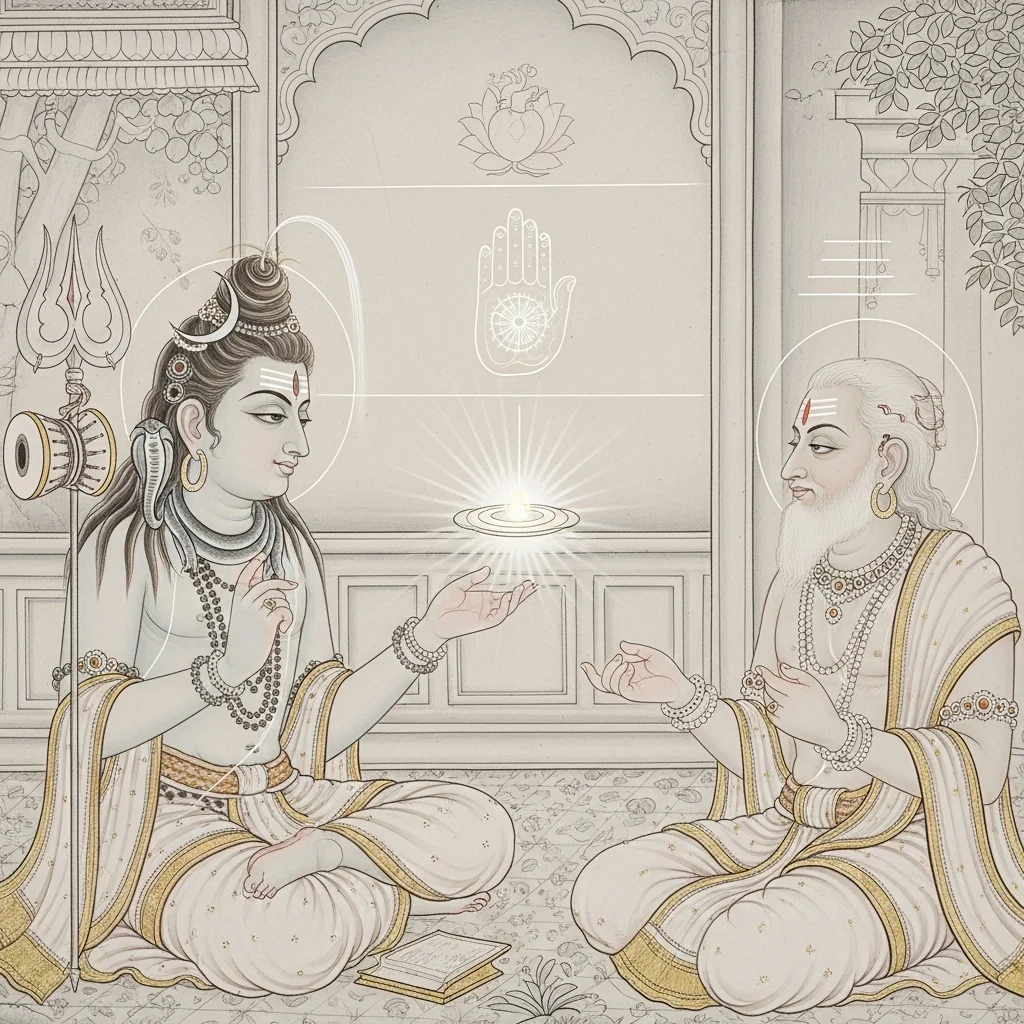
Chapter 6 unfolds as a carefully ordered theological dialogue. Devī affirms the wonder of what has been narrated and asks why Someshvara’s efficacy surpasses other cosmically praised liṅgas, and what distinctive power belongs to the Prabhāsa-kṣetra. Īśvara replies that the teaching to follow is a supreme rahasya, and exalts the Prabhāsa-māhātmya as highest among all tīrthas, vows, recitations, meditations, and yogas. The discourse then shifts from praise of place to a dense apophatic and metaphysical portrayal of the Someshvara liṅga: it is steadfast, imperishable, and unchanging; free from fear, stain, dependence, and conceptual proliferation. Though beyond ordinary praise and discursive speech, it is revealed as a manifest “lamp of knowledge” for realization. Sound-metaphysics (praṇava/śabda-brahman), inner-location imagery (heart-lotus, dvādaśānta), and non-dual descriptors (kevala, dvaita-varjita) are interwoven throughout. A Vedic anchoring is added through a verse on knowing the Mahān Puruṣa beyond darkness, followed by the admission that Someshvara’s full greatness cannot be expressed even over thousands of years. The phalaśruti concludes inclusively: anyone of any varṇa who reads or recites this becomes freed from sins and attains the desired aims.
Shlokas
Verse 1
देव्युवाच । अत्यद्भुतं महादेव माहात्म्यं कथितं मम । अपूर्वं देवदेवेश कदाचिन्न श्रुतं मया
Devī said: “O Mahādeva, you have narrated to me a most wondrous greatness—something unprecedented, O Lord of the gods. Never before have I heard this.”
Verse 2
ब्रह्मांडे यानि लिंगानि कीर्तितानि त्वया मम । तेषां प्रभावेनाधिक्यं सोमेशे तत्कथं वद
“Of the liṅgas in the whole cosmos that you have described to me, how does Somēśvara surpass them in power and excellence? Tell me that.”
Verse 3
किं प्रभावो महादेव क्षेत्रस्य च सुरेश्वर । तन्मे ब्रूहि सुरेशान याथातथ्यं ममाग्रतः
“O Mahādeva, O Lord of the gods—what is the true power of this sacred kṣetra? O Sureśāna, tell it to me exactly as it is, plainly before me.”
Verse 4
ईश्वर उवाच । अतः परं प्रवक्ष्यामि रहस्यं परमं तव । प्रभासक्षेत्रमाहात्म्यं सोमेशस्य वरानने
Īśvara said: “Now, O fair-faced one, I shall declare to you the supreme secret—the greatness of Prabhāsakṣetra and of Somēśvara.”
Verse 5
तीर्थानां परमं तीर्थं व्रतानां परमं व्रतम् । जाप्यानां परमं जाप्यं ध्यानानां ध्यानमुत्तमम्
“Among all pilgrim-places it is the supreme tīrtha; among all vows it is the supreme vow; among all recitations it is the highest japa; among all meditations it is the finest meditation.”
Verse 6
योगानां परमो योगो रहस्यं परमं महत् । तत्तेहं संप्रवक्ष्यामि शृणु ह्येकमना प्रिये
“It is the highest of yogas, a great and supreme secret. That I shall now explain to you—listen, beloved, with a single-pointed mind.”
Verse 7
सोमेशं परमं स्थानं पंचवक्त्रसमन्वितम् । एतल्लिंगं न मुंचामि सत्यंसत्यं मयोदितम्
“Somēśvara is the supreme abode, endowed with the five faces. I do not abandon this liṅga—this is truth, truth, as spoken by me.”
Verse 8
यच्च तत्परमं देवि ध्रुवमक्षयमव्ययम् । सोमेशं तद्विजानीहि मा विकल्पमना भव
“And whatever is supreme, O Devī—firm, imperishable, and undecaying—know that to be Somēśvara. Do not let your mind fall into doubt.”
Verse 9
निर्भयं निर्मलं नित्यं निरपेक्षं निराश्रयम् । निरंजनं निष्प्रपंचं निःसंगं निरुपद्रवम्
Fearless, stainless, eternal; needing nothing and resting on nothing; untainted, beyond worldly proliferation; unattached and free from disturbance.
Verse 10
तल्लिंगमिति जानीहि प्रभासे संव्यवस्थितम् । अपवर्गमविज्ञेयं मनोरम्यमनामयम्
Know that to be the liṅga, established in Prabhāsa. It is liberation itself—beyond ordinary knowing—delightful to the heart and free from all affliction.
Verse 11
नित्यं च कारणं देवं मखघ्नं सर्वतोमुखम् । शिवं सर्वात्मकं सूक्ष्ममनाद्यं यच्च दैवतम्
Know that Divinity as eternal and the very Cause—Śiva, the slayer of arrogant sacrifice, facing all directions; all-pervading as the Self of all, subtle, beginningless—He who is the true Godhead worshipped at Prabhāsa.
Verse 12
आत्मोपलब्धिविज्ञेयं चित्तचिंताविवर्जितम् । गमागमविनिर्मुक्तं बहिरंतश्च केवलम्
That Reality is to be known through direct Self-realization; it is free from the mind’s constructions and anxieties, beyond coming and going, and it alone remains—purely present both without and within.
Verse 13
आत्मोपलब्धिविषयं स्तुतिगोचरवर्जितम् । निष्कलं विमलात्मानं प्रकटं ज्ञानदीपकम्
It is the object of Self-realization, beyond the reach of mere praise; partless, pure in essence, manifest as the lamp of true knowledge.
Verse 14
तल्लिंगमिति जानीहि प्रभासे सुरसुंदरि । निरावकाशरहितं शब्दं शब्दांतगोचरम्
O fair one among the gods, know that at Prabhāsa this is called the “Liṅga”—beyond all spatial extension, yet grasped as the inner purport of sound, reaching to the end, and the transcendence, of words.
Verse 15
निष्कलं विमलं देवं देवदेवं सुरात्मकम् । हेतुप्रमाणरहितं कल्पनाभाववर्जितम्
That God is partless and stainless—the God of gods, the very essence of the celestials—free from causal proof and all measure, untouched by imagination or conceptual fabrication.
Verse 16
चित्तावलोकविषयं बहिरंतरसंस्थितम् । प्रभासे तं विजानीहि प्रणवं लिंगरूपिणम्
Know Him at Prabhāsa as the object of inward contemplation, abiding both outside and within—Pranava (Oṃ) itself, taking the form of the Liṅga.
Verse 17
अनिष्पंदं महात्मानं निरानंदावलोकनम् । लोकावलोकमार्गस्थं विशुद्धज्ञानकेवलम्
Unmoving is that Great Self—beheld beyond the play of pleasure; standing on the path by which the worlds are witnessed, it is pure knowledge alone.
Verse 18
विद्याविशेषमार्गस्थमनेकाकारसंज्ञितम् । स्वभावभावनाग्राह्यं भावातीतमलक्षणम्
Established on the path of distinct spiritual insight, it is spoken of in many forms; grasped only by contemplation of its own nature, it transcends all states of becoming and is without limiting marks.
Verse 19
वाक्प्रपंचादिरहितं निष्प्रपञ्चात्मकं शिवम् । ज्ञानज्ञेयावलोकस्थं हेत्वाभासविवर्जितम्
Śiva is free from the proliferation of speech and every display; His very nature is beyond all manifoldness. Abiding as the Seer of both knowledge and the known, He is devoid even of the semblance of causal limitation.
Verse 20
अनाहतं शब्दगतं शब्दादिगणसंभवम् । एवं सोमेश्वरं विद्धि प्रभासे लिंगरूपिणम्
Know Someśvara at Prabhāsa—Liṅga-formed—as the unstruck inner sound (anāhata), present within sound itself, the source from which the categories beginning with sound arise.
Verse 21
शब्दब्रह्मगतं शान्तं स शब्दांतगमास्पदम् । सर्वातिरिक्त विषयं सर्वध्यानपदे स्थितम्
He is tranquil, established in the Śabda-Brahman—Brahman known through sacred sound—and is the final refuge where all words come to their end. Transcending every object of experience, He abides as the very goal and ground of all meditation.
Verse 22
अनादिमच्युतं दिव्यं प्रमाणातीत गोचरम् । अधश्चोर्ध्वं गतं नित्यं जीवाख्यं देहसंस्थितम्
Beginningless, unfailing, and divine, He moves beyond the reach of all measures and proofs. Ever pervading below and above, He is the eternal One who, as the ‘jīva’, abides within the body.
Verse 23
हृदादिद्वादशांतस्थं प्राणापानोदयास्तगम् । अग्राह्यमिन्द्रियात्मानं निष्कलंकात्मकं विभुम्
Abiding in the subtle ‘twelfth end’ beginning from the heart, He is the rise and the setting of prāṇa and apāna. Ungraspable by the senses, He is the inner Ātman of the faculties—spotless in essence and all-pervading.
Verse 24
स्वरादिव्यंजनातीतं वर्णादिपरिवर्जितम् । वाचामवाच्यविषयमहंकारार्द्धरूपिणम्
Transcending vowels and consonants, beyond all letters and their forms, He is the very “unsayable” object that speech cannot grasp—yet He is also the subtle ground in which egoity (ahaṅkāra) takes partial form.
Verse 25
अप्रतर्क्यमनुच्चार्यं कलनाकालवर्जितम् । निःशब्दं निश्चलं सौम्यं देहातीतं परात्परम्
Beyond reasoning and beyond utterance, free from all calculation and time—soundless, unmoving, and gentle—He transcends the body and stands as the Supreme beyond even the supreme.
Verse 26
भूतावग्रहरहितं भावाभावविवर्जितम् । अविज्ञेयं परं सूक्ष्मं पञ्चपञ्चादिसंभवम्
Free from the limiting grasp of elemental forms, beyond both being and non-being, He is unknowable—supremely subtle—yet the source from which the groups of five and other principles arise.
Verse 27
अप्रमेयमनंताख्यमक्षयं कामरूपिणम् । प्रभवं सर्वभूतानां बीजांकुरसमुद्भवम्
Immeasurable, named “Infinite”, imperishable, assuming forms according to will, He is the origin of all beings—like the seed and sprout from which life unfolds.
Verse 28
व्यापकं सर्वकामाख्यमक्षरं परमं महत् । स्थूलसूक्ष्मविभागस्थं व्यक्ताव्यक्तं सनातनम्
All-pervading, known as the fulfiller of all aims, imperishable, supreme and vast, He abides within the divisions of gross and subtle—eternal, both manifest and unmanifest.
Verse 29
कल्पकल्पान्तरहितमनादिनिधनं महत् । महाभूतं महाकायं शिवं निर्वाणभैरवम्
Beyond the cycles of kalpas and their endings—beginningless, endless, vast—the Great Element, the Cosmic Body: Śiva Himself, Bhairava whose very nature is nirvāṇa, liberating peace.
Verse 30
एवं सदाशिवं विद्धि प्रभासे लिंगरूपिणम् । योगक्रिया विनिर्मुक्तं मृत्युंजयमनादिमत्
Know Sadāśiva thus: here in Prabhāsa He abides in the form of the Liṅga—beyond all yogic techniques and ritual acts—the beginningless Mṛtyuñjaya, Conqueror of Death.
Verse 31
सर्वोपसर्गरहितं सर्वतोव्यापकं शिवम् । अव्यक्तं परतो नित्यं केवलं द्वैतवर्जितम्
He is Śiva—free from every affliction, all-pervading on every side; unmanifest, transcendent, eternal, pure, the One, devoid of all duality.
Verse 32
अनन्यतेजसाक्रांतं प्रभासक्षेत्रवासिनम् । भूरिस्वयंप्रभप्रख्यं सर्वतेजोऽधिकं हरम्
In Prabhāsa-kṣetra abides Hara, pervaded by incomparable radiance—renowned for abundant self-luminosity, surpassing all other splendors.
Verse 33
शरण्यंदेवमीशानमोंकारं शिवरूपिणम् । देवदेवं महादेवं पंचवक्त्रं वृषध्वजम्
He is the refuge-giving Lord, Īśāna—Oṃkāra embodied in Śiva’s form; the God of gods, Mahādeva, five-faced, whose banner bears the bull.
Verse 34
निर्मलं मानसातीतं भावग्राह्यमनूपमम् । सदा शांतं विरूपाक्षं शूलहस्तं जटाधरम्
Stainless and beyond the mind, grasped through pure inner devotion, incomparable—ever peaceful; the wide-eyed Lord, bearing the trident in His hand, wearing matted locks.
Verse 35
हृत्पद्मकोशमध्यस्थं शून्यरूपं निरञ्जनम् । एवं सदाशिवं विद्धि प्रभासे लिङ्गरूपिणम्
Know Sadāśiva thus: abiding in the center of the heart-lotus, of the nature of inner openness (śūnya), stainless and unattached—manifest in Prabhāsa as the form of the Liṅga.
Verse 36
योऽसौ परात्परो देवो हंसाख्यः परिकीर्तितः । नादाख्यः सुव्रते देवि सोऽस्मिन्स्थाने स्थितः स्वयम्
That God who is beyond even the beyond, celebrated as ‘Haṃsa’ and also as ‘Nāda’—O Devī of good vows—He Himself abides in this very place.
Verse 37
एतदादिस्वरूपं च मया योगबलेन तु । विज्ञातं देवि गदितं दिव्यमात्मानमात्मना
This primordial essential nature has been realized by me through the power of yoga; O Devī, I have declared it—having known the divine Self by the Self.
Verse 38
ऋग्वेदस्थस्तु पूर्वाह्णे मध्याह्ने यजुषि स्थितः । अपराह्णे तु सामस्थो ह्यथर्वस्थो निशागमे
In the morning He abides as the Ṛgveda; at midday He is established in the Yajus; in the afternoon He stands as the Sāma; and at nightfall He is present as the Atharva.
Verse 39
वेदाहमेतं पुरुषं महांतमादित्यवर्णं तमसः परस्तात् । तमेव विदित्वा न भवेत्तु मृत्युर्नान्यः पंथा विद्यते वै जनानाम्
I know that Great Person, radiant like the sun, beyond the darkness. Knowing Him alone, death does not arise; for people there is truly no other path.
Verse 40
इतीरितस्ते तु महाप्रभावः सोमेशलिंगस्य कृतैकदेशः । वृतं न चाब्दैर्बहुभिः सहस्रैर्वक्तुं च केनापि मुखैर्न शक्यम्
Thus, only a small portion of the great glory of the Someśvara Liṅga has been spoken to you. Even in many thousands of years, it cannot be fully encompassed—nor can anyone describe it with any number of mouths.
Verse 41
ब्राह्मणः क्षत्रियो वैश्यः शूद्रोऽपीदं पठेद्यदि । निर्मुक्तः सर्वपापेभ्यः सर्वान्कामानवाप्नुयात्
Whether a brāhmaṇa, kṣatriya, vaiśya, or even a śūdra—whoever recites this (māhātmya) is freed from all sins and attains the fulfillment of all righteous desires.