Adhyaya 16
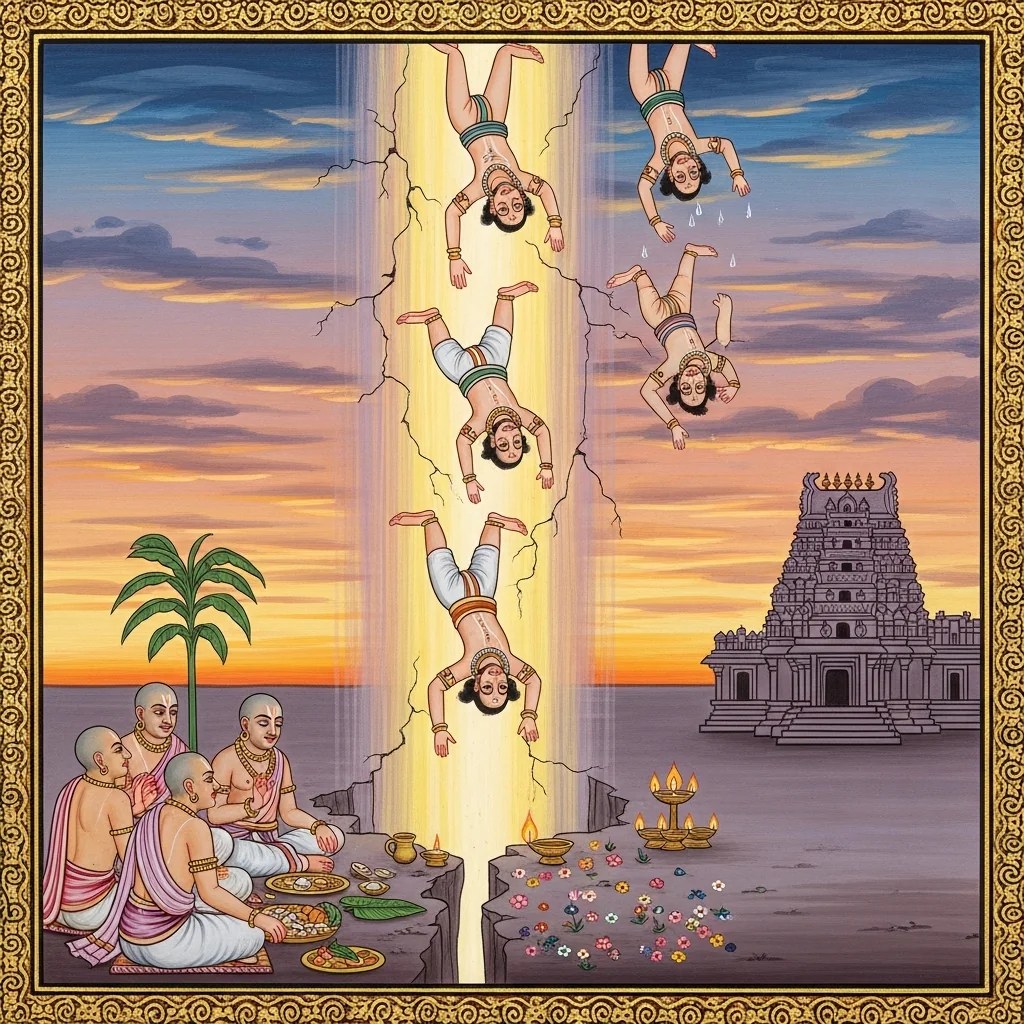
Īśvara instructs Devī on the māhātmya of a great pātāla-vivara (a fissure leading to the nether realms) near Arkasthala at Prabhāsa. The origin is first set forth: in a time of darkness, innumerable powerful rākṣasas arise, hostile to Sūrya. They mock the rising Divākara, and the Sun replies with righteous, dharma-born wrath; by the intensification of his gaze the rākṣasas fall from the sky like weakened planets—likened to fallen fruit or stones released—showing that adharma loses its footing and collapses. Driven by wind and impact, they shatter the earth and descend to rasātala, eventually reaching Prabhāsa; their fall is linked to the fissure’s becoming manifest and visible. Arkasthala is praised as a divine locus granting “all siddhis,” with this pātāla-vivara as its great adjacent feature; many other such openings have been hidden by time, but this one remains revealed. The place is called the middle portion of Sūrya’s tejas, golden in nature, guarded by Siddheśa, and especially potent on solar festival occasions; it also points to a tri-saṅgama—Brāhmī, Hiraṇyā, and the ocean—yielding koṭi-tīrtha-like merit. Finally, a regulated worship is prescribed at the gateway named Śrīmukha-dvāra: on caturdaśī, for a year, one should worship the Mātṛgaṇas (beginning with Sunandā) with offerings in the older ritual idiom (animals/food), along with flowers, incense, and lamps, and by feeding brāhmaṇas—promising siddhi. Hearing this māhātmya is said to free an excellent person from adversities.
Shlokas
Verse 1
ईश्वर उवाच । पातालविवरस्यापि माहात्म्यं शृणु सांप्रतम् । पूर्वपृष्टं महादेवि ब्रह्मणा विश्वकर्मणा
Īśvara said: Now hear also the greatness of the Pātāla-cavern. O Mahādevī, it was formerly enquired about by Brahmā and by Viśvakarman.
Verse 2
तमोभावे समुत्पन्ने जातास्तत्रैव राक्षसाः । सूर्यस्य द्वेषिणः सर्वे ह्यसंख्याता महाबलाः
When a state of darkness arose, rākṣasas were born right there—countless, mighty, and all of them haters of the Sun.
Verse 3
ते तु दृष्ट्वा महात्मानं समुद्यंतं दिवाकरम् । ते धूम्रप्रमुखाः सर्वे जहसुः सूर्यमंजसा
But when they saw the great-souled Sun rising, those led by Dhūmra all at once attacked the Sun directly.
Verse 4
अस्माकमंतकः कोऽयं विद्यते पापकर्मकृत् । इत्यूचुर्विविधा वाचः सूर्यस्याग्रे स्थितास्तदा
“Who is this—our destroyer—this doer of sinful deeds?” Thus, standing before the Sun, they spoke in many ways.
Verse 5
इति श्रुत्वा तदा देवः क्रोधस्फुरिताधरः । राक्षसानां वचश्चैव भक्ष्यमाणो दिवाकरः
Hearing these words, the god Divākara (the Sun), with lips quivering in anger, was assailed as the rākṣasas pressed upon him with their speech and attack.
Verse 6
ततः क्रोधाभिभूतेन चक्षुषा चावलोकयत् । स क्रूररक्षःक्षयकृत्तिमिरद्विपकेसरी
Then, overcome with wrath, he cast his gaze. That Sun—like a lion to the elephant of darkness—became the destroyer of the savage rākṣasas.
Verse 7
महांशुमान्खगः सूर्यस्तद्विनाशमचिंतयत् । अजानन्नंततश्छिद्रं राक्षसानां दिवस्पतिः
The radiant Sun, the sky-ranging lord of day, contemplated their destruction—yet he did not know the hidden opening by which the rākṣasas could escape.
Verse 8
स धर्मविच्युतान्दृष्ट्वा पापोपहतचेतसः । एवं संचिंत्य भगवान्दध्यौ ध्यानं प्रभाकरः
Seeing them fallen away from dharma, their minds struck by sin, the blessed Prabhākara (Sun) reflected thus and entered deep meditation.
Verse 9
अजानंस्तेजसा ग्रस्तं त्रैलोक्यं रजनीचरैः । ततस्ते भानुना दृष्टाः क्रोधाध्मातेन चक्षुषा
Unaware that the three worlds had been overrun by the night-stalkers through their baleful power, the Sun beheld them with eyes swollen with wrath.
Verse 10
निपेतुरंबरभ्रष्टाः क्षीणपुण्या इव ग्रहाः । राक्षसैर्वेष्टितो धूम्रो निपतञ्छुशुभेंऽबरात्
They fell, cast down from the sky like planets whose merit is spent. A smoke-hued mass, wrapped about by rākṣasas, came plunging down from the heavens, shining as it fell.
Verse 11
अर्द्धपक्वं यथा तालफलं कपिभिरावृतम् । यदृच्छया निपेतुस्ते यंत्रमुक्ता यथोपलाः
Like a half-ripe palm fruit surrounded by monkeys, they tumbled down by chance—like stones released from a machine.
Verse 12
ततो वायु वशाद्भ्रष्टा भित्त्वा भूमिं रसातलम् । जग्मुस्ते क्षेत्रमासाद्य प्रभासं वरवर्णिनि
Then, driven off course by the force of the wind, they broke through the earth into Rasātala; and reaching the sacred region, they came to Prabhāsa, O fair lady.
Verse 13
यत्र चार्कस्थलो देवः सर्वसिद्धिप्रदायकः । तत्सान्निध्यस्थितं देवि पातालविवरं महत्
For there is the divine Arkasthala, bestowing every attainment. Near that sacred presence, O Devī, lies a great opening into Pātāla, the netherworld.
Verse 14
अन्यानि कोटिशः संति तानि लुप्तानि भामिनि । कृतस्मरात्समारभ्य यावदर्कस्थलो रविः
O radiant one, there are millions of other openings, yet they have vanished; this one endures from the time of Kṛtasmara, so long as Ravi, the Sun, remains established at Arkasthala.
Verse 15
देवमातुर्वरं प्राप्य सिद्धयोऽष्टौ व्यवस्थिताः । एतस्मिन्नंतरे देवि सूर्यक्षेत्रमुदाहृतम्
Having received a boon from the Mother of the Gods, the eight Siddhis took their stations. In that very interval, O Devī, it was proclaimed as Sūrya-kṣetra, the Sun’s holy region.
Verse 16
सूर्यस्य तेजसो देवि मध्यभागं हि तत्स्मृतम् । सर्वं हेममयं देवि नापुण्यस्तत्र वीक्षते
O Goddess, that place is remembered as the very central portion of the Sun’s radiance. There everything is as if made of gold; there, O Devī, no inauspiciousness is seen.
Verse 17
विवराणां शतं चैकं स्पर्शाश्चैव तु कोटिशः । तत्र संति महादेवि सिद्धेशस्तु प्ररक्षति
O Great Goddess, there are a hundred and one openings, and the contact-points are in the millions. They exist there, and Siddheśa indeed protects that sacred place.
Verse 18
इदं क्षेत्रं महादेवि प्रियं सूर्यस्य सर्वदा । सूर्यपर्वणिसंप्राप्ते कुरुक्षेत्राधिकं प्रिये
O Great Goddess, this sacred field is always dear to the Sun. When the Sun’s holy occasion arrives, beloved, it becomes even more meritorious than Kurukṣetra.
Verse 19
ब्राह्मी चैव हिरण्या च संगमश्च महोदधेः । एतत्त्रिसंगमं देवि कोटितीर्थ फलप्रदम्
Brāhmī and Hiraṇyā, and also their confluence with the great ocean—this triple confluence, O Goddess, bestows the fruit of crores of tīrthas.
Verse 20
देवमाता च तत्रैव मंकीशस्तत्र तिष्ठति । नागस्थानं नगस्थानं तत्रैव समुदाहृतम् ।१
There indeed is Devamātā, and Maṃkīśa abides there. The place called Nāgasthāna and also Nagasthāna are likewise declared to be there.
Verse 21
इति संक्षेपतः प्रोक्तमर्कस्थलमहोदयम् । राक्षसानां च संपातादभूच्च विवरं यथा
Thus, in brief, the great glory of Arkasthala has been told; and how, due to the onrush of Rākṣasas, a fissure—an opening—came to be.
Verse 22
अन्यानि तत्र देवेशि लुप्तानि विवराणि वै । एवं तु प्रकटं तत्र दृश्यतेऽद्यापि भामिनि
Other openings there, O Lady of the Gods, have indeed disappeared. Yet this one remains manifest there and is seen even today, O radiant one.
Verse 23
श्रीमुखं नाम तद्द्वारं रक्ष्यते मातृभिः प्रिये । वर्षमेकं चतुर्द्दश्यां नियमाद्यस्तु पूजयेत्
That gateway is called Śrīmukha, beloved, and it is guarded by the Mothers. Whoever, with disciplined observance, worships there on the fourteenth lunar day for one full year—
Verse 24
तत्र मातृगणान्देवि सुनंदाद्यान्विधानतः । पशुपुष्पोपहारैश्च धूपदीपैस्तथोत्तमैः । विप्राणां भोजनैर्देवि तस्य सिद्धिर्भविष्यति
There, O Devi, one should duly worship the hosts of the Mothers—beginning with Sunandā—according to rule, with offerings of animals (as prescribed), flowers and gifts, and with excellent incense and lamps. By feeding the Brāhmaṇas, O Goddess, his attainment will be fulfilled.
Verse 25
तस्मात्सर्वप्रयत्नेन तत्रार्कस्थलसंनिधौ । पूजयेन्मातरः सर्वा यदीच्छेत्सिद्धिमात्मनः
Therefore, with every effort, near Arkasthala one should worship all the Mothers, if one desires spiritual accomplishment for oneself.
Verse 26
एतास्तु मातरो देवि सुनंदागणनामतः । ख्यातिं यांति प्रभासे तु क्षेत्रेस्मिन्वरवर्णिनि
O Goddess, these Mothers—known collectively as the Sunandā-gaṇa—attain renown and manifest glory in this sacred field of Prabhāsa, O fair-complexioned one.
Verse 27
एतत्संक्षेपतः प्रोक्तं पातालोत्तरमध्यतः । तच्छ्रुत्वा मुच्यते देवि सर्वापद्भ्यो नरोत्तमः
This has been stated in brief, drawn from the middle portion of the Pātālottara. Hearing it, O Devi, the best of men is freed from all calamities.