Adhyaya 185
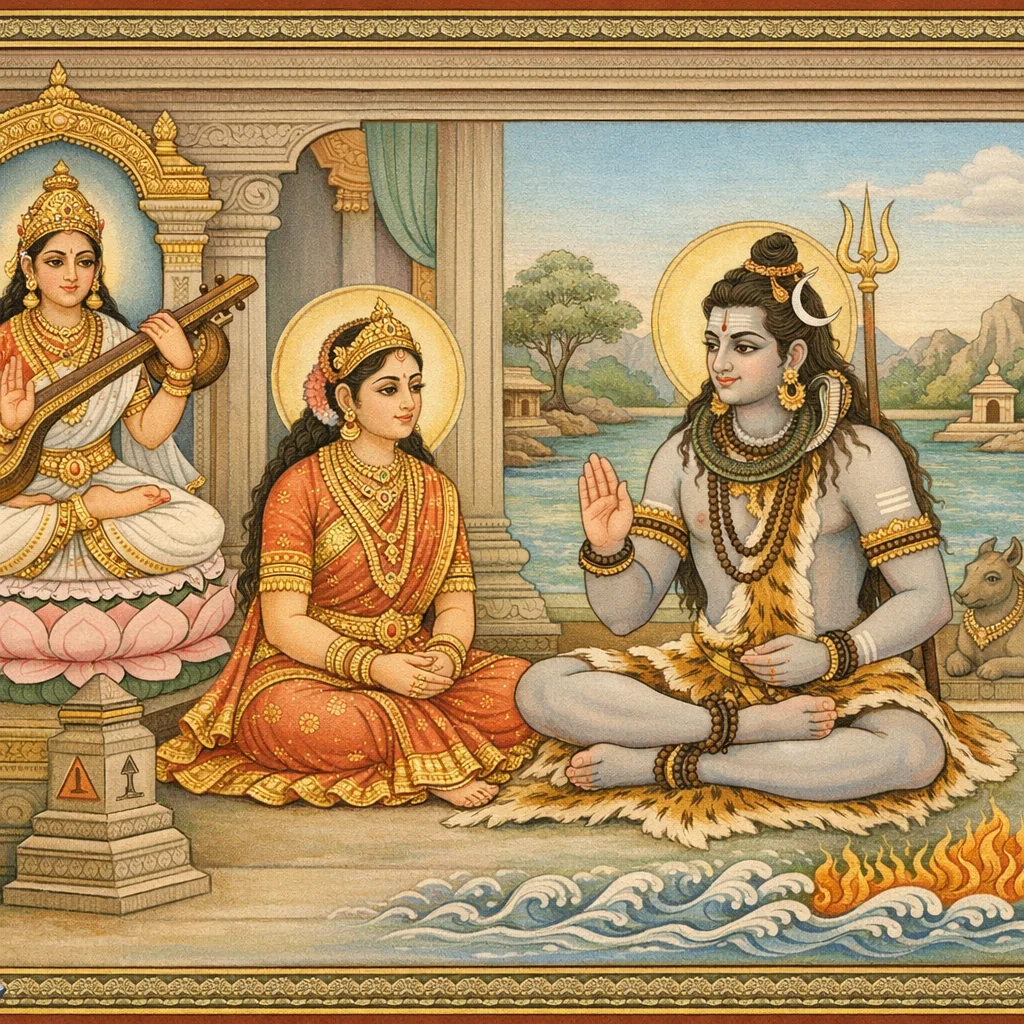
This adhyāya records Īśvara’s instruction to Mahādevī concerning a localized manifestation of Devamātā Sarasvatī in Prabhāsa kṣetra. She is revered as “Devamātā” (Mother of the Devas), praised in the world as Sarasvatī, abiding in the nairṛta (southwest) quarter and assuming the Gaurī-form (Gaurī-rūpa). She is described as seated in pādukāsana, with a form linked to “vaḍavā” imagery. The text explains the epithet: the devas are protected like children by a mother from the fear of the vaḍavānala, and thus the learned affirm her as Devamātā. It then gives a calendrical observance: on the tṛtīyā (third lunar day) of Māgha, a disciplined man or a restrained, virtuous woman who worships her attains desired aims. Hospitality is praised as highly meritorious: feeding a couple with sweet rice (pāyasa) with sugar and the like yields fruit comparable to a great Gaurī-feeding rite. The chapter concludes with a dāna injunction to gift golden sandals (suvarṇa-pādukā) to a well-conducted brāhmaṇa at this sacred site.
Shlokas
Verse 1
ईश्वर उवाच । ततो गच्छेन्महादेवि देवमातरमव्ययाम् । मंकीशान्नैरृते भागे गौरीरूपसमाश्रिताम् । देवमाता सरस्वत्या नाम लोकेषु गीयते
Īśvara said: “Then, O Mahādevī, one should go to Devamātā, the imperishable Goddess. To the south-west of Maṃkīśa she abides in the form of Gaurī. In the worlds she is renowned by the name ‘Devamātā Sarasvatī.’”
Verse 2
पादुकासनसंस्था च तत्र देवी सरस्वती । गौरीरूपेण सा तत्र वडवाश्रितविग्रहा
There, the Goddess Sarasvatī abides upon a pādukāsana, a seat of sandals. In that very place she is present in the form of Gaurī, having assumed a manifestation connected with Vaḍavā, the submarine fire.
Verse 3
मातृवद्रक्षिता देवा वडवानलभीतितः । देवमातेति लोकेऽस्मिं स्ततः सा विबुधैः कृता
Like a mother, she protected the gods from the fear of the Vaḍavānala, the fire of Vaḍavā. Therefore, in this world the wise established her fame as “Devamātā,” the Mother of the Devas.
Verse 4
माघे मासे तृतीयायां यस्तामर्चयते नरः । नारी वा संयता साध्वी सर्वान्कामानवाप्नुयात्
In the month of Māgha, on the third lunar day (Tṛtīyā), whoever worships her—whether a man or a restrained and virtuous woman—attains all desired aims.
Verse 5
दंपती भोज येद्यस्तु पायसैः शर्करादिभिः । गौरीसहस्रभोज्यस्य दत्तस्य फलमाप्नुयात्
But whoever feeds a married couple with sweet milk-rice, sugar, and the like, attains merit equal to having offered a feast to a thousand devotees of Gaurī.
Verse 6
सुवर्णपादुका देया तत्र विप्राय शीलिने
There, one should give golden sandals as a gift to a well-conducted brāhmaṇa.