Adhyaya 363
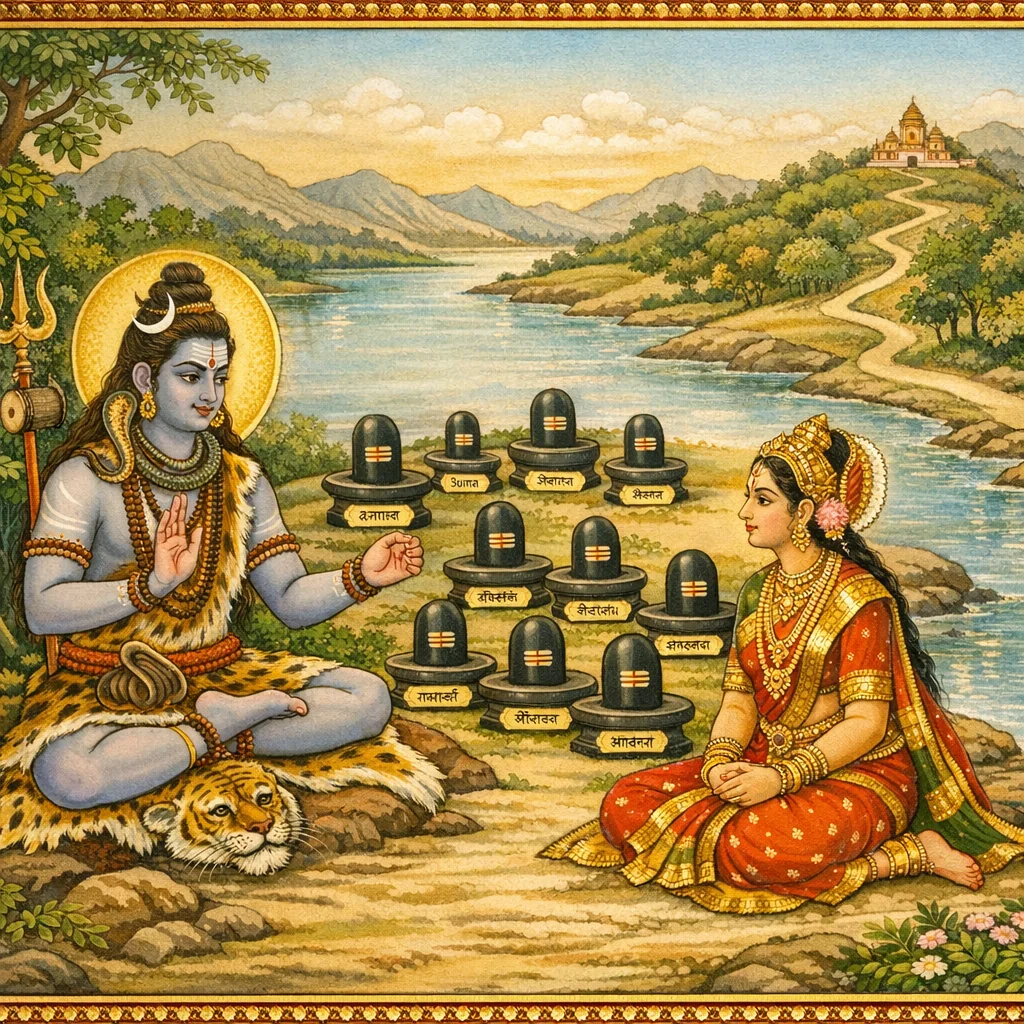
In this chapter, Īśvara speaks to Devī and instructs her—thus guiding the pilgrim as well—to go north from the place called Goṣpada to the renowned sacred spot Valāya, marking the distance as two gav-yūti as a practical measure for pilgrimage. There, a cluster of the “eleven Rudras” is indicated through their associated sthāna-liṅgas (site-liṅgas). Representative names such as Ajāikapād and Ahirbudhnya are mentioned, implying a recognized Rudra list embodied in local shrines. The central directive is ritual: one should worship these liṅgas in due manner (vidhivat), and the declared fruit is complete purification—release from all sins (sarva-pātaka). The colophon preserves the text’s identity as Skanda Mahāpurāṇa, Prabhāsa Khaṇḍa, Prabhāsakṣetramāhātmya section, chapter 363.
Shlokas
Verse 1
ईश्वर उवाच । ततो गच्छेन्महादेवि गोष्पदस्योत्तरे स्थितम् । गव्यूतिद्वितयेनैव वलाय इति विश्रुतम्
Īśvara said: “Then, O great goddess, one should go to the place situated to the north of Goṣpada—at a distance of two gavyūtis—well-known by the name Valāya.”
Verse 2
तत्रैकादशरुद्राणां स्थानलिंगान्यपि प्रिये । अजैकपादहिर्बुध्न्यः संतीत्यादीनि नामतः । पूजयेत्तानि विधिवन्मुच्यते सर्वपातकैः
There, O beloved, are also the fixed liṅgas (sthāna-liṅga) of the Eleven Rudras—known by name as Aja, Ekapād, Ahirbudhnya, Saṃtīti, and others. One who worships them properly, according to the rite, is released from all sins.
Verse 362
इति श्रीस्कांदे महापुराण एकाशीतिसाहस्र्यां संहितायां सप्तमे प्रभासखण्डे प्रथमे प्रभासक्षेत्रमाहात्म्य एकादशरुद्रलिंगमाहात्म्यवर्णनंनाम द्विषष्ट्युत्तरत्रिशततमोऽध्यायः
Thus, in the Śrī Skanda Mahāpurāṇa—within the Saṃhitā of eighty-one thousand verses—this concludes the 362nd chapter of the seventh, Prabhāsa Khaṇḍa, in the first part, the Prabhāsakṣetra Māhātmya, entitled “The Description of the Greatness of the Eleven Rudra-liṅgas.”